|
 It’s a fact of life – no one likes to sit in traffic. Watching people drive in a lane that’s clearly marked as ending in 400 ft. makes me crazy and rubberneckers should stay home and watch Cops. It’s a fact of life – no one likes to sit in traffic. Watching people drive in a lane that’s clearly marked as ending in 400 ft. makes me crazy and rubberneckers should stay home and watch Cops.
But traffic happens and some companies, such as the app Waze, are making it their business to help people avoid traffic. Waze is a GPS app which links to users together to help reroute drivers on the “path of least resistance”. It does this by tracking users’ speed and direction as well as by having drivers input information such as a stalled car, crash, cops, etc. on the roads. This information is shared with other Waze users and the electronic bread crumbs help the app redirect a percentage of drivers to alternative routes.
What’s really interesting about this approach to traffic management is that it’s very similar to how ant colonies travel and communicate with each other.
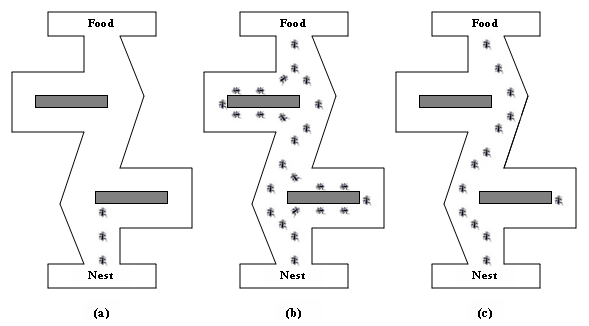
The term “ant colony optimization” (ACO) is now a broadly used term that was originally credited to researcher Marco Dorigo in the ‘90s. ACO is a strategy for organizing movement largely based on actual ant behavior. As ants travel back and forth from food sources to their nest they leave a trail of pheromones. Other ants can smell the pheromone and choose the path with the strongest pheromone concentrations.
Similar to the Waze app, more feedback (AKA more pheromones) helps the ant choose the optimal path, while the pheromone concentrations evaporate on the sub-optimal paths. The term stigmergy is used to describe this mechanism of coordination used by insects. Specifically, that the insect leaves a trace in the environment that stimulates the performance of subsequent work.
Humans are not so efficient.
 Ants have a strict, non-selfish adherence to optimizing their colony. In a recent experiment, ants were place in a chamber with two exits. Different levels of citronella oil were added to the chamber and the scientists tracked how ants exited from the chamber avoiding the citronella oil. The ants spread out over the area and more carefully arranged themselves ahead of time to avoid jamming the exits. The researchers ran a computer simulation to observe how humans would have responded in a similar situation and they immediately made for and began jamming the exits. Ants have a strict, non-selfish adherence to optimizing their colony. In a recent experiment, ants were place in a chamber with two exits. Different levels of citronella oil were added to the chamber and the scientists tracked how ants exited from the chamber avoiding the citronella oil. The ants spread out over the area and more carefully arranged themselves ahead of time to avoid jamming the exits. The researchers ran a computer simulation to observe how humans would have responded in a similar situation and they immediately made for and began jamming the exits.
This tendency for humans to pursue “selfish routing” strategies, at the cost of the larger network, has long been noted in traffic. And one study shows that if one percent of drivers cancelled their trip, all drivers’ trips would be reduced by 18 percent.
What do you think? Will you cancel your commute today?
| 

 2
2

 Re: Following Ants Could End Traffic Jams


Good Answers:
"Almost" Good Answers: