|
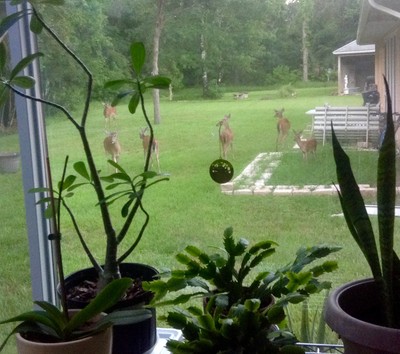
It’s  beginning to look a lot like deer season in upstate. Lately, the county routes around my home have been swarming with deer and fawns, which requires extra care when driving after dark. I’ve also found many prints and droppings around my yard. beginning to look a lot like deer season in upstate. Lately, the county routes around my home have been swarming with deer and fawns, which requires extra care when driving after dark. I’ve also found many prints and droppings around my yard.
For my deer hunter friend, who literally takes the entire month of deer gun season off from work, this is a sign of a robust population and good chances he’ll get at least one or two deer before winter.
Outright, I’m not pro- or anti-hunting. I am against poaching or needless slaughter of animals, but someone like my friend who butchers and keeps or gives away all the valuable parts of a deer are an essential part of the local ecosystem.
When the first settlers arrived in North America, deer were an invaluable food supply. This remains true today for many subsistence hunter-farmer communities, such as Native American reservations. Yet when settlers arrived here, wolves, coyotes, cougars and bears were among the other deer predators. Slowly, humans diminished these predator populations due to systematic eradication and overtaking their habitats. Eventually their numbers were reduced to the point where humans were the only predators with a significant impact on the deer population.
Deer populations reached a critical point in the early 1900s, just as conservation and environmentalism ideology began to take root. State and local game authorities now conduct randomized sampling to extrapolate annual dear populations, and consider that in relation to fawn recruitment rates (the percentage of fawns that make it through the summer), surveys and registered hunter reports. The number of white-tailed deer in the U.S. is well over 30 million, which is more deer than prior to European settlement according to this study (.pdf) by University of Nebraska – Lincoln.
While wolves and bears seem more menacing than deer, deer actually kill around 200 people per year in 1.2 million vehicle collisions. Sophie Gilbert, professor of wildlife ecology at the University of Idaho, is another scientist calling for more aggressive predator population rehab programs, which she believes will ultimately cull the deer population enough to reduce deer and vehicle collisions by 22 percent, saving 5 lives and nearly 700 injuries each year. In West Virginia, drivers have a 1 in 44 chance of having a deer collision.
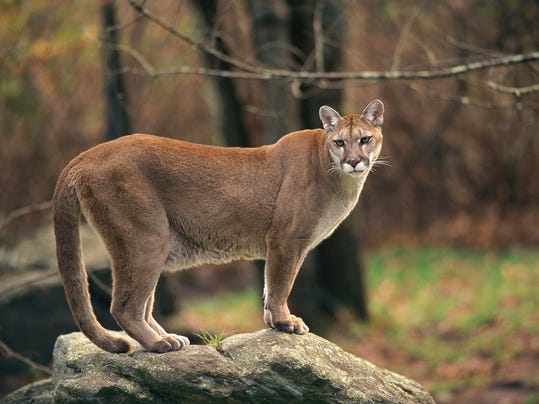 Gilbert believes that 10,300 cougars distributed throughout Eastern states, where deer and car collisions are more common, would be a sufficient start. For those worried about potential cougar attacks on humans, Gilbert estimates only five additional cougar attacks per year would occur, and maybe one resultant death. It’s much tougher to predict how an extra 10,000 big cats in the Eastern U.S. would interact with livestock and pets, however. Gilbert believes that 10,300 cougars distributed throughout Eastern states, where deer and car collisions are more common, would be a sufficient start. For those worried about potential cougar attacks on humans, Gilbert estimates only five additional cougar attacks per year would occur, and maybe one resultant death. It’s much tougher to predict how an extra 10,000 big cats in the Eastern U.S. would interact with livestock and pets, however.
Human conservation of deer has worked out so well it’s beginning to have a clear detriment. Deer hunting popularity has fallen steadily since 1983, despite a small uptick in the last U.S. Fish and Wildlife Service survey (.pdf). Perhaps it’s time to bring back the predators.
| 


 Re: Managing Deer Populations for Auto Safety