|
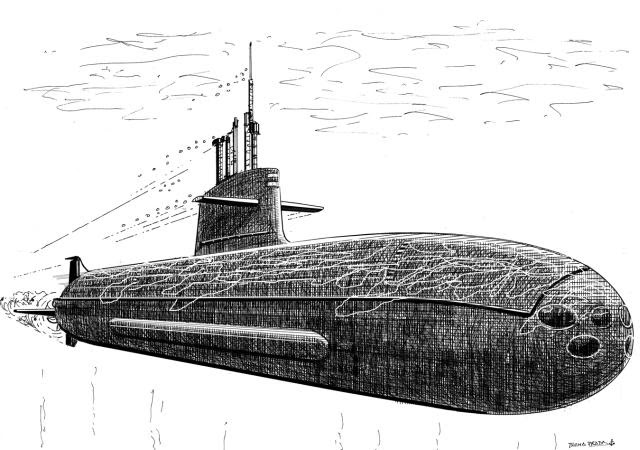 The Spanish submarine navy is small – currently operating only three French-built, Agosta-class, S-70 submarines. During the 1980’s, when these boats were commissioned, Spain began planning for their successor, the S-80. Developed by the Spanish shipbuilder Navantia, one of the major enhancements of this new design was the incorporation of a bio-ethanol air independent propulsions (AIP) system which would enable the boats to be submerged for longer spans of time than their diesel-electric predecessors. Additionally, this new design touted highly automated systems allowing for a smaller crew, advanced armament capabilities and a significant decrease in the boats’ magnetic, infrared, visual and radar signatures. The first boat was scheduled to enter naval service in 2015. The Spanish submarine navy is small – currently operating only three French-built, Agosta-class, S-70 submarines. During the 1980’s, when these boats were commissioned, Spain began planning for their successor, the S-80. Developed by the Spanish shipbuilder Navantia, one of the major enhancements of this new design was the incorporation of a bio-ethanol air independent propulsions (AIP) system which would enable the boats to be submerged for longer spans of time than their diesel-electric predecessors. Additionally, this new design touted highly automated systems allowing for a smaller crew, advanced armament capabilities and a significant decrease in the boats’ magnetic, infrared, visual and radar signatures. The first boat was scheduled to enter naval service in 2015.
However, the S-80 development came to a screeching halt in 2013 when, during testing, it was determined that weight imbalances caused the boat to lack proper buoyancy. In short, the submarine could submerge without a problem, but may not be able to resurface afterwards! During a review, it was determined that the 2300-ton displacement of the original design was overshot by more than 70 tons, thus causing the buoyancy problem. But, how did this happen? A former Spanish official stated that a decimal point was placed in the wrong spot early on during the engineering design phase of the project and 'nobody paid attention to review the calculations'.
General Dynamics, Electric Boat Division in Groton, CT was hired to find an answer to the buoyancy problem. The proposed solution was to lengthen the S-80 submarine from 71 to 81 meters in order to increase the buoyancy.
But wait, there is more.
In July of 2018, it was announced that the length added to the S-80 submarine, sometimes now called the S-80 Plus, caused the boat to be too long to fit into the 78-meter-long docks at the Cartagena Naval Base in Spain where it will be stationed. The port will need to be dredged and reshaped in order to properly dock the S-80.
As a result of all these changes, the per boat cost of the S-80 submarines increased from an originally estimated €439 million ($503 million US) to €978 million ($1.12 billion US). General Dynamics was paid €14 million ($16 million US) for their consulting fees which necessitated an estimated €16 million ($18 million US) expansion project at the naval yard. And the 2015 delivery date for the first boat of this class has been rescheduled to 2022.
Always check your work - especially your decimal points!
Note: As if the above problems were not enough, the AIP design will not be ready for installation until the third boat is deployed in 2026, with the first two boats receiving refits in 2032.
References:
https://nationalinterest.org/blog/buzz/spain%E2%80%99s-billion-dollar-ethanol-powered-s-80-super-submarines-are-too-big-fit-their-docks
https://www.dailymail.co.uk/news/article-5968067/Sub-standard-900million-Spanish-submarine-heavy-sail-big-dock.html
https://www.nytimes.com/2018/07/18/world/europe/spain-military-submarine.html
Image: https://www.elsnorkel.com/2017/07/el-sistema-aip-de-los-s-80-plus.html
| 


 Re: Overweight Spanish Submarines


"Almost" Good Answers: