Previous in Forum: PCB Differential Pairs for Audio   Next in Forum: Difference Between AC and DC motor
Close
Close
Close
11 comments
Rate Comments: Nested
Guru
Hobbies - DIY Welding - New Member

Join Date: Apr 2008
Location: Bristol, Tennessee
Posts: 1177
Good Answers: 58

RC Servo Control

01/08/2016 5:37 PM

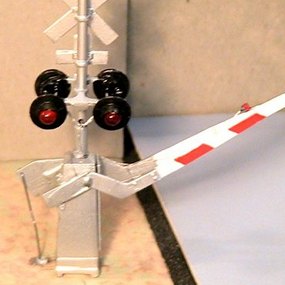
I'm using a 5volt Tower Pro sg90 servo for my model train crossing gate. I want it to move slowly down and slowly up as the train passes. I am using phototransistors to sense the train, have a module with a spdt relay (no, nc). I'm hoping to find something ready-built, another module. I would like this all to be as small as possible. Thanks.

__________________
mike k
Register to Reply
Interested in this topic? By joining CR4 you can "subscribe" to
this discussion and receive notification when new comments are added.

"Almost" Good Answers:

Check out these comments that don't yet have enough votes to be "official" good answers and, if you agree with them, vote them!
Guru

Join Date: Mar 2007
Location: by the beach in Florida
Posts: 33392
Good Answers: 1817
#1

Re: RC servo control

01/08/2016 5:53 PM

Maybe a Tortoise switch machine motor?

http://www.azatrax.com/working-crossing-gates.html

__________________
All living things seek to control their own destiny....this is the purpose of life
Register to Reply Score 1 for Good Answer
Guru

Join Date: Oct 2008
Posts: 42355
Good Answers: 1693
#2
In reply to #1

Re: RC servo control

01/08/2016 7:16 PM

I don't always give a GA for an internet search.

But, sometimes.....................

Register to Reply Score 1 for Off Topic
Guru
United Kingdom - Member - Not a New Member Hobbies - Musician - New Member Hobbies - Fishing - New Member

Join Date: May 2006
Location: Reading, Berkshire, UK. Going under cover.
Posts: 9684
Good Answers: 468
#3

Re: RC Servo Control

01/09/2016 8:29 AM

The 'bang-bang' speed of the servo is 0.1 s/60 degrees, so you'll never get slow movement unless you use a mechanical damper (e.g. a dashpot) or some kind of proportional control. I don't know if a ready-made solution is available, but the cheapest way to go would be to use a progammable device (e.g. a PIC microcontroller, or maybe an Arduino or Raspberry Pi) to drive it. Not trivial, unless you're already familiar with such things.

__________________
"Love justice, you who rule the world" - Dante Alighieri
Register to Reply
Guru
Hobbies - DIY Welding - New Member

Join Date: Apr 2008
Location: Bristol, Tennessee
Posts: 1177
Good Answers: 58
#4
In reply to #3

Re: RC Servo Control

01/09/2016 6:55 PM

I have found only one supplier, Tony Williams in the UK, who has solved this problem. His crossing controller operates the servos nice and slow. I can't tell how he does it by looking at his PC board, and he's not telling, either. Somehow he fits control for two servos, lights, the bell, and two sensors on a playing card sized board. I'm working with him on one for US trains, but am curious as to how it's done.

__________________
mike k
Register to Reply
Guru

Join Date: Oct 2008
Posts: 42355
Good Answers: 1693
#5

Re: RC Servo Control

01/09/2016 7:00 PM

Have you considered a miniature DC gear motor and some type of lash-up with levers and such?

Register to Reply
Guru
Hobbies - DIY Welding - New Member

Join Date: Apr 2008
Location: Bristol, Tennessee
Posts: 1177
Good Answers: 58
#6
In reply to #5

Re: RC Servo Control

01/09/2016 9:00 PM

Yes, lyn, I have built a few crossings,with motors and gears like you mentioned. They are all too complicated, require a permanent train setup, table, etc. I'm trying to build simple, cheap, crossings for folks that put their trains up when not in use. It was all I had as a kid, trains in a box. There seems to be a lack of these for modelers, I'm trying to fill a gap in the hobby.

__________________
mike k
Register to Reply
Active Contributor

Join Date: Nov 2008
Location: Ireland
Posts: 14
#7

Re: RC Servo Control

01/09/2016 11:15 PM

Try this:

www.instructables.com/id/Simple-and-dirty-Pulse-Width-Modulation

__________________
treaney
Register to Reply
Guru
Hobbies - DIY Welding - New Member

Join Date: Apr 2008
Location: Bristol, Tennessee
Posts: 1177
Good Answers: 58
#8
In reply to #7

Re: RC Servo Control

01/10/2016 12:14 AM

Treaney, I agree PWM is probably the way to go, but I can't see where to connect the third connector on a servo to the schematic from instructables.

__________________
mike k
Register to Reply
Guru

Join Date: Oct 2009
Posts: 1460
Good Answers: 30
#9
In reply to #8

Re: RC Servo Control

01/10/2016 3:17 AM

That is because PWM is being used in a slightly different way, to drive a brushed DC motor at varying speeds. For that purpose the important feature is the ratio between on and off and the frequency is relatively unimportant. A servo, on the other hand, requires a steady pulsed input, typically every 20msec. The pulse width, in the range 1-2msec, determines the position of the servo arm.
Have you thought of using a standard RC Tx an Rx as a controller?

Register to Reply
Guru

Join Date: Feb 2013
Posts: 2004
Good Answers: 31
#10

Re: RC Servo Control

01/10/2016 5:05 AM

al@modelrailwaylayoutsplans.com

Try here as this is a model train forum. They are very helpful and I have no doubt someone will provide you the right answer and lead.

Register to Reply
Guru
Popular Science - Weaponology - New Member Safety - ESD - New Member Hobbies - Fishing - New Member

Join Date: Sep 2006
Location: Near Frankfurt am Main, Germany. 50.390866N, 8.884827E
Posts: 17996
Good Answers: 200
#11

Re: RC Servo Control

01/10/2016 6:21 AM

Just an idea, but if you learned PIC programming, or even one of those with a simple BASIC interpreter inside, you could program the whole thing very easily.....some of the chips even have PWM outputs already built in an also controlled by the Chip. I use them for small projects for some years now.....

The chips start at around $2. All documentation is free to download, all the software needed is free to download.

Basically you need the chip, a PC with a USB connection for programming, a few tiny motors and a few transistors and other cheap components....

All in all a simply project. Final cost could be well under $20 (carefully done, maybe under $10), plus your own work.....

An Arduino for example is much too much for such a project.....best of luck, start here:-

rev-ed

__________________
"What others say about you reveals more about them, than it does you." Anon.
Register to Reply
Register to Reply 11 comments

"Almost" Good Answers:

Check out these comments that don't yet have enough votes to be "official" good answers and, if you agree with them, vote them!
Copy to Clipboard

Users who posted comments:

Andy Germany (1); IQ (1); JohnDG (1); lyn (2); mike k (3); phph001 (1); SolarEagle (1); treaney (1)

Previous in Forum: PCB Differential Pairs for Audio   Next in Forum: Difference Between AC and DC motor

Advertisement