Previous in Forum: Do We Need Schedule Replacement for Field Critical Instruments?   Next in Forum: Upstream Pressure of Orifice
Close
Close
Close
17 comments
Rate Comments: Nested
Active Contributor

Join Date: Jan 2016
Posts: 12

How Do VFDs Work in Pumps?

01/22/2016 6:53 AM

As per my knowledge, the Variable Frequency drives controls the motor input frequency with respect to the load requirement from the pump.

But I want to know how these VFD's senses the variation in pump load and changes the frequency/power input to the motor?

Register to Reply
Pathfinder Tags: variable frequency drive
Interested in this topic? By joining CR4 you can "subscribe" to
this discussion and receive notification when new comments are added.

Good Answers:

These comments received enough positive votes to make them "good answers".

"Almost" Good Answers:

Check out these comments that don't yet have enough votes to be "official" good answers and, if you agree with them, vote them!
2
Guru
Popular Science - Evolution - New Member Popular Science - Weaponology - New Member

Join Date: May 2006
Location: The 'Space Coast', USA
Posts: 11119
Good Answers: 918
#1

Re: How Do VFDs Work in Pumps?

01/22/2016 7:17 AM

Simple. As the load on the pump increases the current the pump draws also increases.

The current of the load (pump) is monitored by the VFD and an algorithm within the controller changes the frequency of the VFD based on that current.

Register to Reply Good Answer (Score 2)
Guru

Join Date: Oct 2009
Posts: 1460
Good Answers: 30
#7
In reply to #1

Re: How Do VFDs Work in Pumps?

01/23/2016 8:20 AM

Does it not depend on whether the pump is expected to deliver a constant flow or a constant pressure?

Register to Reply
Guru
Popular Science - Evolution - New Member Popular Science - Weaponology - New Member

Join Date: May 2006
Location: The 'Space Coast', USA
Posts: 11119
Good Answers: 918
#8
In reply to #7

Re: How Do VFDs Work in Pumps?

01/23/2016 7:33 PM

It might, but the original question was how the VFD sensed the load of the pump.

Register to Reply
Active Contributor

Join Date: Jan 2016
Posts: 12
#9
In reply to #1

Re: How Do VFDs Work in Pumps?

01/24/2016 11:08 PM

Thanks for the response.
And your answer itself is my question!!
How does VFD monitors the Current of the load (PUMP)? because i have seen that VFD's are connected to motors with only power supply cables and there is no other sensor feedback chords and all, and if the current drawn by the pump itself is varies with respect to the pump load variation, then whats the necessity of the VFD?
I'm a fresher in this domain, can you please explain the exact scenario briefly.
thanks again,Prakash

Register to Reply Score 1 for Good Answer
Guru
Technical Fields - Technical Writing - New Member Engineering Fields - Piping Design Engineering - New Member

Join Date: May 2009
Location: Richland, WA, USA
Posts: 21017
Good Answers: 795
#11
In reply to #9

Re: How Do VFDs Work in Pumps?

01/24/2016 11:37 PM

Most of not all VFD's monitor motor current; one way is with current transformers around internal conductors, giving an amp signal to the control board.

__________________
In vino veritas; in cervisia carmen; in aqua E. coli.
Register to Reply
Guru
Popular Science - Evolution - New Member Popular Science - Weaponology - New Member

Join Date: May 2006
Location: The 'Space Coast', USA
Posts: 11119
Good Answers: 918
#12
In reply to #9

Re: How Do VFDs Work in Pumps?

01/25/2016 9:31 AM

A simple Hall Effect current sensor on the VFD's PC board is all you need. There are other methods, but that is probably the cheapest.

Most VFDs have that or some other mechanism to sense over-current anyway.

Register to Reply
Member

Join Date: Jan 2016
Posts: 5
#16
In reply to #9

Re: How Do VFDs Work in Pumps?

02/15/2016 1:32 AM

Nice question!

When you use your pump with out VFD, you need some driving force ( Valve )to change your duty point on system curve so that the pump delivery(Flow, Head & Power) will get change to match your S curve.

Change in duty point is achieved by the use of valve and hence pump working point change and according your consumption of current changes say from Left of BEP to Right .(here u see some save in power consumption when u run at lower flow point)

But using VFD is completely different case, When pump need less flow and pressure in the system vfd changes the speed (Reduces) to meet required Pressure and flow. As per affinity if u reduce ur speed by one unit ur power consumption get reduced by 3 unit (3 times). Hence VFD is more efficient to save your power consumption by reducing ur speed.

I agree VFD completely works on change in frequency depending on the load required to ur system.

Conventional method was the use of Temperature sensors (Dp) in a room which sends the signal to your vfd drive to increase or decrease the frequency sending to motor from mains.

But now a days some algorithm is maintained inside vfd to overcome this use of Sensors.

I have a doubt of how this algorithm checks the temperature in different room and indirectly says the load required to meet the requirement.

Register to Reply Score 1 for Off Topic
Power-User

Join Date: Nov 2015
Posts: 335
#2

Re: How Do VFDs Work in Pumps?

01/22/2016 7:27 AM

Input signal of a closed loop system such as you stated is from, analog level, temperature or pressure sensor from some part of the system that demands flow, pressure, discharge, cooling, etc.

AH was also right on it.

But, hey, I do tutorial, if you like for $10 bucks

__________________
"And ye shall seek me, and find me, when ye shall search for me with all your heart."
Register to Reply
Guru
Technical Fields - Technical Writing - New Member Engineering Fields - Piping Design Engineering - New Member

Join Date: May 2009
Location: Richland, WA, USA
Posts: 21017
Good Answers: 795
#3

Re: How Do VFDs Work in Pumps?

01/22/2016 3:22 PM

One possibility is that a pressure transducer senses the pump discharge pressure, with the VFD adjusting the motor speed to maintain a steady pressure.

__________________
In vino veritas; in cervisia carmen; in aqua E. coli.
Register to Reply
Active Contributor

Join Date: Jan 2016
Posts: 12
#10
In reply to #3

Re: How Do VFDs Work in Pumps?

01/24/2016 11:13 PM

Thanks for the response,

I have seen Sensor-less pumps, in that the VFD's are works with the absence of the sensors like pressure transducers/temperature transducers.

Regards,

Prakash

Register to Reply
Participant

Join Date: Feb 2014
Posts: 3
#4

Re: How Do VFDs Work in Pumps?

01/23/2016 12:37 AM

Centrifugal pumps follow law of similitude, by which discharge, head vary with speed, and speed is directly proportional to input frequency of the electrical motor. However, take proper advice from pump experts for which cases qualify for VFD operation. Visit us at www.excelcon.in for consultancy in pumping systems and operation

Register to Reply Score 1 for Off Topic
Guru
Technical Fields - Technical Writing - New Member Engineering Fields - Piping Design Engineering - New Member

Join Date: May 2009
Location: Richland, WA, USA
Posts: 21017
Good Answers: 795
#5
In reply to #4

Re: How Do VFDs Work in Pumps?

01/23/2016 2:41 AM

On the contrary, do not use fly-by-night outfits.

__________________
In vino veritas; in cervisia carmen; in aqua E. coli.
Register to Reply
Commentator

Join Date: Dec 2009
Posts: 87
Good Answers: 5
#6

Re: How Do VFDs Work in Pumps?

01/23/2016 7:22 AM

Anexcellent report about the high efficient heating systems with VFD you can find here:

http://greenspec.buildinggreen.com/blogs/grundfos-and-wilo-smart-circulator-pumps-hydronic-heating

In my old house we used a circulation pump which due to the combination with warm water processing was also year round running with 160W of power when engaged.

Our new Grundfoss heating system circulation pump (oK in a better insulated home and only taking care of the heating system ) runs now with a max. power of 28W at the beginning of the heating cycle and will constantly reduce the power due to the reduced load of the moving water column. At the end of the heating cycle the pump will reach 8 Watts only. And that with a rating of the pump in ltr./min. which is nearly equal to the pump in the old house. The price of the new pump was 1.5 times the cost of a replacement pump for the old pump, which broke down shortly before we could move out of the old house. But this really pays off in short time.

Register to Reply Score 1 for Good Answer
2
Guru
United States - Member - New Member Engineering Fields - Power Engineering - New Member

Join Date: Sep 2006
Location: California, USA, where the Godless live next door to God.
Posts: 4665
Good Answers: 804
#13

Re: How Do VFDs Work in Pumps?

02/01/2016 10:06 PM

"But I want to know how these VFD's senses the variation in pump load and changes the frequency/power input to the motor?"

Hmmm... you seem to have something backward here.

The VFD doesn't necessarily SENSE the variation in the pump load, the VFD technically is just what CONTROLS the variation of the pump load.

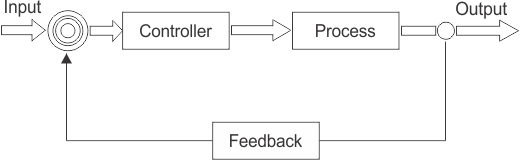
The VFD simply responds to a command signal given to it from something or someone that is "deciding" what the pump speed must be. What makes that decision is separate, often called a "Loop Controller". The loop controller takes in a process variable (PV) signal, as well as a setpoint (SP) from the user, then puts out a controlled variable (CV) output command that matches the desired condition. The VFD, attached to the motor, is simply the final actuator against that CV output command.

So for example let's say you want the pump to maintain a pressure in a piping system. You will have a pressure transducer that provides a 4-20mA signal proportional to pressure in the pipe. That goes into the Loop Controller as the PV, the value being measured. The end user (person, such as you) decides that the pressure that you want to maintain in the pipe is 15 PSI, the SP. So the transducer is calibrated to put out 12mA of current at 15 PSI. When the pipe pressure drops to 10PSI, the signal to the Loop Controller drops, so it tells the VFD to increase the speed with an output signal (CV), which the VFD uses to raise the frequency and increases the pressure. You need the Loop Controller in there because it must anticipate the rate of change, the magnitude of the response, and the how often it changes, otherwise the pump just constantly speeds up and slows down (called "hunting") without stabilizing.

An easy to understand example of a Loop Controller is if you have ever used the "Cruise Control" in your car. The Speed Setting is your SP, the speedometer has a transducer providing a feedback of the actual speed (PV), and the Loop Controller is acting (CV) upon a servo controller attached to your throttle mechanism to increase or decrease the engine power. In fact if you have ever rested your foot on the gas pedal and started going up a hill, you will feel the pedal get pulled down under you. That's the CV commanding the throttle servo. Same thing as telling the VFD to increase or decrease frequency (in fact if it is an electric car, it IS a VFD you are commanding).

In many cases, VFD manufacturers now build-in the Loop Controller as part of the VFD just for convenience and to save money for the user. But that isn't inherently part of the VFD, it's an added feature. Personally, I don't use that, I always use a separate Loop Controller. That way if the VFD dies, I can replace it with anything I can get quickly because the Loop Controller remains the same, and that's the complicated part of the system programming.

__________________
** All I every really wanted to be, was... A LUMBERJACK!.**
Register to Reply Good Answer (Score 2)
Active Contributor

Join Date: Jan 2016
Posts: 12
#15
In reply to #13

Re: How Do VFDs Work in Pumps?

02/11/2016 3:36 AM

Thanks for the response,

But i have already said that i have seen the pump with VFD that works without any sensors/transducers, its completely like a open loop but virtually it is a closed loop. this type of systems are called "Sensor-less Pumps".

to get more clarity/understanding about my question you can refer the below link,

http://www.buildingservicesindex.co.uk/entry/45703/Armstrong-Integrated/Armstrong-IVS-Sensorless-Pump/

Regards,

Prakash

Register to Reply
2
Guru
United States - Member - New Member Engineering Fields - Power Engineering - New Member

Join Date: Sep 2006
Location: California, USA, where the Godless live next door to God.
Posts: 4665
Good Answers: 804
#17
In reply to #15

Re: How Do VFDs Work in Pumps?

10/17/2016 8:57 PM

I read the data sheet on the link that you posted, and I see your confusion. This PARTICULAR system is custom designed to work with THEIR pump specifically. Here is what they say:

  • Sensorless control is an innovative concept for circulating pumps.
    Pump performance and characteristic curves for ten different
    speeds are embedded in the memory of the speed controller during
    manufacture. This data includes power, pressure and flow
    across the flow range of the pump. During operation, the power
    and speed of the pump are monitored, enabling the controller to
    establish the hydraulic performance and position in the pumps
    head-flow characteristic.
    These measurements enable the pump to continuously identify the head and flow at any point in time, giving accurate pressure control
    without the need for external feedback signals. Patented software technology within the controller ensures trouble-free operation
    in all conditions.
    Incorporating the pump’s hydraulic data into the controller and removing sensors results in true integration of all components and
    removes the risk of sensor failure.

So in other words, this relates to their specific PACKAGE of their pump and VFD, in which empirical performance data of the pump is loaded into the VFD as a form of set point for a PID loop, using the pump power itself at the Control Variable feedback to the loop. Interesting concept, but not really something you could do on any pump with any drive, it relies upon that tested performance data and a "look-up table" of data points.

There are other drives out there that have the ability to be connected to a pump in which the user runs through a series of test points like this, and the drive learns this data. But again, YOU as the user must teach the drive this information by simulating it, which is not always possible or practical.

For the most part it is better to decide up front what your control variable will be (i.e. pressure, flow etc.) and use a separate transducer as the input into a PID control loop in the drive. That way if the drive dies, it can be replaced by any other drive that is readily available. In the example you provided, if their drive fails, it can ONLY be replaced by that EXACT same drive. That will likely be a problem in 5 years, the average length of time a product like that lasts in the marketplace before it is updated and changed.

__________________
** All I every really wanted to be, was... A LUMBERJACK!.**
Register to Reply Good Answer (Score 2)
Active Contributor

Join Date: Sep 2015
Posts: 14
#14

Re: How Do VFDs Work in Pumps?

02/04/2016 7:11 AM

A viable-frequency drive is an electronic controller that adjusts the speed of an electric motor by modulating the power being delivered. Variable-frequency drives provide continuous control, matching motor speed to the specific demands of the work being performed. Variable-frequency drives are an excellent choice for adjustable-speed drive users because they allow operators to fine-tune processes while reducing costs for energy and equipment maintenance.

Register to Reply Score 2 for Off Topic
Register to Reply 17 comments

Good Answers:

These comments received enough positive votes to make them "good answers".

"Almost" Good Answers:

Check out these comments that don't yet have enough votes to be "official" good answers and, if you agree with them, vote them!
Copy to Clipboard

Users who posted comments:

Anonymous Hero (3); Excel (1); jayanth (1); JRaef (2); Mr. small (1); pgowda (3); phph001 (1); silver123 (1); Tornado (3); uli_newBuilder (1)

Previous in Forum: Do We Need Schedule Replacement for Field Critical Instruments?   Next in Forum: Upstream Pressure of Orifice

Advertisement