Previous in Forum: Animals Give Clues to Origins of Human Number-Crunching   Next in Forum: Segway Turns 15
Close
Close
Close
4 comments
Rate Comments: Nested
The Engineer
Engineering Fields - Engineering Physics - Physics... United States - Member - NY Popular Science - Genetics - Organic Chemistry... Popular Science - Cosmology - New Member Ingeniería en Español - Nuevo Miembro - New Member

Join Date: Feb 2005
Location: Albany, New York
Posts: 5060
Good Answers: 129

Vacuum Birefringence Possibly Detected

11/30/2016 7:58 AM

A recent CR4 challenge question involved the vacuum birefringence in the presence of a very strong magnetic field around binary pulsar system. Today I came across an article in which researchers suspect they have detected vacuum birefringence in the presence of a pulsar. It's a pretty cool discovery and I thought I'd pass along a link to the article.

First Signs of Weird Quantum Property of Empty Space

Register to Reply
Interested in this topic? By joining CR4 you can "subscribe" to
this discussion and receive notification when new comments are added.

"Almost" Good Answers:

Check out these comments that don't yet have enough votes to be "official" good answers and, if you agree with them, vote them!
Guru

Join Date: Apr 2010
Location: About 4000 miles from the center of the earth (+/-100 mi)
Posts: 9910
Good Answers: 1141
#1

Re: Vacuum Birefringence Possibly Detected
11/30/2016 10:10 PM

A little background...

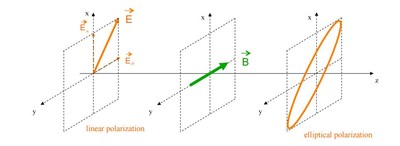
Birefringence is when the velocity of light (refractive index, n) varies between two perpendicular polarizations (fast and slow axis). A good example is calcite crystals.

https://en.wikipedia.org/wiki/Birefringence

When light is linearly polarized at 45 degrees to these axes, the result is that it becomes elliptically polarized due to the difference in speed of propagation.

Theoretically there should be birefringence in a vacuum due to the existence of virtual electron-positron pairs, but the effect is extremely small. The refractive index for light polarized parallel to the magnetic field is different from the light polarized perpendicular to the field. The difference in refractive index Δn is:

https://indico.in2p3.fr/event/7399/session/6/contribution/179/material/slides/0.pdf

where B is in Teslas. With the strength of magnetic fields available in laboratories (max 100T), the effect is well below the noise level of sensors and the effect has not been measured, AFAIK.

However, neutron stars have magnetic fields that may be as high as a million to 100 million Teslas, far higher than anything that can be reproduced on earth.

https://en.wikipedia.org/wiki/Orders_of_magnitude_(magnetic_field)

Register to Reply Score 1 for Good Answer
Guru
Technical Fields - Technical Writing - New Member Engineering Fields - Piping Design Engineering - New Member

Join Date: May 2009
Location: Richland, WA, USA
Posts: 21017
Good Answers: 795
#2

Re: Vacuum Birefringence Possibly Detected

11/30/2016 10:48 PM

No wonder I can't get rid of being cross-eyed....

__________________
In vino veritas; in cervisia carmen; in aqua E. coli.
Register to Reply
Guru

Join Date: Mar 2007
Location: by the beach in Florida
Posts: 33392
Good Answers: 1817
#3

Re: Vacuum Birefringence Possibly Detected

12/01/2016 12:54 AM

__________________
All living things seek to control their own destiny....this is the purpose of life
Register to Reply
Guru

Join Date: Dec 2016
Posts: 2914
Good Answers: 115
#4

Re: Vacuum Birefringence Possibly Detected

12/08/2016 3:02 AM

RX J1856.5-3754 is a magnetar, a rare type of neutron star with an extremely powerful magnetic field. The fields around these stars utterly defy imagination. A typical magnetar's field strength is about 1010 Tesla (quadrillions of times greater than Earth's). The energy density in a field of this magnitude exceeds 104 times the E/c2 energy density of lead. In other words, a cubic meter of such a magnetic field has an equivalent mass of 110-120 million kilograms, or about 125,000 short tons. That's a lot of energy.

Putting it another way, were the energy in that cubic meter suddenly released on Earth, it would be enough to remove a substantial portion of Earth's crust. In terms of nuclear weapons, about 2.5 billion megatons' worth. And that is just one cubic meter. The energy stored in the entire field? Unimaginable. While it is convenient for a magnetar to be this close for study, a big starquake and we just might be up the creek without a paddle. It depends on whether the crack is facing in our direction at the time.

The surface of a magnetar is under tremendous stress not only from the star's enormous gravity but also from its magnetic field. As the field diminishes the stresses in the crust reconfigure and can rupture the surface resulting in a 'starquake.' While these cracks may be only a few kilometers long (the entire star is less than 20 km in diameter), they can release enough energy to outshine the entire galaxy for a few milliseconds at gamma wavelengths and, voila! A gamma-ray burst, or GRB. One such GRB ripped through our Solar System a few decades ago, nearly fried and blinded a few our space probes, and measurably heated Earth's upper atmosphere on the facing side. That star was 50,000 light years away. This one is 400.

Register to Reply
Register to Reply 4 comments

"Almost" Good Answers:

Check out these comments that don't yet have enough votes to be "official" good answers and, if you agree with them, vote them!
Copy to Clipboard

Users who posted comments:

Andrew Westman (1); Rixter (1); SolarEagle (1); Tornado (1)

Previous in Forum: Animals Give Clues to Origins of Human Number-Crunching   Next in Forum: Segway Turns 15

Advertisement