Previous in Forum: Graphene and Silly Putty   Next in Forum: 220 VAC Electric Baseboard Heater Without A Ground
Close
Close
Close
28 comments
Rate Comments: Nested
Guru

Join Date: Mar 2007
Location: by the beach in Florida
Posts: 33392
Good Answers: 1817

Deaeration of Seawater For Process

12/20/2016 4:36 PM

What becomes of the deaerated seawater that's used in oil and gas processing? Is this water less corrosive than fresh water?

__________________
All living things seek to control their own destiny....this is the purpose of life
Register to Reply
Interested in this topic? By joining CR4 you can "subscribe" to
this discussion and receive notification when new comments are added.

"Almost" Good Answers:

Check out these comments that don't yet have enough votes to be "official" good answers and, if you agree with them, vote them!
Guru

Join Date: Oct 2008
Posts: 42355
Good Answers: 1693
#1

Re: Deaeration of seawater for process

12/20/2016 4:46 PM

Oil and gas: Water treatment in oil and gas production – does it matter ...

"The averaged maximum OIW (dispersed oil in water) value is now 30mg/l in the produced waters discharged overboard.

several operators have internally introduced a zero produced water discharge target for both existing and new assets."

No idea what all this really means.

Register to Reply
Guru

Join Date: Mar 2007
Location: by the beach in Florida
Posts: 33392
Good Answers: 1817
#3
In reply to #1

Re: Deaeration of seawater for process

12/20/2016 5:11 PM

..."Eta is the leading supplier of deaeration plants around the world, with over 400 plants worldwide. The majority of seawater deaeration plants supplied by Eta use vacuum stripping.[59]"...

http://www.koch-glitsch.com/process/pages/eta-process-plant.aspx

https://en.wikipedia.org/wiki/Deaeration

http://www.percocohs.com/17%20-%20Section-12%20%20Seawater%20systems.pdf

__________________
All living things seek to control their own destiny....this is the purpose of life
Register to Reply
Guru

Join Date: Jul 2005
Location: Stoke-on-Trent, UK
Posts: 4496
Good Answers: 137
#7
In reply to #3

Re: Deaeration of seawater for process

12/21/2016 11:11 AM

I worked on N Sea oil jobs in the 80s, mostly seawater filtration for secondary recovery. Mainly deep-bed sand filters, typically 2.5m dia, 4 - 8 each rig. Also some precoat filters using diatomaceous earth. We had designs for deaerators, gas stripping and vacuum, but ETA got most of the orders. Deaeration needed to prevent bacterial growth clogging the pores in the strata. Chemical scavenger added after physical deaeration.

The oil/water mixture then separated and the produced water dumped overboard. I can't remember max oil content allowed but Lyn's 30mg/l sounds reasonable. Salt content was much higher than seawater, about 3x if memory serves, and about 90°C. One operator was planning to filter the produced water and re-inject it, but I don't think it ever happened.

For your original question, I think seawater is far more corrosive than fresh, deaerated or not.

__________________
Give masochists a fair crack of the whip
Register to Reply
Guru

Join Date: Apr 2010
Location: About 4000 miles from the center of the earth (+/-100 mi)
Posts: 9910
Good Answers: 1141
#2

Re: Deaeration of seawater for process

12/20/2016 5:00 PM

"Dissolved gas removal

Surface water (fresh or saline) will contain dissolved oxygen that must be removed by the water-treating facility. Oxygen in concentrations of 0.5 ppm in hydrogen-sulfide-free water and 0.01 ppm in water containing hydrogen sulfide is generally considered to be sufficient to cause corrosion problems in the facilities and bacteria-plugging problems in an injection reservoir. For this reason, attempts are made to exclude oxygen from produced-water systems by maintaining gas blankets on all tanks. However, these systems sometimes must be designed to handle rainwater, which may introduce dissolved oxygen in sufficient quantities to require removal. All seawater contains oxygen, and while the location of surface-water intakes can be arranged to minimize the oxygen content, oxygen will have to be removed in almost all cases.

Some water sources contain ammonia, H2S, or CO2, which must be removed. The following are capable of removing these dissolved gases:

  • chemical scavengers
  • gas stripping
  • liquid extraction "

http://petrowiki.org/Surface_water_treatment_for_injection

My understanding is that the water remains underground where the oil or gas was. I suspect they use whatever water is locally available in large quantities at the cheapest cost.

Register to Reply
Guru

Join Date: Apr 2011
Posts: 8006
Good Answers: 286
#4
In reply to #2

Re: Deaeration of seawater for process

12/20/2016 7:03 PM

"....All seawater contains oxygen...."

That might be true if your sample size is large enough. If all seawater contains enough oxygen is an entirely different question.

__________________
Eternal vigilance is the price of knowledge. - George Santayana
Register to Reply
Guru

Join Date: Apr 2011
Posts: 8006
Good Answers: 286
#5

Re: Deaeration of Seawater For Process

12/20/2016 7:10 PM

'...Is this water less corrosive than fresh water?...'

Of what material, under what condtions? Are you making the comparison to degassed freshwater?

There are definitely problematic corrosion that occur in anoxic conditions.

__________________
Eternal vigilance is the price of knowledge. - George Santayana
Register to Reply
Guru

Join Date: Mar 2007
Location: by the beach in Florida
Posts: 33392
Good Answers: 1817
#6
In reply to #5

Re: Deaeration of Seawater For Process

12/20/2016 8:25 PM

Well I always thought that the salt content of the water was an oxidation catalyst, while that may be true it seems that the oxygen content is more of a factor....So I was wondering between deaerated saltwater and freshwater , which would be the more corrosive...? ...and if this deaerated seawater is being used in offshore oil and gas recovery, what becomes of it....Is it dumped at sea? If so, what sort of quantity are we talking? ....and what is the ph of this wastewater?

__________________
All living things seek to control their own destiny....this is the purpose of life
Register to Reply
Guru

Join Date: Apr 2011
Posts: 8006
Good Answers: 286
#17
In reply to #6

Re: Deaeration of Seawater For Process

12/21/2016 4:25 PM

I don't know specifics of the process water you speak of.

Each corrosion scenario is specific to the material experiencing corrosion, so therearen't universal guides that transcend all materials. There are some general guidelines as to corrosions in aqueous conditions related to iron and steel.

Generally if without oxygen for corrosion to proceed rapidly iron needs either an abundant supply of protons (low pH, below 6 will suffice) or the presence of certain types of anerobic microbes and chemicals they require. Methanogenic, acetogenic, nitrate reducing and sulfate reducing microbes all are known to contribute to accelerated corrosions of iron based materials in anoxic basic conditions. Sulfate reducing bacteria corrosions seem to be the the most common.

So even knowing a notice conditions and assuming iron based materials, I am unable to give you a simple answer. This is one case where my excessive wordiness isn't the real culprit. There are simply to many other factors involved to allow a simple answer for 'Which is more corrosive'.

__________________
Eternal vigilance is the price of knowledge. - George Santayana
Register to Reply
Guru

Join Date: Oct 2008
Posts: 42355
Good Answers: 1693
#8

Re: Deaeration of Seawater For Process

12/21/2016 11:34 AM

Why did you ask such a strange question?

Proximity to the ocean?

Burning curiosity?

Bar bet?

Register to Reply
Guru

Join Date: Mar 2007
Location: by the beach in Florida
Posts: 33392
Good Answers: 1817
#9
In reply to #8

Re: Deaeration of Seawater For Process

12/21/2016 12:11 PM

I just found it interesting that to save money oil and gas processing facilities use plain steel pipe with deaerated salt water and that was effective...and also that the salt has little effect on the ph of the water....I always thought that salt water was corrosive because of the salt and that that raised the ph to the point that it stripped the metal and facilitated rusting by being a catalyst on the surface of the steel....but you can halt that process by removing the oxygen from something composed of mostly oxygen because not all the oxygen is bound to hydrogen....then I got to thinking that all this water with no oxygen is being returned to the environment and it must have some effect....I know that water with low oxygen creates a dead zone at the mouth of the Mississippi river and other places....

https://en.wikipedia.org/wiki/Dead_zone_(ecology)

But yes I am looking for innovative ways of protecting my assets at the beach...

__________________
All living things seek to control their own destiny....this is the purpose of life
Register to Reply
Guru

Join Date: Mar 2007
Location: by the beach in Florida
Posts: 33392
Good Answers: 1817
#10
In reply to #9

Re: Deaeration of Seawater For Process

12/21/2016 2:33 PM

..."Rusting of iron consists of the formation of hydrated oxide, Fe(OH)3, FeO(OH), or even Fe2O3.H2O. It is an electrochemical process which requires the presence of water, oxygen and an electrolyte. In the absence of any one of these rusting does not occur to any significant extent."...

"Rust has been called “the great destroyer” and “the evil.” The Pentagon refers to it as “the pervasive menace.” It destroys cars, fells bridges, sinks ships, sparks house fires, and nearly brought down the Statue of Liberty. Rust costs America more than $400 billion per year—more than all other natural disasters combined. (reference: RUST: the longest war)"

http://corrosion-doctors.org/Experiments/rust-chemistry.htm

__________________
All living things seek to control their own destiny....this is the purpose of life
Register to Reply
Guru

Join Date: Mar 2007
Location: by the beach in Florida
Posts: 33392
Good Answers: 1817
#11
In reply to #10

Re: Deaeration of Seawater For Process

12/21/2016 2:39 PM

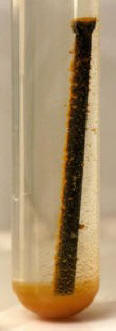
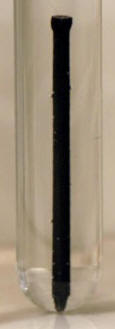
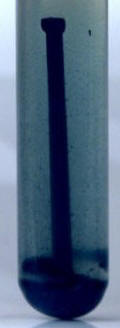
"Only Iron and steel rust. Other metals corrode. Rusting is an oxidation process. What we normally call rust is a flaky red-brown solid which is largely hydrated iron.The primary corrosion product of iron is Fe(OH)2 (or more likely FeO.nH2O), but the action of oxygen and water can yield other products having different colors:

  1. Fe2O3.H2O (hydrous ferrous oxide, sometimes written as Fe(OH)3) is the principal component of red-brown rust. It can form a mineral called hematite.
  2. Fe3O4.H2O ("hydrated magnetite" or ferrous ferrite, Fe2O3.FeO) is most often green but can be deep blue in the presence of organic complexants as shown here.
  3. Fe3O4 ("magnetite") is black

Red-brown flaky rust

Black magnetite

Blue/green unstable rust

__________________
All living things seek to control their own destiny....this is the purpose of life
Register to Reply
Guru

Join Date: Jun 2007
Posts: 1035
Good Answers: 40
#12
In reply to #9

Re: Deaeration of Seawater For Process

12/21/2016 2:52 PM

Re: "I always thought that salt water was corrosive because of the salt and that that raised the ph to the point that..."

Salt water is corrosive because it fulfills the "electrolyte" portion of the *4* requirements for a Corrosion Cell:

1) An Anode [material (or portion thereof), that is the "Active" part]

2) A Cathode [material (or portion thereof), that is the "Noble/Passive/Inactive" part]

3) An electrolyte environment [able to transport electrons, which is the positive/metal ions in seawater; e.g., sodium ions]

4) A Metallic Path

The "NACE Defined" Splash Zone is the most corrosive {"natural"} environment on the planet because of the saltwater AND the excess of dissolved O2 therein.

Where our "typical Freds/Joes" get mucked-up, in trying to explain the PROCESS of corrosion in this environment, is thinking that OXYGEN is "responsible for" the "OXIDATION" part of the process...

IT IS NOT_!!!

The corrosion process involves REDOX reactions (Reduction And Oxidation, simultaneously)... cannot happen "one-at-a-time")!

Oxidation is the LOSS of (or "giving-up" of) an electron.

Reduction is the GAINING of (or "picking-up" of) an electron.

When oxygen (O2) is involved in the corrosion process, it is involved in REDUCTION {cathodic} REACTIONS (i.e., the reduction of oxygen is THE most predominant cathodic reaction in the splash zone).

"Deaeration of Seawater" reduces the POTENTIAL for Cathodic Reactions to occur..... and..... "GUESS WHAT"...

Anodic reactions {a.k.a. "oxidation"} CAN ONLY OCCUR AS FAST AS Reduction Reactions are occurring...(!)

Re-read ... re-think it all ... "understand-it-all"...

[EDIT] : you got #10-11 in while I was typing...

Re: "which requires the presence of water, oxygen and an electrolyte..." WRONG!!!!!

"Water" is NOT a "requirement" ... Distilled water will NOT act as an electrolyte. Whatever reference you copied/pasted from should have been MORE specific/correct, by stating the 4 requirements listed above......

AND --- {doggone-it!} ... oxygen is NOT a "requirement" for corrosion cell. (It just happens to "be around" more often than not, and thus gets itself involved.)

Cheers , and , "Merry Christmas" to one and all ~ !

Register to Reply
Guru

Join Date: Mar 2007
Location: by the beach in Florida
Posts: 33392
Good Answers: 1817
#13
In reply to #12

Re: Deaeration of Seawater For Process

12/21/2016 3:04 PM

Is there any type of disruptive signal that can be generated to halt this process....? Is there any kind of sacrificial strategy that could be incorporated?

__________________
All living things seek to control their own destiny....this is the purpose of life
Register to Reply
Guru

Join Date: Jun 2007
Posts: 1035
Good Answers: 40
#15
In reply to #13

Re: Deaeration of Seawater For Process

12/21/2016 3:19 PM

There are several "variations-on-the-themes", so-to-speak, to combat corrosion (options are NOT always "available" or "economically-feasible", unfortunately).

Take-away ANY of those *4* requirements mentioned, and, VOILA! No "corrosion cell" (no corrosion activity).

ISOLATE the article from the electrolyte environment, and... ("Likewise/above").

Separate the anode/cathode sites (electrically)...

When SUBMERGED in saltwater, "Cathodic Protection" works great!

It will NOT work on your car (as discussed in another thread)... unless you park it IN the Gulf-of-Mexico...

Register to Reply
Guru

Join Date: Mar 2007
Location: by the beach in Florida
Posts: 33392
Good Answers: 1817
#16
In reply to #13

Re: Deaeration of Seawater For Process

12/21/2016 4:15 PM

What about this? Is this a scam, or does it work?

http://www.erps.com.au/how-erps-works.html

Oops, found this...

"There are various products on the market claiming to provide cathodic electrochemical protection to your car, just by injecting electrons into your metalwork - but they don't work. ... The rust happens not where the metal is dry, nor where the metal is wet - but at the interface between the wet and dry metal."

http://corrosion-doctors.org/Car/car-electronic-rust.htm

http://corrosion-doctors.org/Car/car-rust-inhibitor.htm

__________________
All living things seek to control their own destiny....this is the purpose of life
Register to Reply
Guru

Join Date: Jun 2007
Posts: 1035
Good Answers: 40
#14
In reply to #12

Re: Deaeration of Seawater For Process

12/21/2016 3:11 PM

... needing to add, "outside-the-Edit-Time-Window"...

I stated that neither "water nor oxygen are requirements for corrosion" ... and ... before anybody opens-mouth-inserts-foot:

Think what happens when you (or "Bill Nye the Science Guy") stick a small plate/coupon of 1018 steel into a beaker of nitric acid. Does the acid "eat-it-up"...?

NO! The gazillions of hydrogen ions in the acid act as a FABULOUS electrolyte.

The carbon (and other noble constituents) in the non-homogeneous steel act as the bazillions of "Cathodic sites"....

and, the iron acts as the bazillions of "Anodic sites"....

Which of the 4 "requirements" is not yet mentioned? Yep, it's there...(!)

Was ANY "Oxygen" needed for corrosion to occur...?

Was any "water" needed for corrosion to occur...?

People need to STUDY, in order to be able to RECOGNIZE what is TRUTH.....

Register to Reply
Guru

Join Date: Apr 2011
Posts: 8006
Good Answers: 286
#22
In reply to #14

Re: Deaeration of Seawater For Process

12/21/2016 9:36 PM

Your 'steel in nitric acid' example doesn't really show corrosion in the absence of oxygen or water.

Nitric acid is comprised in large part of oxygen. In fact Oxygen isn't merely present, nitric acid is mostly oxygen.

Water will be present in most Nitric acid, but if you do happen to find some pure Nitric acid, iron and steel will quickly passivate ...the reaction stops about as quickly as it started.

So it appears you have oxygen (HNO3) and if the corrosion is going to be significant you need water.

Perhaps you have an alternate example?

__________________
Eternal vigilance is the price of knowledge. - George Santayana
Register to Reply
Guru

Join Date: Jun 2007
Posts: 1035
Good Answers: 40
#24
In reply to #22

Re: Deaeration of Seawater For Process

12/22/2016 11:26 AM

"Oh, the shame"... (I should have waited until I had a good night's sleep before responding). Exhaustion is no excuse for having picked such a poor example; but, I *was* (as mentioned) trying to preclude somebody ELSE jumping in and "opening-mouth-inserting-foot", by regurgitating some "Basic" NACE training, as having done at Posts #16, #24, #25, #27, #39 {& others} at THIS Thread, and, Posts #10 & #18 at THIS thread, {and elsewhere}.

(Obviously), I am not, and do not claim to be, an "expert" on acids. I do find them to be fascinating, insofar as their being an absolute necessity to our very existence, and, playing such a major role in so many different industries.

Instead of the poor example, I should have stuck to the fundamentals (as previously listed).

While I freely admit that it might be considered by some to be "off-topic", bringing "obscure" scenarios into a discussion that revolves around the corrosivity of "deaerated_seawater", the full title of the thread includes "in oil and gas processing".

NACE possesses such a plethora of knowledge involving EVERY aspect of corrosion under every imaginable condition, that no single person could possibly read-and-remember it all.

And, within that body of knowledge, it is understood that corrosion CAN, and DOES in fact, occur in the absence of oxygen. And, this condition exists ('widespread') within the oil & gas industry.

Likewise, corrosion, CAN, and DOES in fact, occur in the absence of water. What is necessary is an "electrolyte". And, while seawater IS, in fact, the most abundant electrolyte on the planet (and, contributes to the greatest amount of corrosion that we experience)... it is certainly NOT a "requirement" for corrosion. Likewise, most electrolytes with which the typical layperson is familiar include water... (unless they work in a lab). There exist, in man's worldwide body of "labs"/"production facilities", numerous products that provide "electrolyte" properties in the absence of H2O.

In acids, the predominant influence on corrosion is the presence of the hydrogen ion (the pH scale, "potentz Hydrogen, for acids being a measure of the hydrogen ion [H+] activity*). Bases on the other hand, at "the opposite end of the pH scale" from acids, are measured by the concentration of hydroxyl groups [OH-].

* → An H+ ion will happily "steal" an electron from a material {such as a metal}, thus instigating the "oxidation reaction" portion of the REDOX reaction mechanism of corrosion. The greater the concentration of H+ ions, the better the electrolyte it makes, and thus, the greater its effect on corrosion....

The subject is difficult-at-best, and, one cannot take "as Gospel" everything one reads on the web (including Wiki); the first paragraph on pH states:

"Pure water is neutral, being neither an acid nor a base." Yet NACE teaches us that "laboratory-grade" pure-as-pure-can-be water (H2O) will exhibit the tendency for some molecules to dissociate naturally... continually dissociating and re-associating into-and-from H+/OH- ions/groups. Thus, pure water is said to be "amphoteric" in nature, as it can act as either a very weak acid or a very weak base, "circumstance-dependent".

[Lo-and-behold, the term "amphoteric" is also applied to metals such as lead, aluminum, magnesium and others that are "happy" in neutral pH solutions, yet will corrode when subjected to EITHER an acidic OR a basic environment. Worthy-of-mention is the fact that carbon steels are not amphoteric; they will corrode when placed in acidic environments, yet are actually afforded a degree of corrosion resistance when placed in alkaline environments.]

Thanks for the "catch".... I shall strive to post only when better-rested in the future...(!)

Register to Reply Score 1 for Good Answer
Guru

Join Date: Apr 2011
Posts: 8006
Good Answers: 286
#26
In reply to #24

Re: Deaeration of Seawater For Process

12/22/2016 12:17 PM

GA

I really appreciate a response like that.

After making such forceful initial comments, it is great to see a willingness to correct errors immediately without the all to common first attempts to defend what was originally said.

__________________
Eternal vigilance is the price of knowledge. - George Santayana
Register to Reply Off Topic (Score 5)
Guru

Join Date: Jun 2007
Posts: 1035
Good Answers: 40
#27
In reply to #26

Re: Deaeration of Seawater For Process

12/22/2016 3:24 PM

self-OT'ing

I have always believed in that old "philosophical-tenet-context" of "Share what you know", and (at times) I get a bit "wound-up" when I see individuals spouting-off with stuff that resonates of "hillbilly nonsense". Then, too, every-now-and-again ...

[as when I've been on my feet all day or more, getting more exhausted than I am used to, as Tu-Wed & Thur morning]:

every-now-and-again , I have been known to "stumble", and jump-the-gun trying to preclude such stuff having the chance to get started...

Thank goodness we can learn from our (as well as other people's) mistakes, and not re-make them(!)

Register to Reply Off Topic (Score 5)
Guru

Join Date: Apr 2011
Posts: 8006
Good Answers: 286
#20
In reply to #12

Re: Deaeration of Seawater For Process

12/21/2016 5:17 PM

'.. Distilled water will NOT act as an electrolyte...'

Just to clarify for anyone who may mistakenly believe the previous means DI or high purity distilled water is not corrosive, that is not the case. DI and other high purity water is incompatible with iron, carbon steel, copper and several other materials due to severe corrosive effects.

__________________
Eternal vigilance is the price of knowledge. - George Santayana
Register to Reply
Guru

Join Date: Mar 2007
Location: by the beach in Florida
Posts: 33392
Good Answers: 1817
#18

Re: Deaeration of Seawater For Process

12/21/2016 4:41 PM

"Despite the developments in corrosion resistant alloys over the past few decades, carbon steel still constitutes an estimated 99% of the material used in the oil industry. It is usually the most cost effective option, being a factor of 3 to 5 times cheaper than stainless steels. Yet its corrosion resistance is poor in aggressive environments, and the cost savings can only be realized by adding a corrosion inhibitor to the environment or applying a protective coating to the steel. Inhibitors are used in a wide range of applications, such as oil pipelines, domestic central heating systems, industrial water cooling systems and metal extraction plants.

A particular advantage of corrosion inhibition is that it can be implemented or changed in situ without disrupting a process. The major industries using corrosion inhibitors are the oil and gas exploration and production industry, the petroleum refining industry, the chemical industry, heavy industrial manufacturing industry, water treatment facilities, and the product additive industries. The largest consumption of corrosion inhibitors is in the oil industry, particularly in the petroleum refining industry. The total consumption of corrosion inhibitors in the United States has doubled from approximately $600 million in 1982 to nearly $1.1 billion in 1998."

So what is the corrosion inhibitor of choice?

"Inhibitors are chemicals that react with a metallic surface, or the environment this surface is exposed to, giving the surface a certain level of protection (see corrosion costs study findings).Inhibitors often work by adsorbing themselves on the metallic surface, protecting the metallic surface by forming a film. Inhibitors are normally distributed from a solution or dispersion. Some are included in a protective coating formulation. Inhibitors slow corrosion processes by either:

  • Increasing the anodic or cathodic polarization behavior (Tafel slopes);
  • Reducing the movement or diffusion of ions to the metallic surface;
  • Increasing the electrical resistance of the metallic surface.

http://corrosion-doctors.org/Inhibitors/Introduction.htm

__________________
All living things seek to control their own destiny....this is the purpose of life
Register to Reply Score 1 for Good Answer
Guru
Safety - Hazmat - New Member United States - US - Statue of Liberty - New Member Engineering Fields - Chemical Engineering - Old Hand

Join Date: Mar 2011
Location: Lubbock, Texas
Posts: 14331
Good Answers: 162
#19

Re: Deaeration of Seawater For Process

12/21/2016 5:01 PM

if the oxygen content is less than 100 ppb, then some heat stress cracking in certain steels will be reduced. Pitting slows down a bit, but it still probably needs some corrosion inhibitor.

Once discharged, or rather before discharge, it probably needs to be saturated with oxygen once again by good air contact, to protect fish.

__________________
If it ain't broke, don't fix it. Just build a better one.
Register to Reply
Guru

Join Date: Apr 2010
Location: About 4000 miles from the center of the earth (+/-100 mi)
Posts: 9910
Good Answers: 1141
#21

Re: Deaeration of Seawater For Process

12/21/2016 5:51 PM

It would make an interesting science experiment for some enterprising student. Water can be deaerated bu bringing it to a boil. Test water, salt water, and deaerated versions of both sealed in jars, each with a nail inside. See which nail rusts first.

Register to Reply
Guru

Join Date: Mar 2007
Location: by the beach in Florida
Posts: 33392
Good Answers: 1817
#23
In reply to #21

Re: Deaeration of Seawater For Process

12/21/2016 9:43 PM

Also a good plan for testing corrosion inhibitors...although here where I live probably just have to set it outside....

__________________
All living things seek to control their own destiny....this is the purpose of life
Register to Reply
Guru

Join Date: Oct 2008
Posts: 42355
Good Answers: 1693
#25

Re: Deaeration of Seawater For Process

12/22/2016 11:39 AM

Are you sorry you asked the question yet?

Register to Reply
Guru

Join Date: Mar 2007
Location: by the beach in Florida
Posts: 33392
Good Answers: 1817
#28
In reply to #25

Re: Deaeration of Seawater For Process

12/25/2016 3:05 PM

Not even, this is an ongoing process that may take years to run its course....testing begins soon....

__________________
All living things seek to control their own destiny....this is the purpose of life
Register to Reply
Register to Reply 28 comments

"Almost" Good Answers:

Check out these comments that don't yet have enough votes to be "official" good answers and, if you agree with them, vote them!
Copy to Clipboard

Users who posted comments:

Codemaster (1); James Stewart (1); lyn (3); ndt-tom (5); Rixter (2); SolarEagle (10); truth is not a compromise (6)

Previous in Forum: Graphene and Silly Putty   Next in Forum: 220 VAC Electric Baseboard Heater Without A Ground

Advertisement