Previous in Forum: Selection of Upstream Breakers   Next in Forum: Efficiency of Induction Motor
Close
Close
Close
14 comments
Rate Comments: Nested
Active Contributor

Join Date: Jan 2017
Posts: 13

Solid State Transformer

01/14/2017 3:05 PM

I have read many research paper on solid state transformer a.k.a power electronics transformer(PET) . they all highlighted the disadvantages of conventional transformer and how they can be overcome using PET. so anyone here know about this idea ? did any one work on this project.

Register to Reply
Interested in this topic? By joining CR4 you can "subscribe" to
this discussion and receive notification when new comments are added.

Good Answers:

These comments received enough positive votes to make them "good answers".

"Almost" Good Answers:

Check out these comments that don't yet have enough votes to be "official" good answers and, if you agree with them, vote them!
Guru
United Kingdom - Member - New Member

Join Date: Aug 2010
Location: Resting under the Major Oak
Posts: 4347
Good Answers: 181
#1

Re: solid state transformer

01/14/2017 3:46 PM

They are being installed in London as part of a flexible LV network

__________________
The reports of my death are greatly exaggerated.
Register to Reply
Active Contributor

Join Date: Jan 2017
Posts: 13
#2
In reply to #1

Re: solid state transformer

01/14/2017 3:52 PM

Do you have any report or any kind of written information that I can show to my teachers? I will be very thankful to you.

Actually I googled about this and I didn't get any information . Even there is no prototype available on internet about solid state transformer

Register to Reply
Guru

Join Date: Oct 2008
Posts: 42355
Good Answers: 1693
#3
In reply to #2

Re: solid state transformer

01/14/2017 4:10 PM

First, learn how to search.

I googled "power electronics transformer" and got about 1,090,000 results (0.75 seconds)

So, go back and do some real research instead of asking others to do the search for you.

Register to Reply
Active Contributor

Join Date: Jan 2017
Posts: 13
#5
In reply to #3

Re: solid state transformer

01/14/2017 4:15 PM

Lyn , there are only research papers available for this topic. There is no hardware implementation available or there is no video available for this .. you can google it ..

Register to Reply
Guru

Join Date: Oct 2008
Posts: 42355
Good Answers: 1693
#8
In reply to #5

Re: solid state transformer

01/14/2017 4:33 PM

" you can google it .."

So can you.

How to Search the Internet Effectively | MediaSmarts

<Beam me up Scottie>

Register to Reply
Guru

Join Date: Apr 2010
Location: About 4000 miles from the center of the earth (+/-100 mi)
Posts: 9910
Good Answers: 1141
#4

Re: solid state transformer

01/14/2017 4:14 PM

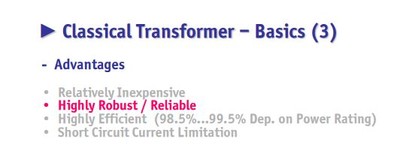
From my knowledge, conventional transformers are less expensive and more reliable. It's hard to beat the reliability of wire and iron. Conventional transformers are also highly efficient (~99%).

https://www.pes.ee.ethz.ch/uploads/tx_ethpublications/__ECPE_SST_Workshop_2016_SST_Concepts_Challenges_Opportunities_FINAL_JWK_270116.pdf

(See page 14).

Register to Reply Score 1 for Good Answer
Active Contributor

Join Date: Jan 2017
Posts: 13
#6
In reply to #4

Re: solid state transformer

01/14/2017 4:18 PM

I studied this report already .. but the thing is I want to know . Did anyone do some work on this project?

Register to Reply
Guru

Join Date: Dec 2010
Posts: 1686
Good Answers: 116
#14
In reply to #4

Re: solid state transformer

01/15/2017 10:40 AM

I agree 50/60Hz transfo is simple iron, insulation and copper and very reliable.

When I started electronics, most radios had thermionic bottles/tubes and heavy 50 Hz transfos. Televisions were more "advanced", the kilovolt 50 Hz transfos of the first TVs were avoided by series cathode heaters and EHT for picture tube from flyback of a small "iron dust" core 10 kHz line scan transfo.

When the PC computer came along, the standard "200 watt" PSU was switch mode, with isolation by 25 kHz & up ferrite transfo, a small lump in the box.

Now, even the smallest "plug-top" PSU has a 100 khz plus isolating transfo preceded by bridge rectifier to DC and followed by rectifiers for DC output. All this gear is very reliable.

Copper is becoming scarce and expensive, so DC-DC can cut out a lot of cost, as well as size and weight.

I can understand power distributers being interested by

  1. Running existing cables with DC for 40% more transfer at lower loss [DC at peak voltage of AC service & same current].
  2. Smaller, lighter equipment in substations allowing higher power in existing space with quick-change wheel-in,wheel-out modular additions/replacements and standby parallel capacity.
  3. Being able to control direction and magnitude of power transfer between points - the ordinary transfo is two way and power transfer is tied inherently to a small % voltage difference from no-current between ends.
  4. Being able to transfer between existing substations when needed, even if phase/voltage difference makes hard connection impractical.

I just bought an electronic ballast for a fluorescent light tube - it is rated for DC input 176 – 280 V (lamp start ≥ 198 V DC) as well as AC 198 – 264 V 50/60 Hz.

So the bits for the DC Home are already "commodities".

Register to Reply
2
Guru
United States - Member - New Member Engineering Fields - Power Engineering - New Member

Join Date: Sep 2006
Location: California, USA, where the Godless live next door to God.
Posts: 4665
Good Answers: 804
#7

Re: solid state transformer

01/14/2017 4:26 PM

It's not really a "solid state transformer". It HAS an isolation transformer inside of it! What they are really is a Switch Mode Power Supply with transistors on the front and back end with the transformer in the middle. The only advantage I can see of going to the extra cost is that the output voltage (and I suppose frequency and phasing) is programmable. That might make it useful in labs for testing porpoises, but there is no point in adding the extra complexity and cost for simple transformation, so it's pointless to compare it to anything other than maybe some other form of variable lab power source.

__________________
** All I every really wanted to be, was... A LUMBERJACK!.**
Register to Reply Good Answer (Score 2)
Guru

Join Date: Dec 2016
Posts: 2914
Good Answers: 115
#9

Re: solid state transformer

01/14/2017 5:04 PM
Register to Reply
2
Guru

Join Date: Aug 2014
Location: Port Macquarie N.S.W. Australia
Posts: 1071
Good Answers: 225
#10

Re: solid state transformer

01/14/2017 10:30 PM

A few years back, US company Cree built a prototype 1 megawatt solid state transformer (SST or IUT) consisting of a group of 10kV 100 amp modules operating at 20kHz.

The unit could provide up to 250kVA, measured only 400mm high and weighed in at just 34kg. An equivalent conventional transformer would be over a metre high, weigh around 800kg and would operate only at the incoming frequency - 60Hz in the US - 50Hz down under.

A great advantage of the higher frequency is that it allows the transformer to more readily integrate with the growing trend towards HVDC transmission in that it can directly transform incoming low frequency AC into the high frequencies that are required for the conversion to HVDC output.

One of the difficulties with HV, MV and LVDC transmission is the problem of arcing when opening the feeder, this can be somewhat alleviated with SST technology.

Output frequency and voltage can be very much more easily controlled at a local distribution level to ensure power quality remains constant over a much wider load movement.

The big hurdle to overcome with these devices appears to be the ability for the electronics to withstand very high voltages, slow switching speeds and inherent power losses.

This would seem to be at least partly under control with the use of Silicon Carbide and Gallium Nitride rather than the conventional doped Silicon devices. A SiC or GaN IGBT or HFET can operate at switching speeds in excess of 400% faster than Si ones, and with about 10% of the losses.

Some of the units now available can do simple AC-AC transformation, AC-DC conversion or DC-AC inversion all in the one package. They all have built in communication facilities for power management.

They can also be configured for bi-directional flow, something that conventional transformers cannot do.

Register to Reply Good Answer (Score 2)
Active Contributor

Join Date: Jan 2017
Posts: 13
#11
In reply to #10

Re: solid state transformer

01/15/2017 7:23 AM

everything i found is on paper. i cant find any prototype or any hardware on internet .. if you can provide me with some hardware knowledge

Register to Reply
Guru

Join Date: Dec 2016
Posts: 2914
Good Answers: 115
#12
In reply to #11

Re: solid state transformer

01/15/2017 7:50 AM

Pick up the phone or email the UK people doing this. See my comment above.

Register to Reply
Guru
Canada - Member - Specialized in power electronics

Join Date: Feb 2008
Location: Montreal, Canada.
Posts: 1372
Good Answers: 80
#13
In reply to #11

Re: solid state transformer

01/15/2017 9:26 AM

There are little needs for them as AC-AC units. As correctly pointed out above by others, this is for special applications where the frequency needs to be changed or a conversion to (or from) DC is needed. Think solar, wind...

Modern airplanes use them to save weight but they are often coupled with other functions.

In our field (water treatment, see diagram below) we use large power electronics converters (G11, G12) to feed the ozone generators (10kW to 2.5MW). We transform the line voltage (380-480, 3 phases) into a high voltage medium frequency (~1500Hz) using a "smaller" transformer (T13) not shown in the picture below. We cannot do without as some galvanic isolation is needed between the load and the line. Look up www.ozonia.com for application details.

I have been doing power electronics for Imalog for 20 years and implemented hundreds of industrial applications. I was never asked to simply step up or down the line voltage with a power converter. That would have been a waste of money. As already pointed out by others, power converters shine when the electricity waveform needs to be transformed. In simple AC voltage conversion, the good old magnetic transformer is usually the best choice.

__________________
Experienced is earned, common sense is taught, both are rare essentials of life.
Register to Reply
Register to Reply 14 comments

Good Answers:

These comments received enough positive votes to make them "good answers".

"Almost" Good Answers:

Check out these comments that don't yet have enough votes to be "official" good answers and, if you agree with them, vote them!
Copy to Clipboard

Users who posted comments:

67model (1); Andrew Westman (2); JRaef (1); lyn (2); marcot (1); muhammad asad (4); Rixter (1); spades (1); TonyS (1)

Previous in Forum: Selection of Upstream Breakers   Next in Forum: Efficiency of Induction Motor

Advertisement