Previous in Forum: Shielded Cable And Why?   Next in Forum: Troubleshoot On Central Air Conditioning
Close
Close
Close
14 comments
Rate Comments: Nested
Commentator

Join Date: Apr 2012
Location: Sanskrit
Posts: 57

Surge Suppression Circuit

05/01/2018 4:32 AM

Can someone explain me how this surge suppression circuit works ? and what could lead to the Diodes blowing up ?

for full size picture please click here

Register to Reply
Pathfinder Tags: Surge suppression voltage spike
Interested in this topic? By joining CR4 you can "subscribe" to
this discussion and receive notification when new comments are added.

Good Answers:

These comments received enough positive votes to make them "good answers".

"Almost" Good Answers:

Check out these comments that don't yet have enough votes to be "official" good answers and, if you agree with them, vote them!
Guru
Popular Science - Weaponology - New Member United Kingdom - Member - New Member

Join Date: May 2007
Location: Harlow England
Posts: 16512
Good Answers: 670
#1

Re: Surge Suppression Circuit

05/01/2018 5:22 AM

As far as I can tell from a cursory glance it's not a surge suppression circuit, it looks like some sort of horrible high voltage supply.
The diodes probably blow due to the inrush current to those capacitors.
Ah I've looked a bit closer... a diode and capacitor across the contacts may help?
I still can't see any supression, ok the resistor across the contacts does charge the caps slowly to help stop the inrush, but it all looks a bit iffy.
It doesn't show what the actual load is.... unless it's just some hot resistors, but they presumably have some inductance so there will be back EMF and stuff floating about when the switch opens.
Need a better explanation of the purpose of the circuit.
Del

__________________
health warning: These posts may contain traces of nut.
Register to Reply Score 1 for Good Answer
Guru
Engineering Fields - Electrical Engineering - Been there, done that. Engineering Fields - Control Engineering - New Member

Join Date: Dec 2008
Location: Long Island NY
Posts: 15600
Good Answers: 981
#2

Re: Surge Suppression Circuit

05/01/2018 8:13 AM

Del is correct, there is no voltage surge suppression circuitry shown in this circuit. Most surge suppression designs act on the incoming voltage exceeding expected levels for brief amounts of time. Therefore a voltage surge could easily be the culprit to toast those diodes.

There is a very simple current surge circuit of the relay coil C1 and its contact bypassing the 10 ohm resistor. If that relay is a time delay relay for multiple cycles of the incoming power then I can see it having some useful function at limiting the inrush current. The unlimited inrush current might damage the diodes.

I dislike this current surge approach. The minimum time delay of a mechanical relay from coil energizing to contact closing is not a guaranteed attribute unless that relay is a time delay relay. Also the coil of this relay is sensing the incoming AC voltage and not the DC voltage across the capacitor. It is therefore indirectly responding to the inrush scenario instead of directly measuring the voltage that creates an inrush current. Even if this relay is a time delay relay I still dislike this approach. If the contacts ever weld together(unlikely) or the current limiting resistor fails open (likely) then full inrush current will happen. The inrush current might be anything up to the arc flash current. Also an open 10 ohm resistor path will never be detected because the relay contact will eventually bypass it.

__________________
"Don't disturb my circles." translation of Archimedes last words
Register to Reply
Guru
United Kingdom - Member - Indeterminate Engineering Fields - Control Engineering - New Member

Join Date: Jan 2007
Location: In the bothy, 7 chains down the line from Dodman's Lane level crossing, in the nation formerly known as Great Britain. Kettle's on.
Posts: 32175
Good Answers: 839
#3

Re: Surge Suppression Circuit

05/01/2018 9:51 AM

The diodes blow up when there is either too much reverse voltage, or too much forward current, for them to sustain.

__________________
"Did you get my e-mail?" - "The biggest problem in communication is the illusion that it has taken place" - George Bernard Shaw, 1856
Register to Reply
2
Guru
Engineering Fields - Power Engineering - New Member

Join Date: May 2007
Location: NYC metropolitan area.
Posts: 3230
Good Answers: 444
#4

Re: Surge Suppression Circuit

05/01/2018 11:31 AM

Surge suppression in the electronic sense is not included in this circuit, there are no varistors to clamp (suppress) voltage spikes. There is some crude electrical speed surge suppression via the 10Ω 225W resistor that is across the n.o. relay contacts. That resistor limits the cold inrush surge current to the series string of 310Ω resistors until the relay coil picks up and bypasses the 10Ω resistor.

The fatal flaw in this design is the fact that that the circuit will not detect single phasing; i.e., if CΦ is not energised, then the relay still picks up, but the full load is being carried by the remaining phases as a single phase load. That means that the remaining four diodes, not six, are subject to the cold inrush current. The diodes blow at electronic speeds long before the fuses will melt at electrical speeds, and/or the circuit breakers will operate at mechanical speeds.

Somebody saved a few bucks by not using three phase sensing.

__________________
“Tell me and I forget. Teach me and I remember. Involve me and I learn.” Ben Franklin.
Register to Reply Good Answer (Score 2)
Guru

Join Date: Dec 2010
Posts: 1686
Good Answers: 116
#5

Re: Surge Suppression Circuit

05/01/2018 1:03 PM
  1. C1 provides a current surge limitation, by keeping the 10 ohm resistor in circuit until the 1500 MFD capacitors have charged to near normal voltage.
  2. The time to close of C1 contact varies according to the time in cycle when main 3 phase contacts close. However, C1 likely takes over 20 milliseconds to close, 2 half cycles. The R x C time constant of 10 ohm & 500 MFD is 5 milliseconds, so initial charging surge current will be negligible by 20 ms.
  3. I cannot read, with certainty, load resistor values, but wattage makes current about 3 amps [250 ohm load?] - so diode rating is decided by 600V x √2/10ohms = 90 amp surge current.
  4. Have you checked all 3 caps of 1500 MFD are seeing equal voltage?
  5. Diodes might fail due to reverse voltage spike - but circuit effectively keeps 20MFD//500 MFD connected to line through forward biased diodes all the time, which is a big spike limitation. Voltage dependent resistors VDR could be added to clamp spikes of very short duration.
  6. Diodes might fail due to current surge caused by line overvoltage, but as noted in 2 above the capacitance charging time is only 5 ms. You could add semiconductor-type fast fuses, which should blow before the diodes - but if this is an external problem repeated fuse failures will occur.
  7. One diode open-circuit reduces output, but one short circuit will cause other diodes to fail. How many diodes failed? Were all replaced, including survivors?
  8. The usual questions apply a) has this gear been working for years without trouble till now b) has failure happened more than once recently? c) has some change to plant or local loads been made, since when faults occur? d) has there been trouble with something else, which might disturb rectifier, recently?
Register to Reply
Guru
Popular Science - Weaponology - New Member United Kingdom - Member - New Member

Join Date: May 2007
Location: Harlow England
Posts: 16512
Good Answers: 670
#6
In reply to #5

Re: Surge Suppression Circuit

05/01/2018 1:29 PM

Nice post but I'd suggest that on your point number 5 those big caps will do nothing to suppress fast spikes.
I think their high frequency impedance will be too high.
I reserve the right to be wrong as it's not may area.
As you say a VDR is prob' a good idea .
Del

__________________
health warning: These posts may contain traces of nut.
Register to Reply
Guru

Join Date: Dec 2010
Posts: 1686
Good Answers: 116
#8
In reply to #6

Re: Surge Suppression Circuit

05/01/2018 3:42 PM

Hi Del,

I agree item 5, caps may not have low inductance [good 10 mmF film capacitors for AC connect the whole end of the foil to the terminal, which minimises inductance], but I feel this is proven equipment well able to survive connection to 600V 3 phase, so those diodes are robust.

All diodes are a "reverse avalanche breakdown" diode and those probably have a reverse breakdown energy minimum withstand as part of their spec.

It may all depend on the actual high frequency impedance of the source supply and what loads are switched on it and by what. Replacing an old breaker by a much faster new one may have increased the magnitude or number of spikes on a common source.

This may be equipment which was fine with a 50 metre cable run from the isolator, but now connected close to the supply transformer and frequently operated breakers.

Register to Reply
Commentator

Join Date: Apr 2012
Location: Sanskrit
Posts: 57
#10
In reply to #5

Re: Surge Suppression Circuit

05/02/2018 1:11 AM

Are you saying that C1 will take some time to close even if 600 VAC is directly applied on to the diode Bridge, the AC voltage will not be 600 until after some time (20 ms) and the coil will not activate waiting it to reach 600 VAC . This is interesting to note

but i thought the coil should pickup and close the contact the moment 600 is applied to the bridge as it is also connected to the coil

Register to Reply
Guru
Popular Science - Weaponology - New Member United Kingdom - Member - New Member

Join Date: May 2007
Location: Harlow England
Posts: 16512
Good Answers: 670
#11
In reply to #10

Re: Surge Suppression Circuit

05/02/2018 3:05 AM

"...and close the contact the moment 600 is applied..."
Err, how long do you think a "moment" is exactly?
Have you never wired up a relay so you can watch the contact bounce on a scope?
If not I strongly suggest that you do it.
Del

__________________
health warning: These posts may contain traces of nut.
Register to Reply
Guru

Join Date: Dec 2010
Posts: 1686
Good Answers: 116
#12
In reply to #10

Re: Surge Suppression Circuit

05/02/2018 8:11 AM

Minggrabber, you have some misunderstandings.

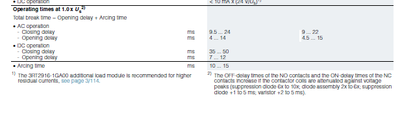
As example, following is from Siemens 3RT contactor catalog, the time to close contacts after applying AC to coil.....

There is a large spead of times, 9 to 22 ms (partly because voltage of sine wave at instant of connection can be zero to peak) - your contactor would be selected on its minimum time.

The AC voltage into diodes will reach whatever voltage the source sine waves have at the instant the main contactor closes - it will then follow the sine curves. The ideal output of a 3 phase bridge fluctuates at 360 (300?, 6 x mains frequency) Hz from peak sine voltage to peak x 0.92. The voltage on the capacitors will rise as they charge - limited by the 10 ohm resistor - approximately 85% peak in 10 ms, 98% in 20 ms. By design, the capacitor voltage, when 10 ohm is shorted, should not cause excessive diode surge current - this will depend on...

Source supply impedance - unknown - suppose zero.

Capacitor internal resistance ESR - about 0.75 ohm for 3 x 470 mmF 400V in series*.

Difference between supply voltage and capacitor voltage = D.

* suggests that for 90 amp (peak) surge, D = 67 volts, note at 85% peak volts on capacitor D = 140V.

If you confirmed the load resistance, supply frequency and gave the C1 contactor, capacitor and diode make, rating and type code, one could go further. Length, cross section, material (copper?) of AC cable feeding this box would help.

67model

Register to Reply
Guru

Join Date: Apr 2010
Location: About 4000 miles from the center of the earth (+/-100 mi)
Posts: 9910
Good Answers: 1141
#7

Re: Surge Suppression Circuit

05/01/2018 2:33 PM

What I see here is a 3 phase, full wave bridge rectifier which charges capacitors on the DC side with a voltage equal to the peak-to-peak voltage of the AC. After they have charged, there should be no more current drawn through the diodes until a spike occurs.

When a voltage spike comes along, the appropriate diode will be forward biased and its energy will hopefully be absorbed by the capacitors and resistors.

If your diodes burned out, I would suspect that a capacitor (or capacitors) shorted out and the overcurrent killed the diodes. (A failed capacitor may seem good until it has the circuit voltage impressed across it.)

Register to Reply Score 1 for Good Answer
2
Guru
United States - Member - New Member Engineering Fields - Power Engineering - New Member

Join Date: Sep 2006
Location: California, USA, where the Godless live next door to God.
Posts: 4665
Good Answers: 804
#9

Re: Surge Suppression Circuit

05/01/2018 6:55 PM

This thing looks like one of those phony-baloney "power corrector" or "energy saver" units sold on the internet that is supposed to have a "patented electronic circuit" that will "save 40% energy" blah, blah, blah by "cleaning up your power and making everything run more efficiently". Or in one particularly egregious case, they said that their device "changed the spin of the electrons so that they flowed easier in the conductors" (no lie, I actually read that in one!). It's all a scam, it doesn't really do much of anything and in fact CONSUMES power.

My guess, based on the few of these I have dissected, is that the little current limiting resistor over heated and opened, so when the contacts close 20ms later, there is no current limiting effect any more and the capacitor charging current fries the diodes. Why did that CL resistor fry? Most likely power line (grid switching) transients that cause that contactor to chatter in and out.

__________________
** All I every really wanted to be, was... A LUMBERJACK!.**
Register to Reply Good Answer (Score 2)
Guru

Join Date: Aug 2007
Location: Earth - I think.
Posts: 2143
Good Answers: 165
#13
In reply to #9

Re: Surge Suppression Circuit

05/02/2018 10:28 AM

they said that their device "changed the spin of the electrons so that they flowed easier in the conductors"

__________________
TANSTAAFL (If you don't know what that means, Google it - yourself)
Register to Reply Off Topic (Score 5)
Guru

Join Date: Dec 2010
Posts: 1686
Good Answers: 116
#14
In reply to #9

Re: Surge Suppression Circuit

05/02/2018 6:02 PM

JRaef,

I give you a good answer mark. I expect the OP would at least check resistor OK with ohm-meter.

If I was designing this unit, that 10 ohm resistor would be the biggest problem. The specified item hits 20x rated current.

Bare resistance wire on a porcelain rod, old firebar style would work - expect rate of temperature rise & expansion will crack-up anything encapsulated quickly.

Register to Reply
Register to Reply 14 comments

Good Answers:

These comments received enough positive votes to make them "good answers".

"Almost" Good Answers:

Check out these comments that don't yet have enough votes to be "official" good answers and, if you agree with them, vote them!
Copy to Clipboard

Users who posted comments:

67model (4); JRaef (1); Kilowatt0 (1); minggrabber (1); PWSlack (1); RAMConsult (1); redfred (1); Rixter (1); user-deleted-1105 (3)

Previous in Forum: Shielded Cable And Why?   Next in Forum: Troubleshoot On Central Air Conditioning

Advertisement