Previous in Forum: Pens for Engineers   Next in Forum: How Can Over-pressure of a Gas Main Cause a Fire/Explosion in a House?
Close
Close
Close
18 comments
Rate Comments: Nested
Guru
Hobbies - HAM Radio - New Member Hobbies - Model Rocketry - New Member

Join Date: Jan 2007
Posts: 787
Good Answers: 52

Step Up and Step Down

09/14/2018 12:14 PM

I have mentioned this in previous posts but I am one of those people that goes a bit crazy with holiday lights. I do the whole computer controlled setup utilizing LED lights that are individually addressable. (This post got a little long, if you would like to skip some reading jump down to “the challenge” part)

The why

The controllers to run these lights vary in price and I have a number of them as I have added more lights. I recently moved to a new house that has a much bigger yard (I didn’t have a yard before). Bigger space means both that I will spread the lights out more and possibly add more over time. I have two varieties of lights, some run on 12 volts and some run on 5 volts, the control signals are the same. The controllers I have used thus far connect to the computer by wired Ethernet and then connect to the lights. There is a limited distance that the signals from the controller to the lights can run before they begin to fail. I have some controllers that can run around 2,000 lights and some that can run around 10,000 lights. So far I have been placing the controllers as central as possible and keeping the runs as short as possible, this will be difficult with the new space. 10 to 15 feet works fine after that it gets dicey, It is possible to extend the distance but not easy.

The solution

A few years ago a diy wireless type of controller entered the market. This controller is based on the ESP8266 module and uses the inexpensive esp-01 version. This method is mostly due to the programming skills of one person. This module runs on 3.3 volts although the lights require a 5 volt data signal so it is necessary to shift the logic levels. Because of this shift, it requires power with both voltages. Since the lights run on either 12 or 5 volts so your power supply will be one or the other. The solution for a while was simply to have a 5v and 3.3v regulator and a jumper to switch out the 5v one. Last year the creator of the controller introduced a board with a buck boost converter that doesn’t require jumpers.

The problem

The boards being sold that work at either voltage without jumpers are $20 and since I need about 50 boards to control all my lights and I like to solder I am seeking a less expensive diy approach. That board utilized a TPS62175 buck boost converter although that is capable of passing the 5 volts through. Most step down and step up converters will not work when the input and output voltage are the same. The TPS62175 chip is a surface mount chip that requires an oven for soldering, also it costs about $1.50 when purchased in small quantities. The coils and capacitors necessary to make it run add more cost. I wanted a more diy approach ideally something that is through hole and with minimum cost but would do the same thing.

The challenge

Keeping costs as low as possible make a power supply that will work from a 5 volt or 12 volt input and output both 5v and 3.3v no matter what the input is. My first approach was to purchase various step down converter modules to see if any would work taking in 5 volts and putting out 5 volts, none of the ones in an affordable price range did. I did have a thought about utilizing the 5v regulator setup and creating a comparator circuit to automatically short it out when the input is 5v, although I didn’t explore that option.

The approach

My first approach was to use a cheap step down converter to go from 5 or 12 volts down to 3.3v and that seemed to work fine. I then used a step up converter to go from 3.3v to 5v and that worked. I connected the esp-01 module and logic level shifter and it did indeed control the lights just fine. The one issue I discovered with this setup is that depending on the wiring when the lights drew the max current it was possible for the voltage to dip. If this dip went down to about 4.75 volts the 3.3v step down stopped working. My second approach reversed the setup so I stepped up the input to 15v (just needs to be something above 12) and then I stepped that down to 5v and used a 3.3v regulator. This setup also worked and proved much more voltage tolerant.

The cost

I used a step down converter commonly referred to as a mini360 and a step up converter called an MT3608. In quantities of 10 the step down was about 32cents each and the step up was about 41cents. The ams1117 3.3v regulator was about 3cents, for a total cost of 76 cents for the power conversion circuit. I suspect the power quality isn’t great (I didn’t put it on a scope) but it worked fine without any filtering caps although I may add some.

The question

I don’t love the idea of chaining a step up and step down converter to do what one part can do, it just isn’t an elegant solution. What do you think is this a bad design? Do you have a better solution that would be at, or lower in cost but achieve the same results?

For reference

These are links to some designs I discussed and you can find schematics on the pages.

http://forkineye.com/wp-content/uploads/2016/09/ESPixelStick-V2-Assembly-and-Usage.pdf

https://www.doityourselfchristmas.com/wiki/index.php?title=ESPixel_Stick_%26_ESPixel_Pops

Register to Reply
Interested in this topic? By joining CR4 you can "subscribe" to
this discussion and receive notification when new comments are added.
Guru

Join Date: Apr 2010
Location: About 4000 miles from the center of the earth (+/-100 mi)
Posts: 9910
Good Answers: 1141
#1

Re: Step Up and Step Down

09/14/2018 1:44 PM

So, how about a 7 volt Zener diode in series with a 5 volt relay connected to the 12volt/5volt input. This relay would take the place of your jumper. The relay would only energize if 12 volts was present. Your 5 volt output would either be powered from a 5 volt regulator connected to 12 volts or directly from the input through the relay contacts.

Register to Reply
Guru
Hobbies - HAM Radio - New Member Hobbies - Model Rocketry - New Member

Join Date: Jan 2007
Posts: 787
Good Answers: 52
#2
In reply to #1

Re: Step Up and Step Down

09/14/2018 2:22 PM

It should work although I would be a little concerned if it would be possible to get a 12v spike go through before the relay energized. Also not sure how the cost of a relay and zener would compare to the converters.

Register to Reply
Guru

Join Date: Apr 2010
Location: About 4000 miles from the center of the earth (+/-100 mi)
Posts: 9910
Good Answers: 1141
#7
In reply to #2

Re: Step Up and Step Down

09/15/2018 10:34 PM

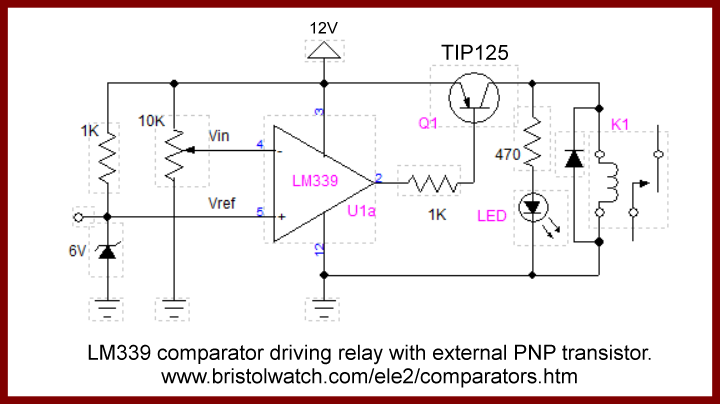
OK, here's a different idea, involving a relay. The default (unenergized) contact connects the 5 volt output to a 5 volt regulator IC fed from the 5v/12v input, and the energized contact connects the output to the 12/5 volt input directly. This way you don't have to worry about a spike.

Now you need a voltage sensing circuit to energize the relay if the input is 5 volts and not if it is 12 volts, a comparator circuit that compares a portion of the input voltage with a reference voltage (Zener diode). The voltage divider is adjusted so that if Vin is greater than the Zener voltage Vref the relay remains non-energized. If the Zener voltage is greater, the relay energizes, connecting the output to the 12v/5v input. Here is the basic circuit you can start with...

The Zener, of course, needs to be a lower voltage than 5 volts. Any comparator can probably be used.

I hope this helps.

Register to Reply
Guru
Hobbies - HAM Radio - New Member Hobbies - Model Rocketry - New Member

Join Date: Jan 2007
Posts: 787
Good Answers: 52
#12
In reply to #7

Re: Step Up and Step Down

09/17/2018 10:08 AM

That should work I am not sure it is anymore elegant than two dc-dc converters. I would have to look into the cost of doing it this way. Trying to keep the cost for the parts under $1 is difficult.

Register to Reply
Guru
Engineering Fields - Electrical Engineering - Been there, done that. Engineering Fields - Control Engineering - New Member

Join Date: Dec 2008
Location: Long Island NY
Posts: 15600
Good Answers: 981
#3

Re: Step Up and Step Down

09/14/2018 3:40 PM

A buck-boost converter will solve this handily as you stated but this would not be a cost-effective solution. Buck-boost circuits still warrant enough theoretical knowledge that they still produce thesis papers. If I were to do this I would avoid your power distribution problem by distributing at least 18V and then efficiently dropping the voltage to what each load desires with a simpler buck converter.

__________________
"Don't disturb my circles." translation of Archimedes last words
Register to Reply
Guru
Hobbies - HAM Radio - New Member Hobbies - Model Rocketry - New Member

Join Date: Jan 2007
Posts: 787
Good Answers: 52
#4
In reply to #3

Re: Step Up and Step Down

09/14/2018 4:20 PM

I have over 10,000 led bulbs, at 5v each can draw up to 50mA at full brightness. It would take a lot of buck converters to step down and supply that kind of current if my supplies were 18v.

Register to Reply
Guru
Engineering Fields - Electrical Engineering - Been there, done that. Engineering Fields - Control Engineering - New Member

Join Date: Dec 2008
Location: Long Island NY
Posts: 15600
Good Answers: 981
#5
In reply to #4

Re: Step Up and Step Down

09/14/2018 9:34 PM

And how much copper wire will it take to distribute a single 5V supply to all lamps with no more than a 1V drop with 500 amperes of current?

__________________
"Don't disturb my circles." translation of Archimedes last words
Register to Reply
Guru
Hobbies - HAM Radio - New Member Hobbies - Model Rocketry - New Member

Join Date: Jan 2007
Posts: 787
Good Answers: 52
#6
In reply to #5

Re: Step Up and Step Down

09/14/2018 9:43 PM

I don't know I use multiple power supplies and multiple controllers so I don't have that issue.

Register to Reply
Guru

Join Date: Oct 2009
Posts: 1460
Good Answers: 30
#8
In reply to #6

Re: Step Up and Step Down

09/16/2018 8:42 AM

Redfred makes a valid point. It would be helpful to know the layout of all the lights, as my inclination would be run AC power as far as the multiple power supplies, all of which put out either 12V or 5V (not both), depending on which chain of LEDs they are attached to. Before each controller receiving a 12V supply is a converter to 5V and/or a separate converter to 3.3V. Likewise the 5V LED chains would be fed from a controller which may or may not need a 3.3V supply.

Register to Reply
Guru
Engineering Fields - Electrical Engineering - Been there, done that. Engineering Fields - Control Engineering - New Member

Join Date: Dec 2008
Location: Long Island NY
Posts: 15600
Good Answers: 981
#9
In reply to #8

Re: Step Up and Step Down

09/16/2018 10:29 AM

AC power distribution brings electrical safety concerns with it. GFCI will mitigate this.

__________________
"Don't disturb my circles." translation of Archimedes last words
Register to Reply
Guru

Join Date: Oct 2009
Posts: 1460
Good Answers: 30
#11
In reply to #9

Re: Step Up and Step Down

09/16/2018 3:53 PM

True. It is possible (though we do not know) that the power supplies are under cover and that only the low-voltage lines are out in the wild.

Register to Reply
Guru
Hobbies - HAM Radio - New Member Hobbies - Model Rocketry - New Member

Join Date: Jan 2007
Posts: 787
Good Answers: 52
#13
In reply to #11

Re: Step Up and Step Down

09/17/2018 10:38 AM

In the past before I moved to a new house, I used just 3 power supplies to run everything. The power supplies were inside the house and I used short runs of low voltage cable to run out the window to the displays that were near on the side of the house. One 300amp 5v supply to run the largest display (about 5000 bulbs). A 5v 150amp for the ball display (1800 bulbs). A 12v 62amp server power supply for the trees and some other lights (about 4000 bulbs) this stuff had the longest runs but was fine. I did it this way because I had these power supplies sitting around and the runs were short. Even with runs of 10 feet or less I did run into some issues of minor voltage drops but it was manageable. The controllers I was using also needed runs no more than 10 feet so I did my best to keep all my wires short.

Now that I have a larger yard using 3 power supplies and short low voltage runs is not possible. Instead I plan to use around 20 power supplies with low voltage runs just a foot or two. The controllers will all be wireless in water proof containers and connected directly to the lights. The power supplies will be in water proof enclosures mounted on poles or hung off trees. I will use outdoor rated extension cords (gfci protected) for now since time is short. In the future I plan to bury cable and install outlets in the yard at various points. I don't know the details past that since I am still working on planning it out and getting the equipment ready.

Register to Reply
Guru

Join Date: Oct 2009
Posts: 1460
Good Answers: 30
#15
In reply to #13

Re: Step Up and Step Down

09/17/2018 12:09 PM

Have you thought of raiding a computer junkyard for the power supplies?

Register to Reply
Guru
Hobbies - HAM Radio - New Member Hobbies - Model Rocketry - New Member

Join Date: Jan 2007
Posts: 787
Good Answers: 52
#16
In reply to #15

Re: Step Up and Step Down

09/17/2018 12:46 PM

I already purchased the power supplies I am going to use. I have used computer power supplies in the past and they work well. The 12v server supplies mentioned in a comment are great although the fans are very noisy but can be adjusted down, I have at least 10 of them. ATX style computer supplies are good for 5v and I am sure I have more than 10 of those also. I probably do have enough of both of these supplies to run everything if I opted to use them.

I purchased a number of power supplies that are 5v and 12v but all have the same physical shape that will fit in a popular weather proof enclosure. They were inexpensive enough and will make setting them up outdoors easier. I can always use the computer supplies as a backup.

Register to Reply
Guru

Join Date: Jul 2017
Posts: 520
Good Answers: 14
#17
In reply to #16

Re: Step Up and Step Down. Squirrel Cage Fans

09/17/2018 5:19 PM

Squirrel Cage Fans

You sound like a capable kind of guy. I have had very good luck adapting quiet squirrel cage HVAC surplus fans to provide adequate air flow at low noise levels to server class power supplies. In some cases the server fans adjust their own speeds to be adequate for the temperatures sensed. In those cases you may only have to supply the HVAC style high volume of moving air and the noise of the server fans never starts due to the lower temperatures detected. In other cases, I removed propeller style fans(some of these were even noisy when freewheeling) and had to install some passive components to fool the inoperative fan sensing mechanism.

I was using the whole server in one situation and tested without removing fans. All of the fans adjusted under software control so I did not have to remove fans nor did I have to move that server out of the house(which would have made the utility room noisy.) I did install some fan control software into Linux on that particular server and it did still rev up briefly while booting until the daemon for that software automatically assumed control. Since that server was seldom powered down, it worked out well. YMMV

______________

thewildotter

Register to Reply
Guru
Hobbies - HAM Radio - New Member Hobbies - Model Rocketry - New Member

Join Date: Jan 2007
Posts: 787
Good Answers: 52
#18
In reply to #17

Re: Step Up and Step Down. Squirrel Cage Fans

09/18/2018 10:36 AM

The server supplies I have the fan would probably regulate by software if they were connected to a server.

Out of a server you need to short some pins to get them to turn on and they default to full fan which sounds like a jet engine. Shorting some other pins you can get the fan to slow down and if you want adjust the speed with a resistor. I have seen mods were a thermal sensor is used to self regulate the fan, and I purchased the parts for that but never did it.

At the amperage my lights draw with the fan at its lowest speed, the supplies don't have any detectable warmth. The server supplies are not a convenient size for a weather proof enclosure so I don't plan to use them this year.

The new power supplies I got the fan seems to self regulate based on current draw. The supplies will all be outside in mostly below freezing temperatures so I am not that worried about heat either way.

Register to Reply
Guru

Join Date: Jul 2017
Posts: 520
Good Answers: 14
#10
In reply to #6

Re: Step Up and Step Down. Scaling has its Limits

09/16/2018 11:08 AM

Paradigm Shift(for Dinosaurs and for High Power Electronics Scaling has its Limits)

Seems to me that your currents at 5v and 12v are beyond long runs of wire and simple DIY circuit solutions. I suspect that you already have a need for mains power out into the weather. I have, in the past solved somewhat similar myself with multiple plastic igloo dog houses with plastic floors raised above the ground on concrete block, with open doors, and with a rain resistant top vent for weather resistance. I placed my power supplies up on another layer of fireproof block inside the doghouse and tested to insure adequate ventilation to exhaust generated heat. I have placed, at various times, car chargers, server class power supplies, and welders in my shelters. I ran outdoor rated extension cords long enough to place all "outdoor" connections within the doghouse and cable tied to the top of a cinder block.

Once you have such a setup, you can take advantage of commercial designs for supplying regulated power of several voltages from a power supply designed for the currents to be supplied from any one pet shelter at the lower, safer voltages like 12 and 5 on short runs of thick copper to uses near the shelter. In my case, I saved huge amounts of money since I was able to use server class power supplies with lots of current at 12v and 5v and some even had 3.3v. These can be had used from Goodwill Computerworks, local auctions, ebay, or other used sources at a tiny fraction of their original cost. In my case, I drove grounding rods into the soil and grounded the metal case of the server class power supply using the green screw on that box to a thick wire clamped to my grounding rod. Back at the human house I used a pigtail GFI to supply the power cord. The power supplies may get hot so you need to space them up off of the plastic floor and do some testing to see how hot. I used some insulated automotive spade connectors and thick wires to supply my high current/low voltage beyond the pet shelters.

My uses were all constantly attended and only ran a few days so you may want something more permanent and fireproof than plastic pet shelters. You may well find that your total power consumption is considerably lower than your previous setup since commercial power units are often designed to minimize power use in server farms where it adds up to a lot of money. Consult the info plate on the power supply units to determine the amount of current at each voltage any one box can supply. You may need to look up how to short together certain pins on their connectors to get the PSU to turn on since many of them do not until you plug in a motherboard. Most PSU's have an integral power switch but if not, you might wire a switch into the motherboard detector loop for an easy way to switch the box on and off without handling the extension cord connector. I mounted a weatherproof emergency off mushroom on phenolic at the top of the hardware cloth covering the door of the igloo for my setup since I did not want pets getting in and wanted easy, lighted, and obvious access to drop power.

There are many, interacting safety issues in your overall operation. Using commercial equipment will not eliminate all of them but it might help. You are on your own to address them effectively. My experiences were all without incident but your setup safety is something you decided to own when you scaled up to the extent you did. I in no way suggest that my techniques "cover" any of the safety issues you have. Long runs of wire carrying a lot of current are fire hazards, long runs of wire of any size outdoors are lightening hazards, house power running around your yard without grounded conduit installed by a licensed electrician is hazardous, etc., etc., etc. You may find that your insurance will not cover disasters stemming from such an extreme installation. Using LED lights instead of incandescent helps but at these counts you get back into the problems presented by large currents melting insulation on wires and such if you do not have adequate background to choose your materials, supplies, and equipment wisely and install it with adequate care according to local laws and regulations.

______________

thewildotter

Register to Reply
Guru

Join Date: May 2016
Posts: 1746
Good Answers: 87
#14

Re: Step Up and Step Down

09/17/2018 11:32 AM

I tend to default to old school and get a single transformer with 3.3, 5 and 12 volt taps and regulate those as necessary. It's perhaps a bit wasteful, but it is simple, reliable and relatively cheap for what you get.

Register to Reply
Register to Reply 18 comments
Copy to Clipboard

Users who posted comments:

frankd20 (7); Jpfalt (1); phph001 (3); redfred (3); Rixter (2); thewildotter (2)

Previous in Forum: Pens for Engineers   Next in Forum: How Can Over-pressure of a Gas Main Cause a Fire/Explosion in a House?

Advertisement