Previous in Forum: Reactive Flash   Next in Forum: Cleaning of Cooling Pads of Evaporative Air Coolers
Close
Close
Close
4 comments
Rate Comments: Nested
Member

Join Date: Oct 2018
Posts: 6

Degrees of Freedom in a Chemical Process

10/12/2018 4:41 AM

Hello everyone

I am currently doing an exercise of a process to make styrene from ethylbenzene and benzene. First task is to analyze the degrees of freedom to see if they are saturated. And then saturate the degrees of freedom for both distillate columns. The flowsheet is the following:
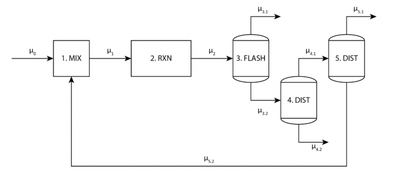
Two reactions take place in the reactor (second unit):

- C8H10 -> C8H8 + H2

- C6H6 + 3 H2 -> C6H12

They occur in gas-phase at 1.3 bar. Both reaction conversion (XA and XB) are known. The feed is only ethylbenzene and benzene (5:1 molar ratio).

We remove H2 as soon as possible as it is dangerous. Both distillations columns contain a partial reboiler and total condenser. Styrene is removed by the first column at low pressure and low temperature. The second distillation column is working at atmospheric pressure.

What I've done for the degrees of freedom (in order of the flowsheet):

- Mixer : d = 4 . Saturate with both inlet streams (u0 and u5.2) as well as PMix and TMix.

- RXN : d = 3 . Saturate with inlet stream (u1 ) as well as PRxn and TRxn.

- Flash : d = 3 . Saturate with inlet stream (u2 ) as well as TFlash and the recovery of one key component (eg: we suppose that this is Hydrogen and recovery of 1% (to be realistic) since we want to take it off).

- Dist 1 : d = (P+Q) +5 (from my notes...). Saturate with inlet stream (u3.2 ) as well as Pdist1 , receovery of light key component and also the one of the heavy key component. The two remaining we can fix reflux ratio to infinite at the top and the bottom if we assume Fenske conditions. (Q denotes thermal behaviour that we fix at 0 except from reboiler and condenser because of adiabatic conditions).

- Dist 2 : Same as Dist 1 except inlet stream and pressure are different.

I was first wondering if all of this was correct. Moreover, I will need to guess some parameters before doing my shortcut model I suppose. How could I guess the temperature of the Flash if I don't know the temperature of the reaction? I suppose it will be around the cooling water temperature (so maybe 37°C ??). I guess the choice needs to be done according to hydrogen to avoid any explosion.

Register to Reply
Interested in this topic? By joining CR4 you can "subscribe" to
this discussion and receive notification when new comments are added.
Guru
United Kingdom - Member - Indeterminate Engineering Fields - Control Engineering - New Member

Join Date: Jan 2007
Location: In the bothy, 7 chains down the line from Dodman's Lane level crossing, in the nation formerly known as Great Britain. Kettle's on.
Posts: 32175
Good Answers: 839
#1

Re: Degrees of Freedom in a Chemical Process

10/12/2018 4:53 AM

<...hydrogen...avoid any explosion...>

The only reason any explosion would take place anywhere is in the event of fuel, oxygen and a source of ignition were present simultaneously and the pressure of the combustion products were to exceed the maximum sustainable pressure rating of the item within which the explosion took place.

Within the process-containing equipment, two of these are absent.

Hydrogen tends to escape through the smallest of seals and will travel through some solids, so getting rid of it in a controlled and environmentally responsible manner is the subject of further process design. A characteristic of it is that its molecular velocity at ambient temperatures exceeds the escape velocity of this planet, so it tends to go straight up. This characteristic explains why there is so little of it in this planet's atmosphere.

__________________
"Did you get my e-mail?" - "The biggest problem in communication is the illusion that it has taken place" - George Bernard Shaw, 1856
Register to Reply
Member

Join Date: Oct 2018
Posts: 6
#2
In reply to #1

Re: Degrees of Freedom in a Chemical Process

10/12/2018 5:23 AM

Well, that's the problem from the textbook but I get your point. They add that it's taken out to burn it It's not really the topic.

Register to Reply Off Topic (Score 5)
Guru
United Kingdom - Member - Indeterminate Engineering Fields - Control Engineering - New Member

Join Date: Jan 2007
Location: In the bothy, 7 chains down the line from Dodman's Lane level crossing, in the nation formerly known as Great Britain. Kettle's on.
Posts: 32175
Good Answers: 839
#3

Re: Degrees of Freedom in a Chemical Process

10/12/2018 5:44 AM

<...the cooling water temperature...> will be no lower than the wet-bulb temperature of the air passing through the cooling tower, unless a fridge unit is in place to produce chilled water.

__________________
"Did you get my e-mail?" - "The biggest problem in communication is the illusion that it has taken place" - George Bernard Shaw, 1856
Register to Reply
Member

Join Date: Oct 2018
Posts: 6
#4
In reply to #3

Re: Degrees of Freedom in a Chemical Process

10/12/2018 9:20 AM

Thanks. I see what you mean but how can I find this wet-bulb temperature ? I have seen the Wikipedia page but this exercise (from a book) doesn't provide Cp values. So, I need to find a reasonable temperature of the flash by thinking of the composition. From the conservions I got for both reactions (50% for the first and 95% for the second), I can imagine we mostly have styrene and hydrogen, styrene and a bit of cyclohexane. Since hydrogen has a very low boiling point (it's a gas...), we don't need to reach high-T. So, even room temperature would work... Or is it too high and need to take a lower value?

Register to Reply
Register to Reply 4 comments

Previous in Forum: Reactive Flash   Next in Forum: Cleaning of Cooling Pads of Evaporative Air Coolers

Advertisement