Previous in Forum: Transformer Sizing   Next in Forum: Problems with Old Circuit Breakers
Close
Close
Close
14 comments
Rate Comments: Nested
Member

Join Date: Oct 2018
Posts: 5

Switching DC Earth Fault

10/30/2018 8:58 AM

I work at a power utility where 220 VDC is used for relays and other protection schemes. I worked on a positive DC earth fault and found it to be on 11KV switchgear discrepancy switch, as I removed the supply from breaker to discrepancy switch positive earth fault indication went away and negative earth fault appeared. On checking, the voltage from negative to ground was found to be 0V and from positive to ground it was 220 VDC. But on connecting 1 amp lamp from positive to ground it does not glow. Can any one please guide me how to cater with this negative earth fault? If it is false indication then what can be done further?

Register to Reply
Pathfinder Tags: DC earth fault
Interested in this topic? By joining CR4 you can "subscribe" to
this discussion and receive notification when new comments are added.

Good Answers:

These comments received enough positive votes to make them "good answers".

"Almost" Good Answers:

Check out these comments that don't yet have enough votes to be "official" good answers and, if you agree with them, vote them!
Guru
United Kingdom - Member - Not a New Member Hobbies - Musician - New Member Hobbies - Fishing - New Member

Join Date: May 2006
Location: Reading, Berkshire, UK. Going under cover.
Posts: 9684
Good Answers: 468
#1

Re: Switching DC Earth Fault

10/30/2018 11:15 AM

What instrument did you use to measure the 220Vdc from pos. to gnd? I high-impedance DVM could be picking up anything. Try measuring again with the lamp connected.

__________________
"Love justice, you who rule the world" - Dante Alighieri
Register to Reply Score 1 for Good Answer
Member

Join Date: Oct 2018
Posts: 5
#2

Re: Switching DC Earth Fault

10/31/2018 12:04 AM

I don't understand what is meant by high impedance DVM,As I know all voltmeters have high impedance. I used Fluke DVM to measure voltages. Additionally, when I connect bulb across positive and ground, the indication of negative Earth fault changes to positive earth fault.

Register to Reply
3
Guru
United Kingdom - Member - Not a New Member Hobbies - Musician - New Member Hobbies - Fishing - New Member

Join Date: May 2006
Location: Reading, Berkshire, UK. Going under cover.
Posts: 9684
Good Answers: 468
#4
In reply to #2

Re: Switching DC Earth Fault

10/31/2018 6:03 AM

Modern digital voltmeters have impedances typically greater than 1 megaOhm, which means that they present virtually no load when measuring. This means that they can measure induced voltages on otherwise isolated wires. "Old-fashioned" analog meters have impedances more like 10kΩ or less, which is low enough to drain away induced charge, and give a reading of the "real" voltage.

Some DVMs (e.g. Fluke 114, 116 and 117, but others are available) have the ability to switch between high and low input impedance when measuring voltages.

__________________
"Love justice, you who rule the world" - Dante Alighieri
Register to Reply Good Answer (Score 3)
Guru
Technical Fields - Technical Writing - New Member Engineering Fields - Piping Design Engineering - New Member

Join Date: May 2009
Location: Richland, WA, USA
Posts: 21017
Good Answers: 795
#5
In reply to #4

Re: Switching DC Earth Fault

10/31/2018 7:13 AM

All hail the Simpson 260!

The last place I worked had some forklifts requiting a 260 in the service kit.

__________________
In vino veritas; in cervisia carmen; in aqua E. coli.
Register to Reply Score 1 for Good Answer
Guru

Join Date: Mar 2011
Location: Sebastopol, California
Posts: 1205
Good Answers: 54
#6
In reply to #5

Re: Switching DC Earth Fault

10/31/2018 10:14 AM

I have 2. One for parts one for service. Awesome tool. Sometimes old school is what you need. That needle can bounce and move in ways that a digital readout can't and that can speak volumes about what you are measuring. You can see ripple and rise and fall. Can't see that with a digital readout unless it is also a DSO.

__________________
Most people are mostly good most of the time.
Register to Reply
Member

Join Date: Oct 2018
Posts: 5
#8
In reply to #4

Re: Switching DC Earth Fault

10/31/2018 11:20 AM

I don't exactly know the model number of meter, but it is a digital voltmeter.

Now I will measure voltage across lamp connected from positive to ground. What if voltage is 110 VDC? Does it mean a false indication?

Thank you so much

Register to Reply
Guru

Join Date: Apr 2010
Location: About 4000 miles from the center of the earth (+/-100 mi)
Posts: 9910
Good Answers: 1141
#9
In reply to #8

Re: Switching DC Earth Fault

11/01/2018 2:17 PM

Now I will measure voltage across lamp connected from positive to ground. What if voltage is 110 VDC? Does it mean a false indication?

Maybe it means the lamp is burned out.

Register to Reply
2
Power-User

Join Date: Jan 2010
Location: Hyderabad
Posts: 343
Good Answers: 22
#3

Re: Switching DC Earth Fault

10/31/2018 12:28 AM

I suppose the 220V DC system is unearthed/isolated/high resistance earthed system.

Tracing DC earth faults is not a simple affair. Please study the scheme clearly and you will get an idea as to what is going on. From your description, it seems the center point of 220V DC source is earthed through high resistance.

Also, check the earth fault detection relay circuit as well. Some times, it may not be as you envisage.

If in doubt, don't hesitate to ask for services of an experienced engineer as DC system is critical for the safety and integrity of the plant and hence should be taken seriously.

__________________
Raghunath
Register to Reply Good Answer (Score 2)
Member

Join Date: Oct 2018
Posts: 5
#7
In reply to #3

Re: Switching DC Earth Fault

10/31/2018 11:15 AM

The DC system here is comprising of a DC charger connected with a three phase supply which further charges the battery bank (serially connected 184 battery cells of 1.4 V DC each) for back up supply and provides direct supply to DC distribution panel as well. All breakers of DC Distribution panel were first checked if there occurs current increment on any (when lamp is connected negative to ground). One breaker was found to have current increment which was further investigated and a circuit causing the fault was isolated. Till it everything was easy to get and work on, but after removing that fault negative earth fault indication is appearing. This fault is unable to glow the lamp when connected positive to ground, how can I work on such a fault which can't glow lamp, how can I trace it?

Further a senior engineer is saying that a negative earth fault is not that important to work on, is this the case? I am unable to satisfy myself.

Register to Reply
Guru

Join Date: Apr 2010
Location: About 4000 miles from the center of the earth (+/-100 mi)
Posts: 9910
Good Answers: 1141
#10
In reply to #7

Re: Switching DC Earth Fault

11/01/2018 5:57 PM

This fault is unable to glow the lamp when connected positive to ground, how can I work on such a fault which can't glow lamp, how can I trace it?

Apparently, there is a high resistance fault on the negative side and there is not enough current flowing to light the lamp. Still, connect the lamp positive to ground. Current will flow from positive, through the lamp into ground and back to the negative side through the fault. With a DC clamp-on ammeter find where on the negative side of the circuit the current is returning. Measure the current at different points in the circuit and check for difference in current flow with the DC clamp-on.

Register to Reply
Guru

Join Date: Dec 2010
Posts: 1686
Good Answers: 116
#12
In reply to #7

Re: Switching DC Earth Fault

11/05/2018 8:21 AM

Raghun is right, I give a "good answer vote".

It seems to me, you do not have a clear understanding of what is happening...

  1. You do not seem to have [or been able] looked at circuit or manual for earth fault relay.
  2. My guess is that this relay has two resistors to earth - one from battery +, one from -. Say they are 50000 ohms. The relay alarms for an unbalance due to a resistance to earth from one pole - say 50000 ohms.
  3. Consider a 10000 ohm relay, or programmable control input, which trips a generating set or breaker. If one end is wired to negative and the other connected to earth by a fault, then you have 220 volts across 50k on + and "50k parallel 10k" on -; that is about 220/[50k + 10k] = 3.7 mA through the relay.
  4. The low current in 4. is deliberately too low to operate relay and cause an unnecessary shutdown & trouble - but you have an alarm to warn of trouble if fault is not removed.
  5. If you, now, put a test lamp to earth from positive; it may have a low enough resistance (in parallel with 50k in earth fault relay) for the 10k relay to energise & trip plant. If another earth fault occurs on positive, you could get 220V across the 10k relay in service & sudden shutdown.
  6. It surprises me you have measured "current increments" on Dist. breakers - I would have operated each breaker off/on till I located the sub-circuit which cleared the earth fault alarm - the sub-circuit with the fault. If you connect a lamp to earth from a circuit you will get a current change through its breaker - you are just adding a known earth fault to a system with one earth fault already.
  7. You may not have identified the faulty sub-circuit, but another one with low enough proper load current for you to detect change due to you adding an earth fault.
  8. Are you trying to find an earth fault on a plant in service? That is difficult.
  9. You can easily have enough leakage on battery cells (due to leak or spitting of electrolyte over years) to operate an earth fault relay. These will behave as resistances across the "50k" ones in earth fault relay. They could balance or make worse a fault to earth in control circuits.
  10. Do you have a record of voltages + and - to earth in past?
  11. Has there been a gradual increase in unbalance or do you not know due to lack of records?

Once you have identified the sub-circuit with fault, you must disconnect parts of that circuit till you find the part with the fault. Something outdoors or out of sight is more likely than in a panel but all is supect. You need to look closely at the wiring diagram or circuit to see what is "down stream" & where you can isolate each part of the circuit to localise the fault.

Register to Reply
Power-User
Engineering Fields - Power Engineering - New Member

Join Date: Aug 2010
Posts: 111
Good Answers: 2
#13
In reply to #7

Re: Switching DC Earth Fault

11/08/2018 4:15 AM

is it possible to re-wire? high impedance negative earth fault may happened to be "in between" terminations..so you will have a peace of mind..certainly earth faults should not be neglected..it may cause your dc system to fail when it is necessarily needed.

__________________
take care of your seconds and the minute will take care of itself..
Register to Reply
Guru

Join Date: Dec 2010
Posts: 1686
Good Answers: 116
#14
In reply to #7

Re: Switching DC Earth Fault

11/09/2018 1:03 PM

I have, in my first post #12, explained how the earth fault alarm detector works.

You have not defined "test lamp". Even a 10 watt 220V lamp is 5000 ohm resistance. An incandescent lamp may have a cold resistance 1/10 of hot. That will certainly cause an earth fault when paralleled with 50000 ohm in E/F relay. All you then do with lamp is show the E/F relay works!!

Reduce the zone, in which the E/F fault could be, by opening sub-breakers, links or fuses as possible (assuming they are breaking + and - poles!!).

Even if plant is in service, there are probably circuits which can be switched off with only an alarm or loss of facility not required e.g. synchronising.

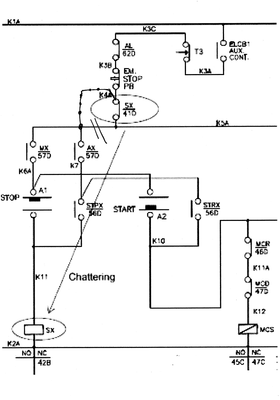
Consider the following circuit....

  1. The wire at the bottom, K2A, is negative supply - if there were an E/F there, it would be difficult to detect ; 4 mA could be 1% of load current, detecting such a difference in the currents between + & - supply would need high precision measurement. Of course, if voltage to earth were zero, it could be a direct short to the relatively few [compared to strings of contacts on positive side] wires/components connected direct to negative.
  2. If wire K11A on right were earthed, MX & AX contacts being open, then wires K10 & K6A would also be earthed - if contact open/close state is "as drawn". There would be a small, but measurable, voltage across coil MCS and voltage <K2A-Earth> would not be zero N.B. 4 mA x 50 ohms is 0.2V across MCS coil.
  3. With earth fault as 2, if K11A were linked to K1A by a test wire, then earth fault would move from negative pole to positive pole. Of course, this would energise coil MCS & one would have to ensure this did no harm or disconnect K12 from MCS first.
  4. In an in-service circuit, contacts may not be in "as drawn" state; however it should be possible to allow for this.
  5. Note that there are usually far fewer components connected direct to negative [and these have a significant resistance, like a coil], so a negative earth fault can be easier to localise, by measuring voltage across items like MCS - which should, no earth fault, have zero or supply voltage across them.

As mentioned by posts to your question, the old DC moving coil pointer voltmeter has advantages when there is supply ripple or AC voltage from floating charger, because they inherently have little response to AC.

The typical DVM measures over several cycles of power frequency & has a switch inside to select 50/60 Hz. If it measures part of a cycle with ripple, this causes a hidden error or a fluctuating reading. The period of measurement comes from the crystal in the DVM which is fine if the mains are 50Hz - however, it could be 49 Hz, so 5 cycles becomes 4.9 cycles - there is 0.1 cycle over, which is + or - and gives an error. If there are DC loads like inverters working at 50Hz, while mains is 49 Hz there may be a difference frequency (1 Hz) fluctuation of the "DC" supply. DVMs do several measurements/second and will give a different reading each time.

The coil MCS in my example could have a High AC impedance & so high AC voltage across it, higher than the full-scale of the DVM on a low DC range. It can be understood why posts are suggesting moving coil analog meters for this kind of fault tracing - 20000 ohms/volt was typical resistance e.g. 0.2 Megohm on 10V range. Remember that with moving coil meters, start with 250V DC range and switch down to read lower values, to avoid meter damage.

If you have pulsed or half wave DC, a DVM becomes useless while the old meter reads the mean value with a pointer "flicker" which gives a clue about what is happening.

67model

Register to Reply
Guru
United States - Member - New Member

Join Date: Mar 2010
Location: In the pool because it is too hot.
Posts: 3054
Good Answers: 141
#11

Re: Switching DC Earth Fault

11/03/2018 7:54 PM

Are your batteries clean and dry? Does one of the connections make a bridge to the ground?

Happened to me with isolated batteries on a grounded frame. One was dirty and sweating.

__________________
Plenty of room here
Register to Reply
Register to Reply 14 comments

Good Answers:

These comments received enough positive votes to make them "good answers".

"Almost" Good Answers:

Check out these comments that don't yet have enough votes to be "official" good answers and, if you agree with them, vote them!
Copy to Clipboard

Users who posted comments:

67model (2); Deefburger (1); dvmdsc (1); JohnDG (2); raghun (1); Ramsha (3); Rixter (2); rockraiden (1); Tornado (1)

Previous in Forum: Transformer Sizing   Next in Forum: Problems with Old Circuit Breakers

Advertisement