Previous in Forum: Is the Cure for Alzheimer's Just Around the Corner?   Next in Forum: Suitable Replacement for Ultrasonic Plastic Welding
Close
Close
Close
8 comments
Rate Comments: Nested
Guru

Join Date: Oct 2008
Posts: 42355
Good Answers: 1693

Who Cares? Real or Fake?

10/31/2018 11:57 PM
Register to Reply
Interested in this topic? By joining CR4 you can "subscribe" to
this discussion and receive notification when new comments are added.
Guru

Join Date: Mar 2007
Location: by the beach in Florida
Posts: 33392
Good Answers: 1817
#1

Re: Who Cares? Real or Fake?
11/01/2018 1:43 AM

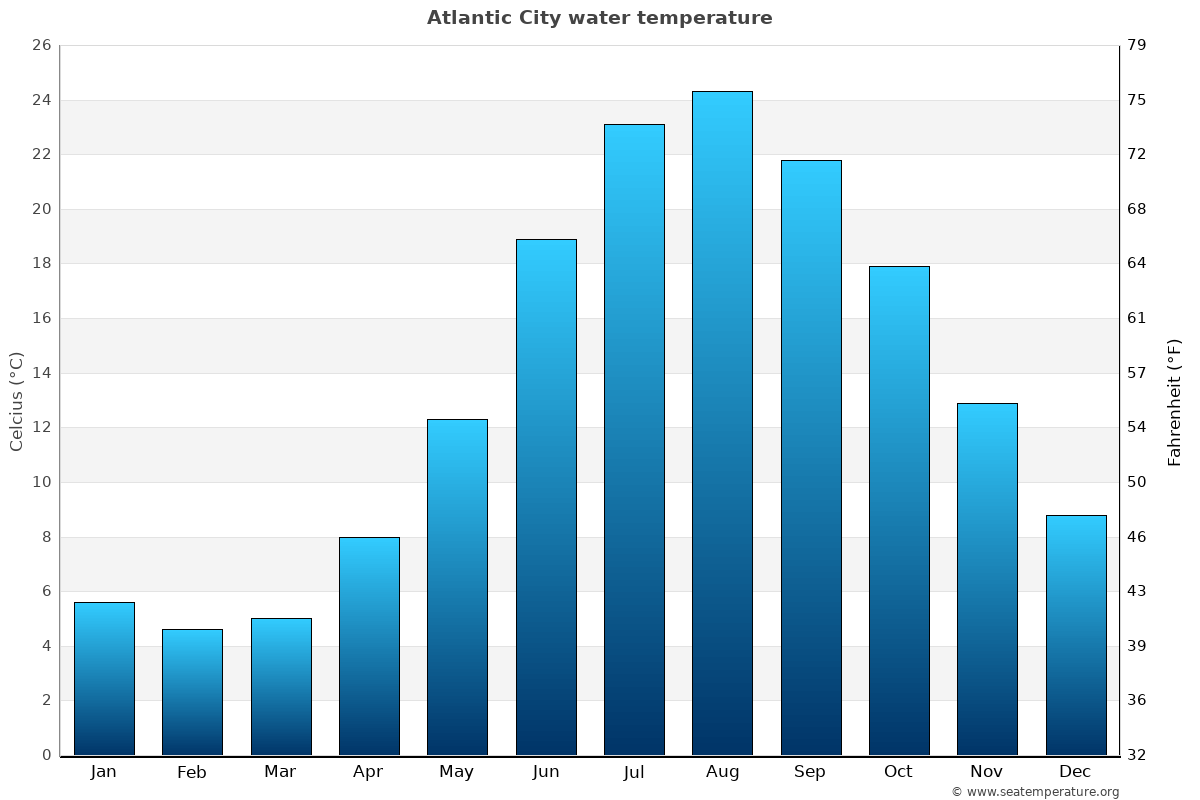
Checking average ocean temperatures against real time current temperatures, seems to disprove any extraordinary heating....

https://www.nodc.noaa.gov/dsdt/cwtg/all_meanT.html

https://www.nodc.noaa.gov/dsdt/cwtg/satl.html

__________________
All living things seek to control their own destiny....this is the purpose of life
Register to Reply Score 1 for Off Topic
Guru
Technical Fields - Technical Writing - New Member Engineering Fields - Piping Design Engineering - New Member

Join Date: May 2009
Location: Richland, WA, USA
Posts: 21017
Good Answers: 795
#2
In reply to #1

Re: Who Cares? Real or Fake?

11/01/2018 1:56 AM

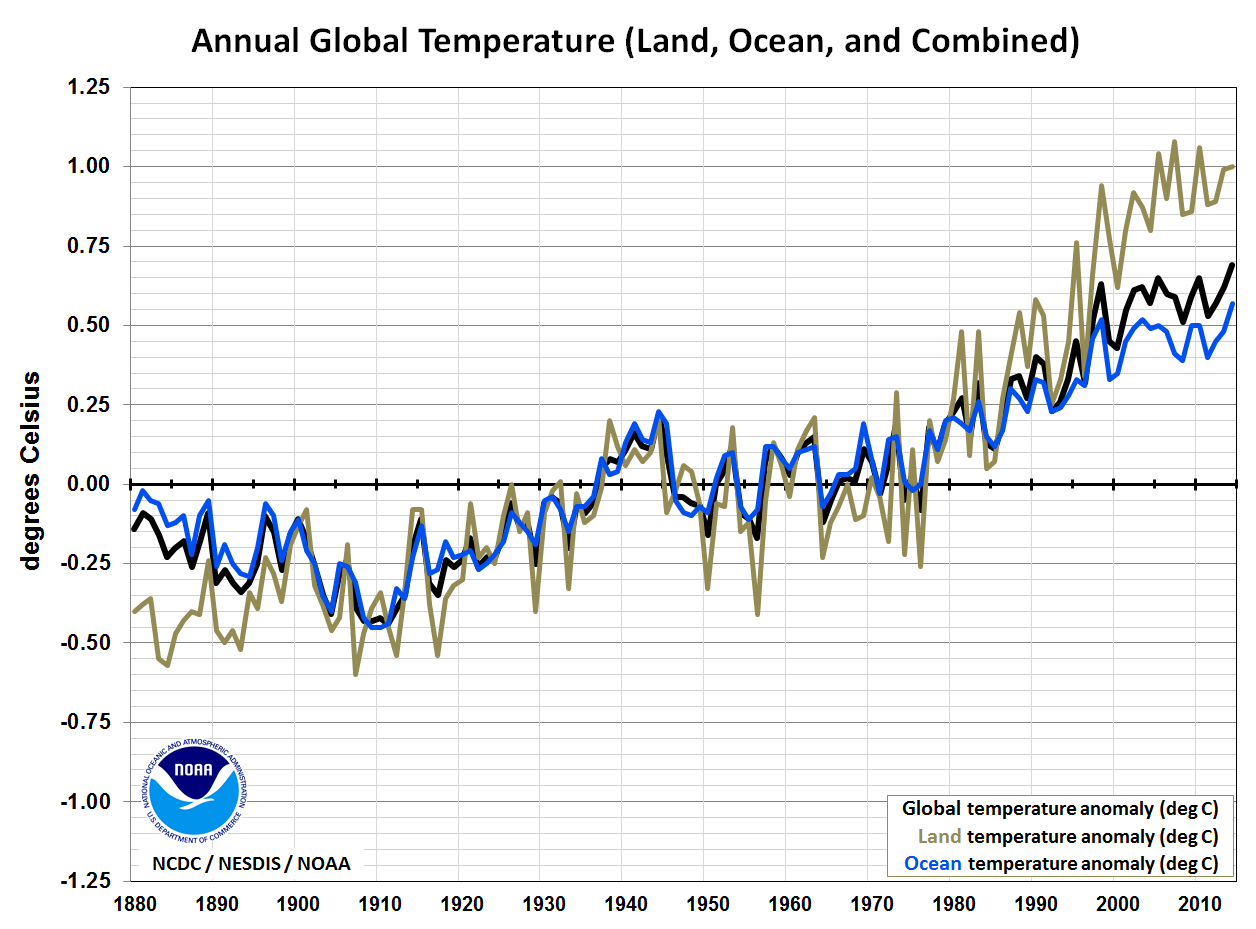
I don't see how your conclusion follows from the tables you gave, which did not include extended year-to-year (much less decade-to-decade or century-to century) comparisons.

__________________
In vino veritas; in cervisia carmen; in aqua E. coli.
Register to Reply
Guru

Join Date: Mar 2007
Location: by the beach in Florida
Posts: 33392
Good Answers: 1817
#3
In reply to #2

Re: Who Cares? Real or Fake?

11/01/2018 2:19 AM

The measurements are too short term to have any meaning....

__________________
All living things seek to control their own destiny....this is the purpose of life
Register to Reply Score 1 for Off Topic
Guru

Join Date: Mar 2007
Location: by the beach in Florida
Posts: 33392
Good Answers: 1817
#4
In reply to #2

Re: Who Cares? Real or Fake?

11/01/2018 2:26 AM

That's the whole point, the measurements are too short term to have any meaning....only good for data...no conclusions, no theory's, no proof of anything....

__________________
All living things seek to control their own destiny....this is the purpose of life
Register to Reply
Guru
Technical Fields - Technical Writing - New Member Engineering Fields - Piping Design Engineering - New Member

Join Date: May 2009
Location: Richland, WA, USA
Posts: 21017
Good Answers: 795
#5
In reply to #4

Re: Who Cares? Real or Fake?

11/01/2018 3:53 AM

Then why did you post them?

__________________
In vino veritas; in cervisia carmen; in aqua E. coli.
Register to Reply
Guru

Join Date: Oct 2008
Posts: 42355
Good Answers: 1693
#6
In reply to #5

Re: Who Cares? Real or Fake?

11/01/2018 10:04 AM

It makes him feel important and gives him something to do besides pulling wings off butterflies or yelling at the neighbor's kids.

Register to Reply Score 1 for Off Topic
Guru

Join Date: Apr 2008
Location: Chicago
Posts: 3990
Good Answers: 144
#7

Re: Who Cares? Real or Fake?

11/01/2018 10:06 AM

It's a guarantee that measurement of a variable will vary over time.

Warmer water = hotter fire because hotter fire = warmer water.

Blame the Neanderthals of the past and the present.

I care but as SE has pointed out the data points exactly where you want it to.

__________________
High Tolerance is Beautiful
Register to Reply
Guru

Join Date: Apr 2011
Posts: 8006
Good Answers: 286
#8

Re: Who Cares? Real or Fake?

11/05/2018 4:57 AM

Did you actually read the article you linked?

Here is an excerpt:

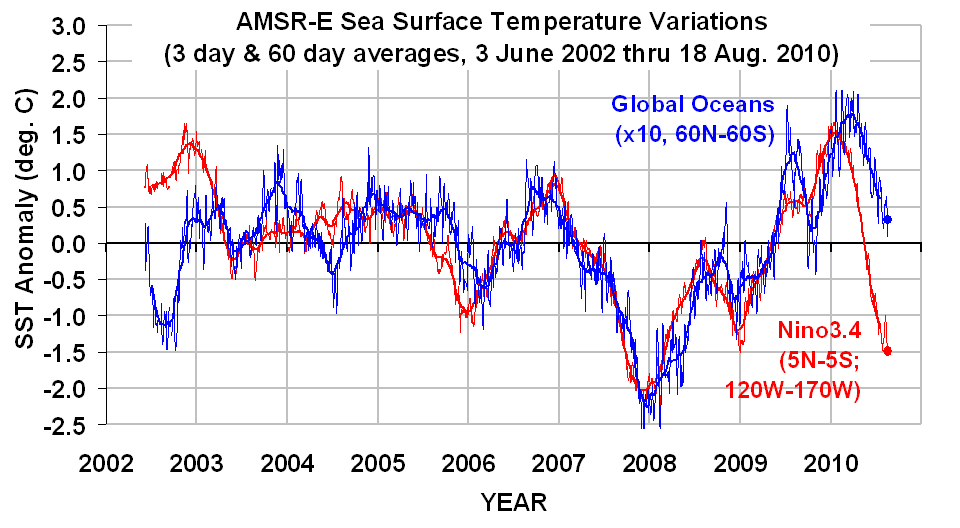
"... Sea surface temperatures across the globe increased by about 0.1 degrees Celsius since 1951, but showed no significant trend between about 1998 and 2013, today’s paper notes.

This raises an obvious question. If Earth is gaining heat, but the surface isn’t warming very much, where is the heat going instead?

Into the deep

Monitoring temperature change at Earth’s surface is a poor indicator of what’s happening below, says the new paper. The surface is strongly affected by natural climate fluctuations, such as El Niño, which can temporarily speed up or slow down the pace of warming.

Data collected by a network of free-floating sensors, known as ARGO floats, show that from January 2006 to December 2013, a lot more heat has been finding its way to the deep ocean instead.

Overall, the researchers found the oceans down to 2,000m depth warmed by 0.4 to 0.6 watts per square metre. Notably, about half of this warming occurred below 700m, the paper says.

The deep ocean, between 500m and 2,000m, has warmed steadily by about 0.002 degrees Celsius per year since 2006, the authors conclude. That’s equivalent to 0.2 degrees Celsius per century.

The smaller volume of water between the surface and 500m means a similar amount of warming has caused temperatures to rise faster, by about 0.005 degrees per year.

Balancing the books

The total warming between the surface of the ocean and 2,000m, 0.4 to 0.6 watts per square metre, agrees well with the increase in the heat being trapped by greenhouse gases in the atmosphere, the paper says. In other words, Earth’s energy budget effectively balances over the past seven years.

What we’re seeing in the surface is not an interruption in the amount of heat entering the oceans, rather it’s ocean dynamics redistributing that heat to deeper ocean layers, the paper explains.

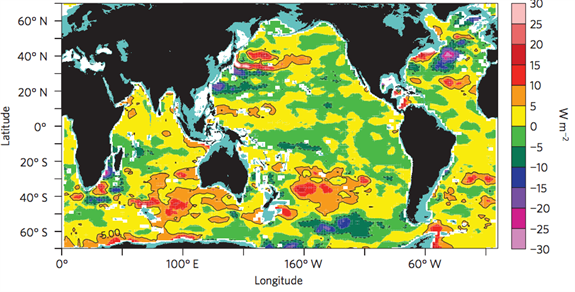
Trend in ocean heat content (0-2,000m) over the ARGO period from 2006 to 2013. Source: Roemmich, D. et al. (2015)

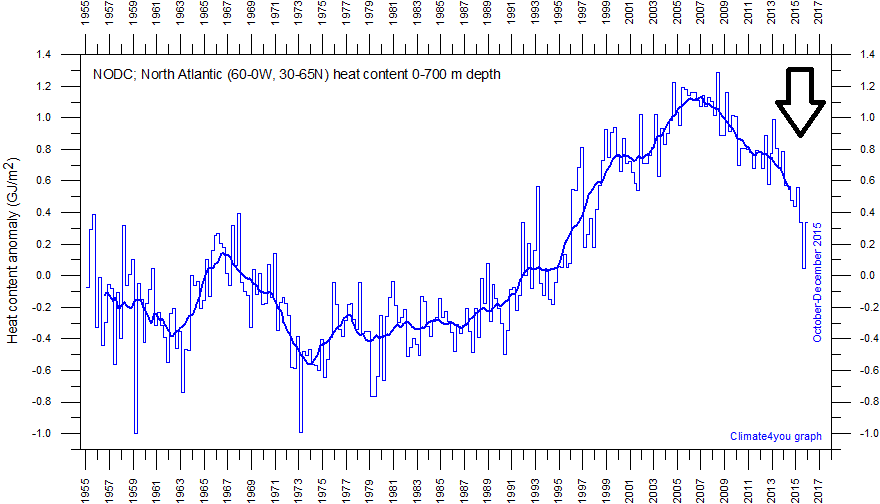
About two thirds of the heat taken up by the oceans since 2006 occurred in the subtropical southern hemisphere, mostly in the South Indian and Pacific Oceans with weaker warming in the South Atlantic, according to the paper’s findings. Some of their calculations suggest that figure could be as high as 98 per cent. The North Atlantic saw slight cooling, as you can see in the map above.

ARGO: A new tool

Usually, climate scientists look at trends over longer time periods than seven years. But when it comes to the oceans, collecting reliable data over such vast areas has been problematic.

Temperature measurements in the deep ocean have traditionally been sparse. Over the past 50 years, about half a million complete temperature profiles – from the surface down to 1,000m – have been collected, mostly by research ships.

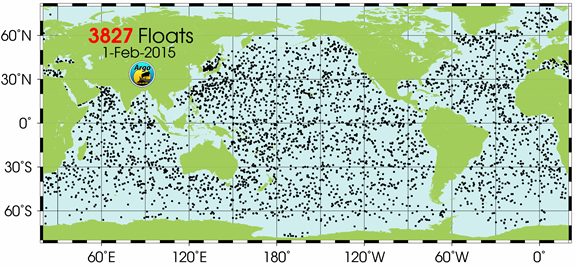
Monitoring the seas became a lot easier in about 2000 with the advent of ARGO – a network of free-floating buoys measuring temperature in the top 2,000m of the oceans. Around 3,800 floats now collect 10,000 profiles per month, a total of 1.2 million profile since 2006.

As of 1nd Feb 2015, there are around 3,800 free-floating ARGO buoys traversing the oceans monitoring temperature and salinity in the top 2,000m. The image above shows only buoys that reported in the previous 30 days. Source: ARGO programme

But it’s proved difficult to combine the new ARGO measurements with older, more traditional measurements, the paper explains. The uncertainty you get when you try to estimate how much heat the ocean have taken up over more than a few decades is almost as big as the signal itself.

To get the most accurate current estimate of ocean heat uptake possible, the authors focus on just this period of ARGO data, which is reliable and has good global coverage.

Future of ARGO

It’s fair to say Argo has provided scientists with a wealth of new data, on top ofthe measurements from ships and satellites. But estimates of ocean warming still come with a fair bit of uncertainty. There are few ARGO floats in the Arctic and Indian Oceans, for example. ...."

__________________
Eternal vigilance is the price of knowledge. - George Santayana
Register to Reply
Register to Reply 8 comments
Copy to Clipboard

Users who posted comments:

JE in Chicago (1); lyn (1); SolarEagle (3); Tornado (2); truth is not a compromise (1)

Previous in Forum: Is the Cure for Alzheimer's Just Around the Corner?   Next in Forum: Suitable Replacement for Ultrasonic Plastic Welding

Advertisement