Previous in Forum: Tan Delta Correction Factor   Next in Forum: How to Define Hysteresis Loop in ANSYS Maxwell
Close
Close
Close
49 comments
Rate Comments: Nested
Active Contributor

Join Date: Nov 2018
Posts: 15

Magnetic Shielding of PCB at 50Hz

11/30/2018 3:34 PM

Hi,

I am new in EMI, and I have to find a solution to shield our PCB against magnetic filed at 50 Hz. our circuit has to operate very close to a transformer 2-3 cm distance and transformer leaks magnetic filed. I know metallic shield doesn't work and i have to use high permeability materials like mumetal. but even using mumetal doesn't look like can help at such a low frequency based on my calculation using this calculator:

https://cecas.clemson.edu/cvel/emc/calculators/SE_Calculator/nearfieldSE.html

by the way, shielding the transformer is not an option for me. I have to shield the PCB, also cost and weight are the important concern as well. the total size of the pcb is 35"X16"

is there anyone know what I should do?

thanks

Ari

Register to Reply
Pathfinder Tags: Magnetic Shielding
Interested in this topic? By joining CR4 you can "subscribe" to
this discussion and receive notification when new comments are added.

"Almost" Good Answers:

Check out these comments that don't yet have enough votes to be "official" good answers and, if you agree with them, vote them!
Guru
Engineering Fields - Instrumentation Engineering - New Member Hobbies - Automotive Performance - New Member Technical Fields - Education - New Member Fans of Old Computers - TRS-80 - New Member Hobbies - Musician - New Member

Join Date: Jan 2008
Location: Tucson, AZ
Posts: 1331
Good Answers: 30
#1

Re: magnetic shielding of PCB at 50Hz

11/30/2018 3:47 PM

Find a read a copy of this:

__________________
...and the Devil said: "...yes, but it's a DRY heat..!"
Register to Reply Score 1 for Good Answer
Active Contributor

Join Date: Nov 2018
Posts: 15
#2

Re: Magnetic Shielding of PCB at 50Hz

11/30/2018 4:05 PM

Sorry the dimensions are not correct. it is 35 cmX16cm.

Register to Reply
Guru

Join Date: Mar 2007
Location: by the beach in Florida
Posts: 33392
Good Answers: 1817
#3

Re: Magnetic Shielding of PCB at 50Hz

11/30/2018 4:57 PM
__________________
All living things seek to control their own destiny....this is the purpose of life
Register to Reply Score 1 for Good Answer
Guru
Hobbies - DIY Welding - Wannabeabettawelda

Join Date: May 2007
Location: Annapolis, Maryland
Posts: 7940
Good Answers: 458
#4

Re: Magnetic Shielding of PCB at 50Hz

11/30/2018 6:40 PM

A thick enough metal shield will work. It might not be practical . . . .

It might be better to re-design the circuits on the PCB so they are not as susceptible to the 50 Hz magnetic fields.

Rarely will you find a 'magic bullet' when it comes to difficult EMI problems. I was involved in an effort to improve the EMI performance for a system and we spent almost 2 years getting to the point where we didn't fail MIL-STD-461 as badly.

Register to Reply Score 1 for Good Answer
Active Contributor

Join Date: Nov 2018
Posts: 15
#6
In reply to #4

Re: Magnetic Shielding of PCB at 50Hz

11/30/2018 6:59 PM

usually which components or circuits would be more susceptible to magnetic field? how can i do troubleshooting to find out which part creates the problem?

Register to Reply Score 1 for Good Answer
Guru
Engineering Fields - Instrumentation Engineering - New Member Hobbies - Automotive Performance - New Member Technical Fields - Education - New Member Fans of Old Computers - TRS-80 - New Member Hobbies - Musician - New Member

Join Date: Jan 2008
Location: Tucson, AZ
Posts: 1331
Good Answers: 30
#7
In reply to #6

Re: Magnetic Shielding of PCB at 50Hz

11/30/2018 7:13 PM

Start at INPUT and visually follow signal/control path through to OUTPUT...verify against schematic/block diagram.

__________________
...and the Devil said: "...yes, but it's a DRY heat..!"
Register to Reply Score 1 for Good Answer
Active Contributor

Join Date: Nov 2018
Posts: 15
#23
In reply to #7

Re: Magnetic Shielding of PCB at 50Hz

12/07/2018 4:48 PM

the layout is very complicated. it is 10 layers PCB

1- TOP LAYER

2-AGND-DGND-1

3-IN1-SIGNAL

4-POWER1

5-IN2-SIGNAL

6-DGND_AGND_2

7-POWER2

8-IN3-SIGNAL

9-DGND_AGND_3

10-BOTTOM

In such a complected circuit, how would you track and find a loop or ...?

Register to Reply
Guru

Join Date: Dec 2010
Posts: 1686
Good Answers: 116
#24
In reply to #23

Re: Magnetic Shielding of PCB at 50Hz

12/07/2018 6:23 PM

In reply to Ari, Post #23, you find the sensitive area by susceptibility search coil method item 3 of my post #19.

Note that a peak current of 2 amps [√2 amp r.m.s. sine] in three turn coil 50mm diameter gives a peak flux of 53 μT at 25mm from centre of coil along axis. It's 2.8 times as strong at 0 mm from centre & about twice as strong as that close to coil wires - that is if you hold the edge of the coil close to PCB.

As noted in post #19, the European test level for 50Hz magnetic immunity is 53μT peak in air. A caution - the standard gives test level but does not give any standard of performance to be met - this depends on the product & what the manufacturer states. For example, a battery operated toy which makes a sound could be considered OK if removing the test field and doing on/off/on cycle restores normal operation after complete silence under test.

You did not give the degree of reduction of performance you get or what kind - is it visual or an error of measured value?

67model

Register to Reply
Active Contributor

Join Date: Nov 2018
Posts: 15
#34
In reply to #24

Re: Magnetic Shielding of PCB at 50Hz
01/10/2019 1:09 PM

Hi,

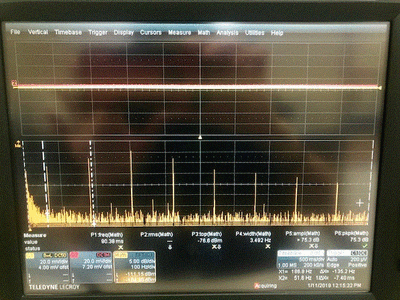
finally we got near-field probe set. it has 3 magnetic field probes with 6, 3 and 1 cm diameter. First i measured the magnetic field emission form the transformer using oscilloscope it shows the it shows -78 dbm signal very close to the transformer at 60 Hz, and 3th harmonic -72dBm at 180 and 5th ...

then to find out which part of the unit under test is susceptible the magnetic field, I connect the 6 cm probe to signal generator and set the frequency to 60 Hz, and voltage 10 volt p-p, the move the probe very close to the circuit and in different orientation but can't see any effect. is that because the signal is too week? that's the maximum voltage i can get from signal generator, and i don't have any amplifier.

do you have any suggestion how can i use this probes for susceptibility test?

do i have to buy an amplifier to increase the current?

is it possible increasing the current too much, burn the probe?

Thanks

Register to Reply
Guru

Join Date: Dec 2010
Posts: 1686
Good Answers: 116
#35
In reply to #34

Re: Magnetic Shielding of PCB at 50Hz

01/11/2019 6:29 AM

Hi Ari,

It would be very useful to see the emission waveform on the 'scope screen - this immediately shows if it is "near sinusoid waveform" with small harmonics of low number or a pulse which will have lots of harmonics (and possibly high peak value - EMC tests usually deal in peak values because interference is determined by that). Third harmonic value suggests high harmonics, but could just be a maximum value.

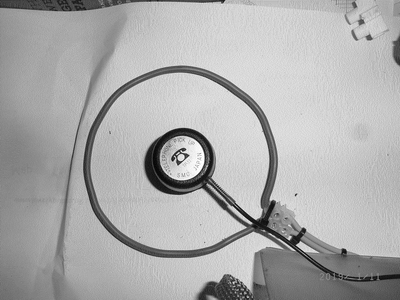
If that is a "digital oscilloscope" with A to D & software & USB connection to computer, there will be a way of downloading a picture of the screen, probably .bmp format, which can be converted to less megabyte files like .jpg or .png. This is my H field susceptibility test coil, taken with digital camera (1.4 MB) and converted to .png, 16 colour (674kB) - I used it to do the "iron shielding" tests I posted here. CR4 tends to reduce the size/resolution of images - if you give it too big a file, detail is poor in image. That is 100mm diameter, one turn, 2.5 sq.mm copper insulated, taken from house power cable. Yellow wire is 0.8 sq.mm, good for 12 amps continuous.

-78 dbm has variable meaning, unfortunately. Literally, it means 10 x logarithm to base 10 of ratio of measured volts to volts for 1 milliwatt in resistance R. R can be any value, but for telephone/radio frequency circuits 50, 75, 500 and 600 ohms are standards. One mW is approximately 0.25 volts rms in 50 ohm & 0.77V rms in 600 ohm. That makes your levels about 200 microvolt peak, 50 ohm.

What calibration levels do your emission probes claim?? e.g. xx Volts peak into yy ohms resistive at zz tesla peak sine @ 60Hz test.

Do you know what peak Tesla that -78dB means??

If your generator is 50 ohms, 10 volts peak, then short circuit is 0.2 amps peak. Have you measured the volts across probe with scope when driven by that generator??

At power Hz, these probes are almost resistive - what is resistance of probe (& its lead)??

Do probe or scope give yy ohms load?? or is probe open circuit??

Need to go out, further comment later.

67model

Register to Reply
Active Contributor

Join Date: Nov 2018
Posts: 15
#36
In reply to #35

Re: Magnetic Shielding of PCB at 50Hz
01/11/2019 1:11 PM

the probe is 50 ohm input impedance, from Electro-metric. it is shielded.

i tried to make multi-turn coil to increase the H-filed emission, but still the filed is not strong enough with 10 V, p-p sin wave at 60 Hz, and when i used the pulse wave with 1 volt, it almost burn the wire.

the impedance of osciloscope is set to 50 ohm, so i can convert dBm to dbμv=107+dbm =>-78+107=29dbμv

based on calibration chart of scope at 60 Hz, this is equal 153dBpT, or -7 dBGauss

No I haven't measured the volt across the probe, how can I measure that?

Thanks,

Ari

Register to Reply
Guru

Join Date: Dec 2010
Posts: 1686
Good Answers: 116
#38
In reply to #36

Re: Magnetic Shielding of PCB at 50Hz
01/12/2019 4:53 PM

Apologies for error in my post #35 - dBm is 10 x (logarithm base 10) of ratio of power in resistor R to 1 milliwatt [dB = decibel = one tenth of a Bel, a Bel is the logarithm to base 10 of a power ratio. The dBm is 20 x log10 (voltage ratio to volts for 1 milliWatt).

A/ Voltage in 50 ohm for -78 dBm. Power in resistor R at V volts is V2/R watts, for 1 milliwatt, 50 ohm: V2/50 = 0.001, hence V2=0.05 ; V = 0.2236 volts = 223600 microvolts

The log10 of volts ratio for your measured -78dbm will 78/20 = 3.9, - antilog = 7943 so -78 dBm is equivalent to 223600/7943 microvolts = 28.2 μV.

This is the voltage in your 6cm diameter, single turn coil (Electro-Metrics EM-6993).

B/ Expected Voltage in 6cm diameter Ring. Fundamental voltage induced in N turn coil of area A by changing magnetic flux is e = N*A*(dΦ/dt).

For sinusoidal flux Bsin(ωt), where ω = 2*pi*f, the rate of change dΦ/dt is ωBcos(ωt).

The peak value of this is ωB, when cos(ωt) = 1 : at 60 Hz that is 2*3.14159*60*B = 377 radians/second.

For the 6cm pick-up coil [taking 6cm as diameter of wire loop, it may be overall diameter with shield & sheath], area A = 3.14159*0.06*0.06/4 = 0.00283 sq.metres.

Finally, the peak voltage is 377 rad/sec* 0.00283 sq.metre *B Tesla = 1.066 volts/Tesla or 1.066 μVolts/μTesla.

Referring to my post #19, European H field test at 53.3 μTesla peak, this gives 1.066*53.3 = 56.8 μVolts peak at 60Hz N.B. Increasing this for 10cm diameter you get 56.8*(10/6)2 = 157.8 μV peak as given in my post #19.

C/ Comparison of Field Strength Calculations. The figure of 28.2 μV peak at [A] above thus suggests 28.2*1.066 = 30.1 μTesla peak, third harmonic 6dB stronger would be about 60 μTesla peak - or little more than European limit.

Your figure of 153 dBpT is 33 dBμT peak, 3 dB more than above (1.41 times in voltage). I am curious how you get from 29 dBμV to 153 dBpT (45 μT). It may be there is a resistive matching pad in the probe - measuring ohms at its connector would get << 1 ohm if there were just a wire loop & tens of ohms with matching pad. Is there any calibration chart dBm to pT for the probe??

D/ Evaluation of Scope Frequency Spectrum Picture

The actual peak flux depends on the summing of the harmonics with correct phase as well as amplitude - is it possible for "scope" to give normal "voltage versus time" display rather than spectrum & post the waveform??

Third harmonic 180 Hz amplitude is 2 x fundamental - its true amplitude is 2/3 x fundament, since rate of change is 3 x at 180Hz. The 300Hz harmonic is even stronger. Such a level of harmonic distortion looks abnormal for 60 Hz transformer.

E/ Susceptibility Test Coil & Getting Stronger Test H Fields

Your coil, from size of "croc" clips in picture, appears to be about 4 cm long & 4 cm diameter with 25 turns. I estimate wire as 0.5 sq.mm copper, 3.2 m long, resistance 0.11 ohm @ 20'C. Inductance L = N2R/(22.86+25.4[L/R]) = 17 microHenry (N= turns, R= radius cm, L = length cm): reactance 6.4 milliohm@60Hz (negligible, compared to resistance).

Driven from 50 ohms resistive source @ 60 Hz ; it is a short circuit to source; 5V peak would put 5/50 = 0.1 amp peak into coil. You cannot assume output will not be distorted or "clipped" on such load.

I recommend you add 50 ohms resistor in series with coil (rated generator load) and measure coil current with your 50 ohm scope in parallel with 1.0 ohm metal film resistor as a shunt, between coil "bottom" and circuit common/ground. Current should be 0.05 amp peak. If you get twice amplitude & same sine current waveform without 50 ohm resistor in series with coil, you can be happy to use sig. gen on short circuit. Since it is 60 Hz sine, you can measure across the 1.0 ohm with an AC multimeter as a calibration cross check.

Field strength on & along axis at end of N turn solenoid coil R radius, L length (metres) carrying I amps, is μ0 IN/[2√(R2 + L2)]. With your sizes that is 350 μT per amp. With 0.1 amp peak as above, that is only 35 μT peak - or 17.5 with load made up to 50 ohm (0.05 amp peak).

You should measure with your several "H" receiver loops, coaxial at coil end, as a calibration check - specification is "loose" - it does not indicate how many turns "loops" have or if there is a resistive pad built into probe.

F/ Comment & Warning

Considering that only tens of microvolts are being received in a 6 cm diameter turn & that any loops on your victim PCB should be much smaller, the equipment must have exceptional sensitivity.

One thing troubles me - X ray equipment suggests to me very high voltages and low (milliamp) currents; not levels to produce high "H" fields.

However, a transformer for tens of thousands of volts DC, even with a rectifier-capacitor multiplier stack is likely to have thousands of volts on transfo windings.

Are you certain the shielding "on some customer's transformers " is not electrostatic screening?

Why are you sure this problem is "H" field not "E" field (capacitative) coupling??

If you have the Electro-Metrics EM-6992 Hand Held Probe set, it has a ball probe for "E" fields.

67model

Register to Reply
Active Contributor

Join Date: Nov 2018
Posts: 15
#44
In reply to #38

Re: Magnetic Shielding of PCB at 50Hz

01/18/2019 6:58 PM

Hi 67model

C)yes there is a calibration chart and formula to convert the field for Electro-metric probes, see the attached files.

D) I got the time domain signal from the transformer emission using 6 cm probe. it's not sin wave, it is distorted, see the picture,

E) i added 50 ohm resistor to my coil in series, and used a signal generator with sin wave at each harmonic (60 hz, 180 hz, 300, 420, 540, 660,...) and generated magnetic filed close to the circuit (10 volt p-p). i don't see any effect at 60 and 180 Hz, i think because the signal is not strong enough, but at 300 hz and higher it works well as a source of localize noise injection.

i also measured the current pass through the coil with 50 ohm resistor using multimeter, it is 65.5 mA

F) I used the electric probe but didn't see any pick up field on oscilloscope. Also, when i turn the magnetic field probe by 90 degrees, in one direction, there is null which shows the noise is magnetic field! right?

Are you certain the shielding "on some customer's transformers " is not electrostatic screening? I don't think i follow you on this comment! can you elaborate about this?!

Thanks for your help :)

Register to Reply
Guru

Join Date: Dec 2010
Posts: 1686
Good Answers: 116
#45
In reply to #44

Re: Magnetic Shielding of PCB at 50Hz
01/20/2019 4:02 PM

Reply to post #44, by Ari....

Hi, Ari.

First, apology for my error in item C of my post #38, where I got 1.066 μVolts/μTesla in item B & then multiplied 28.2 μVolts peak by 1.066 instead of dividing!!

The correct number is 28.2/1.066 = 26.45 μT which is 20*log(26.45) = 28.45 dB(μT) = 148.45 dB(pT), note 28.2 μV is 29.0 dB(μV).

Your item C),

The 6 cm probe calibration chart number dB(Sm-1) 53 dB @ 0.1 MHz needs extending to 60 Hz; 100Hz is 1000:1 = 60 dB while 100/60 = 1.666 adds another 4.4 dB (for a given flux waveform, induced voltage is proportional to frequency, so chart value changes 20 dB for each 10:1 frequency change). So for 60 Hz the "chart" value is 60 + 4.4 + 53 = 117.4 dB.

The calibration instructions add this to dB(μV) to get dB(Siemens) and state "dB(Siemens) + 2 dB = dB(pT)" so we have......

117.4 + 29.0 + 2 = 148.4 dB(pT)

(how did you get 153 dB(pT) in your post #36??)

Note this is practically identical to the 148.45 dB(pT) above (how accurately can one read 53 dB from chart!): which comes from the e = N*A*(dΦ/dt) [N=1 here] equation as worked out in B/ of my post #38.

I conclude that the 6 cm probe is just a loop of wire ( probably 1 sq.mm, which I find just fits the centre terminal of a BNC socket), electrostatically screened, without any resistors included - you can confirm this by measuring resistance at BNC connector [estimated 3.3 milliohm for 1 sq.mm copper @ 20 'C]. It could be driven as H field generator probe, subject to any current limits advised by Electro-Metric & Co-ax cable current limits.

Your item D)....

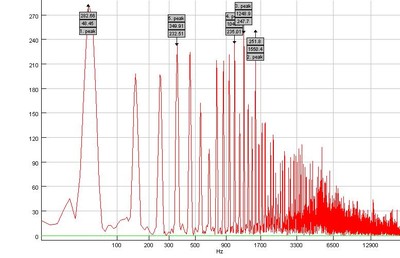
The scope picture looks like a short triangle pulse with a sloping rise followed by a step back to zero. Positive & negative pulse look identical. This would have a lot of harmonics (pulse length << period & step). I cannot read the scales, but I guess peak value is a lot more than any of harmonics in frequency spectrum (28 μV?) & frequency is 60 Hz.

What are the scales & peak amplitude??

Redfred in post #27 suggested X rays in short bursts locked to mains frequency would be a technique to avoid mains frequency interference - field may be a side effect of this.

Your item E) Can we suppose that you have succeeded in affecting your PCB output with H field > 300 Hz from coil driven by sine wave at 65 mA - which have greater peak value than 60 Hz?? The frequency effect would likely be due to capacitor-resistor AC coupling on PCB acting as "high-pass" filters/attenuators of 60 Hz.

My post #40 suggests sound amp to increase current in your coil & I previously suggested mains transfo & lamp to get high power frequency current.

The "joker in the pack" [of playing cards] is that basic Euro "H" field test [which PCB passed] is strictly 50 Hz sine without harmonics (which could induce more voltage than fundamental & pass C-R couplings with less attenuation).

N.B. 65 mA would be 92 mA peak for sine if meter is "true rms" or "mean measuring, scaled for sine".

F) The ball probe is really a capacitor < 1 picofarad. It will give a minute signal unless frequency is very high or you use scope with 1 megohm input resistance [50 ohm termination off?] (typically 20 pF input capacity + coax cable around 60 pF/metre, call it 100 pF which is 100:1 or more capacitance divider) . My "thumb width" measure is that capacitor with two flat parallel 1 cm2 plates, 1 cm apart, in air is about 0.1 pF. If you touch something at EHT with the ball, you must have great confidence in its insulation!

Certainly, you have magnetic noise - but it does not mean there is no electrostatic field! The magnetic probe loop is electrostatic screened, aside from being just a few milliohms at power frequency. Work out reactance of 0.1 pF @ 60 Hz sine - even at 10kV current is < 1 μA giving nV across milliohms ( on the other hand some "pickup place" on your PCB may have 10 Megohm resistance in parallel with 10 pF).

Without having seen transfo myself, a metal enclosure might be 2 mm thick steel (usefull magnetic screen) or 0.1 mm (earthed) copper on plastic sheet like 1 layer PCB board.

Register to Reply
Active Contributor

Join Date: Nov 2018
Posts: 15
#46
In reply to #45

Re: Magnetic Shielding of PCB at 50Hz
01/21/2019 7:05 PM

D) the pick in time domain is 1.43 mV, and the scale is 2mV/div

But in frequency domain, the pick value is for 5th harmonic and then 3rd and 7th harmonic have the same magnitude still higher than 60 Hz!

E)"The frequency effect would likely be due to capacitor-resistor AC coupling on PCB acting as "high-pass" filters/attenuators of 60 Hz. "Can i somehow get ride of this AC coupling and get strong field in 60 Hz?!

F)I measured the filed with electric probe again (changed the impedance of the scope to 1Mohm AC )and i got the following picture, but this field exist everywhere, when i touch the transformer box it get amplified a little but, but even far from the transformer I see this filed, What is this field?!

Register to Reply
Guru

Join Date: Dec 2010
Posts: 1686
Good Answers: 116
#47
In reply to #46

Re: Magnetic Shielding of PCB at 50Hz
01/22/2019 4:03 PM

In reply to Ari post #46,

D) Note 1.43 mV is 50 times the peak value of 28 μV for the fundamental. The spectrum measurement gives little idea of the peak value of real pick-up, except that harmonics to very numbers at uniform amplitude indicate a pulse. EMC test specs require sensitive narrow-band receivers, but oscilloscope time domain view gives a much more rapid impression of peak values & troublesome pulse type voltage (if the signal is enough to be detectable - a pre-amplifier is practical at low frequency & I noted a laptop computer has a 15 mV full-scale 16 bit D/A converter in post #19).

E) As I have pointed out, the "EU" H field test at 50 Hz sine is a "joker" that may give impression of immunity while pulse can affect equipment.

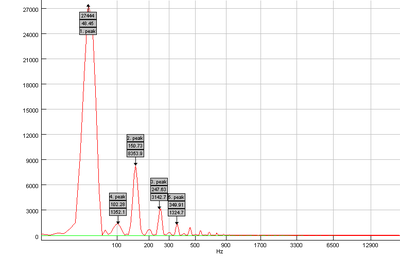
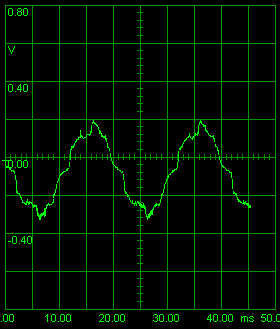
The above time domain & spectrum of "H" induced voltage at 3 cm from transfo I referenced earlier [posts #28 & #33] for steel plate shielding effect [taken with Laptop microphone (16 bit) input & Sigview display software]. As you can see, the wave looks distorted (it is actually "clipping" a little at peaks, it is hitting "full-scale"; 32767 for 16 bits). However, the fundamental 50 Hz peak is 27444 - not much less than timebase display & voltage induced at harmonics is much less & falling fast with frequency.

You cannot make the problem conform to a simple 60Hz test, but should use a test H-field wave form on your "victim" PCB similar to "culprit" causing problem or simulate its effect by using higher frequencies [as you have found] or higher currents at 60 Hz in your test coil, to induce more voltage - I suggested in posts #28 & #39 a lamp/resistor ballast & mains to 6V transfo to get amps in coil. In post #40 I suggested an audio amplifier, which you may be able to drive from your signal generator in pulse mode with similar period, peak field & pulse length [square pulse rather than triangle may do the job] to your Xray kit "culprit".

This would locate the sensitive part of your PCB, and enable measurement of effectiveness of steel shield plates or rotating PCB to move sensitive part away from strong fields or align PCB loop for null rather than maximum.

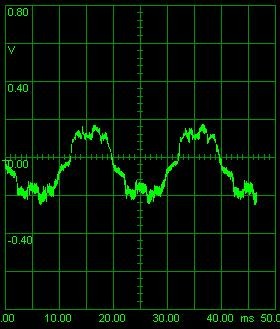
F) Electric fields exist any place you have 230V 50Hz. Standard way to check if 'scope or sound amplifier is working is to touch input with finger! Trace below is touching 1 megohm 'scope input - "cleaner" trace is with other hand touching earthed painted metal of computer case.

Fluorescent light tubes are usual & most cables keep "go" & "return" [H field] & Live/Neutral/Earth [E field] close together which cancels a lot of remote field. However, in tube fitting neutral is buried in earthed steel, cutting its E & H fields - while tube is a gas conductor which is often not in any way shielded & is spaced farther from neutral than in cable.

This is the "E" field of my network router with probe 10cm away from [DC] power entry.....

The spikes at 50 Hz are short & 6000 peak. The spectrum fundamental is 280 peak, but harmonics are similar amplitude up to high numbers - a feature of a pulse.

So your field could be from lots of electric items - try putting E probe close to some.

Regards,

67model

Register to Reply
Guru

Join Date: Dec 2010
Posts: 1686
Good Answers: 116
#49
In reply to #46

Re: Magnetic Shielding of PCB at 50Hz

01/24/2019 10:57 AM

Amplifier to boost signal from H probe [like K1803].

- or power amp [K4003/VM113] for driving coil should not be too difficult to get.

http://velleman.co.uk/contents/en-uk/p7.html

http://velleman.co.uk/contents/en-uk/p132_vm113.html

Register to Reply
Guru

Join Date: Dec 2010
Posts: 1686
Good Answers: 116
#48
In reply to #44

Re: Magnetic Shielding of PCB at 50Hz

01/23/2019 1:32 PM

Ref E), post #,

Since the interference seems to come from harmonics of 60 Hz, this helps a solution because shielding effect of steel increases rapidly with frequency.

Supposing first 10 harmonics are all 50 μV & add together, that is 500μV up to 1140Hz, so 1000 of the peak of ~1500 μV must be due to higher harmonics.

Register to Reply
Guru

Join Date: Dec 2010
Posts: 1686
Good Answers: 116
#39
In reply to #36

Re: Magnetic Shielding of PCB at 50Hz

01/14/2019 5:26 PM

Ari,

Some more thoughts on your test....

I do not know why 1 volt pulse should "burn wire". Unless output of signal gen has failed with short to DC power rail! One would expect 50 ohm output resistance, which limits to 0.1 amp even with 5 Volt peak.

The "maximum power theorem" means that 5V e.m.f. source with 50 ohm series resistance gives maximum power to load if load is 50 ohms - 2.5 volts x 0.05 amps = 125 milliwatts for 5V DC- half that with 5V peak sine. This should only heat an object the size of your solenoid by a few degrees [I estimate 5K rise @200mW].

To get strongest field from N turns carrying I amps, a solenoid is not best. It is better get all turns as close together as possible - as like a single turn carrying N*I amps as possible - say 5 layers of 5 turns. Theoretically, a single turn carrying 25 amp would have twice the field strength on-axis at its centre as at end of solenoid of 25 turns @ 1 amp with length equal to diameter. In practice, temperature rise limits current in close-packed wires. It is most effective to use enamelled copper wire, like a motor winding, cutting out the space & thermal resistance of thick plastic insulation - that 5 layers of 5 turns, 0.5 sq.mm wire, would be about 4x4 mm.

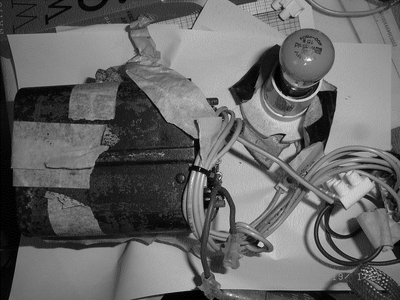
However, it is more practical to put more current into existing coil by using a 60Hz transfo from 60 Hz mains as described in my post #19 item 3 & picture in post #37.

Transformer 20VA 6.3 volt output [~3 amps, secondaries parallel, 25 watt 230V incandescent lamp in series with primary] example below....

https://uk.rs-online.com/web/p/chassis-mounting-transformers/0504561/

3 amps would heat 0.5 sq.mm copper wire a lot, however, short-term 10 amps will warm that wire about 20K in 10 seconds with zero heat loss [adiabatic] - say 100 seconds @ 3 amp. You will have to adjust according to your wire cross-section area, which you did not mention.

67model

Register to Reply
Guru

Join Date: Dec 2010
Posts: 1686
Good Answers: 116
#37
In reply to #34

Re: Magnetic Shielding of PCB at 50Hz

01/11/2019 1:13 PM

Ari,

Further to my post #35, refer to my posts #19, item 1 & 3 and #28 item A & B for susceptibility test & calibration information.

Place your 6, 3, 1 cm pickups on bench co-axial with 100mm coil carrying known 60 Hz sine current and compare their readings - the field of the 100mm coil is not uniform, but small differences in pick-up coil diameter/length & position off/along axis of generator coil have little effect [you can try this for yourself!].

Here are pictures of my "high-tech" lamp/transfo current source, susceptibility test & pick-up coils - you do not need fancy kit except an AC power ammeter.

67model

Register to Reply
Guru

Join Date: Dec 2010
Posts: 1686
Good Answers: 116
#40
In reply to #34

Re: Magnetic Shielding of PCB at 50Hz

01/15/2019 2:43 PM

Ari,

Reply to your post #34, second question.....

To increase current, a sound (audio) amp could be used. Direct connected, the search coil would short-circuit output & cause failure. Put series resistor of rated load for amp in series with coil. Amp rated for 4 ohm best [more current per rated watt]. e.g. 5 volts peak into 4 ohm is 1.25 amps peak, 3.1 watts r.m.s. Many sound amps are not rated continuous for claimed power ["music" power] - need one with good heavy finned heat-sinks - those suitable for bass drums etc more likely to be robust.

67model

Register to Reply
Guru
Engineering Fields - Electrical Engineering - Been there, done that. Engineering Fields - Control Engineering - New Member

Join Date: Dec 2008
Location: Long Island NY
Posts: 15602
Good Answers: 982
#41
In reply to #40

Re: Magnetic Shielding of PCB at 50Hz

01/15/2019 2:59 PM

I've never seen a bass drum requiring an amplifier. The only sounds I've ever heard from an audio amplifier was a soft hum from the cheap ones and a few fan whirrs from some of the old higher powered class AB units.

__________________
"Don't disturb my circles." translation of Archimedes last words
Register to Reply
Guru

Join Date: Dec 2010
Posts: 1686
Good Answers: 116
#42
In reply to #41

Re: Magnetic Shielding of PCB at 50Hz

01/16/2019 6:25 AM

Redfred,

I should have written bass guitar.....

"Heavy Metal" into an "H" field generator coil should rock the X-rays, if anything will.

67model

Register to Reply
Guru
Engineering Fields - Electrical Engineering - Been there, done that. Engineering Fields - Control Engineering - New Member

Join Date: Dec 2008
Location: Long Island NY
Posts: 15602
Good Answers: 982
#43
In reply to #42

Re: Magnetic Shielding of PCB at 50Hz

01/16/2019 9:11 AM

A movable induction coil with an adjustable AC signal (function generator, bass guitar, etc.) along with a power amplifier and dual channel oscilloscope could certainly track down the coupling path and signal levels. One should use a current instead of a voltage probe for the H field source reference on the oscilloscope. H∝I and with a coil, the current lags the voltage applied to it.

__________________
"Don't disturb my circles." translation of Archimedes last words
Register to Reply
Guru

Join Date: Mar 2007
Location: by the beach in Florida
Posts: 33392
Good Answers: 1817
#8
In reply to #6

Re: Magnetic Shielding of PCB at 50Hz

11/30/2018 8:11 PM

...."Good use of ground planes and wiring layout that minimizes parasitic capacitance and ground loops goes a long way toward minimizing EMI.

Emitted radiation, generated by both differential and common-mode currents, propagates along a conducting medium or by radiation through space. Differential-mode currents, flowing synchronously through both signal and power distribution loops, produce time-variant electromagnetic fields and, on simple one- or two-layer PCBs, loops are formed by the digital signals being transferred from one device to another that return by means of the power distribution traces. These loops also act as antennas and pick up the time-variant electromagnetic fields, which create noise in the loops. Additionally, parasitic capacitive coupling occurs between all conductive materials. Even external cables can act like antennas.
Shorter wavelengths can approach the physical dimensions of many EUTs (Equipment Under Test), which leads to possible cavity resonance effects. The resonant frequency is the frequency where integer half-wavelengths correspond to the dimension of the shielding enclosure. A wave is set up inside the enclosure whose nodes (i.e., zero amplitude) lie on the conductive walls of the enclosure. These structures behave as cavity resonators. For example, a 2 in. square by 0.5 in. metallic enclosure resonates at a first order mode of around 12 GHz.
Even weak coupling at these extremely high frequencies can induce strong oscillations which can then couple to any other points in the enclosure or the oscillations can radiate. The danger of a cavity resonance is that if a noise source has a frequency component that corresponds to a resonant point, a large field can be generated at this frequency due to the multiplication or amplification effect by the “Q-factor”. One approach to reduce this phenomenon is to lower the “Q-factor” of the cavity by introducing losses (Q-dampening). "...

https://www.digikey.com/en/articles/techzone/2013/jan/rf-shielding-the-art-and-science-of-eliminating-interference

__________________
All living things seek to control their own destiny....this is the purpose of life
Register to Reply
Guru

Join Date: Mar 2007
Location: by the beach in Florida
Posts: 33392
Good Answers: 1817
#9
In reply to #8

Re: Magnetic Shielding of PCB at 50Hz

11/30/2018 8:28 PM
__________________
All living things seek to control their own destiny....this is the purpose of life
Register to Reply
Guru
Hobbies - DIY Welding - Wannabeabettawelda

Join Date: May 2007
Location: Annapolis, Maryland
Posts: 7940
Good Answers: 458
#20
In reply to #6

Re: Magnetic Shielding of PCB at 50Hz

12/03/2018 1:06 PM

To the maximum extent possible, look for loops in your circuit board layout that will induce currents. Minimize the size of the loops, i.e. keep your signals and their respective returns close together. Be careful with ground planes, they are considered 'good' in a lot of cases, but they can also be problematic when they create unintended return paths. Sometimes, it can be helpful to have 'separate' ground planes that are only tied in one spot (usually with a zero ohm resistor) when you need to separate digital circuits from sensitive analog circuits and the like. That zero ohm resistor can be replaced with a ferrite bead if you need to keep the D.C. potentials the same but you want block higher frequency currents.

In addition to Henry Ott's coverage, Clayton Paul also has a very helpful text on electromagnetic compatibility.

At this point, you will save a tremendous amount of money by hiring an expensive EMI consultant to help you.

Register to Reply
Guru

Join Date: Oct 2008
Posts: 42355
Good Answers: 1693
#5

Re: Magnetic Shielding of PCB at 50Hz

11/30/2018 6:55 PM

Move the PCB and shield the wiring.

Register to Reply
Guru

Join Date: Apr 2011
Posts: 8006
Good Answers: 286
#10

Re: Magnetic Shielding of PCB at 50Hz

11/30/2018 9:12 PM

If you cannot move the PCB, consider augmenting your shielding with compensating coils.

__________________
Eternal vigilance is the price of knowledge. - George Santayana
Register to Reply
Guru
Australia - Member - New Member

Join Date: Jun 2011
Location: Thailand
Posts: 631
Good Answers: 3
#11

Re: Magnetic Shielding of PCB at 50Hz

11/30/2018 10:46 PM

Have you tried a toroidal transformer? I believe they leak less.

__________________
Floss or die!
Register to Reply Score 1 for Good Answer
Guru
Engineering Fields - Electrical Engineering - Been there, done that. Engineering Fields - Control Engineering - New Member

Join Date: Dec 2008
Location: Long Island NY
Posts: 15602
Good Answers: 982
#12

Re: Magnetic Shielding of PCB at 50Hz

12/01/2018 11:57 AM

You need a magnetically permeable metal, like steel or mumetal, to direct the magnetic field around instead of through the sensitive circuit loops. Make a box of this metal. A single plate, like a knights shield, can actually focus the magnetic field onto the circuitry behind it. If this metal box is too thin the metal might saturate and allow a reduced field into your circuitry.

__________________
"Don't disturb my circles." translation of Archimedes last words
Register to Reply
Guru

Join Date: Dec 2010
Posts: 1686
Good Answers: 116
#13

Re: Magnetic Shielding of PCB at 50Hz

12/01/2018 12:50 PM
  1. Volts pick-up due to a magnetic field depends on the area of the loops sensitive to induced voltage - make sensitive parts smaller. Very small wires in very twisted pair to transfer signal may help.
  2. Is it correct to assume that purpose of equipment is to monitor transfo you mention?? Otherwise putting transfo so close was bad decision.
  3. It is very bad that a PCB/transfo assembly has been designed & tested before thinking EMC .
  4. Just shield the sensitive bits, not the whole PCB. It may be best to "bite the bullet", remove sensitive bits from PCB; re-design them into a shielded box & mount it on PCB area vacated.
  5. Find the sensitive bits with a 50Hz search coil.
  6. Test equipment/receivers/transmitters which must have low radiation/pickup have shield boxes inside shield boxes with filters between boxes to pass only required signals. If one box gives 10:1 reduction, two may give 100:1 but just making box thicker may be impractical or ineffective.
  7. Is your desired signal 50Hz - or can you use filters to reject 50Hz??
  8. Can you change the alignment of the transfo or PCB to reduce the field where it matters??
  9. Is it possible to turn PCB through 180 degrees?? Dimensions of 35 x 10 cm are much more than stated 2-3 cm distance to transfo & near field of transfo falls as square or cube law with distance.
  10. It might be possible to fit a pickup coil over sensitive parts & use it for a cancellation signal.
  11. How much improvement do you need to meet specification?? It may not be welcome, but experienced folk in CR4 may be able to tell you that management have got to take some unwelcome decisions - like moving the transfo or making it toroidal with optimum alignment!
Register to Reply
Active Contributor

Join Date: Nov 2018
Posts: 15
#16
In reply to #13

Re: Magnetic Shielding of PCB at 50Hz

12/02/2018 2:10 PM
  1. the PCB board is part of a X-Ray imaging system, and this imaging system has to be close to a transformer. the transformer is not part of our system and our costumers can get it from any manufacturers. some of them get expensive one that are good shielded and then do not create any interference with our system, but some of our customers get transformer that is not very well shielded and has leakage. so we do not have control on the transformer or which type that buy. the only option for us is to make our shielding better.
  2. do I need to ground magnetic shield?
  3. what is 50 Hz search coil? i am going to order near-filed probe kit. they have magnetic loop probe. is that the same as 50Hz search coil?
  4. 50 Hz is not my desired signal, it leaked in from adjacent transformer which has to work close to our system. what do you mean to filter it? do you mean i should first find a loop that is susceptible to 50Hz frequency, then somewhere in the loop put the filter?
  5. I can not change the alignment. It's not practical for me.
  6. the 35 cm X 16 cm is the total dimension of the PCB, and the edge of the PCB is 2-3 cm from the transformer. I am not sure where is the sensitive part to know the exact distance of it to the transformer
  7. "It might be possible to fit a pickup coil over sensitive parts & use it for a cancellation signal", what do you mean? can you elaborate it? i don't get what you mean!
  8. Also another question? how can i use metallic sheet to create eddy current to cancel the magnetic filed? do you think that could be one solution ? or do i need high permeability shielding materials?
  9. do i need full wave simulator like CST MWS to import the circuit and run EMI test on it to see which part is susceptible to the magnetic filed? have you ever use this for troubleshooting?

Thanks for you help

Register to Reply
Guru

Join Date: Apr 2011
Posts: 8006
Good Answers: 286
#17
In reply to #16

Re: Magnetic Shielding of PCB at 50Hz

12/02/2018 5:23 PM

1. Sounds like packaging your equipment with a reliable low leakage transformer would be a priority to reduce costs and enhance performance / satisfaction.

2. It would be a good idea. What is the benefit of leaving it ungrounded?

7. The idea is to minimize the interference with a coil through which a current is passed to create a magnetic field opposing the field that is giving you problems.

8. for conductive metal sheeting to perform well as magnetic shielding the thickness needs to be up to ~4 skin depths. At 50 hertz you're looking at some very thick copper (probably somewhere around 3/4" or 2 cm) or aluminum (probably somewhere around 1 7/8" or 4.75 cm)

__________________
Eternal vigilance is the price of knowledge. - George Santayana
Register to Reply
Active Contributor

Join Date: Nov 2018
Posts: 15
#21
In reply to #17

Re: Magnetic Shielding of PCB at 50Hz

12/07/2018 10:49 AM

Thank you

Register to Reply
Guru
Engineering Fields - Electrical Engineering - Been there, done that. Engineering Fields - Control Engineering - New Member

Join Date: Dec 2008
Location: Long Island NY
Posts: 15602
Good Answers: 982
#18
In reply to #16

Re: Magnetic Shielding of PCB at 50Hz

12/02/2018 10:13 PM
  1. I would be much more worried how the magnetic field will alter the path of the electron beam in the X-Ray tube than any interference on a circuit board.
  2. Magnetic shields do not require a drain wire. Faraday shields require a drain wire. However, often a magnetic shield will also act as a Faraday shield.
  3. This is a loop antenna to sniff for magnetic fields. Integrating the pickup signal will result in a time varying voltage proportional to the magnetic field intersecting the area of the loop. There may be a ferromagnetic core inside the loop to boost gain. This is precisely what your near field probe will be.
  4. A filter is a device that separates things. In this case removing an undesirable frequency component from your analog circuitry. From your questions I believe it is unlikely you will be able to identify, let alone modify your analog circuitry with a suitable filter network.
  5. That is a shame. A 90° rotation in each of the three orthogonal axis is the simplest test to identify if the interference coupling mechanism actually is magnetic instead of electrostatic or acoustic. This test may not be a practical solution but it does help to know how the offending signal is getting in.
  6. The outer dimensions of the circuit board is meaningless information. Knowing which parts of the board contain analog circuitry and how large of a loop area the analog circuit contains is what is critical. To properly correct the circuit board may require a significant change in circuit topology.
  7. This technique is called "humbucking". It is one of the possibles techniques used in altering the analog circuitry. It is used mostly today in electric guitar pickups to permit power line frequency notes intended by the musician to still be picked up but to greatly attenuate powerline coupling into the audio circuitry.
  8. Producing eddy currents will happen with any conductive metal.
  9. Undefined acronyms usually fail to communicate. Magnetic field simulation programs can be very expensive.
__________________
"Don't disturb my circles." translation of Archimedes last words
Register to Reply Score 1 for Good Answer
Active Contributor

Join Date: Nov 2018
Posts: 15
#25
In reply to #18

Re: Magnetic Shielding of PCB at 50Hz

12/07/2018 6:46 PM

1- X-ray tube source is not close to the transformer. it is the X-ray detector that has to be close to the transformer and facing EMI problem

5- can you please elaborate about this troubleshooting?

6- so the analog circuity is important not digital, right? that means i the EMI creates current noise only on analog circuits?

also, can 50 Hz signal create current noise in small loop? or most likely should be a large loop?

Thanks,

Register to Reply
Guru
Engineering Fields - Electrical Engineering - Been there, done that. Engineering Fields - Control Engineering - New Member

Join Date: Dec 2008
Location: Long Island NY
Posts: 15602
Good Answers: 982
#27
In reply to #25

Re: Magnetic Shielding of PCB at 50Hz

12/07/2018 11:56 PM

1- Don't be so sure that only the detector is sensitive to 50 HZ. How would you know if the X-rays were being modulated? You would see the result in the detector signal.

5- If the circuit board, detector or any pickup device 50 HZ noise level does not change with 90° changes in pitch, roll or yaw (one axis at a time) then you probably do not have magnetic coupling as a problem.

6- The digital circuitry usually has more intrinsic noise immunity than analog circuitry. You still can freak out digital circuitry with enough interfering noise. When trying to reduce noise in an electronic system it is always best to examine the analog circuitry first. A 10% change in noise can be measured. Since digital is ON or OFF a 10% change is not noticed.

A small loop certainly can pick up 50 HZ but it will be a smaller signal.

You never mentioned what X-ray detecting sensor is being used; solid state, ion chamber, scintillating fibers, etc.

If I were designing such a system I would use very short bursts of X-rays that were phase locked to the line voltage to remove line voltage interference.

__________________
"Don't disturb my circles." translation of Archimedes last words
Register to Reply
Active Contributor

Join Date: Nov 2018
Posts: 15
#29
In reply to #27

Re: Magnetic Shielding of PCB at 50Hz

12/09/2018 11:56 PM

1-I didn't know if 50 Hz magnetic filed can modulate X-ray signal!!

5- thanks for clarification. I will do this test.

6- so most likely the current noise is created on a loop that carry analog signal.

A/ the direction of magnetic filed that induce this current should be perpendicular to the surface of the loop, right?

B/! now, to shield this loop, i should make a close cylindrical or rectangular shape with magnetic materials to cover this loop in all direction. imaging this loop is in the surface of the PCB board, how can i close the shield from the bottom and make a close envelop? for example if the shield is cubic shape, how can i connect the bottom wall under the PCB to the side walls and top walls?

C/ We have lots of ASICs on our PCB, before i started this series of CR4 discussion, i had no idea that i should look for loop in the PCB, and also i didn't know the shield should be a close envelope! to do a troubleshooting, i put a sheet of mumetal on top of ASICS, however, it reduced the noise in the image. i didn't use a closed envelops, or didn't cover any loop on the PCB. do you have any idea why?

the X-ray detector is used X-ray imaging for medical and security applications.

Thanks,

Register to Reply
Guru
Engineering Fields - Electrical Engineering - Been there, done that. Engineering Fields - Control Engineering - New Member

Join Date: Dec 2008
Location: Long Island NY
Posts: 15602
Good Answers: 982
#30
In reply to #29

Re: Magnetic Shielding of PCB at 50Hz

12/10/2018 9:20 AM

A/ The maximum effect happens when the loop area and the magnetic field line are perpendiculars. A null occurs when they are parallel and gradually change between these two in a trigonometric relationship.

B/ It is accurate to call this shielding but I dislike the term for it implies the wrong technique to properly implement. I prefer to call it magnetic bypassing. The magnetic material has a lower magnetic reluctance (resistance) than free space and non-magnetic materials (like circuit boards and X-ray tubes). So placing a shield-like plate of magnetic material between the magnetic field source the sensitive circuitry can end up focusing just like a convex lens more magnetic field onto the circuit. Providing a low magnetic reluctance in front, behind and connecting between the two in a bypass path around the circuit will reduce the field strength that crosses the circuit.

C/ The focusing analogy I just used still applies. If that mumetal piece focused the magnetic fields onto a magnetically tolerant area of the circuitry and away from the sensitive portions then a noise improvement will happen. However, a change in alignment and location of the circuit board and the magnetic source might now put the sensitive portion into the focusing area, making things worse. If one constructs a box completely around the sensitive circuitry then no orientation can create an interference.

There is one last complication I am compelled to mention. If the magnetic material goes into saturation then the difference between the saturation field level and field strength impacting the magnetic material continues along the original free space path.

__________________
"Don't disturb my circles." translation of Archimedes last words
Register to Reply
Active Contributor

Join Date: Nov 2018
Posts: 15
#31
In reply to #27

Re: Magnetic Shielding of PCB at 50Hz

12/13/2018 9:24 PM

Hi,

i have a question about mode of appearance of Magnetic coupling, can magnetic coupling appear in common mode or most likely is differential mode as the current noise in magnetic coupling shows in a loop, and differential noise also appear in a loop?

Thanks

Register to Reply
Guru
Engineering Fields - Electrical Engineering - Been there, done that. Engineering Fields - Control Engineering - New Member

Join Date: Dec 2008
Location: Long Island NY
Posts: 15602
Good Answers: 982
#32
In reply to #31

Re: Magnetic Shielding of PCB at 50Hz

12/14/2018 9:05 AM

Depending on the spatial geometry between the magnetic field generator and the current carrying wires the interference can be either common or differential mode. Typically two wires will follow virtually identical paths (especially if they are a twisted pair) around the magnetic field generator making a most if not all of the interference current to be common mode.

You should notice that magnetic coupling induces a current in a conductor. Magnetic fields induce an interfering current.

__________________
"Don't disturb my circles." translation of Archimedes last words
Register to Reply
Guru

Join Date: Dec 2010
Posts: 1686
Good Answers: 116
#33
In reply to #31

Re: Magnetic Shielding of PCB at 50Hz

12/14/2018 1:10 PM

Ari,

Consider a cable with two wires spaced 2mm, 1 metre long within a panel, which is spaced 50mm from the panel metalwork...

You could get differential induced voltage in 2mm x 1000mm = 2000 mm2 and common mode induced voltage in 50 x 1000 = 50000mm2 [25 x differential] due to same magnetic fields linking the areas. Twisting the wires in the signal cable ideally makes half the loops have opposite magnetic induced polarity & the in-series sum voltage zero. Practically, there may not be an even number of complete loops in the run or uniform magnetic field in each loop - if a signal cable runs 100m parallel to a power cable a few turns per metre has a good effect, even if the power cable turns a few times over 100m itself.

If the signal is the difference between the 2mm spaced wires & signal input has high 50Hz common mode rejection then no problem [e.g. ethernet has transformer isolation and works at frequencies >>50Hz] - however if a sound pre-amp was joined to a power amp by the two wires & common at both ends was grounded the magnetic e.m.f. would cause a current to flow round the ground loop causing a resistive volt drop in the common signal wire, making an unwanted "hum".

Note that if there were just one ground, there would only be cable capacitance current flow in signal common due to "big loop" magnetic e.m.f. & much less hum.

I read the military specs I used to apply regarding magnetic testing/shielding. At 50 Hz, the test level was 63μT peak - hardly more than EU test level of 53 μT.

Their estimate of shielding effect of 1.6mm thick mild steel is 6:1 with 2:1 reduction for each mm increase of thickness. I tried 20cm x 18 cm x 1.6mm steel plate & 2cm diameter pick-up coil touching its centre. Co-axial 100mm coil carrying 2 amps rms touching plate on opposite side had a 4:1 reduction. Moving 100mm coil away from centre to over plate edge reduced pickup. Putting pickup touching middle 9 x 19 cm bottom of 9x 19 x 19 cm steel box of 0.5 mm thickness [co-axial 100mm coil touching outside of bottom] only reduced to 1:0.7.

Theoretical improvement is not dramatic with mumetal sheet [μr = 300000 vs 300 for steel, resistivity 0.6 vs 0.16 μohm-cm] depends on √ ratio = √[(300000/300)*0.16/0.6] = 16:1 improvement.

To get dramatic improvement you have to enclose equipment in mumetal e.g. 3 cm X 1 cm cross section of 1 mm2 mumetal is 80mm2, compared to enclosed area of 300mm2 but magnetic path through mumetal is ~100000 times easier, very little flux goes through air in box.

Register to Reply
Guru

Join Date: Dec 2010
Posts: 1686
Good Answers: 116
#19
In reply to #16

Re: Magnetic Shielding of PCB at 50Hz

12/03/2018 8:37 AM

Thank you for the additional information, CR4 members cannot see your PCB or its function, but can think of a lot of possible reasons for H field pick-up - most of which may not apply in your problem. For example, many posts came before revealing "transfo" is not a power supply?? for your PCB, but outside your control.

When corresponding about problems it helps to give replies numbered as the originating question - it helps not to have a subject which changes its code with every question/answer.

Keeping with your numbers.....

  1. OK, it seems transfo is outside your supply. However, it is within your sales function to point out the extra design cost, per unit cost and timescale involved in meeting customer B requirement; compared to A who has better shielding. I think there are basic European EMC Directive requirements for Power frequency magnetic field immunity 50/60 Hz @ 30A r.m.s./m. N.B. this field is 53.3 µT peak & induces 131.5 µV peak in a 1 turn loop of 100 mm diameter @ 50Hz [157.8 µV, 60Hz]. Do you meet them? Surface field of Earth 65µT max. It would help if you measured the actual H-field in mounting place each customer gives you, you would know limits to test your PCB "on test bench".
  2. Magnetic shield does not depend on bonding to "signal ground", but E-field does & it would be unwise to surround a circuit with metal & not take advantage!
  3. I should have said "susceptibility search coil". It usually means a receiving rather than transmit function. My approach would be to make several 50mm diameter round turns of about 1 mm2 enamelled copper wire [close bunched] connected through twisted pair wire to a 3 to 6V secondary of a mains transfo capable of as many amps as needed - transfo primary fed from mains by incandescent lamps or resistors to limit current [it is a "wound current transformer (CT) - to "gold plate the hammer"]. The transfo can deliver several times rated current for short periods.
  4. As a basic measure, if your desired signal was 1 kHz, your amplifier input R ohms and you added a series capacitor C of reactance R ohms @ 1kHz it would reduce 1 kHz to 0.7 times, but 50Hz to 1/20 of original. There are many multi-stage R-C circuits, some with amplifiers, to give much better attenuation, as well as digital IC computer programmes which replicate them. You need to put the filter at point where interference enters chain or after ["after" has problem that interference can overload/distort required signal before it gets to filter]. It is much better to reduce "loop area" and e.m.f. caused first. N.B. is it possible your susceptiblity is due to a multi-turn coil there for functional/RFI filter reason?
  5. CR4 takes no responsibility if you tie your hands, to stop them gripping problem.
  6. I am sure you can turn PCB "180 degrees around axis perpendicular to plane of PCB" with new wire runs - this may put susceptible part 15/30 cm from culprit, rather than 3 cm.
  7. You fit a 1 turn coil over the sensitive part and wire it in series with signal; with polarity which opposes the unwanted pickup. It depends on field being same at balance coil as at prime circuit - also culprit field from one customer may have different pattern to next.
  8. Other posts have given figures for eddy-current shielding - you need really thick copper - high permeability is necessary - without any measurement of level of field/ degree of reduction required, mild steel may be good enough.
  9. A complete E-M simulation of circuit is a major project and is useless unless you know culprit field. Measuring magnitude of culprit H-field on X-ray unit with a small multi-turn coil and testing PCB as item 3 above to find "victim" point on PCB is more realistic.

A / Are You sure pick-up is on PCB & not on wiring to it? CR4 cannot see your system or waveform of 50Hz culprit.

B/ A laptop computer has a "boost" microphone input of 10 mV full - scale sensitivity 16 bit A/D 44 ksamples/sec - good for 50 Hz & harmonics. Windows can record "sound" from microphone & you can have 30 day free trial of software like SigView [search net for download] which can record & display & integrate/frequency analyse etc such signals.

C / Coil H-field received voltage is governed by e = N.A.dΦ/dt. Pick-up coil can be calibrated by placing in loop as 3 above driven by known current & using formula for single turn loop H-field. Ideally it needs electrostatic screen on pick-up but this may not be needed - I have not needed, small coils do not pick-up much E-field at low frequency.

Register to Reply Score 1 for Good Answer
Active Contributor

Join Date: Nov 2018
Posts: 15
#26
In reply to #19

Re: Magnetic Shielding of PCB at 50Hz

12/07/2018 7:18 PM

1) We passed EMC compliance test. so, the H-filed that create the noise should be lower than what they use in EMC, right?!!

A/ Our system works with battery and using wireless. so, we don't have any power cable coming to the system and any data cable. but we do have a cable from radio to the antenna inside the system.

Register to Reply
Guru

Join Date: Dec 2010
Posts: 1686
Good Answers: 116
#28
In reply to #26

Re: Magnetic Shielding of PCB at 50Hz

12/08/2018 11:44 AM

Ok, thanks Ari,

1/ If the compliance test "passed" Magnetic field 50Hz susceptibility , then your company should know what were the criteria for a pass in terms of % error or visible distortion of x-ray image. As I wrote, Euro EMC tests do not give criteria [except in product standards]. If pass was good enough, then your culprit field must be greater not lower than test level. This test field would be pure 50Hz, negligible harmonic.

2/ Very unlikely magnetic field of transfo would affect radio antenna/coax cable. Battery power means it is easy to move PCB away from transfo, change alignment, [as suggested by Redfred post #18, item 5, to be sure magnetic field is culprit].

A/ To get some practical measurements in view, I have tried a single turn 100mm diameter coil carrying 2 amps rms.

This gives 25√2 μT peak field on axis at its centre - or 3/4 of Euro 50 Hz test field.

B/ The two amps comes from an oil filled, steel case transfo of ~40 VA rating using two paralleled nominal 6.3V secondaries with about 4 amp total rating - I think it is "C" cored - primary fed via 15 watt incandescent lamp (primary voltage 13). It is 8.5 cm square x 10 cm, excluding terminal bushings on one square end.

C/ My magnetic pick-up coil, connected to laptop microphone input, reads 17000 peak at 50 Hz using Sigview software FFT frequency plot, when placed, same axis, in centre of the 1 turn coil energised as A/ above.. The input is 16 bit, so 32767 full scale, which I have previously found to be 9.9 mV rms for full scale.

D/ Measuring with pick-up [touching] on axis of centre of [not terminal] square end of transfo per B/ I get peak 7500, 50Hz {the only noticeable harmonic are 3rd (440 peak), 5th (280), 7th (380). N.B. An integrator is unnecessary - what matters here is the e.m.f. produced in a pickup coil, not the field responsible - it is dΦ/dt that makes the induced e.m.f.

E/ Moving away from surface readings are 3cm 2700, 6cm 1250, 12 cm 480, 18 cm 200, 30cm 60. Measuring from transfo centre (5cm back from base) that is roughly inverse square law fall from 8 to 17 cm and cube law from 17 to 35 cm - as expected. Energising transfo no-load at 245VAC gives 26000 peak 50Hz @ 3cm [3rd harmonic about 1/4 fundamental] - about ten times C/ reading (primary magnetising current about 40 mA/245V).

E/ shows why military EMC guidelines are emphatic about keeping DISTANCE between magnetic culprits and victims before the difficult, expensive, game of shielding.

F/ I tried a plastic-cased 220VAC plug-top transfo of 5 VA output rating on my 245VAC 50Hz mains (14VA input) . Obviously, it is closer to saturation than it should be, but mostly it is a cheap, inefficient item. At 11 cm from surface at strongest point I get 32000 peak with same pick-up coil. Third harmonic is more volts than fundamental.

G/ You have not given dimensions of your transfo - separation distances must be measured in proportion to maximum dimension of magnetic source item.

Register to Reply
Guru
Popular Science - Cosmology - Let's keep knowledge expanding Engineering Fields - Retired Engineers / Mentors - Hobbies - HAM Radio - New Member

Join Date: Dec 2006
Location: North America, Earth
Posts: 4528
Good Answers: 106
#14

Re: Magnetic Shielding of PCB at 50Hz

12/01/2018 3:34 PM

There is more than one type of mu-metal. One type works with high magnetism, another shields better for low magnetics. Sorry I don't know the specifics. I remember an old instrument that had a shaded-pole motor for its fan. It had 3 mu-metal shields around it (probably the same type) to keep 60Hz out of the circuits around it.

__________________
“I would rather have questions that can't be answered than answers that can't be questioned.” - Richard Feynman
Register to Reply
Guru
Popular Science - Weaponology - New Member Safety - ESD - New Member Hobbies - Fishing - New Member

Join Date: Sep 2006
Location: Near Frankfurt am Main, Germany. 50.390866N, 8.884827E
Posts: 17996
Good Answers: 200
#15

Re: Magnetic Shielding of PCB at 50Hz

12/02/2018 4:42 AM

Shielding is still a good start, also a redesign of the PCB to filter out 50Hz sounds like a good place as well!

Shielding of any connecting cables needs also to be carried out.

Filter for both 50 and 60 Hz, as you never know where or when such units may be used in other countries....Plus, there are companies around that produce such filters, no need to design your own!!

Best of luck!!

__________________
"What others say about you reveals more about them, than it does you." Anon.
Register to Reply
Active Contributor

Join Date: Nov 2018
Posts: 15
#22

Re: Magnetic Shielding of PCB at 50Hz

12/07/2018 10:52 AM

thank you everyone for the comments and suggestions/recommendations..., sorry for the late reply. i was on vacation and just got back. I am going to order magnetic probe and do some troubleshooting and see what i can find. I appreciate everybody time :)

Register to Reply
Register to Reply 49 comments

"Almost" Good Answers:

Check out these comments that don't yet have enough votes to be "official" good answers and, if you agree with them, vote them!
Copy to Clipboard

Users who posted comments:

67model (15); 70AARCuda (2); Andy Germany (1); Ari (14); Brave Sir Robin (2); lyn (1); redfred (7); SolarEagle (3); StandardsGuy (1); Stuart21 (1); truth is not a compromise (2)

Previous in Forum: Tan Delta Correction Factor   Next in Forum: How to Define Hysteresis Loop in ANSYS Maxwell

Advertisement