Previous in Forum: Planetary Gear Calculation   Next in Forum: Pressure Temperature Rating Calculation
Close
Close
Close
7 comments
Rate Comments: Nested
Participant

Join Date: Apr 2019
Posts: 4

Steam Hunting When it was Synchronised

04/02/2019 11:35 PM

We have 2*38.5 MW coal based steam turbines, both always runs at 25 MW individually, Auxiliary consumption 5 MW and inter connection cement plant 9 MW and export to GRID is 36 MW Whenever grid disturbance occurred the grid circuit breaker opening and plant came to home load at TG-1: 3.5 MW and TG-2: 5.8 MW after that points are noted as bellow 1. TG-1 load rapidly dropped to 0 MW and Generator tripping on reverse power protection.( if we are in alert position TG-1 breaker manually opens while load dropping condition and saves from Turbine trip) 2. Whenever TG-1 load dropping, TG-2 load raising rapidly. 3. TG-2 withstanding home load at 9.5 MW ( 5 MW power plant auxiliary and 6.5 MW Cement Plant auxiliary ) 4. after getting clearance from GRID, going synchronised 5. Before Close the Breaker we observed following parameters TG-2 active power : 9.5 MW Reactive power : 2.1 MW Power factor :0.987 Lag Voltage : 11.25 KV ( matched with Grid voltage) Frequency : 49.99 to 49.98 ( matched with Grid Frequency) after getting Synch permit we are closing breaker then immediately Load was hunting from 13.5 MW to 1 MW here we are observed turbine actuator Hunting rapidly. and unable observed frequency of the Generator and Speed of Turbine let me know any suggestion why TG hunting started after synchronization

Register to Reply
Interested in this topic? By joining CR4 you can "subscribe" to
this discussion and receive notification when new comments are added.

"Almost" Good Answers:

Check out these comments that don't yet have enough votes to be "official" good answers and, if you agree with them, vote them!
Guru

Join Date: Mar 2007
Location: by the beach in Florida
Posts: 33392
Good Answers: 1817
#1

Re: Steam Hunting when it was synchronised

04/03/2019 12:27 AM

Sounds like one of your parameters is out of sync, also the generators don't appear to be connected properly...

https://electrical-engineering-portal.com/preparing-to-synchronize-a-generator-to-the-grid

__________________
All living things seek to control their own destiny....this is the purpose of life
Register to Reply
Participant

Join Date: Apr 2019
Posts: 4
#2
In reply to #1

Re: Steam Hunting when it was synchronised

04/03/2019 12:59 AM

sir,

we are matching voltage and frequency with grid then we are getting sync permission.

until we are not closing generator breakers.

and some times observed TG hunting observed at 11 mw at smooth operation

Register to Reply
Guru
United Kingdom - Member - Indeterminate Engineering Fields - Control Engineering - New Member

Join Date: Jan 2007
Location: In the bothy, 7 chains down the line from Dodman's Lane level crossing, in the nation formerly known as Great Britain. Kettle's on.
Posts: 32175
Good Answers: 839
#3
In reply to #2

Re: Steam Hunting when it was synchronised

04/03/2019 7:08 AM

Do bear in mind that no-one on this forum other than the Original Poster can actually see the equipment and its behaviour.

So, it may prove necessary to consult a local, qualified, Electrical Engineer to investigate and diagnose the problem with a view to receiving recommendations from that particular source for its correction.

__________________
"Did you get my e-mail?" - "The biggest problem in communication is the illusion that it has taken place" - George Bernard Shaw, 1856
Register to Reply
Guru

Join Date: Mar 2007
Location: by the beach in Florida
Posts: 33392
Good Answers: 1817
#5
In reply to #2

Re: Steam Hunting when it was synchronised

04/03/2019 8:18 AM

In order to synchronize a generator to the grid, four conditions must be met:

  1. Phase Sequence
  2. Voltage Magnitude
  3. Frequency
  4. Phase Angle
__________________
All living things seek to control their own destiny....this is the purpose of life
Register to Reply
Guru
United Kingdom - Member - Indeterminate Engineering Fields - Control Engineering - New Member

Join Date: Jan 2007
Location: In the bothy, 7 chains down the line from Dodman's Lane level crossing, in the nation formerly known as Great Britain. Kettle's on.
Posts: 32175
Good Answers: 839
#4

Re: Steam Hunting When it was Synchronised

04/03/2019 7:26 AM

The problem might be related to two control loops/systems with similar response times. If two such loops on parallel systems are put into automatic, then neither loop will achieve setpoint for long, as a disturbance, which in this case could be initiated by a minor change in load, may destabilise the whole system. This principle might be what the Original Poster is observing, without necessarily realising it.

  • On process plant, it is dé rigeur to change the control arrangements so that one loop operates on the sum of the two signals and the other on the difference between them. In such situations the response times will then become separated by a factor of 4, which can be an asset in the pursuit of stability as the loops will be tuned differently, one acting quickly and the other at 1/4 of that speed. It is recognised that this principle might not be immediately applicable to the Original Poster's installation.

It is interesting that this post is in the Mechanical Engineering section rather than the Instrumentation one.

__________________
"Did you get my e-mail?" - "The biggest problem in communication is the illusion that it has taken place" - George Bernard Shaw, 1856
Register to Reply
Guru

Join Date: Apr 2010
Location: About 4000 miles from the center of the earth (+/-100 mi)
Posts: 9910
Good Answers: 1141
#6

Re: Steam Hunting When it was Synchronised

04/03/2019 5:21 PM

It sounds like the TG's are not sharing the load (real power).

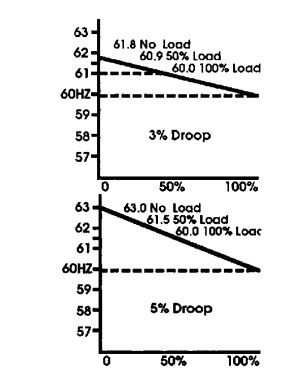
The governors on the turbines have a characteristic called droop, which is the response of speed to power.

If a machine is supplying power by itself, the droop is set to flat (isochronous) so that the output frequency will be stable when the load changes. When you parallel a second machine, its governor should be set in droop mode. While the first generator's (master) governor maintains frequency, the second machine's governor can then be adjusted to share the load.

Check the governors' droop setting.

http://www.woodward.com/WorkArea/DownloadAsset.aspx?id=2147483661

https://en.m.wikipedia.org/wiki/Droop_speed_control

Register to Reply Score 1 for Good Answer
Active Contributor

Join Date: Jan 2016
Posts: 16
Good Answers: 1
#7

Re: Steam Hunting When it was Synchronised

04/04/2019 5:50 AM

Sounds like you need a turbine and generator controls consultant.

Be very cautious if your turbine speed governor has an isochronous setting, in control, if you have that option. One would want the droop governors of both (all) units set the same, if you want them to equally share the load swings. Finally, do not put the zero droop (isochronous) unit into service until the human operators have the islanding (disconnected from the grid) situation stabilized. Probably with a cement plant carried inside the island, that is impossible.

Also, I found that the original posting was hard to follow, because the numbers didn't seem to match. In an islanding situation, the real power produced and consumed has to match 100%. Watts that do not match, instantaneously, cause the machine to accelerate or slow down as kinetic energy is stored in or removed from the rotor (inertia).

Same thing for the reactive (called imaginary) power. If the VARS produced and consumed don't match, instantaneously, the voltage will rise or fall until the excitation system responds or the generator protection system trips the breaker.

Register to Reply Score 1 for Good Answer
Register to Reply 7 comments

"Almost" Good Answers:

Check out these comments that don't yet have enough votes to be "official" good answers and, if you agree with them, vote them!
Copy to Clipboard

Users who posted comments:

Power Prof (1); PWSlack (2); Rixter (1); SolarEagle (2); Venkat Durga (1)

Previous in Forum: Planetary Gear Calculation   Next in Forum: Pressure Temperature Rating Calculation

Advertisement