Previous in Forum: Transformer Neutral Grounding   Next in Forum: Low Fault Level Effect on LRA and FLA
Close
Close
Close
6 comments
Rate Comments: Nested
Associate

Join Date: Nov 2016
Posts: 38

Parallel Connection

04/22/2019 7:14 AM

Dear all

if we connected two generator to same busbar before step up transformer,are this

effect on reactive power(MVAR) and voltage (KV),for those generators and what

will be the behavior the exciter for each generator.and are this connection effect on

the step up transformer.

thanks for all

Register to Reply
Pathfinder Tags: parallel connection
Interested in this topic? By joining CR4 you can "subscribe" to
this discussion and receive notification when new comments are added.

Good Answers:

These comments received enough positive votes to make them "good answers".
5
Guru

Join Date: Apr 2010
Location: About 4000 miles from the center of the earth (+/-100 mi)
Posts: 9910
Good Answers: 1141
#1

Re: Parallel Connection

04/22/2019 10:09 AM

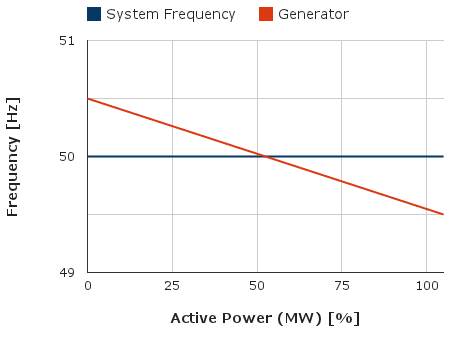
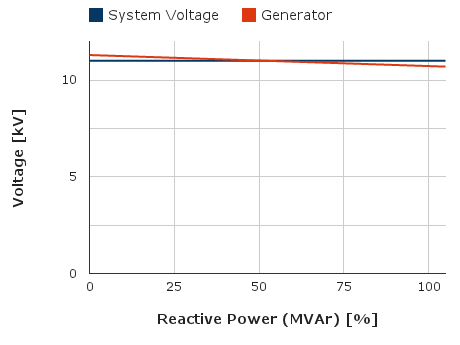
The generator governors control sharing real power (MW) and the voltage regulators which drive the exciters control sharing reactive power(MVAR). One generator governor (master) should be set to isochronous and the other in droop to share the real power (assuming the bus is not already powered). The voltage regulators usually have voltage droop to share the reactive load (MVAR).

Shown below are governor droop to share real power and voltage droop to share reactive power. More information here:

https://www.svri.nl/en/isochronous-vs-droop-control-for-generators/

Register to Reply Good Answer (Score 5)
Guru

Join Date: Apr 2017
Location: Southern Illinois
Posts: 627
Good Answers: 13
#2

Re: Parallel Connection

04/23/2019 12:21 AM

One thing to keep in mind, is that both generators should have roughly the same droop (speed and voltage measured in % of capacity). Otherwise, as the load changes, one could assume more of the change than the other, and not share an equal % of its capacity with the other. And, that's not good. If a load drops off the line, one could reverse power the other. Or, if a large load is started, one could easily get overloaded. Also you need to ensure that you don't get oscillating currents between the two due to reactive load hunting from the voltage regulators. Both generators should run at the same % of their capacity to allow for proper sharing of loads when those loads change. Otherwise one or the other can trip on a fault before you can react to it and dump the whole load on the other. Then the other could be overloaded and trip also. You never really know when a load will come on line or drop off. You don't want one of them to be left carrying the whole starting current/load or get reverse powered from a load dump. Reactive currents could flow between the generators without even getting to the line. Voltage regulator settings are important. Make sure that reactive loads are also equally shared (%-of-capacity-wise). That way, load changes won't take you by surprise.

As far as the effect on the step up transformer goes, I don't think it really cares where it gets it power from, as long as it stays within spec.

__________________
Science is the "cookbook" for making things.
Register to Reply
Associate

Join Date: Nov 2016
Posts: 38
#4
In reply to #2

Re: Parallel Connection

04/24/2019 3:19 PM

Dear sir

thanks for your replay

Please, can I formulate the question in another way

what is the difference between connected tow generator before step up transformer

or after step transformer.and What is the best way between them and why

thanks

Register to Reply
Guru

Join Date: Apr 2017
Location: Southern Illinois
Posts: 627
Good Answers: 13
#5
In reply to #4

Re: Parallel Connection

04/24/2019 8:01 PM

I have no idea. I never worked on/with such a system. Sorry.

__________________
Science is the "cookbook" for making things.
Register to Reply
Guru

Join Date: Dec 2010
Posts: 1686
Good Answers: 116
#6
In reply to #4

Re: Parallel Connection

04/28/2019 5:02 PM

Usually, step-up transfo is necessary because the generator(s) could not economically work at the higher voltage at its power rating.

Grid connections are 33/66/132 kilovolt or similar/more. Even generators of hundreds of Megawatt are not economic at 33 kV. There is a limit to the size of transmission cables which means that higher powers have to go to higher voltage for long distance.

Even if direct connection is feasible, it is usually the case that the amount of short circuit current at HV would wreck the generator for any fault. The transformer serves to limit the current from HV and isolate the generator, enabling effective protection against earth faults in generator stator windings.

The transfo also protects the Grid from the generator & it is unlikely Grid operator would agree to direct connection, since a fault on generator could affect other generator plant & customers.

Register to Reply
Guru
Engineering Fields - Mechanical Engineering - New Member

Join Date: May 2008
Location: CHENNAI, TAMIL NADU, INDIA.
Posts: 1851
Good Answers: 65
#3

Re: Parallel Connection

04/23/2019 12:26 PM

I want to supplement to the cr4 member Rixter.

The load sharing depends upon the Prime Movers droop character also.

DHAYANANHDAN.S

Register to Reply
Register to Reply 6 comments

Good Answers:

These comments received enough positive votes to make them "good answers".
Copy to Clipboard

Users who posted comments:

67model (1); Dennis R. Levesque (2); dhayanandhan (1); kasrop (1); Rixter (1)

Previous in Forum: Transformer Neutral Grounding   Next in Forum: Low Fault Level Effect on LRA and FLA

Advertisement