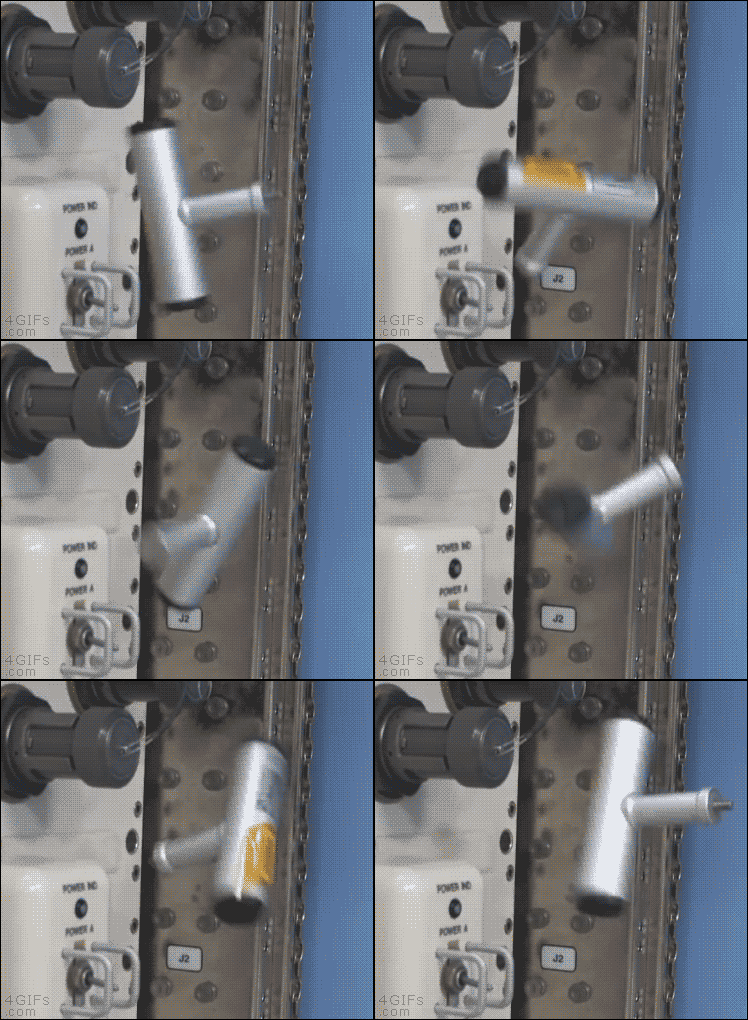
So, plate tectonics slowly moving the land masses around CAN / WILL eventually cause the earth to "flip." How many times has this ALREADY happened during the past 4.5 billion years of existence?
__________________
...and the Devil said: "...yes, but it's a DRY heat..!"
Maybe you could move some mass around so that the rotation axis is about the intermediate inertial axis. It would take a lot of energy since it is now in the minimum energy configuration.
We could then all switch hemispheres, north and south, periodically. It would be a heckuva ride, I suspect! Not the same old boring weather year after year.
__________________
"Did you get my e-mail?" - "The biggest problem in communication is the illusion that it has taken place" - George Bernard Shaw, 1856
Thanks, SE. This is not only fascinating but very well explained. I recalled from dynamics in college that a spinning object was stable about the major and minor axes but not about the intermediate axis, but never understood it until seeing this video.
I think it looks weird because it spins along happily until at some point it flips.
The axis of rotation through the object is really continuously moving around, very slowly when close to the intermediate principal axis, where it spends most of the time, and very quickly when it strays far enough away to be repelled to the same axis 180 degrees away. The process repeats.
It's a similar situation of a pendulum that can swing 360 degrees. It can be stopped almost at the top, an unstable equilibrium point, to eventually be repelled down one side and back up the other.
I'm fascinated by the videos taken on the space station and curious whether you could reproduce this effect on earth other than tossing a tennis racket into the air, which admittedly doesn't have the same impact.
I suppose you could reproduce it on the "vomit comet", but that's a bit pricey for 30 seconds of fun. Maybe a set of gimbals would let an "intermediate axis" object spin freely while supporting it against gravity. It might make a fun "desk toy".
If you decide to steal my idea and manufacture these things, please, at least send me one to play with.
I have not seen this effect before and in fascinating.
He mentioned how the earth is not feeling this effect. I would think the proven poles shifting at a fairly regular rate, that this effect is affecting at least the portion of the earth, that produces our magnetic fields, from inside the basic water bubble or molten core.
RG said nothing about poles reversing, just shifting.
We know for sure that plate tectonics moves large masses of the Earth's crust, albeit very slowly, in terms of human lifetimes. As these masses move, the rotational poles must shift at least slightly.
__________________
Teaching is a great experience, but there is no better teacher than experience.
I am not aware that anyone is arguing that point. However, from the mention of magnetic pole movement, plus the known reversals of the the same, plus several other person confusing the two, plus the random woo around this topic....
__________________
In vino veritas; in cervisia carmen; in aqua E. coli.
There are actually three main components of polar motion. Two are periodic, the Chandler wobble with a period of about 435 days, the annual oscillation, and a slow drift. These wobbles cover about a 15m diameter circle with a center that slowly drifts.
"The annual variation was discovered by Karl Friedrich Küstner in 1885 by exact measurements of the variation of the latitude of stars, while S.C. Chandler found the free nutation in 1891.[8] Both periods superpose, giving rise to a beat frequency with a period of about 5 to 8 years (see Figure 1)."
Polar motion in arc seconds as function of time in days (0.1 arcsec ≈ 3 meters).[1]
"Polar motion is observed routinely by very-long-baseline interferometry,[10]lunar laser ranging and satellite laser ranging.[11] The annual component is rather constant in amplitude, and its frequency varies by not more than 1 to 2%. The amplitude of the Chandler wobble, however, varies by a factor of three, and its frequency by up to 7%. Its maximum amplitude during the last 100 years never exceeded 230 mas."
"There is now general agreement that the annual component of polar motion is a forced motion excited predominantly by atmospheric dynamics."
The Chandler component is due to Euler nutation, a wobble about the angular momentum direction that decays with a time constant of decades or centuries. To still exist it has to be re-excited.
"An investigation was done in 2001 by Richard Gross at the Jet Propulsion Laboratory managed by the California Institute of Technology. He used angular momentum models of the atmosphere and the oceans in computer simulations to show that from 1985 to 1996, the Chandler wobble was excited by a combination of atmospheric and oceanic processes, with the dominant excitation mechanism being ocean‐bottom pressure fluctuations. Gross found that two-thirds of the "wobble" was caused by fluctuating pressure on the seabed, which, in turn, is caused by changes in the circulation of the oceans caused by variations in temperature, salinity, and wind. The remaining third is due to atmospheric fluctuations.[5] "
"The slow drift, about 20 m since 1900, is partly due to motions in the Earth's core and mantle, and partly to the redistribution of water mass as the Greenland ice sheet melts, and to isostatic rebound, i.e. the slow rise of land that was formerly burdened with ice sheets or glaciers.[2]:2 The drift is roughly along the 80th meridian west. However, since about year 2000, the pole has found new direction of drift, which is roughly along the central meridian. This dramatic eastward shift in drift direction is attributed to the global scale mass transport between the oceans and the continents."
There needs to distinguish between 'polar motion' as described and actual Axis-of-Rotation shift, ie a change in the earth axial tilt from the 23.xx deg. with respect to the ecliptic plane; a shift which science does not recognise.
However this happened in the past. It was first discerned by GF Dodwell. I found evidence of this recorded in megalithic calendars (now supported with proxies) (see link https://melitamegalithic.wordpress.com/2019/08/12/searching-evidence-deaths-tsunamis-and-earth-dynamics/ )
The Dzhanibekov Effect can explain how a near symmetric globe but with enough liquid can momentarily cause a partial flip (see bottle with liquid in video) if enough liquid mass disturbs the equality of the moments in the xy axis.
See para 142; quote " In this time they said that the sun had moved four times from his accustomed place of rising, and where he now sets he had thence twice had his rising, and in the place from whence he now rises he had twice had his setting;"
So the assurance at the end of the video may be misleading.
The earth is already flipped - partially-; it is the 23.4deg tilt. The next is to a smaller angle. It perhaps needs to have ice from poles removed, and put around the equator as water (see the bottle in the video towards the end - instability-).
__________________
"Did you get my e-mail?" - "The biggest problem in communication is the illusion that it has taken place" - George Bernard Shaw, 1856
There is evidence that the spin rate has changed, in so much as the year length in days changed. But no hint by how much.
The more important point (which for me was difficult to conceive) was how a partial tilt change could be initiated. As per liquid bottle in video, and the maths, a temporary change or not so small difference in the moments of inertia between the x and y axis in the equatorial plane can/may initiate an axial orientation change. Not a flip of 180deg but tilt change nevertheless. Speculatively this could be due to a large tidal bulge.
Four such changes are recorded, the last was what Dodwell perceived from the ancient tilt measurements.
Whatever,, there is now a mechanism, thanks to Dzhanibekov.
Based on the video, the fluid adds damping and forces the rotating body to it's maximum polar moment. I suspect that the light film of water on the planet is no where near as significant as the magma and liquid iron core at the center of the planet. However, as Dirk Gently says, everything is connected.
Observe the wing nut with ball of clay. When orientation changes 180deg., rotation with respect to space remains same. (ie the earth image later in video should not reverse rotation either).
With respect to bottle, the argument made is IMO wrong. Assuming no air friction, then energy is conserved, as in the case of a solid object. In the solid object every part of it retains its position, but with liquid once it is slightly perturbed liquid flow inside move differently than bottle. The video does not show if end-over-end rotation is stable for long. As per the wing nut, does the bottle change orientation periodically?
The wing nut -and T handle- change orientation repeatedly, while the solid cylinder spins stably. The difference is due to moment of inertia in x,y plane being unequal in first instance but equal in second.
Would a temporary liquid bulge on earth alters/disturbs x,y inertia equality to the extent of initiating an orientation change? This is the crux of the matter since such change appears to have occurred in the past. The importance of this phenomenon is that it goes beyond academic math interest and satellites.
The 23.4 deg tilt is different from what we're discussing here. This tilt is the angle of the earth's axis with respect to the ecliptic, the plane defined by the planets.
If the earth were to flip today, the north pole would still point to Polaris, the pole star, but the north pole would be in a different location on the earth.
There is some evidence that the north pole was in a different position millions of years ago...
If the earth's axis were to remain fixed with respect to the ecliptic, any change in pole position with respect to earth crust will be due to a 'crust shift' (which is happening slowly).
However, as evident in the case of the wing nut, it is axis shift that takes place, with respect to the stars. I am referring to rotational axis shift. The north pole may still be on the same place on earth, but both earth + axis would change orientation.
The wing nut goes into a full 180deg for some duration until it flips again, because moments of inertia are fixed. With earth a partial flip may take place for as long as the changes in inertia moments permit. See 'T' handle in #4.
If you watch the "wingnut movie", you'll notice that the wingnut is spinning counterclockwise when viewed looking at the panel with the spin axis pointed outward from the panel, and, at first you are looking at the top of the wingnut.
After it flips, it is still turning counterclockwise as viewed looking at the panel, but this time the bottom of the wingnut is outward. The spin direction remains the same with respect to the fixed stars because of the conservation of angular momentum. A microbe living on the wingnut would see its "North pole" switch from the top of the wingnut to the bottom.
If the mass distribution of the earth were modified so that it was no longer stable, the earth would still rotate about an axis pointing at the pole star, but the "North pole", where Polaris is directly overhead, would be located at a different location on the earth, even after compensating for continental drift.
There are two separate points to study carefully; and particularly the video at ~10:01, wing nut with clay.
1-- Momentum is conserved in both quantity and direction (vector)
2-- However the rotating mass is changing both its axial orientation and its direction of rotation, which in this case is ending reversed.
So a microbe (or an Egyptian in the Herodotus statement) would see the sun change its place of rising, being in reverse. And the axis (of the body) is pointing to a different place among the stars.
The axial orientation of the momentum vector is separate from the axial orientation (one axis under consideration in a 3dim) of the physical body of the rotating object.
Inching very slowly the video at 10:00 at the initiation point of instability, it can be seen that the axis of rotation is changing its orientation in space. Since, in actual fact it is orbiting the the sun (with satellite + earth), its obliquity to the ecliptic is also changing.
If the earth would undergo a transient moment of instability, it can be seen that its obliquity would undergo some change. Its rate of rotation would change (ie days/year would change). Its axis of rotation would point to some other point among the stars. Historically it means that what Plato claimed as "Now this has the form of a myth, but really signifies a declination of the bodies moving in the heavens around the earth, and --" , that is as seen from earth, is actually possible.
Actually, the polar melting has made the gyroscopic effect on the earth unstable producing a 10 day sine wave cycle that can be observed every day on the weather reports on the news.
I would like to have someone measure the shift from our 23.5 degree angle to the sun. It may already be in the installation charts for solar panels.
Good Answers: