Previous in Forum: Earthing System   Next in Forum: Encapsulated Pole
Close
Close
Close
17 comments
Rate Comments: Nested
Commentator

Join Date: Apr 2012
Location: Sanskrit
Posts: 57

Syncronous Motor Rotating Rectifier

02/17/2020 1:59 PM

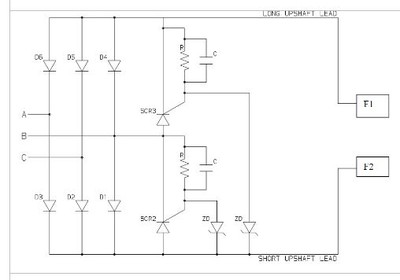
I have got this rotating rectifier for the rotor of the synchronous motor and this circuit needs to be tested.

I have two questions how does it work especially how the Zener diode work in this circuit and how do I find the avalanche voltage for these diodes - I looked in the data sheet and it seems the avalanche will occur at 200 Volts.

Another question is this circuit the two SCR are they for protection to sort the field when it gets above some voltage or it helps during the startup
for better quality pics

https://we.tl/t-AA1E6XSng7

Register to Reply
Pathfinder Tags: Synchronous motor
Interested in this topic? By joining CR4 you can "subscribe" to
this discussion and receive notification when new comments are added.

"Almost" Good Answers:

Check out these comments that don't yet have enough votes to be "official" good answers and, if you agree with them, vote them!
Guru
Engineering Fields - Electrical Engineering - Been there, done that. Engineering Fields - Control Engineering - New Member

Join Date: Dec 2008
Location: Long Island NY
Posts: 15600
Good Answers: 981
#1

Re: Syncronous motor Rotating rectifier

02/17/2020 3:49 PM

Once again CR4 image resolution is a problem. I cannot see enough detail to render a useful opinion. My WAG is that this is actually a DC motor circuit from a 3 phase power source.

__________________
"Don't disturb my circles." translation of Archimedes last words
Register to Reply
Guru

Join Date: Apr 2010
Location: About 4000 miles from the center of the earth (+/-100 mi)
Posts: 9910
Good Answers: 1141
#2

Re: Syncronous motor Rotating rectifier

02/17/2020 7:05 PM

3 phase AC voltage at A, B, and C, is full-wave rectified by diodes D1 - D6,

causing a "ripply DC" across F2-F1. The SCR circuits do appear to be a safety feature. When the Zener diode conducts over its breakdown voltage, current flows through the resistor impressing a voltage across the gate-cathode junction of the SCR which will then conduct as long as there is current flowing.

Voltage across F2 - F1:

Register to Reply Score 1 for Good Answer
Guru

Join Date: Apr 2010
Location: About 4000 miles from the center of the earth (+/-100 mi)
Posts: 9910
Good Answers: 1141
#3
In reply to #2

Re: Syncronous motor Rotating rectifier

02/17/2020 8:11 PM

I'm guessing that there is a DC exciter field in the stator controlled by a voltage regulator. Three coils on the rotor (exciter rotor) are delta connected to A, B, C, which pass 3 phase current to this rectifier circuit.

The output, F1 and F2 drive the rotor field winding which generates power in the stator windings, which are the output of the alternator.

Register to Reply
Guru

Join Date: Mar 2007
Location: by the beach in Florida
Posts: 33392
Good Answers: 1817
#4
In reply to #3

Re: Syncronous motor Rotating rectifier

02/17/2020 8:22 PM

So this is a speed controller circuit?

__________________
All living things seek to control their own destiny....this is the purpose of life
Register to Reply
Guru

Join Date: Apr 2010
Location: About 4000 miles from the center of the earth (+/-100 mi)
Posts: 9910
Good Answers: 1141
#5
In reply to #4

Re: Syncronous motor Rotating rectifier

02/17/2020 8:40 PM

The only difference between a synchronous motor and an alternator is the direction that power is flowing. If you turn it with an engine, it's an alternator. If you apply power to the stator windings, it's a synchronous motor.

https://circuitglobe.com/excitation-system-of-synchronous-machine.html

Register to Reply
Guru

Join Date: Jul 2016
Posts: 1367
Good Answers: 105
#7
In reply to #5

Re: Syncronous motor Rotating rectifier

02/17/2020 11:20 PM

Synchronous motors require starting windings, amortisseur windings, to get the motor close to synchronous speed, then the field is applied to pull the rotor into synchronism.

Generators/alternators don't require these windings, though you can drive a synchronous motor and make it a generator. Won't work, running an alternator as a motor unless it is rotated up to a reasonable speed before applying power.

Register to Reply
Guru
Hobbies - HAM Radio - New Member United Kingdom - Big Ben - New Member Fans of Old Computers - Altair 8800 - New Member Canada - Member - New Member

Join Date: Jun 2006
Location: Toronto
Posts: 3968
Good Answers: 120
#6

Re: Syncronous motor Rotating rectifier

02/17/2020 9:11 PM

they call this synchronous rectification and they do it with fets now instead of diodes to avoid the diode drops.

https://www.google.com/search?q=FET+synchronous+rectification&oq=FET+synchronous+rectification&aqs=chrome..69i57.2391j0j8&sourceid=chrome&ie=UTF-8

__________________
Per Ardua Ad Astra
Register to Reply
Guru

Join Date: Jul 2016
Posts: 1367
Good Answers: 105
#8
In reply to #6

Re: Syncronous motor Rotating rectifier

02/17/2020 11:33 PM

Or commonly called in the U.S. brushless exciter. Usually the rotating phase rectifiers are not controlled, the rotor/field excitation current of the main machine is controlled by the current in the fixed field winding control, so no sliprings are required. Think of the exciter as an inside-out pilot alternator, where the phase windings rotate, and the field winding is stationary.

Not sure how you can actively control the rotating rectifiers on a synchronous motor brushless exciter, I think the references cited do not apply to synchronous motor excitation rectification, interesting nonetheless.

Register to Reply
Guru

Join Date: Jul 2016
Posts: 1367
Good Answers: 105
#9

Re: Syncronous motor Rotating rectifier

02/17/2020 11:52 PM

It would help to include the circuitry that is not part of the exciter, such as the pilot exciter phase windings and the exciter field winding control.

Of interest is the motor field application relay, which energizes the field winding once the motor is close to synchronous speed. We can't see that from here, to quote PW Slack.

From your manual, the pilot exciter phase windings are clamped until the rotor is up to speed, to prevent residual magnetism from energizing the field prematurely, which would hinder starting the motor.

The manual is reasonably well written, but does assume a certain knowledge of the subject matter. The test procedure looks pretty straight forward.

Register to Reply
Commentator

Join Date: Apr 2012
Location: Sanskrit
Posts: 57
#10

Re: Syncronous motor Rotating rectifier

02/18/2020 12:02 AM

I think when the rotor is not rotating and there is AC 3 phase in the stator of the motor the rotating magnetic field of the stator will induce a single phase voltage back into this circuit because this is connected to the Rotor

now since the diodes in the path of the current it will only conduct during half cycle but once SCR are turned on by Zener both positive and negative cycle current will flow in circuit .

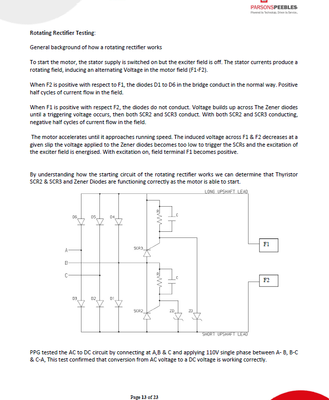
General background of how a rotating rectifier works

To start the motor, the stator supply is switched on but the exciter field is off. The stator currents produce a

rotating field, inducing an alternating Voltage in the motor field (F1-F2).

When F1 is positive with respect to F2, the diodes D1 to D6 in the bridge conduct in the normal way. Positive

half cycles of current flow in the field.

When F2 is positive with respect F1, the diodes do not conduct. Voltage builds up across The Zener diodes

until a triggering voltage occurs, then both SCR2 and SCR3 conduct. With both SCR2 and SCR3 conducting,

negative half cycles of current flow in the field.

The motor accelerates until it approaches running speed. The induced voltage across F1 & F2 decreases at a

given slip the voltage applied to the Zener diodes becomes too low to trigger the SCRs and the excitation of

the exciter field is energised. With excitation on, field terminal F1 becomes positive.

By understanding how the starting circuit of the rotating rectifier works we can determine that Thyristor

SCR2 & SCR3 and Zener Diodes are functioning correctly as the motor is able to start.

Here it says that the motor starts - I am not aware of this method of starting syncronous motors - interesting

Register to Reply
Guru

Join Date: May 2018
Location: Under the spreading Bunya Trees, South Burnett, Queensland, Australia
Posts: 807
Good Answers: 65
#11

Re: Syncronous motor Rotating rectifier

02/18/2020 4:02 AM

By controlling the three phases A,B,C, it is possible to change the excitation of the synchronous motor make it run with leading or lagging power factor, used in Draglines to correct power factor to the supply.

This is also used in Synchronous Condensers to correct the power factor seen by the supply authority.

The sync motors I have worked with use amortisseur or squirrel cage winding so they act as an induction motor and when at normal run speed the Dc field is applied and the motor slips into sync with the supply frequency.

Some use wound rotor motors where the rotor windings are connected to a load that is gradually reduced to act as a soft start before the dc winding is energised. I am talking about 3 to 10 MW HV motors.

__________________
Hare today, goon tomorrow!
Register to Reply
Guru

Join Date: Apr 2010
Location: About 4000 miles from the center of the earth (+/-100 mi)
Posts: 9910
Good Answers: 1141
#16
In reply to #11

Re: Syncronous motor Rotating rectifier

02/20/2020 4:35 PM

By controlling the three phases A,B,C, it is possible to change the excitation of the synchronous motor make it run with leading or lagging power factor, used in Draglines to correct power factor to the supply.

That's the same effect as is seen in paralleled alternators where the excitation (voltage adjustment) differs between the two. Cross-currents (reactive current) flows between the two machines.

"...if the excitation of one of the alternators is increased, it will cause flow of synchronising current Isy almost in quadrature with supply voltage V. Therefore, the load current of alternator 1, whose excitation has been increased, will be I1, the phasor sum of Isy and I and that of alternator 2 will be I2, the phasor difference of Isy and I."

http://www.engineeringenotes.com/electrical-engineering/alternators/parallel-operation-of-alternators-devices-electrical-engineering/29784

Register to Reply
Commentator

Join Date: Apr 2012
Location: Sanskrit
Posts: 57
#12

Re: Syncronous motor Rotating rectifier

02/18/2020 4:09 AM

Did some Testing attaching scope waveforms in the document

https://gofile.io/?c=FtncXy

When the SCR fires the Diode part vanishes- Can someone comment Please ?

Register to Reply
Commentator

Join Date: Apr 2012
Location: Sanskrit
Posts: 57
#13

Re: Syncronous Motor Rotating Rectifier

02/18/2020 8:43 AM

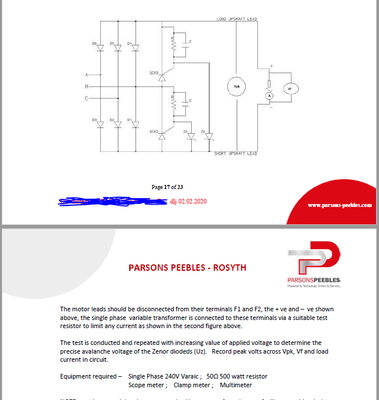
AC single phase using a variac was connected at F1 F2, after disconnecting the rotor

got this waveform on scope,looks good so far

then increased the voltage from the variac and at 144vac the waveform changes

as the SCR triggered by the Zener diode . I wonder where is the diode part gone ???

I expected to see both diode half wave followed by SCR half wave but here

Register to Reply Score 1 for Good Answer
Guru

Join Date: Apr 2010
Location: About 4000 miles from the center of the earth (+/-100 mi)
Posts: 9910
Good Answers: 1141
#14
In reply to #13

Re: Syncronous Motor Rotating Rectifier

02/18/2020 2:26 PM

I wonder where is the diode part gone ???

I expected to see both diode half wave followed by SCR half wave but here

Once the voltage reaches the point where the Zener breaks down, current goes through the resistor impressing a voltage across the gate-cathode junction of the SCR. Once the SCR is triggered on, it remains on as long as current is flowing through it. Once the current stops, the SCR is again non-conducting until the gate is triggered.

"Forward conduction mode[edit]

An SCR can be brought from blocking mode to conduction mode in two ways: Either by increasing the voltage between anode and cathode beyond the breakover voltage, or by applying a positive pulse at the gate. Once the SCR starts conducting, no more gate voltage is required to maintain it in the ON state.

There are two ways to turn it off:

  1. Reduce the current through it below a minimum value called the holding current, or
  2. With the gate turned off, short-circuit the anode and cathode momentarily with a push-button switch or transistor across the junction."

https://en.wikipedia.org/wiki/Silicon_controlled_rectifier

Register to Reply
Power-User

Join Date: Dec 2019
Posts: 160
Good Answers: 14
#17
In reply to #14

Re: Syncronous Motor Rotating Rectifier

02/20/2020 6:07 PM

The variac source will turn the SCR off during the cycle when F1 is positive with respect to F2. This effectively applies about 1 V to the SCR with the anode negative and the cathode positive turning the SCR off.

Register to Reply
Power-User

Join Date: Dec 2019
Posts: 160
Good Answers: 14
#15
In reply to #13

Re: Syncronous Motor Rotating Rectifier

02/19/2020 2:10 PM

I think this is a bogus circuit. If you remove the SCR's and supplied 3-phase to a-b-c you'll have a full-wave DC bridge rectifier and an unfiltered DC output F1 (neg) and F2 (pos). There isn't a trigger circuit, as such, to the SCR gate, the SCR' are only turned on if the Zener threshold is exceeded; but when the SCR turns on there is a short circuit between a or c and b depending on whether a or c is positive with respect to b. Which SCR turns on depends on whether a or c, or is positive with respect to b. Now, it appears in the oscilloscope that F1 and F2 is the voltage source and the output is supposed to be a, b, c. There has to be a load in series with the variac to get the waveform shown because, if F1 is positive with respect to F2 diodes D1-D6 are forward biased and conducting, effectively shorting out the SCR's. When F1 is negative with respect to F2 you get the half wave as shown and when the voltage is increased to the point the Zener diode conducts, the SCR turns on and you get the clipped phase of the AC.

Register to Reply
Register to Reply 17 comments

"Almost" Good Answers:

Check out these comments that don't yet have enough votes to be "official" good answers and, if you agree with them, vote them!
Copy to Clipboard

Users who posted comments:

aurizon (1); minggrabber (3); R_i_c_h (2); redfred (1); Rixter (5); rwilliams (3); SolarEagle (1); Stef (1)

Previous in Forum: Earthing System   Next in Forum: Encapsulated Pole

Advertisement