Previous in Forum: Lighting Calculation as Per AS 2293   Next in Forum: 500 KV Auto Transformer with Oil to SF6 Bushing Test
Close
Close
Close
5 comments
Rate Comments: Nested
Anonymous Poster #1

How to Generate an Excitation AC Current from Microcontroller Port?

03/16/2020 10:03 PM

I have a CT with 1000 turns secondary, and 1000 turns test winding, and obviously one turn primary. The turns ratio between secondary and test winding is 1:1, and from primary to secondary is 1000:1. This mean the current I inject in the test winding will be the same in the secondary winding. The test winding is not always active comparing to the secondary winding which has a burden resistor and is being continuously monitored by an ADC. What I'm trying to do is to generate a detectable 50Hz AC current (something between 30 uA to 10 mA) with the microcontroller.
The CT detects current as low as 10 mA in the primary. Let's say we have 20 mA in the primary, we have 20 uA in the secondary. So that's why even 20 uA would be enough as the test signal.

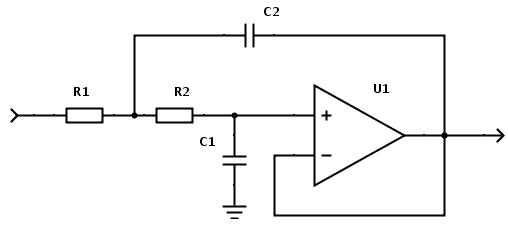
The idea below is to generate a PWM and make it pass through a low pass filter to get a close sine wave. The capacitor at the output of the opamp for AC coupling and a resistor to limit the current since the DC resistance of the test winding is 80 ohms.

Is this idea good? I heard I need a way to disconnect the test winding asap the test is done so not to interfere with the actual secondary winding.

Reply
Interested in this topic? By joining CR4 you can "subscribe" to
this discussion and receive notification when new comments are added.

Good Answers:

These comments received enough positive votes to make them "good answers".
2
Guru

Join Date: Apr 2010
Location: About 4000 miles from the center of the earth (+/-100 mi)
Posts: 9912
Good Answers: 1141
#1

Re: How to Generate an Excitation AC Current from Microcontroller Port?

03/17/2020 10:04 PM

I don't see why it wouldn't work. A CT works in both directions. I once tested some circuit breakers by driving a CT with a variac to generate a large current in a loop of wire connected to the breaker.

You could use a 555 timer to generate a square wave, cheaper than a microcontroller. A single RC stage isn't going to make a pretty sine wave. You might think about filtering with a Sallen-Key filter if a better sinewave is important. (I don't know, maybe your transformers will do some filtering for you.)

Sallen Key filter: Online Calculator

Reply Good Answer (Score 2)
Anonymous Poster #1
#3
In reply to #1

Re: How to Generate an Excitation AC Current from Microcontroller Port?

03/22/2020 11:33 AM

Here is better quality pic of the circuit.

I don't need perfect sine wave, so that should be OK. As long as it's AC. I added R2 to limit the max current. The resistance of the test winding (measured with a meter) ranges across 75-100 ohms in different models. But I got a question.. Doesn't R2 and C2 present a load for the test winding? Putting the micro port in high impedance would help? Also, as the ratio between secondary and test winding is 1:1, does the burden resistor across the actual secondary present a load for the test drive?

Reply
Guru

Join Date: May 2018
Location: Under the spreading Bunya Trees, South Burnett, Queensland, Australia
Posts: 809
Good Answers: 65
#2

Re: How to Generate an Excitation AC Current from Microcontroller Port?

03/18/2020 4:27 AM

Why not just use a low voltage AC transformer with the primary controlled by a variac to impress the required signal onto the test winding so you produce the desired result.

As for the test winding surely you need to have it shorted when not in use else if it is open circuited then the voltage at its terminals will be as high as can be achieved before the CT saturates and could theoretically reach 1000 times the line voltage. CT shorting blocks should be used such that when the external load is disconnected the block automatically shorts the CT.

Your project would seem to be excessively complex for a task easily achieved.

__________________
Hare today, goon tomorrow!
Reply
Guru

Join Date: Dec 2010
Posts: 1686
Good Answers: 116
#4

Re: How to Generate an Excitation AC Current from Microcontroller Port?
03/24/2020 2:07 PM

It seems to me you are making an assumption that the primary single turn is unloaded.

If it is loaded (powered up) then your test currents will swamped by unknowns. Even with power off, there may be source capacitors which circulate primary currents. A user will not make his system to suite your test method.

A 1000 turn test winding seems a lot of trouble compared to a single turn, or better the actual primary.

Since your primary test current is only milliamps, assuming your primary can be isolated for test, I would use a 240V/6V bell or similar transformer from mains with a 240V primary resistor to limit the current. The 6V winding would be connected to circulate through your primary. The current in your CT primary could be measured directly by a multimeter. The waveform would be as good as a filtered square wave.

N.B. if you want a known current in the test winding, a resistor in the GND return of the test winding, connected [via resistor] to inverting input of IC makes current follow the IC voltage input - watch out for loop gain/phase oscillation problems!

I note that with your proposed circuit the actual current in the test winding will depend greatly on the IC supply voltage, its actual output swing, the low pass filter parts [R1, C1?] and R2/C2 & test winding. Also, once you power the primary, the test winding will circulate a current in your test winding/circuit, theoretically equal to that in the secondary, which is a huge error, ignoring damage to IC, R2, C2 if secondary should be disconnected.

In practical situations, you must also consider the current in the test/secondary/primary winding circuit should there be a short circuit in the primary circuit. Good multimeters do not have a quick high breaking capacity fuse in both volt and current circuits for nothing. A quick calculation shows that a 5 metre run of 2.5 sq.mm copper cable to a socket allows a short-circuit current of 3 kA rms at 230V [around here you can have 16 kA fault level at the house entry].

Reply
Anonymous Poster #1
#5
In reply to #4

Re: How to Generate an Excitation AC Current from Microcontroller Port?

04/16/2020 9:02 PM

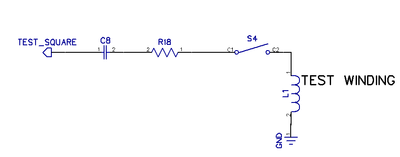
I made a few changes, but have to test them. I removed the op amp, and just let the micro port directly into the test winding. I added an analog switch to open the winding when not testing. C18, R18 form a high pass filter. The micro would output a square wave. See below.

Reply
Reply to Forum Thread 5 comments

Good Answers:

These comments received enough positive votes to make them "good answers".
Copy to Clipboard

Users who posted comments:

67model (1); Anonymous Poster (2); Rixter (1); Stef (1)

Previous in Forum: Lighting Calculation as Per AS 2293   Next in Forum: 500 KV Auto Transformer with Oil to SF6 Bushing Test

Advertisement