Previous in Forum: Information Security   Next in Forum: Telecom Engineer
Close
Close
Close
16 comments
Rate Comments: Nested
Commentator

Join Date: Oct 2006
Location: Buenos Aires, Argentina
Posts: 89

Water Detection at Pump Intake

08/02/2020 2:08 PM

Hi, I need help to resolve some problem with the water supply to my house, which is located in a second floor of a building.

I have a pump in the third floor (a terrace) to feed the tanks which in turn feed the house. My issue is that at certain hours, the water pressure from the company is not enough to reach my pump, so if in this moment the pump starts it will run dry, not a convenient situation, specially for the sealings.

In summary, I need a device to sensor if, at pump intake, there is water or not. I suppose that it would possible to do with two contacts, for example 1/8” apart, and appropiate circuit to detect the condition, whether or not there is water between them, so to drive a relay or contactor to drive the the pump (⅓ HP)

I’m mechanical engineer, and I ask for some advice of how to do that, in a low budget basis. I prefer an electronic device, not something electromechanical, like a float and a switch, because I had this device and the experience was not good.

Thanks a lot.

Gabriel, Buenos Aires, Argentina

__________________
Gabriel, Buenos Aires, Argentina
Register to Reply
Pathfinder Tags: Water detection
Interested in this topic? By joining CR4 you can "subscribe" to
this discussion and receive notification when new comments are added.

"Almost" Good Answers:

Check out these comments that don't yet have enough votes to be "official" good answers and, if you agree with them, vote them!
Guru

Join Date: Apr 2010
Location: About 4000 miles from the center of the earth (+/-100 mi)
Posts: 9910
Good Answers: 1141
#1

Re: Water detection at pump intake

08/02/2020 4:13 PM

I think what you are looking for is called a "Pumpsaver".

Register to Reply
Commentator

Join Date: Oct 2006
Location: Buenos Aires, Argentina
Posts: 89
#8
In reply to #1

Re: Water detection at pump intake

08/03/2020 10:36 AM

Thanks for your comment.

__________________
Gabriel, Buenos Aires, Argentina
Register to Reply
Power-User

Join Date: Nov 2009
Posts: 335
Good Answers: 63
#2

Re: Water detection at pump intake

08/02/2020 4:20 PM

A conductivity or capacitance switch could be used to signal the presence or absence of water in the pipe and to interlock the pump in the event there's no water.
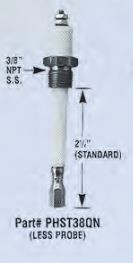
There are two components, the electrode probe that goes into the pipe,

and an electronic controller with a relay output:

The pipe must be grounded to be the other electrode in the sensing circuit.

The ones I'm familiar with are designed for level applications, where the electrode probe is inserted from the top or side of the tank. As you can see from the dimensions , the probe is several inches (55mm) long. The probe can be inserted into a Tee with a nipple and coupling to as a stand-off so that the probe can sense the water but not obstruct the flow path.

Register to Reply
Guru

Join Date: Apr 2010
Location: About 4000 miles from the center of the earth (+/-100 mi)
Posts: 9910
Good Answers: 1141
#3

Re: Water detection at pump intake

08/02/2020 7:04 PM
Register to Reply
Guru

Join Date: Mar 2007
Location: by the beach in Florida
Posts: 33392
Good Answers: 1817
#4

Re: Water detection at pump intake

08/02/2020 10:19 PM

I think I would rather have a booster pump on the ground that would correct the problem instead of just adapting to it...or possibly a larger water tank as an alternative...In any case I would demand a constant supply of water...

__________________
All living things seek to control their own destiny....this is the purpose of life
Register to Reply Score 1 for Good Answer
Guru

Join Date: Aug 2014
Location: Port Macquarie N.S.W. Australia
Posts: 1071
Good Answers: 225
#5

Re: Water detection at pump intake

08/02/2020 11:41 PM

I am assuming that the pump (on the third floor) is located somewhere near the tanks which, as you have stated, then feed the house.

I also assume that the main water supply (which at times does not have sufficient pressure to reach that third floor) comes into the house at ground level.

As pumps generally have a higher maximum head (the height they can push the water) than they do suction lift (the depth from which they can suck the water, would it not be a better proposition to relocate the pump down to a lower level (preferably ground level) so that it does not suffer this problem?

This may be a simple cut and shut operation to achieve, assuming of course (I do a lot of that), that the water supply can keep the pump flooded even at ground level

Register to Reply Score 1 for Good Answer
Guru

Join Date: Dec 2010
Location: North West England
Posts: 1170
Good Answers: 153
#6

Re: Water detection at pump intake

08/03/2020 3:45 AM

As well as a water presence sensor you need a water pressure sensor. If there is water but at a very low pressure, when the pump starts it will possible suck the feed line dry but more likely it will cause cavitation damaging the impellers. Seal damage you have to replace the seals and possibly the motor if the pump seizes, impeller damage you have to replace the pump.

Register to Reply
Guru
United Kingdom - Member - Indeterminate Engineering Fields - Control Engineering - New Member

Join Date: Jan 2007
Location: In the bothy, 7 chains down the line from Dodman's Lane level crossing, in the nation formerly known as Great Britain. Kettle's on.
Posts: 32175
Good Answers: 839
#7

Re: Water detection at pump intake

08/03/2020 5:00 AM

There is a non-intrusive thing called a phase angle detector, which measures the peak of the voltage waveform, the peak of the current waveform, and infers the angle between two.

  • If the peaks are close together, then the pump is doing work, which classes as "water present".
  • If the peaks start to get spaced out then the pump is not doing any work, which classes as "water absent". The pump can then be stopped through external controls.

Will that do?

[Used successfully on a water treatment plant many years ago.]

__________________
"Did you get my e-mail?" - "The biggest problem in communication is the illusion that it has taken place" - George Bernard Shaw, 1856
Register to Reply
Commentator

Join Date: Oct 2006
Location: Buenos Aires, Argentina
Posts: 89
#9

Re: Water Detection at Pump Intake

08/03/2020 10:38 AM

Thanks for your comment and advices.

__________________
Gabriel, Buenos Aires, Argentina
Register to Reply
Guru

Join Date: Jul 2016
Posts: 1367
Good Answers: 105
#10

Re: Water Detection at Pump Intake

08/03/2020 12:32 PM

As suggested by several, a low pressure switch on the suction seems to be the best solution, inexpensive & reliable. This one allows pumping with 5 psi or more on the suction, installs in a small threaded hole, and costs $22 from this source.

My first thought was a conductive type level sensor, but this idea is much better.

https://www.freshwatersystems.com/products/low-pressure-shut-off-switch-1-8-male-npt

Register to Reply Score 1 for Good Answer
Commentator

Join Date: Oct 2006
Location: Buenos Aires, Argentina
Posts: 89
#11
In reply to #10

Re: Water Detection at Pump Intake

08/03/2020 6:54 PM

Hi, I agree that is the simplest way, but the pressure shut off is high, 5 psi means 3 meters of column of water. To much for my case.

Thanks for your interest.

Gabriel

__________________
Gabriel, Buenos Aires, Argentina
Register to Reply
Guru

Join Date: Jul 2016
Posts: 1367
Good Answers: 105
#14
In reply to #11

Re: Water Detection at Pump Intake

08/03/2020 9:49 PM

You can’t get 5 psi from your water supply on the 3rd floor? Maybe you would be better off with a vented head tank, filled with a float valve or valve run by a level switch. The fact that you have water in the suction pipe won’t prevent you from operating the pump with inlet pressure low enough to damage the pump due to cavitation, perhaps more damage than running dry. Interlock the pump based on level, that way you know you have some atmospheric pressure for NPSHA. Home Depot sells these, similar equipment used in industrial apps for sewers & dirty sumps. Highly reliable in my 30 yrs of application in industrial locations.

Register to Reply
Power-User

Join Date: Nov 2009
Posts: 335
Good Answers: 63
#12
In reply to #10

Re: Water Detection at Pump Intake

08/03/2020 7:50 PM

Great idea, far less costly than a conductivity switch.

5 PSI = ~3.5m water column

The pressure switch would have to mounted in the vertical supply line ~3.5m below the top of the suction inlet to the pump to "prove" a columm of water 3.5m above the pressure switch.

The only concern is that when flow starts, a venturi effect of the flow across the sensing will is likely to reduce the pressure and the switch could trip, unless the pressure reduction is in the switch deadband. I know of no formula for calculating pressure drop across a dead headed orifice port. Does anyone else?

Register to Reply
Guru

Join Date: Jul 2016
Posts: 1367
Good Answers: 105
#13
In reply to #12

Re: Water Detection at Pump Intake

08/03/2020 9:30 PM

The calculation is the same as for calculating the pressure drop for flow through the run of a tee fitting. Since there is no flow in the tee branch, the pressure there will be slightly less than at the entry of the tee, but the velocity will be relatively low, designed for economic operation. Unlikely to cause even a 1/2 psi drop for normal 1” flow applications.

Register to Reply
Guru
Engineering Fields - Civil Engineering - Member

Join Date: Mar 2011
Location: ''but, don't we get PAID to ask questions?...''
Posts: 1661
Good Answers: 17
#15

Re: Water Detection at Pump Intake

08/04/2020 5:26 PM

Do you have a swimming pool at ground level where you reside?

If your upstairs water does not need to be potable, then a swimming pool could be made to function as a stand-by water supply...

__________________
''illigitimi non carborundum...''(i.e.: don't let the fatherless (self-deluding,sabotaging, long-term-memory-impaired, knee-jerking, cheap-shotting, mono-syllabic, self-annointed, shadow-lurking, back-biting, off-topic-inquisitors) grind you down...)
Register to Reply Score 2 for Off Topic
Guru

Join Date: Dec 2010
Posts: 1686
Good Answers: 116
#16

Re: Water Detection at Pump Intake

08/15/2020 3:54 PM

An electronic device is not low budget compared to a mechanical pressure switch.

You should get the minimum suction pressure for your pump from its manufacturer. Then you can find a suitable switch.

From what you write & size of pump; it may not have a starter with overload protection. There is a risk the pump will start & the pressure loss in suction pipe resets suction pressure switch - causing a cycle of starts, which are high stress (heating) for motor. The simple precaution is a timer which, when the pump stops, does not allow it to start again for about 10 minutes. This may be no problem -compared to your observation of service running times & stationary times.

I guess there is now a level switch controlling the pump, with enough differential to avoid frequent short runs of motor.

Register to Reply
Register to Reply 16 comments

"Almost" Good Answers:

Check out these comments that don't yet have enough votes to be "official" good answers and, if you agree with them, vote them!
Copy to Clipboard

Users who posted comments:

67model (1); Carl_E (2); Gabriel (3); jhhassociates (1); MR. Guest (1); PWSlack (1); Rixter (2); rwilliams (3); SolarEagle (1); spades (1)

Previous in Forum: Information Security   Next in Forum: Telecom Engineer

Advertisement