Previous in Forum: Yaskawa A1000 Current Detection Error   Next in Forum: Heating Elements in 3 Phase Configuration
Close
Close
Close
34 comments
Rate Comments: Nested
Active Contributor

Join Date: Mar 2011
Posts: 17

Watt Reducer Circuit

08/13/2020 1:49 PM

Should I put the PLC Relay switch before or after the Watt Reducer? Circuit A or B? I have 16 solenoid valves running off a PLC in a sequence. Does the Watt Reducer need to have power all the time to keep capacitor charged or does it not matter? The valve manufacturer provided the Watt Reducers but did not have specs.

Register to Reply
Interested in this topic? By joining CR4 you can "subscribe" to
this discussion and receive notification when new comments are added.

Good Answers:

These comments received enough positive votes to make them "good answers".

"Almost" Good Answers:

Check out these comments that don't yet have enough votes to be "official" good answers and, if you agree with them, vote them!
Guru

Join Date: Apr 2008
Location: Chicago
Posts: 3990
Good Answers: 144
#1

Re: WATT REDUCER CIRCUIT

08/13/2020 1:57 PM

I was looking into this during the previous post and didn't find much..

Why don't you hook it up in various configurations and measure the resulting watts and operational temperature after a a continuous duty cycle?

The worst that can happen is the smoke escapes? In the name of science...

I'm interested in finding out how well it could work at all?

__________________
High Tolerance is Beautiful
Register to Reply
Active Contributor

Join Date: Mar 2011
Posts: 17
#2
In reply to #1

Re: WATT REDUCER CIRCUIT

08/13/2020 2:17 PM

yes I was planning to breadboard the circuits and try both but hope to find a correct answer here. I have 16 valves with 16 watt reducers run off 16 relays from 1 PLC

Register to Reply
Guru

Join Date: Dec 2007
Location: Haverhill, MA
Posts: 1149
Good Answers: 151
#3

Re: Watt Reducer Circuit

08/13/2020 4:24 PM

I would put it between the PLC output and the load (solenoid), but that is my WAG without reviewing the device's documentation

__________________
The older I am, the better I used to be
Register to Reply
2
Power-User

Join Date: Dec 2019
Posts: 160
Good Answers: 14
#4

Re: Watt Reducer Circuit

08/13/2020 10:37 PM

I suspect the capacitor is in series with the solenoid and has a resistor in parallel with the capacitor. When the power is applied the capacitor allows full voltage to be applied to the solenoid and as it charges the resistor is to supply enough current to keep the solenoid on plus a safety factor. When power is removed the capacitor discharges through the resistor and is ready for the next cycle. It doesn't matter if the PLC actuating contact is before or after the "watt saver" device (unless you are using a transistor output to drive the solenoid; in that case you need to put in some transient protection to prevent the solenoid transient on turning off from damaging the transistor output.

Register to Reply Good Answer (Score 2)
Power-User

Join Date: Jan 2015
Location: Johannesburg, South Africa
Posts: 248
Good Answers: 3
#12
In reply to #4

Re: Watt Reducer Circuit

08/15/2020 3:39 AM

The protection diode on the output of the PLC will be activated by the negative pulse created by the collapsing magnetic field from the coil.

__________________
Tragedy for Engineers is thinking they know so much that they can not learn from any body else.
Register to Reply
Power-User

Join Date: Dec 2019
Posts: 160
Good Answers: 14
#16
In reply to #12

Re: Watt Reducer Circuit

08/16/2020 12:46 AM

Not all PLC transistor outputs have diode protection built in.

Register to Reply
Guru

Join Date: Aug 2005
Location: Hemel Hempstead, UK
Posts: 5826
Good Answers: 322
#18
In reply to #16

Re: Watt Reducer Circuit

08/17/2020 7:04 AM

And anyway, in this case the PLC "output" is just a relay contact (don't know if that relay is part of the PLC or driven by it). So any transistors are completely isolated from the circuit under discussion.

__________________
If you spend all your time looking for people and things to complain about: trust me, you will find plenty to complain about.
Register to Reply
Guru

Join Date: Dec 2010
Location: North West England
Posts: 1170
Good Answers: 153
#5

Re: Watt Reducer Circuit

08/14/2020 4:00 AM

How critical is the timing of your solenoid operation? If the watt saver is after the contact there will be a delay of 500-700 milli-seconds while the capacitor charges before the solenoid actuates. (when you build your breadboard you should time this. The delay quoted is not fact, just an experienced guess) But because the watt saver is not continuously charged I would expect it to have a longer service life.

Summary: Contact before - Slower operation - longer life, Contact after - Quicker operation - shorter life

Register to Reply
Power-User

Join Date: Jan 2015
Location: Johannesburg, South Africa
Posts: 248
Good Answers: 3
#15
In reply to #5

Re: Watt Reducer Circuit

08/15/2020 11:42 AM

The cap is a coupling cap and the Negative plate on switch on will immediately start charging through the coil of the valve which is a wire and practically a short circuit until the magnetic field expand and oppose the current flow. By that time, a split second later the valve is fully on. The delay is fractional more than raw 24V application would be.

Do we want to suggest that a Bass Boom will be delayed 700mS by a coupling capacitor in music, that will be chaos.

__________________
Tragedy for Engineers is thinking they know so much that they can not learn from any body else.
Register to Reply
Guru

Join Date: Mar 2007
Location: by the beach in Florida
Posts: 33392
Good Answers: 1817
#6

Re: Watt Reducer Circuit

08/14/2020 8:16 AM

The only thing I see is the possibility of a voltage spike from the watt reducer damaging the plc if the circuit is rated below the spike, so that would have to be tested and the spec found for the plc contact circuit....and also the possibility that the maintenance current is rendered too low when resistance of the plc is added to the circuit...so the operating parameter of the watt saver and the working range of the plc must both be known...or you could just put it after the plc, if the momentary delay is not an issue....

__________________
All living things seek to control their own destiny....this is the purpose of life
Register to Reply
Guru

Join Date: Aug 2005
Location: Hemel Hempstead, UK
Posts: 5826
Good Answers: 322
#7

Re: Watt Reducer Circuit

08/14/2020 11:37 AM

It's worth having a quick "look" at the reducer with a meter.

I'm guessing that the blue wire will go straight through the device.

Most simplistically the brown wire will just have a resistor in series; and, a capacitor in parallel with the resistor.

If this is the case it makes absolutely no difference whether the controller contact is before or after the reducer.

__________________
If you spend all your time looking for people and things to complain about: trust me, you will find plenty to complain about.
Register to Reply
Power-User

Join Date: Jan 2015
Location: Johannesburg, South Africa
Posts: 248
Good Answers: 3
#8

Re: Watt Reducer Circuit

08/14/2020 12:20 PM

The capacitor is actually a coupling Capacitor and do not charge as a capacitor in a smoothing circuit. It is used and act like a short circuit when the contact is activated and will immediately activate the valve and then the current through the resistor will be used to keep the valve activated. For the circuit to work the way it was designed the PLC contact MUST be installed before the resistor and capacitor.

The rise in Voltage on activating the contact will go through the Capacitor as a positive pulse and the size of the Capacitor determine the amount of current available for switching/activating the valve. Current coming through the resistor will hold the valve activated but may fail to solidly/positively switch it on.

__________________
Tragedy for Engineers is thinking they know so much that they can not learn from any body else.
Register to Reply
Guru

Join Date: Aug 2005
Location: Hemel Hempstead, UK
Posts: 5826
Good Answers: 322
#13
In reply to #8

Re: Watt Reducer Circuit

08/15/2020 6:19 AM

"For the circuit to work the way it was designed the PLC contact MUST be installed before the resistor and capacitor."

Why on earth do you say that?

The only difference is that: with the contact before the RC the output of the RC steps up then discharges to the stable active state; with the contact after the RC the output of the RC steps low then charges to the same stable active state.

__________________
If you spend all your time looking for people and things to complain about: trust me, you will find plenty to complain about.
Register to Reply
Power-User

Join Date: Jan 2015
Location: Johannesburg, South Africa
Posts: 248
Good Answers: 3
#14
In reply to #13

Re: Watt Reducer Circuit

08/15/2020 11:37 AM

The purpose of the cap is to couple the arriving 24 volts directly to the valve. The cap must be at a discharged voltage through the coil in the valve. This cap is a coupling cap and it needs the voltage to be applied to the empty 0V state on the Positive side of the cap. The rise in voltage will create a current towards the negative plate of the cap through the valve and that will activate the valve and give a rise in voltage on the negative side. The purpose of the cap is only to give that initial current rush to activate the valve. It has no other purpose. The current through the Watt reducer will keep the valve on. The circuit needs to see the rise of voltage through the cap and the current will rush through the valve coil which is practically a short until the magnetic field expand and slow the current to equalize the voltage on both sides of the cap. The other way will also work but there is only one right way.

__________________
Tragedy for Engineers is thinking they know so much that they can not learn from any body else.
Register to Reply
Guru

Join Date: Aug 2005
Location: Hemel Hempstead, UK
Posts: 5826
Good Answers: 322
#17
In reply to #14

Re: Watt Reducer Circuit

08/17/2020 6:54 AM

Just for the record it's the changing magnetic field which causes the back emf; so, an inductors impedance is high when voltage is first applied and then reduces to its DC resistance in the steady "on" state.

You are right that the cap must be discharged at the start of a "turn on", but, it doesn't matter whether both sides are at 0V or 24V.

When the circuit reaches its steady "on" state the voltage across the capacitor is at its maximum. That value is simply the result of the potential divider formed by the resistor and the steady state DC resistance of the coil.

__________________
If you spend all your time looking for people and things to complain about: trust me, you will find plenty to complain about.
Register to Reply
Power-User

Join Date: Jan 2015
Location: Johannesburg, South Africa
Posts: 248
Good Answers: 3
#19
In reply to #13

Re: Watt Reducer Circuit

08/17/2020 10:56 AM

Just to clear up my response. If the feed wires stay connected to the 24V the Watt Reducer will see the Relay contact as an open circuit and the cap positive and negative plate will charge to 24V through the resistor. You need the rise in Voltage on the positive plate to couple through the Capacitor and cause rush in current through the Solenoid, therefore the negative plate must discharge totally before every activation of the solenoid.

__________________
Tragedy for Engineers is thinking they know so much that they can not learn from any body else.
Register to Reply
Guru

Join Date: Aug 2005
Location: Hemel Hempstead, UK
Posts: 5826
Good Answers: 322
#20
In reply to #19

Re: Watt Reducer Circuit

08/18/2020 7:11 AM

You are right that the cap must be discharged at the start of a "turn on", but, it doesn't matter whether both sides are at 0V or 24V.

__________________
If you spend all your time looking for people and things to complain about: trust me, you will find plenty to complain about.
Register to Reply
Guru

Join Date: Aug 2005
Location: Hemel Hempstead, UK
Posts: 5826
Good Answers: 322
#21
In reply to #20

Re: Watt Reducer Circuit

08/19/2020 10:26 AM

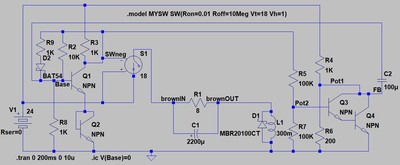
Just for the heck of it I did an LT spice simulation:-

Switch before

Switch after

Waveforms with switch before

Waveforms with switch after

The Brownout wave forms (pale blue) start at 0V and 24V, but quickly become similar. The DC resistance of the inductor is 6 Ohms ( the specs. for solenoids don't seem to give a lot of relevant information) which is why the steady state voltage is just over 10V.

But crucially the current in the inductor wave forms (purple) are identical.

[I had to change the SW parameter from SW to something else (I chose 12) in the voltage controlled switch to get the simulation to work. I have no idea why.]

__________________
If you spend all your time looking for people and things to complain about: trust me, you will find plenty to complain about.
Register to Reply Score 1 for Good Answer
Power-User

Join Date: Jan 2015
Location: Johannesburg, South Africa
Posts: 248
Good Answers: 3
#22
In reply to #21

Re: Watt Reducer Circuit

08/19/2020 2:36 PM

Thank you. Can you do a double take with a momentary switch off in between two on cycles, please.

__________________
Tragedy for Engineers is thinking they know so much that they can not learn from any body else.
Register to Reply
Guru

Join Date: Aug 2005
Location: Hemel Hempstead, UK
Posts: 5826
Good Answers: 322
#23
In reply to #22

Re: Watt Reducer Circuit

08/23/2020 11:32 AM

When the switch is open the only way the capacitor can discharge is through the resistor, so, you really need to leave it about 3 times the RC constant (to get to 95% of the fully discharged state) between on cycles.

However this is what the wave forms look like. I'm probing the input to the inductor in both cases.

The waveforms are identical. You can see that the first pulse is higher than the subsequent ones because I haven't waited long enough between them: this would just get worse if I made the gap shorter.

__________________
If you spend all your time looking for people and things to complain about: trust me, you will find plenty to complain about.
Register to Reply
Power-User

Join Date: Jan 2015
Location: Johannesburg, South Africa
Posts: 248
Good Answers: 3
#24
In reply to #23

Re: Watt Reducer Circuit

08/23/2020 2:54 PM

Thank you for the trouble you went to. I expected the restore time for the capacitor to be quicker with the contact before the Reducer circuit because it should discharge quicker through the coil of the valve and the limiting resistor than only through the resistor. Under real factory conditions, my experience was that that is actually what happens.

__________________
Tragedy for Engineers is thinking they know so much that they can not learn from any body else.
Register to Reply
Guru

Join Date: Aug 2005
Location: Hemel Hempstead, UK
Posts: 5826
Good Answers: 322
#25
In reply to #24

Re: Watt Reducer Circuit

08/24/2020 11:35 AM

The cap. can't discharge through the coil.

Picture just the resistor and capacitor in parallel and in isolation; now connect either end through even a 100Meg resistor to any random voltage; that end will then instantly be forced to that voltage irrespective of the state of charge of the cap.; the cap. can only discharge through the resistor.

Does that make sense?

__________________
If you spend all your time looking for people and things to complain about: trust me, you will find plenty to complain about.
Register to Reply
Guru

Join Date: Aug 2005
Location: Hemel Hempstead, UK
Posts: 5826
Good Answers: 322
#28
In reply to #25

Re: Watt Reducer Circuit

09/03/2020 7:27 AM

Did that make sense? I'm trying to find out if I've explained it in an accessible way.

__________________
If you spend all your time looking for people and things to complain about: trust me, you will find plenty to complain about.
Register to Reply
Power-User

Join Date: Jan 2015
Location: Johannesburg, South Africa
Posts: 248
Good Answers: 3
#29
In reply to #28

Re: Watt Reducer Circuit

09/03/2020 5:05 PM

Sorry Randall, had some internet connection problems. The neg plate of the cap on applying 24V to the Positive side will immediately be forced up to 24V and cause current to rush through the coil of the valve until the magnetic expansion oppose the current rush and start limiting the flow. Normal current flow will now occur through the limiter. The negative plate of the cap will now be at whatever the voltage is after the drop over the limiter. Maybe 18V. Removing the 24V supply will leave the negative plate at 18V and that Voltage will bleed back to 0V through the coil (wire at low resistance) that is still connected to the cap, if the contact is before the limiter. If the contact is after the cap the 18V must dissapate/ discharge through the resistor, and that should add time to the period for the next switch in with the contact.

__________________
Tragedy for Engineers is thinking they know so much that they can not learn from any body else.
Register to Reply
Guru

Join Date: Aug 2005
Location: Hemel Hempstead, UK
Posts: 5826
Good Answers: 322
#30
In reply to #29

Re: Watt Reducer Circuit

09/06/2020 5:36 AM

The cap cannot discharge through the coil.

Imagine the cap on its own in isolation; now connect the negative side to the coil: that side will imediately move to the voltage on the coil; the cap will remain in the same state of charge it had before it was connected; it can only discharge when you connect the resistor in parallel, or, some thing else to the other end from the coil.

__________________
If you spend all your time looking for people and things to complain about: trust me, you will find plenty to complain about.
Register to Reply
Power-User

Join Date: Jan 2015
Location: Johannesburg, South Africa
Posts: 248
Good Answers: 3
#31
In reply to #30

Re: Watt Reducer Circuit

09/07/2020 4:39 PM

On switching off the valve, that cap will have only the dropping voltage over the resistor as charge but the negative plate, if the drop is 3 Volts, will be at at 21 Volts. I'm not asking you how it works, I'm telling you. That 21V must be removed when you remove the 24V, to remove it the lack of Electrons on the plate, that is why it is 21V positive will be replaced by electrons from Negative side of the circuit, which is on the other side of the coil in the valve. The electrons will come through the valve to dissipate the 21V. While it dissipate the 21V some electrons will move through the current limiter to also replace the electrons removed on the positive plate that was at 24V, preparing the circuit to be ready for the next switch on action. This Cap is a Coupling Capacitor and act totally different to a DC smoothing Capacitor. Even though it is a polarised capacitor it is used in the DC circuit for one purpose only and that is to act like a short circuit only on application of Voltage on the Positive side plate, after that it has no purpose any more and the valve is kept activated by the current through the current limiter. If need I will explain it to you in electron theory. This action must happen and can only happen in the shortest time period if the switching contact do not remove the path to the electron source that sits on the other side of the coil in the valve. Putting the activation contact between the limiter and the coil will remove this vital electron replacement component that is needed to make this circuit function optimally.

__________________
Tragedy for Engineers is thinking they know so much that they can not learn from any body else.
Register to Reply
Guru

Join Date: Aug 2005
Location: Hemel Hempstead, UK
Posts: 5826
Good Answers: 322
#32
In reply to #31

Re: Watt Reducer Circuit

09/08/2020 6:23 AM

Forget about the function of the whole circuit for a minute; just do the mental experiment:

a capacitor is sitting in complete isolation with a voltage of 3V across it;

connect a 1 Giga-Ohm resistor whose other end is connected to 1 million volts to the -ve end of the cap.;

that end of the cap. immediately moves to 1 million Volts;

the cap. remains with 3V across it.

Anything here you disagree with?

__________________
If you spend all your time looking for people and things to complain about: trust me, you will find plenty to complain about.
Register to Reply
Power-User

Join Date: Jan 2015
Location: Johannesburg, South Africa
Posts: 248
Good Answers: 3
#33
In reply to #32

Re: Watt Reducer Circuit

09/08/2020 1:36 PM

This cap is in a Circuit, the rule is as a coupling capacitor what happens on the one side also happens on the other side as a coupling cap as long as it move. So fixed voltage on the one side of a cap will give you an initial pulse and then nothing happens. This is how you can sound a buzzer momentarily to indicate that dc voltage was restored or lost. The buzzer only sound with a change in voltage. Removing the other side of the buzzer from termination will stop it from working. This circuit is straight forward and it is a common application in industrial controls. It may be that we are saying the same thing but my 3rd language english does not get what you explain or do not bring over what I explain. I do not think we will agree. Thank you for the effort I appreciate it.

__________________
Tragedy for Engineers is thinking they know so much that they can not learn from any body else.
Register to Reply
Guru

Join Date: Aug 2005
Location: Hemel Hempstead, UK
Posts: 5826
Good Answers: 322
#34
In reply to #33

Re: Watt Reducer Circuit

09/10/2020 8:51 AM

We are not saying the same thing.

In this simple scenario:-

Where x is the initial voltage across the cap., and, Vt is a function of V at time t=0 and the parameters of the inductor.

I believe that x will remain constant.

You seem to believe that x will reduce over time.

(Of course I'm assuming perfect components ie. no leakage through the cap.)

__________________
If you spend all your time looking for people and things to complain about: trust me, you will find plenty to complain about.
Register to Reply
Guru

Join Date: Dec 2010
Posts: 1686
Good Answers: 116
#9

Re: Watt Reducer Circuit

08/14/2020 4:04 PM

Without the Watt Reducer spec, you do not know its off-time before you can re-energise solenoid. If you are using one of 16 solenoids with a short sequence 0ff-time, this could be trouble.

You have drawn the reducer as a 4-wire device - looking at the image, are they twin core cables coming from each end?

Some commentators have assumed the reducer is the simplest 2 wire resistance/capacitor type. In many cases this would require an electrolytic capacitor, which would be polarity sensitive. An internal diode would remove that problem, but reducer would only work with one polarity. An elaborate Reducer might have a circuit for reset quicker than the valve.

My inclination would be to try PLC contact before reducer, in commission at least you could swap out the reducer without removing supply from several? valves. If PLC after reducer more difficult for reducer to know valve is being turned off, because it only delivers a small current vs a 24V step if input is switched.

Ask whoever specified the reducer if they will...

A) supply proper use information?

B) indemnify you against loss/delay if your tests damage a reducer?

C) Pay you to carry out tests, due to non-supply of instructions?

D) Compensate you for delays - you already have a delay fixing this problem?

Register to Reply
Power-User

Join Date: Dec 2019
Posts: 160
Good Answers: 14
#10

Re: Watt Reducer Circuit

08/14/2020 7:33 PM

You haven't indicated the voltage or power the solenoid requires. The power requirement depends on the size of the solenoid so the particulars will be vague. You can measure the resistance of the watt saver by measuring across the brown wire in and the brown wire out. Polarity can affect this because of the capacitor so the plus side of the meter goes on the brown wire on the input side. The capacitor will add some delay but it shouldn't be very long. This value, with the solenoid coil resistance, will allow you to calculate the voltage required to hold the solenoid in the on state. When the solenoid is switched ON, it doesn't matter whether the switch is on the input side or the output side of the watt-reducer, the solenoid will have the full DC voltage applied because the capacitor is initially discharged. As the capacitor charges the current will drop to the minimum holding current of the solenoid. When the switch is opened the solenoid will turn-off and the capacitor will discharge through the watt-reducer resistor in parallel with the capacitor.

Register to Reply
Power-User

Join Date: Jan 2015
Location: Johannesburg, South Africa
Posts: 248
Good Answers: 3
#11
In reply to #10

Re: Watt Reducer Circuit

08/15/2020 3:33 AM

What delay are you guys talking about. This cap has only one job and that is to act as a short circuit on applying the voltage to immediately pass as much current as possible to the solenoid coil which is also a short on activation. The Capacitor in series with the load is a coupling capacitor. It is there for one purpose only and that is to overcome or bypass the restriction of the watt restrictor. After the switch on period the voltage over the cap is whatever the drop over the restrictor, will be only a small voltage in comparison to the 24V available. This Capacitor makes the switch on time as short as it would have been if you applied the 24V directly to the Valve. The capacitor is there to overcome the limiting effect of the current limiter/restrictor. It is there to make sure that solenoid is activated with maximum current, to engage properly, which it may not with the restricted current. It acts like in Audio circuits, where Capacitors are used to couple the AC and isolate the DC. The cap is there to couple the change/rise in Voltage from 0V up to 24V in no time to the Coil of the Solenoid. That Capacitor have a input and output side in the way it is used. The input side is the positive side because you are going to connect it to +24V and the Output side faces through the coil to negative or 0V. The rise in current on the coil will cause a magnetic field that will oppose the current and stop the connection from being or looking like a short and prevent the fuse from blowing. Increasing the size of the capacitor will look more and more like a short and at some size blow the fuse. If you connect the Output side of that Capacitor to OV the fuse will pop or the driving circuit will pop. The magnetic field created by this quick rising current will cause a rise in voltage on the input side of the solenoid and the capacitor will lose its purpose and settle at a Voltage equal to the drop over the restrictor.

__________________
Tragedy for Engineers is thinking they know so much that they can not learn from any body else.
Register to Reply
Active Contributor

Join Date: Mar 2011
Posts: 17
#26

Re: Watt Reducer Circuit

09/02/2020 4:08 PM

ok I did amp meter tests with and without the watt reducer. without is .52 amps, with is .49 amps. I was expecting a lot more difference so I think I will not use the watt reducers in the circuit and run the solenoid valves without the watt reducers. this would have involved a bunch more wire and terminal strips.... 8 valves are on at any point in time so that's total 4.16 amps. my transformer provides 12 volt DC 40 amps so these "watt reducers" are not worth the hassle?!?!

Register to Reply Score 1 for Good Answer
Guru

Join Date: Aug 2005
Location: Hemel Hempstead, UK
Posts: 5826
Good Answers: 322
#27
In reply to #26

Re: Watt Reducer Circuit

09/03/2020 7:23 AM

Thanks GA.

Lots of the discussions here have asssumed a lot about the Watt Reducer circuit.

Can you measure the DC impedance of the brown wires in the Watt reducer, and, the DC impedance of the solenoid coil. Also measure to see if the blue wires of the Watt reducer are short, and, if there is any connection between the brown and blue wires.

Just one small thing: the pictures in your original post indicated 24V DC, but now you're talking about 12V DC?

__________________
If you spend all your time looking for people and things to complain about: trust me, you will find plenty to complain about.
Register to Reply
Register to Reply 34 comments

Good Answers:

These comments received enough positive votes to make them "good answers".

"Almost" Good Answers:

Check out these comments that don't yet have enough votes to be "official" good answers and, if you agree with them, vote them!
Copy to Clipboard

Users who posted comments:

67model (1); brian nuclear (2); gringogreg (1); JE in Chicago (1); jhhassociates (1); Oomborrie (11); R_i_c_h (3); Randall (13); SolarEagle (1)

Previous in Forum: Yaskawa A1000 Current Detection Error   Next in Forum: Heating Elements in 3 Phase Configuration

Advertisement