Previous in Forum: PV generator   Next in Forum: 33 kV and 11 kV line sheet format
Close
Close
Close
6 comments
Rate Comments: Nested
Anonymous Poster #1

Dead End Poles and Double Dead End Poles

09/05/2022 11:02 PM

Sirs,

How are dead end poles and double dead end poles defined? Can they be of single pole type and double pole type? As per text book, they say that every 10th pole shall be dead end poles and they say that these are of double pole type.

regards,

Reply
Interested in this topic? By joining CR4 you can "subscribe" to
this discussion and receive notification when new comments are added.

Good Answers:

These comments received enough positive votes to make them "good answers".

"Almost" Good Answers:

Check out these comments that don't yet have enough votes to be "official" good answers and, if you agree with them, vote them!
2
Guru

Join Date: Mar 2007
Location: by the beach in Florida
Posts: 33392
Good Answers: 1817
#1

Re: Dead End Poles and Double Dead End Poles.

09/05/2022 11:16 PM

..."Transmission lines act as the utility interstate system where electricity is transmitted at high voltages in order to reduce the energy lost in long-distance transmission.

Although it’s hard to quantify structure types since there are always exceptions to the rules and never-ending configurations, transmission structures can be considered dead-end, strain or suspension.

A dead-end structure is where conductors and ground wires are pulled only on one side, unless it is a double dead-end structure, and are used where:

• Line ends
• Line turns at a large angle
• At major crossings like highways or rivers
• Divide line into segments

For strain structures, the conductors are directly attached through in-line insulators through or around the tower. In suspension transmission structures, the conductor phases pass through the structure, and are suspended from the insulator."...

..."Dead-end structures, or strain-termination structures, are used wherever a transmission line ends. It is specifically designed to withstand relative greater deal of stress and strain. Dead-end structures at the end of a transmission line are generally identified by insulator strings in the strain insulators

Dead-end construction may also be found within transmission lines at any point where excess strain is placed on the structures or its components. Example of these is double dead-end, wherein it supports strain of each phase of a line in two directions....."

http://www.transmission-line.net/2010/12/transmission-line-structures.html

https://www.distransteel.com/blog/bid/92385/back-to-basics-in-transmission-structures

__________________
All living things seek to control their own destiny....this is the purpose of life
Reply Good Answer (Score 2)
Guru

Join Date: Mar 2007
Location: by the beach in Florida
Posts: 33392
Good Answers: 1817
#2
In reply to #1

Re: Dead End Poles and Double Dead End Poles.

09/05/2022 11:55 PM

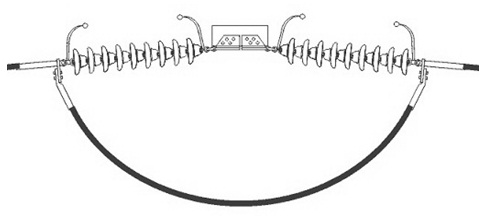
This double line insulator attaches the wire to the pole to relieve the strain on the wire...

...and would have guy wires supporting the load on the opposite sides...

__________________
All living things seek to control their own destiny....this is the purpose of life
Reply
Guru

Join Date: Aug 2005
Location: Hemel Hempstead, UK
Posts: 5826
Good Answers: 322
#3

Re: Dead End Poles and Double Dead End Poles

09/06/2022 6:31 AM

Are you talking about power lines, telecom. lines, or, something else?

__________________
If you spend all your time looking for people and things to complain about: trust me, you will find plenty to complain about.
Reply
Anonymous Poster #2
#4

Re: Dead End Poles and Double Dead End Poles

09/07/2022 6:44 AM
Reply Score 1 for Good Answer
Anonymous Poster #2
#5

Re: Dead End Poles and Double Dead End Poles

09/07/2022 7:41 AM
Reply Score 1 for Good Answer
Guru
Engineering Fields - Nuclear Engineering - New Member

Join Date: Sep 2009
Location: Louisville, OH
Posts: 1926
Good Answers: 36
#6

Re: Dead End Poles and Double Dead End Poles

09/07/2022 9:42 PM

I spent around 20 years in the electric pole industry, but have been retired for about 18 years, so terminology may have changed. We supplied single-tube poles as opposed to lattice structures, but the connection terminology should be the same.

Dead-end or suspension types would depend on how the conductor is attached to the pole (arm.) In DE types the conductor is attached directly to the pole or arm through the insulator.. In the suspension type, the conductor is attached to the insulator, which hangs from the arm, and the pole doesn't see the tension load. I didn't design the line itself, just the poles used to hold the conductors, which can have very large tensions. An interesting thing about the suspension type: if the conductor on the left side fails, the suspension insulator swings to the right to add its length to the catenary; this reduces the tension drastically.

A double dead-end (I don't recall us using that term) would have the DE connection going in each direction from the pole; it does not mean 2 poles. (but there are other types such as H-Frames, and V-structures which would require multiple poles.)

The line design would have to incorporate a DE pole, you said every 10 poles, to prevent the whole system from having a cascade (domino) failure in case of a broken conductor. This would be to limit the damage. We also had to evaluate high wind and ice loading conditions.

Hope I have answered what you need.

__________________
Lehman57
Reply
Reply to Forum Thread 6 comments

Good Answers:

These comments received enough positive votes to make them "good answers".

"Almost" Good Answers:

Check out these comments that don't yet have enough votes to be "official" good answers and, if you agree with them, vote them!
Copy to Clipboard

Users who posted comments:

Anonymous Poster (2); Lehman57 (1); Randall (1); SolarEagle (2)

Previous in Forum: PV generator   Next in Forum: 33 kV and 11 kV line sheet format

Advertisement