Solar Tracking for Solar Cookers and Solar Panels, Project Update
04/25/2024 4:24 AM
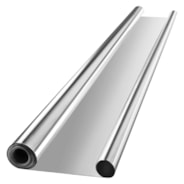
Anyone know how to chose the best "specular" reflector for solar cookers? (more at the bottom of this) My project is to make a low tech timed tracker for solar panels and solar cookers on Equatorial mount. First of all, thank you all for helping me find a synchronous motor for my project back in September and October. It was essential to get the project started. After that, I ended up using the "nextdoor" app to find old 30 pound propane tanks as the containers of water that power the movement. (The price of plastic cylindrical cans was crazy and I wanted something cheap). You can find details about how I produce gradually increasing air pressure in the old Synchronous motor thread from October. The latest and best version of my solar tracker proof of concept uses 2 decertified 30 pound propane tanks with the tops cut off, and bottom 6 inches of plastic paint drums as floats, and rubber tubing and a "timing string" to let through the right amount of air to an airlift pump to move the solar panel at exactly the right speed. It is a lot more accurate than I expected! I have ran it several days from 8.45 am until 6 pm and it points within 5 degrees of straight at the sun or better! for that entire time. Mine is just a proof of concept, and perhaps people will make an electronic version of this, or a pole mounted version, with the 2 water containers welded to the pole or with a similar air powered "timer" that switches on and off a motor to move the solar panels. I know it doesn't need to be this accurate for solar panels but the end goal is to use it to track parabolic solar cooker reflectors. And those do need to have accurate tracking. I used aluminum foil in the past, but I tested it around November December, and found that a laser dot gives a line reflection in one direction and a semicircle reflection in another direction. This is because (under the microscope) alu foil and alu sheet has microscopic ridges (like corrugations) on its shiny surface. This is not what I want in a parabolic dish reflector! I got in an argument with 2 solar cooking communities on Facebook. They refuse to tell people about my testing results, and continue to claim that foil is a good reflector. So specular probably means something with mirrorlike reflection, probably aluminum layer on plastic with a plastic cover. Indian researchers found "chrome vinyl car wrap" was good, but they didn't say which brand. I kind of have to find a good reflector, because my design has to compete with commercial solar cookers (which all have polished mirror aluminum on them). If I chose a poor reflector for my demo model, they will cry rubbish and happily mock my tracker effort. The solar cooking community have luddite leaders and they won't help.
The video of the latest version is below, I approached precision from the "opposite direction" of an engineer. (partly because those synchronous motor does not exactly rotate at 1 rpm and apparently each one is slightly different). So I made the wooden wheel that the panel rotates on, then ran it through something like 180 degrees of rotation at full speed, and then I used a timer that turns on and off the synchronous motor for say 70 seconds and 50 seconds, (or whatever you want) for the full day to get it to rotate the solar panel at exactly 15 degrees per hour. When I found that the thing was running a tiny bit fast still, I fine tuned the on off periods, (just once) and ever since then, it has worked perfectly. Approaching precision from "the back" means I could use my sloppy shop skills and still make something pretty darn accurate and fairly cheap. One of these controllers, in a shed, can run maybe 5 or 10 or 20 solar trackers. My proof of concept is bulky and ugly, but I think eventually people will make it much nicer. Thank you, Brian
Re: Solar Tracking for Solar Cookers and Solar Panels, Project Update
04/25/2024 8:55 AM
...and found that a laser dot gives a line reflection in one direction and a semicircle reflection in another direction
I'm afraid I'm in the aluminum foil camp. A laser dot is highly collimated and only hits the foil at a single spot and so magnifies any tiny imperfection. You're cooking meat, not making astronomical pictures, so all the reflector has to do is capture the light from a large area and redirect it towards the food, no optical precision necessary.
Actually, some imprecision may be beneficial to spread the image of the sun over the target and not apply all the heat in one spot. And a foil reflector is relatively cheap and can be replaced if it gets dirty.
Re: Solar Tracking for Solar Cookers and Solar Panels, Project Update
04/25/2024 6:18 PM
It isn't a tiny imperfection, here in Canada, the entire surface of foil has little corrugations on it. Its like the roof of a mini shed all across the bright side of aluminum foil. I got so much pushback from the solar cooking guys, (who absolutely refused to point a laser pointer at pieces of various different materials), like chocolate bar wrappers, or metalized chip/crisp bags or tinfoil or aluminum roofing sheet, I couldn't believe it! I just thought "these guys are being weird, whatever happened to experimental evidence and repeating experiments to prove right or wrong?". And I also found them to be acting like a cult. My tests clearly show that foil and alu sheet has vastly different reflections in different directions, which might mean that if they apply the foil in a different direction, they will get more heat. But they simply "don't want to know". I just find that incredible. The only people using foil are people doing youtube videos, and people in refugee camps. I think both sets of people should be told the truth, especially the poorest of the poor. The other weird thing is that for the commercial solar cooker that they (solar cooker group leaders) use in videos, no foil is in evidence, its all polished anodized aluminum, and metalized tape from China! As far as I can see, they are a cult, AND a bunch of hypocrites. So I took out my microscope and looked at the surface, and then shone lights and sunlight on foil and rotated it. Same effect as the laser pointer. I Then I found this research from India. Comparison testing different materials These guys in india didn't try foil because it was too hard to put on. They used Foil tape instead. They were testing specifically with a parabolic dish. https://www.jetir.org/papers/JETIR1905A27.pdf I will use a tighter curve than a parabolic dish when I get round to it, but the lost heat from aluminum foil's erratic reflection will still be very significant. I am still mad that they refuse to test different materials at solar cookers dot org. They do comparisons of different "commercial" solar cookers but amateur designers like me don't know which materials give the best results so we are at a huge disadvantage. Based on the Indian tests, vinyl car wrap is a good material, and I will probably buy it. But I don't know what brand to use. A swiss guy used some German tape to do his parabolic dish, so I might go with his recommendation. It's just hard to get stuff direct from a German factory here. Anyway, another issue with foil is that it whitens, (oxidises) very easily. Polishing and adonizing are non starters for normal aluminum sheet too. Adonizing just thickens the oxide layer so if it has grooves in it at start, it will still have them when the oxide skin is thicker. And polishing doesn't work because the oxide layer is Aluminum oxide (polishing grit). Members were not forthcoming about the reflectors on their fancy solar cookers either. They kept mum about the materials used. But anyway, here's the deal, if you can't see your reflection in it, it is a bad reflector for covering parabolic dishes. Pure and simple.
Re: Solar Tracking for Solar Cookers and Solar Panels, Project Update
04/26/2024 4:25 AM
The corrugations are due to the manufacturing process & are from the rollers used to move the sheet through the system.
Mirror polish aluminium sheet is commercially available ie here. In the UK, there are companies that small sheets at around 300mm square for about £5 or they will cut to size. You should be able to find someone local who does the same.
__________________
I didn't have a really important life, but at least it's been funny (Lemmy Kilminster 1945-2015)
You have the problem of converting the flat film to a paraboloid of revolution reflector. The best way I can think of is to cut out long thin triangles, for example, 36 triangles with a 10 degree angle at the pointy end. With all the pointy ends meeting at the center, the triangles could be supported by a parabola shaped support. Just a thought, you may have a better idea.
Re: Solar Tracking for Solar Cookers and Solar Panels, Project Update
04/26/2024 10:11 PM
Thank you, yes, foil may have changed over time. I don't remember it being terrible 15 years ago when I did my original experiments. (The worldwide solar cooking community refused point blank to point laser pointers at any reflective materials to check if my results held out everywhere). I do "cone solar" where I make sections of cones out of chloroplast to approximate the parabolic dish shape. This means I (hopefully) won't have too much of an issue sticking reflective material to the backing. (Plus it doesn't come to a sharp focus like you mentioned) so less likely to burn food or nearby objects or burn or blind people. A solar cooking researcher from Norway originally told me about the cone solar idea. Before that I was only aware of the "petal" method for making solar dishes. I can't upload my pic so its text only for now.
Re: Solar Tracking for Solar Cookers and Solar Panels, Project Update
04/29/2024 2:24 PM
I have already made the reflector, but haven't added the reflective material yet. Originally I was going to use foil, but then I realized it won't work well in a parabolic dish. And it has to work well or everyone will conclude that my dish is rubbish. I'll try to edit my original post to put in pictures of the dish and its "tighter than parabolic" shape.
Re: Solar Tracking for Solar Cookers and Solar Panels, Project Update
04/30/2024 4:11 AM
I've designed many reflectors in the past (long ago), parabolic, elliptical & other shapes, in my days as a commercial lighting designer. Used to use silver anodised aluminium from Anacoil, either polished or stippled depending on the requirement.
__________________
I didn't have a really important life, but at least it's been funny (Lemmy Kilminster 1945-2015)


 2
2
 Solar Tracking for Solar Cookers and Solar Panels, Project Update

 Re: Solar Tracking for Solar Cookers and Solar Panels, Project Update




Good Answers:
"Almost" Good Answers: