Previous in Forum: How Do I Cool Down a Concrete River Bridge?   Next in Forum: Buried Irrigation Pipe Bottom Branch
Close
Close
Close
14 comments
Rating: Comments: Nested
Active Contributor

Join Date: Aug 2025
Posts: 12

RFQ, Request for Quotation (For Construction)

08/08/2025 7:04 PM

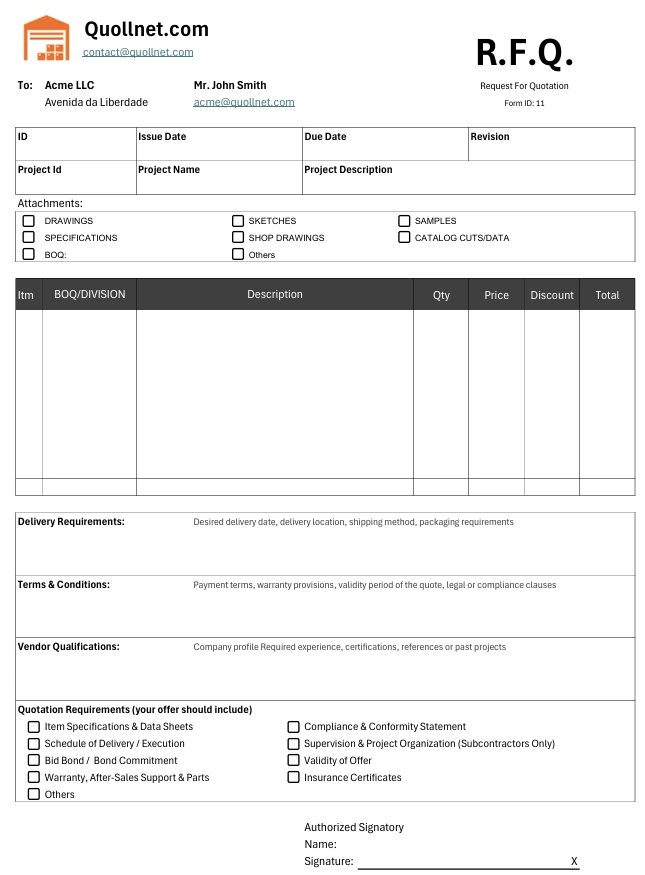
I have designed this form and I want to see if I messed any information there. i'm open for discussion on how to improve it.
This is not meant to be for tendering, this is mainly for procurement department obtaining quotations;

If you are interested in the article, here is the link.
Request for inspection - Quollnet

Register to Reply
Interested in this topic? By joining CR4 you can "subscribe" to
this discussion and receive notification when new comments are added.

Good Answers:

These comments received enough positive votes to make them "good answers".

"Almost" Good Answers:

Check out these comments that don't yet have enough votes to be "official" good answers and, if you agree with them, vote them!
Guru
Hobbies - CNC - New Member Hobbies - DIY Welding - New Member Engineering Fields - Electromechanical Engineering - New Member

Join Date: Aug 2007
Posts: 23647
Good Answers: 420
#1

Re: RFQ, Request for Quotation (for construction)

08/08/2025 8:56 PM

Interesting,…

I’ll throw a few things in starting with… should permitting be included?

__________________
“ When people get what they want, they are often surprised when they get what they deserve " - James Wood
Register to Reply Score 1 for Good Answer
Active Contributor

Join Date: Aug 2025
Posts: 12
#2
In reply to #1

Re: RFQ, Request for Quotation (for construction)

08/09/2025 2:33 PM

do you mean obtaining permits?

Register to Reply
Guru
Hobbies - CNC - New Member Hobbies - DIY Welding - New Member Engineering Fields - Electromechanical Engineering - New Member

Join Date: Aug 2007
Posts: 23647
Good Answers: 420
#3
In reply to #2

Re: RFQ, Request for Quotation (for construction)

08/09/2025 3:22 PM

Yes, Occupancy Permit to start with.

__________________
“ When people get what they want, they are often surprised when they get what they deserve " - James Wood
Register to Reply
Guru
Australia - Member - New Member

Join Date: Feb 2008
Location: Australia
Posts: 2181
Good Answers: 255
#4

Re: RFQ, Request for Quotation (For Construction)
08/10/2025 8:41 AM

I'd suggest something about your standard payment terms (10% on contract acceptance, 10% on commencement, 40% on civil completion, 20% on handover and 20% (Bond) on defect liability period as example)

For projects over $1M, I'd be looking for "similar project examples", essentially references for similar work already completed as evidence of competence. I'd also be interested in corporate capabilities and what will be passed to secondary contractors.

We usually get "profiles" for the major players, like the intended project manager, technical representative and so on.

We run a three level project scope system. The form proposed would maybe pass for a "basic" project like a fence around a site or road surface replacement. Larger and more complex projects have progressively higher governance levels expected on both ourselves and the contractor.

__________________
Just an Engineer from the land down under.
Register to Reply
Guru

Join Date: Sep 2016
Posts: 973
Good Answers: 9
#5
In reply to #4

Re: RFQ, Request for Quotation (For Construction)

08/11/2025 10:23 AM

"(10% on contract acceptance, 10% on commencement, 40% on civil completion, 20% on handover and 20% (Bond)"

Oh I wont be that so interested if you have such proportions. How about 30% on acceptance and commencement, progress billing on 50%, 10% upon completion, 10% after warranty period expires. That to me seems a reasonable proportion.

Register to Reply
Active Contributor

Join Date: Aug 2025
Posts: 12
#12
In reply to #4

Re: RFQ, Request for Quotation (For Construction)

11/19/2025 4:36 PM

Thanks for the detailed feedback — much appreciated.

Just to clarify one point:
The RFQ I posted is intentionally designed for commodity items and well-defined scopes, regardless of contract value.

For example, even a $3M steel or concrete package can still be procured using a simple RFQ if:

  • the specifications are clear,
  • no engineering input is needed,
  • and the vendor is only providing supply or straightforward installation.

So the form is not “limited” to small projects — it is simply aligned with situations where price and compliance are the primary evaluation criteria.

The items you mentioned (corporate capability, team CVs, subcontractor strategy, governance levels, payment milestones, etc.) definitely apply, but only when the package requires:

  • technical or engineering methodology,
  • design or coordination,
  • complex execution planning,
  • or vendor-led solutions.

In those cases, we issue a full RFP, not an RFQ.

So your comment is absolutely valid for solution-based packages, but not for commodity procurement or clearly defined material orders — even if they are high-value.

Thanks again for the insights — very helpful input.

Register to Reply
Guru
Australia - Member - New Member

Join Date: Feb 2008
Location: Australia
Posts: 2181
Good Answers: 255
#14
In reply to #12

Re: RFQ, Request for Quotation (For Construction)

12/28/2025 7:48 AM

Hello,

Thanks for the feedback.

For higher usage commodity type products and services (Asphalt for our roads $/sqm, pipes for our water network $/m, CCTV inspection of sewer mains $/m) we run a "preferred supplier" process where multiple suppliers are invited to offer their products.

We might select up to three for road resealing programs and have them "approved" for a three year term.

Thus for projects, if we need to do a 25km road resealing program, the department is able to select from already approved vendors to an already agreed price and quality. This means that executive review is only necessary at end of period rather than for each internal project.

__________________
Just an Engineer from the land down under.
Register to Reply
Associate

Join Date: Dec 2017
Posts: 44
#6

Re: RFQ, Request for Quotation (For Construction)

08/11/2025 10:39 AM

Good day.

In our experience, the key in not the description of the construction activity but the adendum which point out all the technicals & financials details that must be considere.

Register to Reply
2
Guru
Hobbies - CNC - New Member Hobbies - DIY Welding - New Member Engineering Fields - Electromechanical Engineering - New Member

Join Date: Aug 2007
Posts: 23647
Good Answers: 420
#7
In reply to #6

Re: RFQ, Request for Quotation (For Construction)

08/11/2025 11:08 AM

That single page is normally amongst many pages in a contract construction project.

There are a number of criteria. As I mentioned earlier, permitting (environment, local, state and federal) can stop a multimillion dollar expansion on a dime. The other items... normally the payment on a large project is cost-plus, just due to the known/unknows not to mention the unknow/unknows.

some types of terms on a construction project.

1. Time and Materials (T&M) Contracts

A Time and Materials (T&M) contract is a flexible payment structure where the client pays the contractor based on actual labor hours worked and materials used.

How It Works:

  • The contractor charges an agreed-upon hourly or daily labor rate.
  • The client reimburses the contractor for all material costs.
  • The final project cost is uncertain until completion.

Best For:

  • Projects with uncertain scopes or frequent design changes.
  • Small-scale renovations or repairs where exact costs are hard to estimate upfront.
  • Situations where materials need to be sourced on demand rather than pre-purchased.

Pros:

  • Flexible – Allows for adjustments in labor and materials as the project progresses.
  • Transparency – The client sees exact costs, reducing pricing disputes.
  • Contractor Protection – Prevents losses if unexpected issues arise.

Cons:

  • Cost Uncertainty – The total cost isn’t fixed, which can lead to budget overruns.
  • Potential Disputes – If material or labor costs increase, disagreements may arise.
  • Requires Detailed Tracking – Both parties must carefully document hours worked and materials purchased.

2. Lump Sum (Fixed Price) Contracts

A Lump Sum contract, also called a Fixed Price contract, establishes a single agreed-upon price for the entire project.

How It Works:

  • The contractor submits a bid outlining the total cost for labor, materials, and profit.
  • Once the price is agreed upon, it does not change—regardless of actual costs incurred.
  • Payments are typically made in installments or upon project completion.

Best For:

  • Well-defined projects with clearly outlined plans, costs, and deadlines.
  • Clients who prefer cost certainty and don’t want unexpected expenses.
  • Small to mid-sized projects with minimal design or material changes.

Pros:

  • Predictable Costs – Clients know the exact amount due from the start.
  • Less Administrative Work – No need for detailed tracking of time or materials.
  • Encourages Efficiency – Contractors are incentivized to work efficiently and control costs.

Cons:

  • Higher Initial Price – Contractors build in a margin for risk, making the lump sum higher than the estimated cost.
  • Limited Flexibility – Changes or unexpected issues require a change order, leading to delays and extra fees.
  • Potential Contractor Risk – If costs exceed estimates, the contractor absorbs the loss.

3. Cost-Plus Contracts

A Cost-Plus contract reimburses the contractor for actual expenses plus an additional percentage-based profit margin.

How It Works:

  • The client pays for all labor and material costs incurred during construction.
  • The contractor receives an agreed-upon percentage or fixed fee as profit.
  • Costs must be well-documented to justify reimbursements.

Best For:

  • Large, complex projects where scope changes are likely.
  • Projects with unknown material costs or where precise budgeting is difficult.
  • Government contracts or nonprofit-funded construction where transparency is essential.

Pros:

  • Fair for Both Parties – The contractor is compensated for actual work done, avoiding unexpected losses.
  • Encourages High-Quality Work – The contractor isn’t pressured to cut corners to stay within a fixed price.
  • Great for Evolving Projects – Easier to adjust for scope changes, material price fluctuations, or design modifications.

Cons:

  • Requires Trust & Documentation – The client must rely on contractor honesty and review detailed cost reports.
  • No Cost Certainty – The final price is unknown until the project is completed.
  • Potential for Overcharging – Without proper oversight, some contractors may inflate costs.

4. Unit Price Contracts (Pay-Per-Unit)

In a Unit Price contract, the project is divided into separate units, and the contractor is paid per completed unit.

How It Works:

  • The contract defines a price for each measurable unit of work (e.g., per cubic yard of concrete, per square foot of flooring).
  • The client pays as units are completed.
  • If more or fewer units are required, the total cost adjusts accordingly.

Best For:

  • Large projects with repeatable tasks (e.g., roads, pipelines, or apartment complexes).
  • Situations where exact quantities of work are unknown upfront.
  • Contractors and clients who want flexibility in scaling work as needed.

Pros:

  • Fair Pricing – The client only pays for work completed, reducing overpayment risks.
  • Flexibility – Easier to adjust quantities of materials or work as needed.
  • Cost Tracking – Payments are made incrementally, allowing better budget control.

Cons:

  • Unit Costs May Vary – Material and labor costs may fluctuate, impacting pricing.
  • Requires Detailed Measurement – Both parties must accurately track completed work to avoid disputes.
  • Can Be More Expensive Overall – Unit pricing may add up to a higher total project cost.
__________________
“ When people get what they want, they are often surprised when they get what they deserve " - James Wood
Register to Reply Good Answer (Score 2)
Active Contributor

Join Date: Aug 2025
Posts: 12
#9
In reply to #7

Re: RFQ, Request for Quotation (For Construction)

10/13/2025 1:16 PM

It seems there’s a bit of a terminology gap around the term “RFQ” (Request for Quotation). In many countries — particularly in North America and parts of Europe — an RFQ is not a tender document but rather a price enquiry form used to collect and compare supplier quotations before moving into a formal contract or tendering phase.

However, in several regions (especially in government and large-scale industrial projects), the term RFQ is used interchangeably with Invitation to Tender (ITT) or Request for Proposal (RFP), making it a binding part of the bidding process.

The RFQ form I shared is intended for the first case — a non-binding price request used in smaller procurement exercises or internal sourcing, where the goal is to standardize how price offers are received and compared. Once a supplier is selected, a formal tender, contract, or purchase order would follow under separate documentation.

So while this template may look light from a tendering perspective, it’s actually designed for practical use in everyday procurement, not for formal bid submissions or large contract awards.

Register to Reply Score 1 for Good Answer
Guru
Hobbies - CNC - New Member Hobbies - DIY Welding - New Member Engineering Fields - Electromechanical Engineering - New Member

Join Date: Aug 2007
Posts: 23647
Good Answers: 420
#11
In reply to #9

Re: RFQ, Request for Quotation (For Construction)

10/13/2025 11:53 PM

good points…

I agree, depending on the company’s standards on what they use. You need to adjust for it.

I use the RFQ for a high level, conservative quote so we can start establishing a budget.

__________________
“ When people get what they want, they are often surprised when they get what they deserve " - James Wood
Register to Reply
Anonymous Poster #1
#8

Re: RFQ, Request for Quotation (For Construction)

08/14/2025 1:02 AM

Hello,

I find that this template is simple and easy to use. However, we currently find that almost all bids have templates which are unique to the project and quite detailed at that, so you might want to consider variants according to different projects.

That aside, we are looking for estimators who can work with us on bid submissions for a post-win / (post potitus) basis for the states of Florida, California and Wisconsin. We wouldn't be able to pay anything up upfront, sorry. In case if you come across someone who is willing to work on partnership or profit sharing basis for some of our ongoing bids, do let me know. We are also looking out for bid solicitation persons with relevant backgrounds on same remuneration basis.

Register to Reply
Associate

Join Date: Dec 2017
Posts: 44
#10

Re: RFQ, Request for Quotation (For Construction)

10/13/2025 2:01 PM

Good day.

I can see a lot of good opinions... it would be a good idea to have some sort of summary.

There si something we use to do it before to submit a proposal: have a meeting with the client and all the suppliers to clarify anything to make the proposal more precise and everybody submit the same

Register to Reply
Active Contributor

Join Date: Aug 2025
Posts: 12
#13

Re: RFQ, Request for Quotation (For Construction)

12/07/2025 6:36 PM

Thanks everyone for the discussion – this exact confusion between RFQ and RFP is what pushed me to sit down and write a longer piece about it.

Very short version of how I see it in construction:

  • RFQ (Request for Quotation) is price-driven. The scope is already defined, and you’re basically asking “How much and when can you deliver?”. That can be for 5,000 USD of bolts or 3M USD of rebar – the value doesn’t turn it into an RFP. It’s still a commodity / clearly defined package.
  • RFP (Request for Proposal) is solution-driven. You’re asking a contractor or specialist to help define how the work will be done: system selection, methodology, sequencing, maybe design responsibility. That’s where risk and sometimes design liability start to shift to the contractor (façade systems, waterproofing concepts, complex MEP, value engineering, etc.).
  • Tender / ITT sits a bit differently again: it’s used when the design is complete and you want “apples-to-apples” prices for a fully defined scope, usually under a more formal/regulated process.

So in my view:
“High value but fully defined” → RFQ
“Need method/solution/value engineering” → RFP
“Final design, full project award” → Tender

I pulled all of this together (with examples, legal flavour and a section on the usual RFI confusion) in an article here if anyone wants the longer version:
RFQ vs RFP vs Tender in Construction

Register to Reply
Register to Reply 14 comments

Good Answers:

These comments received enough positive votes to make them "good answers".

"Almost" Good Answers:

Check out these comments that don't yet have enough votes to be "official" good answers and, if you agree with them, vote them!
Copy to Clipboard

Users who posted comments:

Anonymous Poster (1); gutmonarch (1); Just an Engineer (2); lmiller (4); phoenix911 (4); sqyuma (2)

Previous in Forum: How Do I Cool Down a Concrete River Bridge?   Next in Forum: Buried Irrigation Pipe Bottom Branch

Advertisement