Previous in Forum: A Log Jam Unstick Trick   Next in Forum: Measuring Light Speed Without a Clock
Close
Close
Close
47 comments
Rate Comments: Nested
Commentator

Join Date: Dec 2020
Posts: 75
Good Answers: 3

Which One is the Most Efficient?

01/28/2026 9:28 AM

Would a car with a gasoline engine that’s running at its most efficient RPM that’s running a generator that drives the wheels be more efficient than a combustion engine with supplementary battery power?
US trains do not run on batteries because they run on electrical power produced by a generator which is in turn powered by a diesel engine which keeps the generator powered up and the generator powers electric motors that mechanically drive the wheels.

The big advantage of a diesel running a generator loco over a diesel only loco is that the generator is constantly run at it’s most efficient RPM, taking advantage of minimum fuel used while giving maximum energy, thus making it more efficient than a diesel only train which has to vary its RPM as the load varies.

So, would a car with a gasoline engine that’s running at its most efficient RPM that’s running a generator that drives the wheels be more efficient than a combustion engine with supplementary battery power?

Forget about the noise of an engine running at its most efficient RPM, how to work out in theory which one is the most efficient, the combustion engine with supplementary battery power or the constant RPM engine that’s driving a generator that drives the wheels?

Register to Reply
Interested in this topic? By joining CR4 you can "subscribe" to
this discussion and receive notification when new comments are added.

"Almost" Good Answers:

Check out these comments that don't yet have enough votes to be "official" good answers and, if you agree with them, vote them!
Guru
Hobbies - DIY Welding - Don't Know What Made The Old Title Attractive... Popular Science - Weaponology - New Member United States - US - Statue of Liberty - 60 Year Member

Join Date: Apr 2009
Location: Yellowstone Valley, in Big Sky Country
Posts: 7425
Good Answers: 295
#1

Re: Which one is the most efficient?
01/28/2026 1:09 PM

You have a lot going on here!

First of off, the comparison to a diesel electric locomotive is a red herring; as an example, an automobile would have no use for an immense air compressor like a train has.

Now we have the comparative phrase ‘more efficient’. More Efficient as in fewer dollars spent over the total miles traveled? More Efficient as in fewer episodes of maintenance, and fewer, less expensive parts? More Efficient as in fewer gallons of fuel consumed over useful life of vehicle, disregarding other equipment and operating expenses?

It is my belief that, in whichever metric of efficiency you use, an ICE spinning an alternator that in turn powers hub motors vs. a common ICE and mechanical transmission, the electric motor scheme will be less efficient every time.

__________________
Semper Ubi Sub Ubi
Register to Reply
Guru
Hobbies - DIY Welding - Wannabeabettawelda

Join Date: May 2007
Location: Annapolis, Maryland
Posts: 7940
Good Answers: 458
#2
In reply to #1

Re: Which one is the most efficient?

01/28/2026 2:08 PM

Not sure how to quantify the losses in an "electrical transmission" and a mechanical transmission. I'm sure a locomotive engineer could expound upon that. And like you say, mechanical things have a level of complexity and wear issues, but electrical drive trains have wear-out considerations as well but in a different kind of way.

The Wikipedia page has a detailed description of the power train in a modern diesel-electric as well as brief descriptions of legacy designs. It's worth a quick read.

https://en.wikipedia.org/wiki/Diesel_locomotive

Essentially the powertrain is a diesel engine driving an AC generator with a controllable field, and then a rectifier feeds the DC link and then a variable frequency motor drive (inverter) produces current for the traction motors on the trucks.

Looking at the efficiency losses, we have: (ignoring the losses in the engine as common to both configurations)

1) The AC generator: ~94%

2) The rectifiers: ~97%

3) DC Link losses are probably negligible: ~99%

4) The variable frequency motor drive (inverter): ~92%

These are just spitball numbers from various sources, some of which are from my background with some of these technologies, but this just gets us in the ballpark.

I'm going to guess that the power train efficiency of a modern D-E locomotive is going to be about 83% efficient. Mechanical systems can be more efficient, but probably don't adapt to the wide range of torques and speeds of an electrical drivetrain where you can generate enormous torques at low speeds and also efficiently run at high speeds as well. The cost and complexity of such a transmission would be substantial.

For a car that has a fairly narrow torque vs. speed operating band, a mechanical transmission with a helper motor/generator (standard hybrid) is probably more efficient than a car that has no mechanical energy transmission between the engine and the traction motor(s).

Register to Reply Score 1 for Good Answer
Commentator

Join Date: Dec 2020
Posts: 75
Good Answers: 3
#8
In reply to #1

Re: Which one is the most efficient?

01/29/2026 8:52 AM

"It is my belief that, in whichever metric of efficiency you use, an ICE spinning an alternator that in turn powers hub motors vs. a common ICE and mechanical transmission, the electric motor scheme will be less efficient every time."

If that is true then why would US trains go to the expense and trouble to make diesel electric trains?

Register to Reply
Guru
Hobbies - DIY Welding - Don't Know What Made The Old Title Attractive... Popular Science - Weaponology - New Member United States - US - Statue of Liberty - 60 Year Member

Join Date: Apr 2009
Location: Yellowstone Valley, in Big Sky Country
Posts: 7425
Good Answers: 295
#9
In reply to #8

Re: Which one is the most efficient?

01/29/2026 11:12 AM

Again, with the train.

My comment regards your question in the original post about the as yet undefined ‘efficiency’ using a scheme of an ICE, a generator, and a motor (or perhaps two) in lieu of the today ubiquitous ICE, transmission, and drivetrain in a car. Your question is about automobiles, not about trains.

A locomotive weighs in the neighborhood of 150-200 short ton (300,000 to 400,000 US pounds). A train car has, in general, a maximum allowable GW of 200 short ton (400,000 pounds). So a unit train of coal, say 70 loaded open hopper cars, weighs… a lot.

A car weighs… I dunno, three thousand pound, 4 thousand maybe.

A car and a locomotive exist for very different reasons, and operate in very different frames.

Can a car be made to have a propulsion system sort of like a train? Sure! No examples come to mind, but I would suspect some have already been produced somewhere in the world - why not try it, might actually work. Would such a setup be more efficient than what 99% of the cars manufactured in the last hundred years or so have been doing? By any metric you use, I would doubt it.

If it were more efficient, Tata Motors would be doing it today.

__________________
Semper Ubi Sub Ubi
Register to Reply
Commentator

Join Date: Dec 2020
Posts: 75
Good Answers: 3
#10
In reply to #9

Re: Which one is the most efficient?

01/29/2026 1:52 PM

I agree with you, it was a bad comparison.

Register to Reply
Guru
Hobbies - DIY Welding - Don't Know What Made The Old Title Attractive... Popular Science - Weaponology - New Member United States - US - Statue of Liberty - 60 Year Member

Join Date: Apr 2009
Location: Yellowstone Valley, in Big Sky Country
Posts: 7425
Good Answers: 295
#11
In reply to #10

Re: Which one is the most efficient?

01/29/2026 3:50 PM

A diesel electric locomotive is a reasonable paradigm to describe your project.

Would you tell us why you are investigating a combination of components and vehicle operation that is, as far as I can tell, one of the very few EV combinations not already offered by some auto manufacturer somewhere?

__________________
Semper Ubi Sub Ubi
Register to Reply
Guru
Hobbies - DIY Welding - Don't Know What Made The Old Title Attractive... Popular Science - Weaponology - New Member United States - US - Statue of Liberty - 60 Year Member

Join Date: Apr 2009
Location: Yellowstone Valley, in Big Sky Country
Posts: 7425
Good Answers: 295
#12
In reply to #11

Re: Which one is the most efficient?

01/29/2026 5:09 PM

I should have said something like

A diesel electric locomotive is a reasonable paradigm to describe your project, regarding the relationship of the prime mover, the alternator, and the motor(s).

__________________
Semper Ubi Sub Ubi
Register to Reply
Power-User

Join Date: Mar 2019
Location: 3rd rock from the sun,a small dust mote,in a small insignificant spiral galaxy referred to locally as the Milky Way
Posts: 167
Good Answers: 3
#15
In reply to #8

Re: Which one is the most efficient?

01/29/2026 7:09 PM

Diesel electric trains use electric motors as the final drive because they are series-wound motors, which gives them full control over torque and rpm via field current regulation. It takes a lot of torque to start hundreds of tons moving, and it would take a huge diesel to accomplish this, not to mention the clutch or a torque converter.

The hysteresis between cars couplings acts like a clutch, as the slack in picked up sequentially.

These are the most efficient means to move heavy loads on land. The rolling friction is very low, and the cars are basically drafting each other.

Here is a link to some long trains:

The 10 Longest Freight Trains in the World – freightcourse

__________________
There is no darkness except for ignorance..Shakespeare
Register to Reply
Power-User

Join Date: Jan 2007
Location: Johannesburg, South Africa
Posts: 230
Good Answers: 16
#21
In reply to #15

Re: Which one is the most efficient?

02/03/2026 4:02 AM

Virtually all modern locomotives (whether diesel or pure electric) nowadays have AC motors as final drives, often nowadays with an inverter per axle (see here for just one example.

Register to Reply
Guru

Join Date: Jul 2016
Posts: 1367
Good Answers: 105
#44
In reply to #8

Re: Which one is the most efficient?

05/19/2026 12:22 AM

"a combustion engine with supplementary battery power?"

Where does the energy come from for the supplementary battery power?

Register to Reply
Guru

Join Date: Sep 2007
Location: East Texas
Posts: 1439
Good Answers: 31
#29
In reply to #1

Re: Which one is the most efficient?

03/11/2026 9:09 PM

"the electric motor scheme will be less efficient every time."
Why?
Perhaps a single well aligned chain and sprocket, but multiple mechanical conversions? Even with the extreme high efficiencies of transmissions, some claiming to be more than 90%. That conversion is not the only mechanical conversion that takes place between the prime mover and drive wheel.
In power by wire auto application, where the wheel is the rotor, there are neither mechanical nor directional conversions.
Granted, electric power control can be lossy, but as materials and methods advance that will change.
Electric motors also lend themselves well to regeneration, more so than mechanical and hydraulic systems?
This ain't over till the Fat Lady sings, and I think I hear her warming up?

__________________
"The greater danger for most of us lies not in setting our aim too high and falling short; but in setting our aim too low, and achieving our mark." -- Michelangelo
Register to Reply
Power-User
United States - Member - Western Wisconsin

Join Date: Mar 2007
Location: Wisconsin USA
Posts: 305
Good Answers: 25
#3

Re: Which one is the most efficient?

01/28/2026 2:24 PM

For an internal combustion engine to run at its peak efficiency it needs to be at its most efficient RMPs AND under its most efficient load. In a hybrid system, the engine can be kept under load and at its peak efficiency by charging batteries when excess power is available. If the batteries are fully charged, the engine can shut off until it is needed again.

The trick is to keep the engine at the correct RPM and load for peak efficiency. It is almost impossible to do that without some way to store the excess energy produced in normal driving conditions where a very low percentage of time is spent at full throttle.

__________________
Troy
Register to Reply Score 1 for Good Answer
Guru
Hobbies - CNC - New Member Hobbies - DIY Welding - New Member Engineering Fields - Electromechanical Engineering - New Member

Join Date: Aug 2007
Posts: 23647
Good Answers: 420
#4

Re: Which One is the Most Efficient?

01/28/2026 5:38 PM

to throw this out to learn off of history. And to throw in an alternative idea.

Back in the 30’s/40’s. Ferdinand Porsche when he was bidding against I beleive it was Krupp on the Tiger tanks. He design his proto-type with diesel over electric. In the trials there were so many fires Porsche was eliminated. But he did build some of the turrets.

now that was in its infancy, material, technology and understanding came a long way since then. I don’t believe far enough.

Even with this, you need to keep in mind that to create electricity power by a ICE. The weight itself would eliminate doing so. Along with this, when you change mechanical energy to electrical energy there are energy losses evolved.

Now, what was brought up earlier in CR4, is flywheels. Where when braking, you transfer power to the flywheel. And when accelerating, you draw off the stored energy from the flywheel.

__________________
“ When people get what they want, they are often surprised when they get what they deserve " - James Wood
Register to Reply
Guru
Hobbies - DIY Welding - Wannabeabettawelda

Join Date: May 2007
Location: Annapolis, Maryland
Posts: 7940
Good Answers: 458
#5
In reply to #4

Re: Which One is the Most Efficient?

01/28/2026 6:09 PM

Would the flywheel(s) be electrically coupled to the energy source/sink? I would have no idea how to do that mechanically without some sort of CVT.

Register to Reply
Guru
Hobbies - CNC - New Member Hobbies - DIY Welding - New Member Engineering Fields - Electromechanical Engineering - New Member

Join Date: Aug 2007
Posts: 23647
Good Answers: 420
#16
In reply to #5

Re: Which One is the Most Efficient?

01/30/2026 10:09 PM

Along with that,

  • How be big the flywheel size and weight.
  • Depending on the size, How does the gyroscopic forces act.

on another recent post, I would say electric.

where I mentioned my great grand parent put in a a Sears and Roebuck wind generator. Where if the wind wasnt strong enough to began spinning the wind mill,, there’s a switch that turn it from a generator to a motor where it would draw off the 32 volt batteries to get it spinning, once it started spinning you throw the switch back where it became a generator.

and now you have a weight issue…

__________________
“ When people get what they want, they are often surprised when they get what they deserve " - James Wood
Register to Reply
Guru
Hobbies - DIY Welding - Wannabeabettawelda

Join Date: May 2007
Location: Annapolis, Maryland
Posts: 7940
Good Answers: 458
#17
In reply to #16

Re: Which One is the Most Efficient?

02/02/2026 1:56 PM

Sears and Roebuck used to be Amazon before there was an Amazon. I remember going with my mom to the Sears 'outlet' which was just a small storefront in Quinzy attached to a warehouse to pick up boxes of peeps. Real peeps.

Register to Reply Off Topic (Score 5)
Guru
Hobbies - CNC - New Member Hobbies - DIY Welding - New Member Engineering Fields - Electromechanical Engineering - New Member

Join Date: Aug 2007
Posts: 23647
Good Answers: 420
#18
In reply to #17

Re: Which One is the Most Efficient?

02/02/2026 2:47 PM

When I was about 8yo, the dentist we had, they had a replica of an old Sears and Roebuck catalog in the waiting room, I always like looking through that.. you know,.. when I was done reading boys life and Highlights magazines.

__________________
“ When people get what they want, they are often surprised when they get what they deserve " - James Wood
Register to Reply Off Topic (Score 5)
Guru
Hobbies - DIY Welding - Wannabeabettawelda

Join Date: May 2007
Location: Annapolis, Maryland
Posts: 7940
Good Answers: 458
#19
In reply to #18

Re: Which One is the Most Efficient?

02/02/2026 5:16 PM

Always waited for the "Wishbook" to come out in the fall.

Register to Reply Off Topic (Score 5)
Guru

Join Date: Oct 2006
Location: 44.56024"N 15.307971E
Posts: 8277
Good Answers: 270
#22
In reply to #5

Re: Which One is the Most Efficient?

02/06/2026 5:08 PM

It could be done possibly by configuring the flywheel like a rotor in an alternator, with permanent magnets and the stationary stator from which the power could be taken and used. It could act as a motor or generator depending on needs.(Probably what they are already doing).

A big loss in vehicles is caused by mechanical braking, which wastes energy in the form of heat.

In this regard, an electric vehicle with dynamic braking has an advantage.

__________________
"A man never stands so tall as when he stoops to help a child." "Never argue with a stupid person.They will drag you down to their level and beat you with experience" "To create an apple pie from scratch, first you must create a universe"
Register to Reply
Guru

Join Date: Oct 2006
Location: 44.56024"N 15.307971E
Posts: 8277
Good Answers: 270
#32
In reply to #5

Re: Which One is the Most Efficient?

03/22/2026 9:48 AM

My basic understanding is the flywheel alternator functions both as a sink and source for power. A dual purpose device. When excess power is available, it is used to speed up the fly wheel, and conversely when propulsion energy is needed it becomes a magnetically coupled alternator. Using vfd motors on each drive wheel.

Some city buses use this and top off the flywheel speed as necessary at each stop.

This would be good on a small scale for domestic use.

Put the flywheel into a concrete container underground,(like a well casing) to prevent danger if the flywheel exploded. It would not have to be deep.

Utility companies would never allow this, they would go ape*,but eventually they will disappear in favor of distributed power. No telling how long it will be delayed.

Utility companies in Hawaii are charging customers to put their solar energy on their grid.

Now they just burn it up on outside heaters or fans or area lights staying on 24/7.

Tesla's idea of free power to everyone was destroyed when his financers found out it was going to be free.

$$$ rules. The real golden rule.

__________________
"A man never stands so tall as when he stoops to help a child." "Never argue with a stupid person.They will drag you down to their level and beat you with experience" "To create an apple pie from scratch, first you must create a universe"
Register to Reply
Guru

Join Date: Oct 2006
Location: 44.56024"N 15.307971E
Posts: 8277
Good Answers: 270
#33
In reply to #32

Re: Which One is the Most Efficient?

03/22/2026 10:10 AM

Note: A flywheel weighing 1KG,2 meter diameter, rotating at 1000 rpm has nearly 1million Joules of energy.

Simple math.

How long could this run a normal house?

I see the potential here with even smaller, lighter flywheels, but of course the smaller the higher the rpm required.

There is a sweet spot for every demand.

If I lived in Hawaii I would put automatic "blinds" on my solar panels to turn off the sunlight when not needed.

__________________
"A man never stands so tall as when he stoops to help a child." "Never argue with a stupid person.They will drag you down to their level and beat you with experience" "To create an apple pie from scratch, first you must create a universe"
Register to Reply
Guru

Join Date: Oct 2006
Location: 44.56024"N 15.307971E
Posts: 8277
Good Answers: 270
#34
In reply to #33

Re: Which One is the Most Efficient?

03/22/2026 10:14 AM

On a side note: The world speed record for a steam powered locomotive is 126 MPH. Amazing what they could do back in 1938!

__________________
"A man never stands so tall as when he stoops to help a child." "Never argue with a stupid person.They will drag you down to their level and beat you with experience" "To create an apple pie from scratch, first you must create a universe"
Register to Reply Off Topic (Score 5)
Guru
Hobbies - DIY Welding - Don't Know What Made The Old Title Attractive... Popular Science - Weaponology - New Member United States - US - Statue of Liberty - 60 Year Member

Join Date: Apr 2009
Location: Yellowstone Valley, in Big Sky Country
Posts: 7425
Good Answers: 295
#35
In reply to #33

Re: Which One is the Most Efficient?

03/22/2026 10:42 AM

One million Joules? That sounds like a lot! Let’s have a closer look at the numbers.

One Joule is one watt second. 60 seconds, then 60 min… I am getting 278 watt hours, if no losses.

Mrs. Doorman likes to use those tabletop night-light things that melt smelly aroma wax bricks. Those little buggers use a 25 watt incandescent bulb. So, you could in theory run one nightlight for about eleven hours.

__________________
Semper Ubi Sub Ubi
Register to Reply
Guru

Join Date: Oct 2006
Location: 44.56024"N 15.307971E
Posts: 8277
Good Answers: 270
#36
In reply to #35

Re: Which One is the Most Efficient?

03/22/2026 5:51 PM

Link to a flywheel energy calculator:

There was a typo in my OP, it should have been 10,000,000 Joules, which is 3.046174 KWH:

https://www.toolsrail.com/mechanical-engineering/flywheel-energy-storage-calculator.php

__________________
"A man never stands so tall as when he stoops to help a child." "Never argue with a stupid person.They will drag you down to their level and beat you with experience" "To create an apple pie from scratch, first you must create a universe"
Register to Reply
Guru
Hobbies - DIY Welding - Don't Know What Made The Old Title Attractive... Popular Science - Weaponology - New Member United States - US - Statue of Liberty - 60 Year Member

Join Date: Apr 2009
Location: Yellowstone Valley, in Big Sky Country
Posts: 7425
Good Answers: 295
#37
In reply to #36

Re: Which One is the Most Efficient?

03/22/2026 7:03 PM

Well, okay. Maybe we should let the kWh thing rest for a little while.

I was hoping you might have had a closer look at the flywheel, too. It sort of looks like you might have had your thumb on the scale.

Flat solid disc, one kg mass, 2 meter diameter (1 meter radius), 1,000 rpm. These are correct parameters and conditions?

A million Joules sounded pretty high. Ten million Joules is… let’s just use you link to the flywheel calculator and see.

Using your calculator, I am getting 2,741.56 Joules, not a million.

One kg seems light, and 1,000 RPM seems slow.

__________________
Semper Ubi Sub Ubi
Register to Reply
Guru

Join Date: Oct 2006
Location: 44.56024"N 15.307971E
Posts: 8277
Good Answers: 270
#38
In reply to #37

Re: Which One is the Most Efficient?

03/23/2026 8:53 AM

Another typo I found. I must have been half sleep when I posted this. It should have been 1000 Kg...

(I've got to be more careful and proof read carefully before posting)

I used nice round numbers to help create a rule of thumb for calculating.

__________________
"A man never stands so tall as when he stoops to help a child." "Never argue with a stupid person.They will drag you down to their level and beat you with experience" "To create an apple pie from scratch, first you must create a universe"
Register to Reply
Guru
Hobbies - DIY Welding - Don't Know What Made The Old Title Attractive... Popular Science - Weaponology - New Member United States - US - Statue of Liberty - 60 Year Member

Join Date: Apr 2009
Location: Yellowstone Valley, in Big Sky Country
Posts: 7425
Good Answers: 295
#39
In reply to #38

Re: Which One is the Most Efficient?

03/23/2026 9:42 AM

Ah-HA!

A thousand kg sounds much more reasonable. I figured you slipped a decimal somewhere.

Appreciate the kickback here.

__________________
Semper Ubi Sub Ubi
Register to Reply
Guru

Join Date: Jul 2005
Location: Stoke-on-Trent, UK
Posts: 4496
Good Answers: 137
#40
In reply to #37

Re: Which One is the Most Efficient?

03/23/2026 9:59 AM

A few things wrong with this whole thing. It's not hard to calculate the energy as your figure, 2,741.56 Joule.

Also assuming a uniform disc, I make the thickness 0.04mm. Hardly a practical proposition.

__________________
Give masochists a fair crack of the whip
Register to Reply
Guru
Hobbies - DIY Welding - Don't Know What Made The Old Title Attractive... Popular Science - Weaponology - New Member United States - US - Statue of Liberty - 60 Year Member

Join Date: Apr 2009
Location: Yellowstone Valley, in Big Sky Country
Posts: 7425
Good Answers: 295
#41
In reply to #40

Re: Which One is the Most Efficient?

03/23/2026 10:21 AM

Even with correcting the typo error for the flywheel mass to 1,000 kg I am getting kinetic energy to now operate three night lights simultaneously for about 10 hours (about 760 watt⋅hours) before this poops out… in theory.

Real world conversion losses would reduce that time considerably.

__________________
Semper Ubi Sub Ubi
Register to Reply
Power-User
United States - Member - Western Wisconsin

Join Date: Mar 2007
Location: Wisconsin USA
Posts: 305
Good Answers: 25
#13
In reply to #4

Re: Which One is the Most Efficient?

01/29/2026 5:24 PM

Some may find this interesting. Here are a couple links explaining the Williams Flywheel base hybrid system developed for F1 but used elsewhere.

https://www.youtube.com/watch?v=KPJwJfdzP9o

https://www.youtube.com/watch?v=r5ee1l8thvs

__________________
Troy
Register to Reply
Guru

Join Date: Oct 2006
Location: 44.56024"N 15.307971E
Posts: 8277
Good Answers: 270
#23
In reply to #13

Re: Which One is the Most Efficient?

02/06/2026 5:40 PM

In the '90s I remember a flywheel battery company that was doing a lot of testing. I don't remember the name of the company, and it has probably been bought by another larger company. The things I remember about it is the rotor had to be in a vacuum to reduce friction, the bearings were magnetic, and the flywheel was composed of different materials depending on the expected forces encountered, with the strongest material on the outside. The flywheel effect made it difficult for vehicles so they incorporated 2 flywheels running in opposite directions.

These magnetic bearings were not resistant to shock loads like are present in vehicles, so they had to be used in a stationary location only.

I have heard of some city buses using flywheel storage and they are charged at every stop if needed. They use a cylindrical flywheel at low RPM and high mass.

__________________
"A man never stands so tall as when he stoops to help a child." "Never argue with a stupid person.They will drag you down to their level and beat you with experience" "To create an apple pie from scratch, first you must create a universe"
Register to Reply
Power-User

Join Date: Jul 2017
Posts: 236
Good Answers: 9
#6

Re: Which One is the Most Efficient?

01/29/2026 5:12 AM

"So, would a car with a gasoline engine that’s running at its most efficient RPM that’s running a generator that drives the wheels be more efficient than a combustion engine with supplementary battery power?"
Firstly, a normal ICE powered car very rarely runs at the optimal RPM due to speed, load, traffic, weather conditions etc. so compared to a engine that is running at a constant speed independant of external circumstances, a ICE loses out.

Adding electric motors to the wheels will only give increased performance and power.

Adding a battery will change things as the ICE motor is then only charging a battery and the battery supplies the power to the wheels, so the ICE power unit can be optimised to only run / charge the battery as needed. The electric motors then cope with the demands imposed by the car, weight, speed, traffic etc.
The big difference is in the size of the ICE engine required to move the Mass. A typical medium sized car / Light SUV would normally use a 2.0 engine but in the case of a Hybrid a 1.0 liter engine would be enough to keep the Battery charged so economically better, quieter, lighter.

Register to Reply
Power-User

Join Date: Mar 2019
Location: 3rd rock from the sun,a small dust mote,in a small insignificant spiral galaxy referred to locally as the Milky Way
Posts: 167
Good Answers: 3
#7

Re: Which One is the Most Efficient?

01/29/2026 5:57 AM

The hybrid vehicle could be more efficient if it is using dynamic braking, recharging the batteries when coasting or decelerating, whereas mechanical brakes simply burn up the excess energy that was produced by the engine.

Diesel electric are the most efficient movers of terrestrial heavy loads, on a ton-per-mile-per unit of fuel basis.

The huge cargo ships are the most efficient overall, and they use tramp oil, so thick that it has to be heated to be pumped. Tramp oil is the bottom of the distillery column, the dregs, so it is also the cheapest.

Size has its advantages.

__________________
There is no darkness except for ignorance..Shakespeare
Register to Reply
Power-User

Join Date: Apr 2007
Posts: 273
Good Answers: 12
#14

Re: Which One is the Most Efficient?

01/29/2026 7:09 PM

The first reason that diesel-electric is used for trains is that peak torque from an electric motor occurs when the rotational speed is zero. That means that you get maximum torque when you need it most--starting from a standing start.

The second reason is that the motors can go from zero to max speed needed for the train without shifting gears. Can you imagine changing gears in a train a mile long?

These characteristics may be nice in a motor vehicle, but we already have EVs that run on batteries, and we already have hybrid vehicles, without the noise of an engine running at it's 'most efficient speed' all the time.

Register to Reply
Guru
Philippines - Member - New Member Engineering Fields - Instrumentation Engineering - New Member Engineering Fields - Control Engineering - Who am I?

Join Date: Oct 2006
Location: Northern Mindanao, Philippines
Posts: 2147
Good Answers: 53
#20

Re: Which One is the Most Efficient?

02/03/2026 1:10 AM

A google search for "examples of diesel-electric vehicles" lists a few vehicles ranging from cars, and pickup trucks, to heavy-duty trucks, locomotives and marine vessels that operate on the IC engine-generator-electric motor design. The Tennessee-class battleships (1920s) and the Queen Mary 2 (2004-present) are examples.
Advantages of diesel-electric systems:

•Optimal engine operation
•Superior torque
•Regenerative braking
•Precise control
•Elimination of complex transmissions
•Reduced wear and tear

Cons:

•More expensive
•More complex (maintenance-wise)
•Heavier (but elimination of reduction gears may offset or reduce the difference)

So, it might not be advisable for cars but better for the bigger vehicles/vessels.

regards,

Vulcan

__________________
Miscommunication: when what people heard you say differs from what you said. Make yourself understood.
Register to Reply
Guru

Join Date: Jan 2007
Location: Edinburgh, Bonnie Scotland
Posts: 1335
Good Answers: 23
#24

Re: Which One is the Most Efficient?

02/11/2026 12:23 AM

Ferdinand Porsche used the series hybrid idea in the 1920’s.
https://en.wikipedia.org/wiki/Lohner%E2%80%93Porsche

Series hybrids are common as they can leave out the gearbox and driveshafts, installing the motors in the hubs and leaving space for converter and battery.

Some get around 100 miles on purely electric from the battery so in daily commutes can be charged overnight. Petrol engine cuts in when battery low and at higher speeds.

https://en.wikipedia.org/wiki/Hybrid_vehicle_drivetrain

__________________
Madness is all in the mind
Register to Reply
Guru

Join Date: May 2018
Location: Under the spreading Bunya Trees, South Burnett, Queensland, Australia
Posts: 807
Good Answers: 65
#25

Re: Which One is the Most Efficient?

02/11/2026 3:46 AM

A lot depends on whether the ICE engine drives a DC generator which supplies DC to the drive motors, a Ward Leonard system where the generator field controls the drive motors. Is a compound motor and generator used or is the traction motors series like drive motors on locos.

Don't forget OHV haulpacks use DC drives as well as AC drives on the trucks. These have lower mechanical drives to fail but they still use planetary gear drives in the final drive and as no batteries are used the retard feature just applies the motors to resistor banks.

As for hybrids the ICE still has the losses whether driving a generator or transmission. Mechanical drive of a vehicle at cruising speed has very little throttle opening and therefore uses less fuel than a motor screaming its head off at a fixed speed, ever listen to a CVT in a modern vehicle the engine is revving its head off.

To work out the efficiencies one need to look at every component in the system.

__________________
Hare today, goon tomorrow!
Register to Reply
Guru

Join Date: Mar 2011
Location: Sebastopol, California
Posts: 1205
Good Answers: 54
#26

Re: Which One is the Most Efficient?

02/11/2026 11:03 AM

My fist thought is you can't compare a train to an automobile. They have very different uses and operate in very different modes. The train runs on steel wheels and rails, very low friction, and at relatively constant speeds when comparing to automobiles. Autos have to start and stop a lot and their torque and power needs vary accordingly. There is no comparison. You might just as well compare the efficiency of spinning wings of a helicopter to the fixed wings of an airplane. Two very different use cases.

__________________
Most people are mostly good most of the time.
Register to Reply
Guru
Popular Science - Weaponology - New Member Hobbies - Fishing - New Member

Join Date: May 2007
Location: Aloha or
Posts: 659
Good Answers: 19
#27

Re: Which One is the Most Efficient?

02/21/2026 12:45 PM

Train diesel engines do not run at a constant speed. They ramp up RPMs to go up a hill for more power.

__________________
Closed biased minds are utterly impervious to any factual evidence which contradicts their beliefs
Register to Reply
Guru

Join Date: Jul 2005
Location: Stoke-on-Trent, UK
Posts: 4496
Good Answers: 137
#28

Re: Which One is the Most Efficient?

02/24/2026 2:40 PM

One reason diesel-electric transmission is used is because a train takes much longer to accelerate, so a clutch as used on road vehicles isn't an option. With diesel-electric the engine can be kept running at high power for as long as necessary. Hydraulic transmission has similar characteristics and has been used, (Voith was one) but gave lower efficiency than diesel-electric.

__________________
Give masochists a fair crack of the whip
Register to Reply
Guru

Join Date: Sep 2007
Location: East Texas
Posts: 1439
Good Answers: 31
#30

Re: Which One is the Most Efficient?

03/11/2026 9:14 PM

Infinitely variable torque and tractive control matter.
This is not JUST about extending the range and performance of a vehicle. It is about extending the range and performance of the Human.
Reactive Proportional Control as applied to Bicycles and Pedi cabs:
Reactive Control optimizes the physics of series resonance as applied to motor/generator power control. It is applicable to many other proportional control processes.
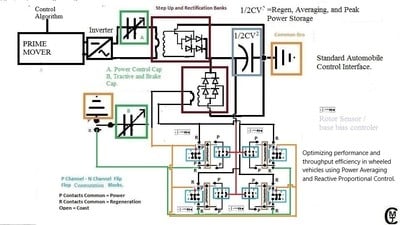
In this proposed hybrid electro-dynamic process, power provided by the prime mover is converted to electrical energy via a crank integrated alternator, and depending on application, the output AC is first fed to a high ratio voltage step up, a full wave rectifier, and then to the power and storage circuit.
Infinitely Variable Torque Control:
Torque is controlled by varying circuit admittance.
Torque demand on the prime mover is controlled by varying the admittance of the Charging Circuit. (1/z where z is circuit impedance) Torque demand on the prime mover is proportional to Charging Circuit Admittance (1/z). Maximum torque demand is greatest when capacitive and inductive values are at resonance with the alternator frequency. The alternator frequency is defined by the rotor speed and number of magnetic poles in the alternator.
The Charging Circuit admittance can be either manually controlled by the operator via a variable control capacitance, inductance, or both; or by a process control algorithm. When combined with temporary storage this eliminates real-time demand on the prime mover and allows the operator or control algorithm to average power input throughout the entire transport cycle regardless of terrain or other demand variables, within limits. Peak tractive demand is met by capacitated energy and can far exceed the peak power output of the prime mover for short periods of time.
For a human powered process this allows the operator to choose when to input power regardless of real time demand.
For Internal Combustion Powered Processes this means optimizing prime mover mass and volume fractions. This process proposes a means to increase energy throughput efficiency, and optimize performance in land based vehicles.
This proportional control method eliminates all mechanical linkage between the crank or shaft and drive wheel(s) and allows for infinitely variable control of power and braking within the limits of wheel to road adhesion.
Input Power is fed into the system independent of real time demand and Propulsion Power is drawn off the storage capacitor based on real time demand. Regenerated brake energy is recovered and returned to storage. The same proportional control methodology is used in initial input power, propulsion and regenerative braking.
Below is the familiar equation for RLC series resonance. As stated above; maximum torque demand on the Permanent Magnet Alternator (PMA) occurs when the PMA output frequency is at resonance with the charging circuit. Maximum propulsion or regenerative braking force is developed when the wheel integrated Permanent Magnet Motor/Generator (PMMG) output frequency is at resonance with the propulsion or regenerative braking circuit. f=1/(2π√LC) in HZ or ω=1/√LC. This is controlled by the operator or algorithm.
In the theory circuit as shown, the system charging circuit, power circuit, and regeneration circuit are so interconnected as to allow allow the charging circuit to function independently of propulsion or regenerative braking.
Prime mover input energy can be continuously or intermittently input regardless of the propulsion or braking state.
In algorithmically controlled processes this allows for averaging power input over the entire transport cycle. For manual operator controlled processes it allows the operator to control the rate of system energy input regardless of instantaneous propulsion or braking demand. The prime mover output can be "averaged" over the entire transport cycle; with the storage system providing peak power. The prime mover is no longer required to respond solely to instantaneous demand defined by acceleration, braking, or grading.

__________________
"The greater danger for most of us lies not in setting our aim too high and falling short; but in setting our aim too low, and achieving our mark." -- Michelangelo
Register to Reply
Guru
Hobbies - DIY Welding - Don't Know What Made The Old Title Attractive... Popular Science - Weaponology - New Member United States - US - Statue of Liberty - 60 Year Member

Join Date: Apr 2009
Location: Yellowstone Valley, in Big Sky Country
Posts: 7425
Good Answers: 295
#31
In reply to #30

Re: Which One is the Most Efficient?

03/12/2026 4:23 AM

From the original post:

“…how to work out in theory which one is the most efficient, the combustion engine with supplementary battery power or the constant RPM engine that’s driving a generator that drives the wheels?”

Trees4Life has not provided clarity on <most efficient> parameters… is it most ton-miles per unit of fuel, or least expensive to construct/produce, or maintenance is handyman easy and parts are available and cheap… there are several completely different efficiencies.

Additionally, OP question scheme excludes batteries or caps: ICE engine → Generator → Wheels. So regeneration is off the table, as is demand averaging or docking with a charger.

__________________
Semper Ubi Sub Ubi
Register to Reply
Guru

Join Date: Mar 2011
Location: Sebastopol, California
Posts: 1205
Good Answers: 54
#42

Re: Which One is the Most Efficient?

05/18/2026 11:36 PM

I have been thinking a lot about this, and in the use case of a train that needs to apply all of it's torque at 0 wheel RPM there are only two technologies that can deliver, Electric, and Steam. There are no diesel only trains. They are all diesel-electric, and that is because of the 0rpm torque requirement. It hasn't got anything to do with efficiency. The fact that the train is also running on a low friction steel rail does have something to do with efficiency once the whole mess is moving. But there is only low ramp up to speed and slow ramp down to stop in such a system. Steel rails are not good for stopping because they are a low friction surface. All of the efficiency of a train setup comes from 100% torque availability at any rpm, inertia, and a low friction rolling surface.
This is not a car or even a semi tractor trailer scenario. You might get some improved efficiency using a diesel electric hybrid tractor trailer with three trailers crossing 100's of Kilometers across long straight FLAT Australian outback or maybe a few hundred miles of desert west US. But any other stop and go vehicle is going to have a very different set of requirements and so this comparison is simply apples and oranges.

__________________
Most people are mostly good most of the time.
Register to Reply
Guru

Join Date: Jan 2007
Location: Edinburgh, Bonnie Scotland
Posts: 1335
Good Answers: 23
#43

Re: Which One is the Most Efficient?

05/19/2026 12:19 AM

PHEVs (plug in hybrid electric vehicles) are widely available in Europe.

They use far smaller petrol engines than would normally be used in an SUV.

Due to the increased torque from the electric drive motors, they can accelerate as fast, or even faster, than the larger engines they replaced.

They often have batteries capable of providing power for up to 50 miles with the engine off for use around town.

Instead of 30-40mpg, they can get 160+.

https://www.skoda.co.uk/new-cars/kodiaq/se-5-seats

just one example.

__________________
Madness is all in the mind
Register to Reply
Member

Join Date: Apr 2009
Posts: 6
#45

Re: Which One is the Most Efficient?

05/19/2026 2:53 AM

I believe Honda and Nissan have produced Hybrid vehicles that don't drive the wheels by the ICE Engine. The ICE Engine only generates power. Someone needs to test these compared with ordinary Hybrids.

Register to Reply Off Topic (Score 5)
Guru

Join Date: May 2018
Location: Under the spreading Bunya Trees, South Burnett, Queensland, Australia
Posts: 807
Good Answers: 65
#46

Re: Which One is the Most Efficient?

05/19/2026 4:09 AM

What you are proposing is that which is used in OHV mine haul trucks where a diesel engine drives an alternator or DC generator with suitable control to drive DC wheel motors or AC wheel motors.

Though the diesel engine does vary its speed from idle. This is used on oil drilling rigs where a diesel engine drives an alternator feeding an SCR pack to drive DC locomotive motors. The engine runs at 1500 or 1600 RPM depending on 50 or 60 Hz required.

The sound of an ICE motor running at a fixed speed to generate power would sound like a vehicle with a CVT transmission, revving for little motion and also the wear at the higher RPM would need to be taken in.

Efficiency; ICE 30-40%, large engines 40-50%, alternator 80% to 97%, electric motor 95%, Electronic control 90% to 95%.

__________________
Hare today, goon tomorrow!
Register to Reply
Guru

Join Date: Jul 2005
Location: Stoke-on-Trent, UK
Posts: 4496
Good Answers: 137
#47
In reply to #46

Re: Which One is the Most Efficient?

05/19/2026 11:17 AM

Why would the engine need to run at a set speed? I'd have thought the SCR pack could accept a range of frequencies. But if it does, it would be 1800 rpm for 60 Hz.

__________________
Give masochists a fair crack of the whip
Register to Reply
Register to Reply 47 comments

"Almost" Good Answers:

Check out these comments that don't yet have enough votes to be "official" good answers and, if you agree with them, vote them!
Copy to Clipboard

Users who posted comments:

Brave Sir Robin (4); Codemaster (3); Deefburger (2); Doorman (9); Gavilan (2); gideon (1); GM1964 (2); HiTekRedNek (7); hitekrednek2 (2); Linz27 (1); phoenix911 (3); rwilliams (1); silvCrow (1); Stef (2); steve45 (1); The Wizard (1); Trees4Life (2); Troy36 (2); Vulcan (1)

Previous in Forum: A Log Jam Unstick Trick   Next in Forum: Measuring Light Speed Without a Clock

Advertisement