regarding to CABLE GLAND,conduit pipes and its fitting i would like to know what is the difference between PG, NPTand UNIFI and what is the relation to relize that??
there are many different thread types, they vary primarily in the angles of the peaks and valleys , the profile of the peaks and valleys and the number of threads per fixed unit of measure. Normally Threads per Inch are used which is the whole number after the nominal diameter eg. 5/16" 24 is a nominal shaft size of 5/16" and there are 24 threads per inch (TPI). most threads are right handed though sometimes left handed threads are used (left side wheel nuts on trucks for eg). You can also have multi start threads where several threads are wrapped around the one rod, normaly to speed up assembly. finally there are Pipe threads they differ in that the threadform and Teeth per inch are generally constant through a large range of sizes. this allows one set of dies to cut many sizes of pipes. Pipe threads are usually tapered, but not always, being designed to jam on. sometimes fine threads eg 24 TPI normally associated with small screws are used on large items for caps or locating collars
After all that, there are a wide variety of designs, NPT is national Pipe thread unified is a similar system normally broken into Fine (UNF or NF) and course (UNC or NC).
the only other thing you need is the spanner sizes, retailers sell bplts etc by shaft size. The spanner however is either measured accoring to shaft size (whitworth) but most, particularly unified and metric use the distance across the nut flats on a six sided nut.
Finally avoid metric if you want to undo things at some distance down the track, the thread design makes them rust solid. If you must use metric sizes use Whitworth threadform and note that Motor Engineers often use a metric fine thread on quite large bolts ( for similar reasons); these are hard to find and the tooling is even rarer outside the factories they are made in.
I've always known Pg to refer to PANZER GAUGE thread form. They don't use this (thank god) in Oz and it was getting rare in the UK 5 years ago.
The details below may be of help!
Pg Steel Conduit Threads
Pg Steel Conduit Threads per DIN 40430 STEEL CONDUIT THREAD; DIMENSIONS
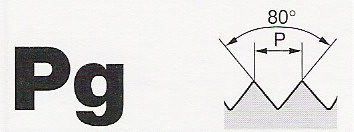
Pg Steel Conduit Threads are manufactured in accordance with DIN 40430 STEEL CONDUIT THREAD; DIMENSIONS. The Pg thread series is designed specifically for steel conduit because of the thin wall cross section of the steel conduit. The thin wall thickness requires a shorter profile thread that will not break through the outside diameter of the steel conduit during the machining process. The 80° included angle of the Pg thread form gives a shorter profile than the more common 60° included angle found in the Unified National thread series and the Metric thread series. There is some discussion about replacing the Pg Steel Conduit Thread per DIN 40430 with a 60° version as specified in BS EN 50262 CABLE GLANDS FOR ELECTRICAL INSTALLATIONS and/or DIN EN 50262 METRIC CABLE GLANDS FOR ELECTRICAL INSTALLATIONS.
Standard Pg Steel Conduit Thread Sizes per DIN 40430 STEEL CONDUIT THREAD; DIMENSIONS
Pg7: Nominal Major Diameter = 12.5mm; Threads-Per-Inch = 20
Pg9: Nominal Major Diameter = 15.2mm; Threads-Per-Inch = 18
Pg11: Nominal Major Diameter = 18.6mm; Threads-Per-Inch = 18
Pg13.5: Nominal Major Diameter = 20.4mm; Threads-Per-Inch = 18
Pg16: Nominal Major Diameter = 22.5mm; Threads-Per-Inch = 18
Pg:21 Nominal Major Diameter = 28.3mm; Threads-Per-Inch = 16
Pg:29 Nominal Major Diameter = 37mm; Threads-Per-Inch = 16
Pg:36 Nominal Major Diameter = 47mm; Threads-Per-Inch = 16
Pg:42 Nominal Major Diameter = 54mm; Threads-Per-Inch = 16
Pg:48 Nominal Major Diameter = 59.3mm; Threads-Per-Inch = 16
__________________
"A common mistake people make when trying to design something completely foolproof is to underestimate the ingenuity of complete fools!" Douglas Adams 1952-2001. E&OE!
Just a brief addition to the last very good post. Unfortunately PG is still very common in EU manufactured electrical components. Even here in the US we see PG threads on cord grips and devices that would accept conduit fittings. Note, most of these companies have an NPT equivalent model also available. RE NPT the size is not based on your normal SAE screw and bolt size but on the size of the ID of the pipe... thus a 1/2 inch NPT fitting would just pass through cutout of ~ 7/8". Also re NPT this is a tapered thread designed to deform when tightened. this is how it gets its seal. To add to the fire, there are two types of NPT, the standard NPT which requires pipe sealant or teflon tape to form a water / pressure tight seal and NPTF which has a slightly different thread angle / accuracy and will tighten down to seal without sealant.
So to add to a long discussion there is a major difference between the two tread types. But there are manufacturers of adapters to convert between the two types... See the Lapp Group as a possible source.


 Conduit Pipes and Cable Glands
 Re: Conduit Pipes and Cable Glands