Previous in Forum: Friction on Rubber surface Area   Next in Forum: valve throttling and selection guide
Close
Close
Close
15 comments
Rate Comments: Nested
Anonymous Poster

mechanical gear stuff

11/06/2008 10:08 PM

I would like to know what is the power of the motor with worm gear ratio 50:1 and 6500rpm.

Reply
Interested in this topic? By joining CR4 you can "subscribe" to
this discussion and receive notification when new comments are added.

Good Answers:

These comments received enough positive votes to make them "good answers".

"Almost" Good Answers:

Check out these comments that don't yet have enough votes to be "official" good answers and, if you agree with them, vote them!
Guru

Join Date: Dec 2007
Posts: 588
Good Answers: 13
#1

Re: mechanical gear stuff

11/06/2008 10:32 PM

the same as one with a 25 to one . Power is not effected by gear ratio's Torque can be changed with gear ratios.

Reply
Guru
Hobbies - RC Aircraft - New Member Hobbies - Automotive Performance - New Member Hobbies - DIY Welding - New Member

Join Date: Jul 2007
Location: Fort Lauderdale Florida
Posts: 5708
Good Answers: 123
#2

Re: mechanical gear stuff

11/06/2008 11:09 PM

The Power of the motor is about 95% of the rating on the motor. The 5% loss is probably due to voltage drop.

__________________
Bob
Reply
2
Guru
New Zealand - Member - Interested in everything- see my Profile please APIX Pilot Plant Design Project - Member - Member Engineering Fields - Electrical Engineering - Member Engineering Fields - Power Engineering - Member Engineering Fields - Civil Engineering - Member Hobbies - Musician - Autoharp and Harmonica Hobbies - Hunting - Member Hobbies - Fishing - Member

Join Date: Nov 2007
Location: Christchurch, (The Garden City), South Island, New Zealand
Posts: 4395
Good Answers: 230
#3

Re: mechanical gear stuff

11/07/2008 12:43 AM

Hello Guest,

The losses through a worm gearbox as you describe will be dependent on the actual power required by the load on that gearbox, plus other factors.

If the motor is a small toy one, and equivalently loaded, the consequent losses in the gearbox can be 35% - 40%.

If the motor is between 1kW and 10kW, and equivalently loaded, the consequent losses in the gearbox can be 10% - 15%.

If the motor is between 11kW and 100kW, and equivalently loaded, the consequent losses in the gearbox can be 10% - 5%.

If the motor is between 100kW and 1MW, and equivalently loaded, the consequent losses in the gearbox can be 5% - 2%.

The above figures are general ones, and are dependent on proper lubrication inside the gearbox, plus proper bearings for the speed and load.

As you can easily see, the larger the gearbox, (within reason) the less the internal losses become on a percentage basis.

The losses in the gearbox result in metal wear, vibration, noise and heat.

Kind Regards....

__________________
"The number of inventions increases faster than the need for them at the time" - SparkY
Reply Good Answer (Score 2)
Guru

Join Date: Aug 2005
Location: Hemel Hempstead, UK
Posts: 5826
Good Answers: 322
#10
In reply to #3

Re: mechanical gear stuff

07/23/2018 6:54 AM

Welcome back!!!!!

__________________
If you spend all your time looking for people and things to complain about: trust me, you will find plenty to complain about.
Reply
Guru
Popular Science - Weaponology - New Member Hobbies - Fishing - New Member

Join Date: May 2007
Location: Aloha or
Posts: 659
Good Answers: 19
#13
In reply to #3

Re: mechanical gear stuff

07/23/2018 11:28 AM

Welcome back!

__________________
Closed biased minds are utterly impervious to any factual evidence which contradicts their beliefs
Reply
Guru

Join Date: Mar 2007
Posts: 2550
Good Answers: 103
#4

Re: mechanical gear stuff

11/08/2008 1:57 AM

The worm gear ratio of 50:1 is very high. At this steep angle the rolling will be largely overtaken by the friction (or sliding) I expect at this ratio, with even multi start, the power transmission efficiency to be less than 50%.

To know output of the motor we must know the load.

The efficiency of 5% to 2% is understated.

We make gear boxes with single stage reduction - worms (ratio :1) with multi start and the efficiency is only about 80% - Motor power 500KW.

We have switched over to planetary chain with efficiency 95% approx. And the effect even in our manufacturing shop is significant -

Gear Box No load power - with Worm drive = 60KW, with planetary = 12KW.

rate the motor based on load accordingly, and if the power is high and you are buing the gear box, think about other types of gears.

__________________
Fantastic ideas for a Fantastic World, I make the illogical logical.They put me in cars,they put me in yer tv.They put me in stereos and those little radios you stick in your ears.They even put me in watches, they have teeny gremlins for your watches
Reply
Guru

Join Date: Jul 2008
Posts: 927
Good Answers: 56
#5
In reply to #4

Re: mechanical gear stuff

11/08/2008 3:14 AM

"We have switched over to planetary chain with efficiency 95% approx. And the effect even in our manufacturing shop is significant -"

That's interesting. Is the system as compact as a gear driven system of the same capacity?

Many in my pastime build telescope tracking systems using worm drives in order to match the Earth's Sidereal rate of rotation. Ratios above 50 to 1 are common.

As you pointed out, shear loads are considerable in our applications. However, the biggest problem is periodic errors caused by minute variations in the precision of the machined parts.

L.J.

__________________
"Both the revolutionary and the creative individual are perpetual juveniles. The revolutionary does not grow up because he cannot grow, while the creative individual cannot grow up because he keeps growing." Eric Hoffer
Reply
Power-User

Join Date: Feb 2008
Posts: 353
Good Answers: 8
#6
In reply to #5

Re: mechanical gear stuff

11/08/2008 3:30 PM

I was working once on high ratio and high efficiency gear box, but did not pursue it, due to perceived little need.

If you care to list the following, I am willing to see if there is an alternative gear box available.

What is the power transmitted, input and output rpm, rough size & weight, purchase price, perhaps the make and the quantity of possible sales per year.

You might not know the last questions, but let me see your data. It might be worthwhile after all.

Regards

__________________
'The devil is in the detail'. Yes, but if the details are right the devil is on vacation.
Reply
Guru

Join Date: May 2006
Location: Placerville, CA (38° 45N, 120° 47'W)
Posts: 6215
Good Answers: 248
#7

Re: mechanical gear stuff

07/22/2018 11:27 AM

As the others have said, there is not enough information to answer the question. The basic definition of electrical power is the product of voltage and current. The basic definition of mechanical power is the product of force and distance divided by time. There are lots of variations on these basic definitions, but no power calculation can be made without all of the required values for the calculation.

A high gear ratio is normally used either to obtain very low speed and/or high torque. If the requirement is low speed, then why use such a high-speed motor?

I'm guessing that this is a very small motor, likely operating on DC. As someone else indicated, very small motors with high ratio gearboxes have notoriously low efficiency, which means that the mechanical power provided to the load will be a small fraction of the electrical energy required to run the motor.

__________________
Teaching is a great experience, but there is no better teacher than experience.
Reply
Guru
Popular Science - Weaponology - New Member Engineering Fields - Engineering Physics - New Member Engineering Fields - Nuclear Engineering - New Member

Join Date: Dec 2007
Location: No. VA, USA (No, it does NOTu mean "won't go"!)
Posts: 1796
Good Answers: 75
#8
In reply to #7

Re: mechanical gear stuff

07/22/2018 9:19 PM

Good answer, DKW, and it leads me to MY question. I am designing a turntable for a lady's group in my church, which, if successful, will most certainly see much more than the planned use. It needs to turn at about 1 RPM, the table is roughly 40 inch diameter, I can apply power at any point along the rim, or underside (so actual track diameter is more a function of available torque and calculated speed of rotation), and the whole thing, battery powered, needs to be able to "turn" a load of about 40 pounds. That's the current spec. Specs may change later, as it sees use.

I managed to purchase a "lazy susan" bearing ring set with a 1000 pound load capacity (way in excess of requirements, but inexpensive, and much better made than anything available from people like Williams Sonoma, or even Home Depot or Lowes.

So, I found a motor, with a large reduction ratio, and according high base RPM (no load, no gear motor speed). It is probably as inefficient as you all have said, but I could live with that. What I can't live with is the growl of the assembly, both that which is mechanically coupled to the turntable by the friction drive I tried, and that of the motor/gearbox assembly. I MIGHT be able to live with the motor/gearbox noise, but would prefer lower speed/more efficiency for longer battery life.

In addition, at least for version 1.0, it has to be low cost (I have about $120 dollars of my own in it now, and was castigated thoroughly by the young lady who asked me to design/build it, and who I babysat when she was 2-3 years old and her Dad and I were fishing buddies, for spending money I can't convince her I could afford), and it has to be fairly light weight. The current assembly weighs about 25 pounds and if it goes up much, the ladies won't be able to set it up when they need it.

Assuming, (and knowing the history of MY 38 years with this church, I'm certain it's a good assumption) this THING finds more widespread use, all those specs might change. But then, so will the funding, storage requirements, etc., and MAYBE someone else will do the redesign anyway. Then it will all be their problem.

Any advice you can give me for power sources? I'm about tapped out, after 6 months of online and local research. And I have several HD, Lowes, and Ace Hardware, as well as Hobby Lobby, and many unaffiliated hobby stores I've visited and checked with. I've also checked some of the available Used and Surplus parts sources in print and online, but I'm certain there are a lot of which I'm unaware.

Anybody wish to weigh in with advice? I'd most appreciate it. If necessary I'll move this to another thread so I don't hijack this one. Though this does appear to be a similar trail.

Thanks.

Micahd

__________________
Been away a while. Miss all my old friends. Some of you I KNOW are still around. Where are the rest?
Reply
Guru

Join Date: May 2006
Location: Placerville, CA (38° 45N, 120° 47'W)
Posts: 6215
Good Answers: 248
#9
In reply to #8

Re: mechanical gear stuff

07/23/2018 1:02 AM

"Any advice you can give me for power sources?" When you say "power sources", my immediate thoughts turn to battery vs. AC adapters, but since you already mentioned 'battery', I assume that by 'power source' you mean the motor/gearing/drive system.

During the last year or so, I happen to have set up a couple of turntables of roughly that size, that can rotate even slower (around 3 min per revolution) and must rotate at a very consistent speed, as they are used for welding. Unfortunately, these are devices that require a forklift to move; just the motor on each of them weighs the 25 lb. that you mention...

On the other hand, besides the gear reductions, we also use voltage reduction. The motors are rated at 2500 RPM @ 90VDC, but we are applying something like 5VDC, so the motors rotate around 100 RPM, and gearing does the rest. These are brushed motors with many windings, so they do still run smoothly at that low voltage. Cheaper motors might not.

You mention rumble; that means something in the system is out of round or out of balance. Running the motor at a lower speed should help reduce that, but if you already have the desired table speed, this would make it run too slowly...

You also mention friction drive. If this is akin to the old inside rim-drive phonograph turntables, then an idler wheel with softer rubber contact surface would reduce the transfer of vibration from the motor to the table.

Obviously I have no idea of what machine tools you may have at your disposal, but one low-cost possibility that comes to mind would be to drill a series of equally-spaced holes close to the rim. These holes could be driven by pins in a small gear-like pinion, or they could hold pegs that are driven by the pinion. At 1 RPM, these should be virtually silent.

Depending on the housing of the apparatus, other possibilities could include belt or chain drives. Look at old phonographs for ideas...

__________________
Teaching is a great experience, but there is no better teacher than experience.
Reply
Guru
Popular Science - Weaponology - New Member Engineering Fields - Engineering Physics - New Member Engineering Fields - Nuclear Engineering - New Member

Join Date: Dec 2007
Location: No. VA, USA (No, it does NOTu mean "won't go"!)
Posts: 1796
Good Answers: 75
#11
In reply to #9

Re: mechanical gear stuff
07/23/2018 9:20 AM

Thank you. I've seen the pin drive idea, but couldn't find a photo. Your description gives me enough to work on, so I'll try it. The Smithsonian used to have a whimsy Machine in their Air and Space art gallery with a silent string driving a 20 foot diameter table, but it's apparently in storage now where I can't study it. It would have worked well too. But its reduction ratio had to be on the order of 2000 to 1, or so, and it's applied torque was so low I saw a toddler stop it with his fingers once (his parents weren't watching). It took a good 5 minutes to get back up to speed , so it had to also have horrendous slip at that ratio with a friction drive.

__________________
Been away a while. Miss all my old friends. Some of you I KNOW are still around. Where are the rest?
Reply
Guru

Join Date: May 2006
Location: Placerville, CA (38° 45N, 120° 47'W)
Posts: 6215
Good Answers: 248
#14
In reply to #11

Re: mechanical gear stuff

07/23/2018 1:25 PM

I had to try it...

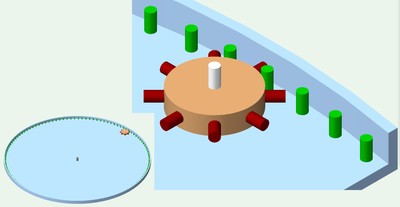
Here's a bottom isometric view of one possibility, with a detail:

Here, the table is 40" in outside diameter, with a 1/4" thick rim and top. The table pins, in green, are 1/4" in diameter and 3/4" long, with 1/2" exposed. There are 120 of them, at 3.0° spacing, on a 39" diameter circle.

The drive wheel is 2" in diameter, with 8 - 1/4" pins @ 45° spacing, each extending 0.4" beyond the disc. The drive wheel center is 18.3" from the table center.

This will give a 15:1 speed reduction from the drive wheel to the table.

I could provide more details if needed.

__________________
Teaching is a great experience, but there is no better teacher than experience.
Reply Score 1 for Good Answer
Guru
Popular Science - Weaponology - New Member Engineering Fields - Engineering Physics - New Member Engineering Fields - Nuclear Engineering - New Member

Join Date: Dec 2007
Location: No. VA, USA (No, it does NOTu mean "won't go"!)
Posts: 1796
Good Answers: 75
#15
In reply to #14

Re: mechanical gear stuff

07/23/2018 7:46 PM

Thank you. Provide more detail? I think not. That would remove my excuse for not starting right now. And since I'm in the middle of a move, I have to wait till later. So I'll get back to you on it, and my thanks.

MicahD

__________________
Been away a while. Miss all my old friends. Some of you I KNOW are still around. Where are the rest?
Reply
Guru

Join Date: May 2016
Posts: 1746
Good Answers: 87
#12

Re: mechanical gear stuff

07/23/2018 11:25 AM

I saw a 50:1 worm gear drive at 6500 RPM once. It was definitely 1.3 HP. And I'm unanimous in that.

Reply
Reply to Forum Thread 15 comments

Good Answers:

These comments received enough positive votes to make them "good answers".

"Almost" Good Answers:

Check out these comments that don't yet have enough votes to be "official" good answers and, if you agree with them, vote them!
Copy to Clipboard

Users who posted comments:

bob c (1); dkwarner (3); Floram (1); Jpfalt (1); Laughing Jaguar (1); micahd02 (3); Randall (1); sb (1); silvCrow (1); Sparkstation (1); vicini (1)

Previous in Forum: Friction on Rubber surface Area   Next in Forum: valve throttling and selection guide

Advertisement