Previous in Forum: HVAC Flow Problems   Next in Forum: Minimum Metal Temperature
Close
Close
Close
9 comments
Rate Comments: Nested
Active Contributor

Join Date: Nov 2008
Posts: 19

Radial Thermal Expansion Calculation

07/21/2009 2:44 AM

Hello All,

For one of our cost Reduction project, i am trying to replace the Treading by Interfernce Fit solution.

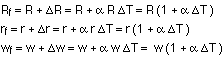
The Body is Aluminum (A360.0) & the Shaft is SS 316 Tube. For the Requisite torque i have identified the Interference value by doing some manual Calculations. Now i am looking for the Temperature required to expand the Aluminum Body (ID from 59" to 59.025"). I used below equation to find out the final Temperature value:-
The Values i put are as below:

rf = 59.025 mm, r = 59 mm, ∆T = T1 - T2 where T2 = 30° C, α = 21 x 10-6 /°C

But after calculation the Temperature (T1) i get is near about 50° C. Eventhough i increase the Interference value to .05", the Temperature i get is about 70 °C, which i dont feel appropriate.

Please suggest if you know more information on this.

Thanks in advance.

Register to Reply
Interested in this topic? By joining CR4 you can "subscribe" to
this discussion and receive notification when new comments are added.
Guru
United Kingdom - Member - Not a New Member Hobbies - Musician - New Member Hobbies - Fishing - New Member

Join Date: May 2006
Location: Reading, Berkshire, UK. Going under cover.
Posts: 9684
Good Answers: 468
#1

Re: Radial Thermal Expansion Calculation

07/21/2009 5:48 AM

Couple of approximations:

Say radius = 60mm, coefficient of expansion = 20e-6 K-1

Multiplying, you get 0.0012 mmK-1

20°C (or K) rise gives you ≈0.024 mm

That's life.

__________________
"Love justice, you who rule the world" - Dante Alighieri
Register to Reply
Guru

Join Date: Mar 2007
Posts: 2550
Good Answers: 103
#2

Re: Radial Thermal Expansion Calculation

07/21/2009 6:07 AM

I will be a bit careful.

The iron and Aluminium has different coefficients of expansion.

For SS we take generally it to be 11μ/m/oC whereas for Al it will be almost twice ie 22μ/m/oC

Additionally the Al has excellent thermal conductivity. As the components go in the operation, the hole (Al gets) heated up and expands much more than the steel which firstly absorbs heat from the Al, then takes its own time to get thoroughly heated so as to unifirmly and fully expand.

Bot these aspects usually results in the loss of interference in the joint. I hope you have taken care of this in your calculations for the required transmission through the interference.

Your calculations are correct.

The Al coeff is 21 x 10-6 /0C

For you required interference is 0.025/59 = 0.000424

So temperature reqd is = 0.000424/0.000021= 20.17 0C

And that from ambient of 30oC is 50.17oC

But now you see the risk?

And also the mild interference that you have taken (almost to the tolerance grade p) will be too low to have a proper drive potential.

We have a thumbrule of going for > 0.1% interference for drive. But that is for steel on steel. No experience with Al on steel (all our pulleys are key driven) with the n6 or p6 interference.

__________________
Fantastic ideas for a Fantastic World, I make the illogical logical.They put me in cars,they put me in yer tv.They put me in stereos and those little radios you stick in your ears.They even put me in watches, they have teeny gremlins for your watches
Register to Reply
Active Contributor

Join Date: Nov 2008
Posts: 19
#3
In reply to #2

Re: Radial Thermal Expansion Calculation

07/21/2009 7:28 AM

Hey Guru,

Thanks for the Information.

Actually there are 2 options available for me, in 1st case i will Expand the Aluminum Body & in second case i will freeze the Steel Body (called as Shrink Fit).

Now i have one more Q - How can i calculate the Time required to heat/Freeze the entire Body (i know the Volume). Thermal Conductivity is related to /m, how to relate it to Volume?

Thanks in Advance.

Register to Reply
Guru

Join Date: Mar 2007
Posts: 2550
Good Answers: 103
#4
In reply to #3

Re: Radial Thermal Expansion Calculation

07/21/2009 8:01 AM

Both are shrink fit (whether you heat the hub or freeze the shaft). It all depends on the availability and feasibility of the facility.

Hub is small, shaft is large - heat the hub.

Shaft is small, hub is large (and quite a bit) - freeze the shaft.

Time to heat or shrink really does not matter much. However the heating is just a bit faster and more so for you since it is aluminium. For our cases, precision components we go for controlled slow heating of the order of 50-60 deg C/ hr in oven and for not so precision upto 90-100 deg c per hr.

For freezing, we put in freezer (maintained at -30 deg C) for 3-4 hrs and take out, by this time despite all the thermal conductivity problems, the temperature is attained by conduction.

In induction heaters, you may get the same unifirm temperature rise in a quarter of an hour or so.

BTW: heat a bit more, since by the time you stop heating and then you start assembly, the temperature will drop. And also since you are at a very large diameter almost 1.5m you need some clearance to position and assemble. I prefer personally atleast another 0.3-0.4mm.

A few brass bronze gears that we assemble with the same tolerances on hub, we heat to 90-100 deg C

again caution- the gears are pinned to the hub, so the interference is not driving - due to low modulus of the bronze as well as for the thermal effects.

I am a bit sceptic because too many cost reduction exercises i have seen has been a major performance compromiser.

__________________
Fantastic ideas for a Fantastic World, I make the illogical logical.They put me in cars,they put me in yer tv.They put me in stereos and those little radios you stick in your ears.They even put me in watches, they have teeny gremlins for your watches
Register to Reply
Guru

Join Date: Dec 2006
Location: Germany 49° 26' N, 7° 46' O
Posts: 1950
Good Answers: 109
#6
In reply to #2

Re: Radial Thermal Expansion Calculation

07/22/2009 2:44 AM

Ferritic/martensitic stainless steel is in the range of TCE you state,

but austenitic (more common) has near 17ppm/K.

Aluminum: preferrably first to anodise with 10µm thickness to prevent seizure.

RHABE

Register to Reply
Guru
Brazil - Member - New Member Engineering Fields - Mechanical Engineering - New Member Hobbies - RC Aircraft - New Member Hobbies - Target Shooting - New Member Hobbies - Automotive Performance - Hey there... interested in exchanging information about car performance? Hobbies - DIY Welding - New Member

Join Date: Jan 2007
Location: Porto Alegre - RS - Brazil 30deg01'39.73"S 51deg13'43.45"W
Posts: 831
Good Answers: 28
#5

Re: Radial Thermal Expansion Calculation

07/21/2009 8:13 PM

I see that you are correct in your calculations and what you need to check was described here. I'd just add a little rule of thumb or two for shrink or loose fit calculations. First, I'd not rely my torque transmission only in the shrink fit, if its a high torque and dependable mechanical transmission. It can loose over time in operation. Better consider splines, bolted joints, or any other power transmission methods. For high end products, even curvic couplings. Second, I've learned a simple tip that works fine for aluminum or aluminum bronze parts against steel parts: for shrink fit, use basically 0,1% of diameter interference. For loose fit, 0,1% in the opposite direction. Several values between them are possible depending on how much or how less you need to adjust it. Works fine. Trust me.

__________________
Humm... suspicious you are...
Register to Reply
Guru

Join Date: Mar 2007
Location: City of Light
Posts: 3943
Good Answers: 183
#7

Re: Radial Thermal Expansion Calculation

07/24/2009 5:30 AM

In your torque calculations have you considered the surface roughness loss at assembly? It can be important depending on the machining quality.

Register to Reply
Anonymous Poster
#8

Re: Radial Thermal Expansion Calculation

08/19/2009 12:56 AM

hi sachin

Am on the project of elliminating bolts by providing shrink fit,material used is cast iron.i hv calculated the stress values with the interference fit but now i need to know the temperature requied for expansion of the same

Thanks in advance

Register to Reply
Active Contributor

Join Date: Nov 2008
Posts: 19
#9
In reply to #8

Re: Radial Thermal Expansion Calculation

08/20/2009 3:51 AM

Hello,

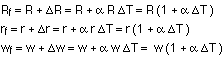
Use below equation to find out the Temperature value:-

The Values i put are as below:

rf = Radius after thermal expansion , r = Radius , ∆T = T1 - T2 where T2 = Atmospheric temperature , α = Co-efficient of Thermal expansion

let me know if you face any problem.

Sachin.

Register to Reply
Register to Reply 9 comments
Copy to Clipboard

Users who posted comments:

Anonymous Poster (1); bhrescobar (1); JohnDG (1); nick name (1); RHABE (1); Sachin Gore (2); sb (2)

Previous in Forum: HVAC Flow Problems   Next in Forum: Minimum Metal Temperature

Advertisement