Previous in Forum: Boiler Feed Pumps   Next in Forum: Understanding MW of electricity
Close
Close
Close
17 comments
Rate Comments: Nested
Participant

Join Date: Dec 2009
Posts: 3

Natural Gas Regulator with Gauge

12/17/2009 4:25 PM

I'd like to see Residential Natural Gas pressure with gauge...

I'm told that natural gas pressure at residences is cranked up in the wintertime.

After having been told that, I started to take note of the kitchen stove burners between fall and winter, and indeed noticed, that the gas flame licks up the side of the saucepan, when in warmer seasons, the flame is smaller than the bottom of the pan.

I'd like to find an important way, to be able to view the pressure, and keep a balanced input of pressure to the home.

Thanks in advance for all good suggestions...

Register to Reply
Interested in this topic? By joining CR4 you can "subscribe" to
this discussion and receive notification when new comments are added.

"Almost" Good Answers:

Check out these comments that don't yet have enough votes to be "official" good answers and, if you agree with them, vote them!
Guru

Join Date: Apr 2006
Location: Cincinnati, Ohio, USA
Posts: 662
Good Answers: 49
#1

Re: Natural Gas Regulator with Gauge

12/17/2009 5:28 PM

It is possible that the gas supplier cranks up the pressure to get enough gas to everybody, but you need not worry.

Every "critical" device in your home- furnace, water heater, etc. that uses gas has a built-in pressure regulator.

On you stove, you become the regulator. Your oven also likely sees a higher flame, but it is regulated to cycle as required to maintain a fixed temperature.

__________________
NO MATTER HOW WELL YOU HAVE DONE SO FAR, ALWAYS TRY TO BE BETTER TOMORROW.
Register to Reply
Participant

Join Date: Dec 2009
Posts: 3
#2
In reply to #1

Re: Natural Gas Regulator with Gauge

12/17/2009 6:16 PM

Thank you for your insight.

I believe I have about a 20-year-old boiler, and although it just had a cleaning, I see significant yellowish flame, rather than blue flame. It's much like the flame licking-up the side of the sauce pan when the gas is not controlled (as you pointed out, by 'me', the cook at the stove.)

It seems the natural gas furnace is the largest source of my gas consumption. Doesn't it make sense that it may be the largest source of waste? If the gas company is pushing more gas in the system, to get it to every nook-and-cranny of the consumer market, doesn't reason that the furnace is wasting energy, licking-up the sides of the boiler pipes, rather than controlled ' blue flame' only across the bottom of the pipes?

Of course, as a technologist, I'm always looking to quantify the information...

Do/can regulators ever go bad?

Happy holidays to all!

: )

Register to Reply
Guru

Join Date: Mar 2008
Location: Atlanta, Georgia
Posts: 749
Good Answers: 13
#14
In reply to #2

Re: Natural Gas Regulator with Gauge

12/19/2009 2:28 PM

MacPC,

Two people on this site have pointed out that the yellow flames you are seeing after a cleaning may be indicators of danger, i.e., a condition of incomplete burning of gas resulting in production of carbon monoxide which does not smell and is a very dangerous and potential killer. We have not seen, either from you or others on this site preoccupied with tertiary abstractions, a positive and firm response from you acknowledging that potential danger and some plan showing your intent to do something about it.

This is an on-line conversation in which we participants can do ought but notice you of perceived potential danger.

I write again just in case we hear, in the absence of your acknowledgment as to potential danger, of the deaths of you and your family. Then at least we will have done our best in terms of warning, and will be able to shrug and offer "We warned him. There was nothing else we could do."

Please respond. What are you doing about those yellow flames? Did you check them against the illustrations of proper and improper burning I offered in my earlier post?

j.

Register to Reply
Guru
Popular Science - Weaponology - New Member Safety - ESD - New Member Hobbies - Fishing - New Member

Join Date: Sep 2006
Location: Near Frankfurt am Main, Germany. 50.390866N, 8.884827E
Posts: 17996
Good Answers: 200
#17
In reply to #1

Re: Natural Gas Regulator with Gauge

12/21/2009 9:38 AM

I am pretty sure that this depends on where you live.

In Germany 20 odd years ago, no house on piped gas had its own regulator ( a serious design failure in my view!). After several bad accidents, the law was changed and each hose has its own regulator.

My house has its own gas tank, when I moved here 23 years ago I changed to a larger storage tank, even further away from the house and had an extra reducer added at the garage.

The installer told me I was wasting my money (but this was required in the UK some years before that!!), but if that is what I wanted, OK. About 10 years or so it was made law, I was the only one around here that did not need an "update!"

Generally a reducer fails to "safe", but occasionally they do not.....better safe than sorry, add a reducer!!! (and a gauge as well!)

__________________
"What others say about you reveals more about them, than it does you." Anon.
Register to Reply
Power-User

Join Date: Aug 2007
Location: San Francisco Bay Area
Posts: 266
Good Answers: 21
#3

Re: Natural Gas Regulator with Gauge

12/17/2009 9:42 PM

If you think there is a pressure variance then perhaps purchasing a manometer would be a good idea. I have no idea about domestic gas valves but every one of the gas valves on my water heaters and ovens in the plant have ports to measure pressure and a screw adjustment to dial in the pressure you want.

http://www.mcmaster.com/#manometers/=4z87fx

http://www.grainger.com/Grainger/wwg/search.shtml?searchQuery=gas+manometer&op=search&Ntt=gas+manometer&N=0&sst=All

__________________
Speed doesn't kill. Sudden stops, brick walls, and old ladies in Buicks do.
Register to Reply
Anonymous Poster
#4

Re: Natural Gas Regulator with Gauge

12/18/2009 5:51 AM

The gas pressure remains the same. They dont crank it up. If anything it might drop slightly. If you have 2 " wc or 5 psi going into your house and the service delivery pressure is 60 psi. No need to crank anything up. All regulator stations that reduce trasmission line pressure to distribution line pressure have an overpressure vent that will open if the pressure rises much more that set at. This setting remains constant.

Register to Reply Score 1 for Good Answer
Guru
Hobbies - DIY Welding - Wannabeabettawelda

Join Date: May 2007
Location: Annapolis, Maryland
Posts: 7940
Good Answers: 458
#8
In reply to #4

Re: Natural Gas Regulator with Gauge

12/18/2009 10:39 AM

Good answer. The gas meter for your residence not only meters your gas but there is invariably a pressure regulator attached to it as well. The regulator provides a constant pressure to your house as the supply pressure may rise and fall due to demand because of pressure drops in the supply lines as the velocity of the gas increases with increased demand. See the photo from Wikipedia.

http://en.wikipedia.org/wiki/Gas_meter

The round disk-like object between the meter and the cut-off valve is your regulator.

You can see some regulators for sale at this site.

http://www.nwpwr.com/products/power_generators/gas_regulators.htm

You can see the over-pressure vent which is the unterminated female pipe fitting pointing down on the "front" of this regulator.

Cheers!

Register to Reply
Guru
Hobbies - HAM Radio - New Member United Kingdom - Big Ben - New Member Fans of Old Computers - Altair 8800 - New Member Canada - Member - New Member

Join Date: Jun 2006
Location: Toronto
Posts: 3968
Good Answers: 120
#5

Re: Natural Gas Regulator with Gauge

12/18/2009 6:44 AM

In winter the gas consumption goes up dramatically, it also varies over the day. Gas is, well, a gas, and it is compressible, = a gradient occurs that get greater in winter. With summer pressure some far out areas might get starved of gas. So they monitor it and feed a little more down the pipe in winter or other peak times. The only way to get more down the pipe = more pressure. Gas is a very low pressure distribution, unlike water.

__________________
Per Ardua Ad Astra
Register to Reply
Participant

Join Date: Dec 2009
Posts: 3
#6

Re: Natural Gas Regulator with Gauge

12/18/2009 9:38 AM

Thank you all!

What should typical natural gas pressure in residences be in the Northern suburbs of Chicago? What PSI (or other measurement?) It doesn't change? It does change?

Happy Holidays!

:)

Register to Reply
Anonymous Poster
#11
In reply to #6

Re: Natural Gas Regulator with Gauge

12/18/2009 6:49 PM

why not say "Merry Christmas" that is what the holiday is. Isnt it?

Register to Reply
Power-User
United States - Member - New Member

Join Date: May 2008
Location: Arizona
Posts: 355
Good Answers: 4
#12
In reply to #6

Re: Natural Gas Regulator with Gauge

12/19/2009 9:40 AM

The pressure downstream of a typical US residential gas regulator is constant thru-out the year, 24/7/365, at 7"wc. Your bill is based on this constant pressure. If the gas company were to increase this pressure, they'd be cheating themselves of income. Therefore it never changes. The piping system downstream of the gas meter is the responsibility of the consumer.

If you are experiencing yellow flames, you should have a gas technician examine the appliance, because this usually indicates a mal-adjusted fuel-air ratio.

Perhaps the yellow flame was higher, giving you the false impression there was more gas pressure in the line.

Register to Reply
Guru
Hobbies - HAM Radio - New Member United Kingdom - Big Ben - New Member Fans of Old Computers - Altair 8800 - New Member Canada - Member - New Member

Join Date: Jun 2006
Location: Toronto
Posts: 3968
Good Answers: 120
#13
In reply to #12

Re: Natural Gas Regulator with Gauge

12/19/2009 1:57 PM

The appliance must see a constant pressure, 7 inch water column (where 32 feet water column = 14.7 PSI).

The down regulator in the meter regulates from a higher line pressure, even so this line pressure is not very high by water standards. In times of high consumption the line pressure can drop below the pressure the down regulator operates to and that can lead to flame droop.

It appears there are low pressure domestic distribution systems that run on 7-11" WC, and there is a 2 PSI system.

These pages give some links.

http://www.engineeringtoolbox.com/natural-gas-pipe-sizing-d_828.html

http://www.propane-generators.com/natural-gas.htm

__________________
Per Ardua Ad Astra
Register to Reply
Power-User

Join Date: Dec 2006
Posts: 346
Good Answers: 6
#7

Re: Natural Gas Regulator with Gauge
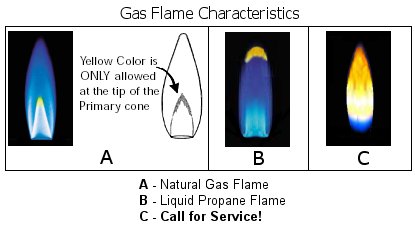
12/18/2009 10:30 AM

macpctech:think about it, very cold weather, pipe sizes are fixed,increasing pressure will not help, you have a regulator, fixed orifice, add more therms, energy to gas. perry

Register to Reply
Guru
Hobbies - HAM Radio - New Member United Kingdom - Big Ben - New Member Fans of Old Computers - Altair 8800 - New Member Canada - Member - New Member

Join Date: Jun 2006
Location: Toronto
Posts: 3968
Good Answers: 120
#9
In reply to #7

Re: Natural Gas Regulator with Gauge

12/18/2009 10:48 AM

there are twp ways to get more fluid down a pipe, a bigger pipe or more pressure. With either a gas or a liquid both methods will work.

Our body has flexible pipes to get more blood to the muscles under stress, the heart also beats with greater frequency = more pressure.

For street gas, all they can do is add pressure to feed more furnaces. In extreme build out areas this can result in too low a pressure for good heat and safety. Since gas uses a mixed fluid to burn, if the pressure falls too low the flame front can leap back to the gas aperture, and make a dangerous hot spot as it heats there. Appliances are made fail-safe, so this should not be a danger. In practice accumulated dust and grease can be ignited and cause a fire inside the stove(top or oven). These stink and make smoke, but unless there is a huge accumulation of grease they should self limit.

__________________
Per Ardua Ad Astra
Register to Reply
Guru
Hobbies - HAM Radio - New Member United Kingdom - Big Ben - New Member Fans of Old Computers - Altair 8800 - New Member Canada - Member - New Member

Join Date: Jun 2006
Location: Toronto
Posts: 3968
Good Answers: 120
#15
In reply to #9

Re: Natural Gas Regulator with Gauge

12/19/2009 4:15 PM

Jack Jersawicz showed certain flames being an indication of incomplete combustion with tiny particles of carbon heated to incandescence in the flame cone. Even worse is if there is any soot. With a sooty flame you will have carbon monoxide. In addition, many gasses are the so called "producer gas" that has carbon monoxide in it and gave rise to those old suicide methods of putting your head in the oven and turning on the gas. Any incomplete combustion in a producer gas has allows the CO to enter the room unburned, incomplete combustion of natural gas or propane creates CO

__________________
Per Ardua Ad Astra
Register to Reply Score 1 for Good Answer
Guru

Join Date: Mar 2008
Location: Atlanta, Georgia
Posts: 749
Good Answers: 13
#10

Re: Natural Gas Regulator with Gauge

12/18/2009 4:35 PM

Every year people die from carbon monoxide poisening.

You said after service the flame that had been blue was now yellow.

Check this image for comparison. If the flame does not look like the natural gas flame in the picture, which is not yellow, turn the unit off and get some one who knows what is proper and how to achieve it.

http://www.appliance411.com/faq/gas_range_flames.shtml

j.

Register to Reply
Guru
Hobbies - HAM Radio - New Member United Kingdom - Big Ben - New Member Fans of Old Computers - Altair 8800 - New Member Canada - Member - New Member

Join Date: Jun 2006
Location: Toronto
Posts: 3968
Good Answers: 120
#16
In reply to #10

Re: Natural Gas Regulator with Gauge

12/19/2009 5:11 PM

If there has been a cleaning, you can get some fine particles that contain traces of sodium salts, which can give a yellow hue to the flame. Usually this aoon abates as loose particles are flushed from the system.

This is a fully aerated flame with added sodium chloride to produce sodium ions.

__________________
Per Ardua Ad Astra
Register to Reply
Register to Reply 17 comments

"Almost" Good Answers:

Check out these comments that don't yet have enough votes to be "official" good answers and, if you agree with them, vote them!
Copy to Clipboard

Users who posted comments:

Andy Germany (1); Anonymous Poster (2); aurizon (5); Brave Sir Robin (1); energygod (1); flyinghigh (1); Jack Jersawitz (2); MacPCtech.com (2); perry (1); Switchman (1)

Previous in Forum: Boiler Feed Pumps   Next in Forum: Understanding MW of electricity

Advertisement