Previous in Forum: generator   Next in Forum: Standards for 11-KV Cable Trench
Close
Close
Close
14 comments
Rate Comments: Nested
Power-User
Popular Science - Weaponology - New Member

Join Date: Jan 2006
Location: Fredericksburg, Virginia USA
Posts: 232
Good Answers: 1

Voltage Conversion

02/14/2010 10:39 AM

I have a friend who has a slicing appliance made in Germany. We live in the US and this particular appliance is designed to run on 230v 50Hz power. I understand this is the standard in Europe. Would it be safe to put a new plug on the end of the cord and connect this machine to the 230v 60Hz electrical supply that is standard here in the US? Will this seriously damage the machine or cause anyone injury? I tried to find some technical info on the manufacturer's website, but it was in German and the google translation didn't seem to offer any insight on this question. I thought maybe they might offer some form of adapter/transformer to facilitate the connection. Is there one commercially available?

__________________
See Bio for signature line........political correctness and insecure people are such a pain-in-the-ass.
Register to Reply
Interested in this topic? By joining CR4 you can "subscribe" to
this discussion and receive notification when new comments are added.
Guru

Join Date: Oct 2008
Posts: 42355
Good Answers: 1693
#1

Re: voltage conversion

02/14/2010 10:53 AM

Check the nameplate. Many electrical devices are rated for both voltages.

They're many posts on this subject at Search This Forum to the right.

If you run a motor designed for 50 Hz at 60 Hz the motor will run 6/5 the design speed. Some reduction in power, but it's done all the time.

Here's one. Re: 50 Hz & 60 Hz

Register to Reply
Guru

Join Date: Dec 2008
Location: nj,usa
Posts: 1252
Good Answers: 33
#2

Re: voltage conversion

02/14/2010 10:55 AM
__________________
CARPE CRUSTULORUM!
Register to Reply
Guru
Engineering Fields - Electrical Engineering - Been there, done that. Engineering Fields - Control Engineering - New Member

Join Date: Dec 2008
Location: Long Island NY
Posts: 15600
Good Answers: 981
#3

Re: voltage conversion

02/14/2010 11:03 AM

Likely the only problem you'll find is that the motor will spin 6/5 faster than before. This will depend on what type of electric motor and speed controls (if any) you have. But what that speed increase will mean to operation mechanics is another thing all together.

I would first consider contacting the manufacturer if they offer a 120VAC 60Hz motor conversion, not just scanning their web site for information. I would be surprised if they can't reconfigure what you have for 120VAC operation. I would expect that even if this involves replacing the motor, that it would be cheaper than wiring in a new power line to provide 240V.

__________________
"Don't disturb my circles." translation of Archimedes last words
Register to Reply
Anonymous Poster
#4

Re: voltage conversion

02/14/2010 12:03 PM

As the other consultants have pointed out, your motor will run faster, some 18-20 % faster. I'll just add that also more current will flow through your motor. That's because of the higher frequency. You can put your hand on the motor and see if it gets too hot. Most likely nothing much will happen except for the higher speed. To get a 120V-60Hz motor would be ideal, provided that the motor frames are exactly identical and suitable to simply replace one another and that the cost is reasonable. And for general information I'll add that in most North American homes 240V at 60Hz is already in the home. Electric cooking ranges run on 240V so there is a 240 V socket in the kitchen. Electric clothes driers also run on 240V.

Register to Reply
Guru

Join Date: Jun 2009
Location: South of Minot North Dakota
Posts: 8376
Good Answers: 775
#5

Re: voltage conversion

02/14/2010 12:51 PM

An electric motor is basically an transformer with a mechanical secondary. Higher frequency will cause it to draw less amps in no load conditions. The higher speed can however cause overloading issues due ot the mechanical part of the machine being ran faster and thats where they are seen drawing to much power and overheating.

The simplest possible solution if the device runs to fast is to change the motor drive pulley if it is a belt driven system to a smaller one so the machine runs at its correct speed.

Being a saw it may work just fine on 60 Hz though. Going from 50 to 60 Hz tends to have less problems than going from a 60 to a 50 Hz application.

Register to Reply
Power-User
Popular Science - Weaponology - New Member

Join Date: Jan 2006
Location: Fredericksburg, Virginia USA
Posts: 232
Good Answers: 1
#6

Re: voltage conversion

02/14/2010 3:28 PM

I gather from the posts (for which I am most grateful) that it would be safe to change the plug on this machine and wire in a receptacle to plug it into. As was mentioned in the post by "guest" there is 230v power near by for the electric oven. It would be a simple matter to install a suitable receptacle. Thanks to all for the timely response.

__________________
See Bio for signature line........political correctness and insecure people are such a pain-in-the-ass.
Register to Reply
Guru

Join Date: Oct 2008
Posts: 42355
Good Answers: 1693
#7
In reply to #6

Re: voltage conversion

02/14/2010 6:25 PM


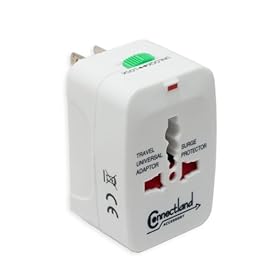
See larger image and other views

NSS has it nailed. No plug change needed.

Register to Reply
Guru

Join Date: May 2006
Location: Placerville, CA (38° 45N, 120° 47'W)
Posts: 6215
Good Answers: 248
#10
In reply to #7

Re: voltage conversion

02/15/2010 1:08 AM

I did check the link, but it is not at all obvious whether this device does anything other than mate differing plug styles. It's way too small to convert 120V 60 Hz to 220V 50Hz, or even 220V 60 Hz, with any significant current. I'd be thrilled if you proved me wrong!

__________________
Teaching is a great experience, but there is no better teacher than experience.
Register to Reply
Anonymous Poster
#12
In reply to #6

Re: voltage conversion

02/15/2010 8:57 AM

In my expierience, 230vac, standard in europe has three legs. The first leg is 230 VAC

the second leg is neutral, and the third leg is ground.

Here in the U.S. standard 240VAC the first leg is 120 VAC, the second leg is 120 VAC and the third is ground, your issue is not with the 50 and 60 Hz but the voltage. you will damage the motor if you simply change the plug. you will put 120 VAC directly to ground. hope you get this before its too late!!

Register to Reply
Guru
Engineering Fields - Electrical Engineering - Been there, done that. Engineering Fields - Control Engineering - New Member

Join Date: Dec 2008
Location: Long Island NY
Posts: 15600
Good Answers: 981
#13
In reply to #12

Re: voltage conversion

02/15/2010 10:42 AM

Connecting neutrals to ground should never be done in the load chassis. So your concern about the US use of split phase and the grounding of neutrals will not be a problem here.

__________________
"Don't disturb my circles." translation of Archimedes last words
Register to Reply
Guru

Join Date: May 2006
Location: Placerville, CA (38° 45N, 120° 47'W)
Posts: 6215
Good Answers: 248
#14
In reply to #12

Re: voltage conversion

02/15/2010 12:22 PM

First, second, third is an inadequate description of the pins on a plug. In agreement with redfred, the outer pins of a split phase 240V outlet in the US carry 120V each with respect to the central pin, and since those 2-120V pins are 180° out of phase, there is 240V between those outer pins.

__________________
Teaching is a great experience, but there is no better teacher than experience.
Register to Reply
Guru
United States - Member - New Member Engineering Fields - Power Engineering - New Member

Join Date: Sep 2006
Location: California, USA, where the Godless live next door to God.
Posts: 4665
Good Answers: 804
#8

Re: voltage conversion

02/14/2010 8:05 PM

"Safe" is a relative term. The motor will be spinning 20% faster than it was. It will also run hotter than it was designed for. So the motor life will be shorter, probably by about 1/2 and if the machine is old already, it's demise may end up happening in short order and if it fries, fire is not safe.

In addition, some slicers have mechanical blade brakes which brings up two more problems:

  1. The added blade speed may mean that the brake will not stop as fast as it is supposed to. Some simple brakes work just on a timer, so if the timer times out before the blade finishes stopping, the brake shuts down and continues spinning which could be dangerous.
  2. Better mechanical brakes use a strong spring loaded mechanism that is released by an electro magnet when you apply power (so that it is "fail safe" in the case of a power failure. That means it has a brake coil on the magnet, and the higher frequency will affect the life of that magnet as well.

So my advice would be to do it, but watch it carefully. Make sure the brake (if any) functions correctly and keep a sharp eye out for magic smoke because as we all know, that's what makes electrical appliances work and if the magic smoke escapes, they stop working!

__________________
** All I every really wanted to be, was... A LUMBERJACK!.**
Register to Reply
Power-User

Join Date: Apr 2007
Posts: 126
Good Answers: 15
#9

Re: voltage conversion

02/15/2010 1:06 AM

We have done the same thing ourselves before and all worked out Okay. Hz is a notation of the speed power is generated , 1800 rpm for 60 hZ or 1500 RPM for 50 Hz, so the slightly less voltage combined with, increased speed creates heating. If you suspect heating you can always put a small fan, directly on that motor and cool it down. I have run , good solid equipment, motors from the 1920's that were designed to be on & off every 20 minutes ( Antique Movie Projectors ) and we have run them hours at a time & for years on end, with the fan additions & fresh air supplies. We also kept the oil checked & changed too. If they start cogging after a run, you then know you ran it too hot !

Lyn Lynch has a good idea too, adapt it with a plug - regulator - adapter. We would have done that back then but, we were just too poor - LOL Or Maybe It Was Just Too Cheap !

Joe Woodall , Managing Partner

Georgia Adobe Rammed Earth & Renewable Energy

http://www.georgiaadobe.com

Register to Reply
Guru

Join Date: Oct 2008
Posts: 42355
Good Answers: 1693
#11
In reply to #9

Re: voltage conversion

02/15/2010 1:29 AM

Thanks, but not so smart came up with the link. I just put the picture up. For that price this plug could only be a passive adapter.

Cheers.

Register to Reply
Register to Reply 14 comments
Copy to Clipboard

Users who posted comments:

Anonymous Poster (2); dkwarner (2); Georgia Adobe (1); JRaef (1); lyn (3); not so smart (1); redfred (2); tcmtech (1); water buffalo (1)

Previous in Forum: generator   Next in Forum: Standards for 11-KV Cable Trench

Advertisement