Previous in Forum: Is IC Piston Engine Really Less Than 1% Efficient?   Next in Forum: Tesla Coil Construction
Close
Close
Close
6 comments
Rate Comments: Nested
Participant

Join Date: Jul 2008
Location: ludhiana,india
Posts: 4

Expanded Tubes in Boiler Drum

02/19/2010 1:18 AM

Can anyone please explain why bank tubes are expanded in boiler drum instead of welding.

Register to Reply
Interested in this topic? By joining CR4 you can "subscribe" to
this discussion and receive notification when new comments are added.

"Almost" Good Answers:

Check out these comments that don't yet have enough votes to be "official" good answers and, if you agree with them, vote them!
Guru
Technical Fields - Technical Writing - New Member Engineering Fields - Piping Design Engineering - New Member

Join Date: May 2009
Location: Richland, WA, USA
Posts: 21017
Good Answers: 795
#1

Re: Expanded tubes in boiler drum
02/19/2010 2:45 AM

One of the biggest problems in understanding codes or construction practices is that the rationales may not be given. Thus any reverse engineering may be just a guess.

Nonetheless I will venture some ideas on this question. For instance, if you have a bundle of tubes flush with the tubesheet, a weld joint is likely to consist of a thin bead with low shear strength. On top of that, as you weld one tube after another, the alternate heating/cooling is likely to set up residual stresses. If the tubes are recessed their own thickness below the tubesheet, at least you can obtain a decent fillet, but even then the throat depth is only 1/√2 the tube thickness.

In contrast, a tube expanded into double grooves will have two circumferential joints in shear, with minimal effects from heat distortion. However, overexpansion could distort the ligaments between the tubes. This is prevented by 1) control of the expansion device, and 2) the requirement for tube pitch to be 1.25 x tube diameter (i.e.,thick enough ligaments to withstand the reasonable tube expansion forces.)

That's just my amateur (or maybe a bit better?) take.

__________________
In vino veritas; in cervisia carmen; in aqua E. coli.
Register to Reply Score 1 for Good Answer
Power-User

Join Date: Jun 2007
Location: outside Cincinnati
Posts: 115
Good Answers: 5
#4
In reply to #1

Re: Expanded tubes in boiler drum

02/20/2010 1:58 AM

We used a modified D type boiler on several ships I was on in the 60's. It was for ease of repair and flexibility. If the sheets were welded we would have to do more work as sea to repair them. With an expanded rolled tube nest it was relatively easy to repair through the hand holes.

this was on 1200 psi superheated 125,000 hp boilers.

__________________
Anything can be made, sometimes at great expense, resulting in greater satisfaction, :)
Register to Reply Score 1 for Good Answer
Guru
United Kingdom - Member - Indeterminate Engineering Fields - Control Engineering - New Member

Join Date: Jan 2007
Location: In the bothy, 7 chains down the line from Dodman's Lane level crossing, in the nation formerly known as Great Britain. Kettle's on.
Posts: 32175
Good Answers: 839
#2

Re: Expanded tubes in boiler drum

02/19/2010 2:59 AM

So they can be removed at 10-year boiler overhaul periods with less damage to the tubeplates than welding would cause.

__________________
"Did you get my e-mail?" - "The biggest problem in communication is the illusion that it has taken place" - George Bernard Shaw, 1856
Register to Reply
Anonymous Poster
#3

Re: Expanded tubes in boiler drum

02/19/2010 3:15 AM

There are welded HEs

Expanded HEs

and both Expanded and welded (or vice versa) HEs.

These are all in the hand of designers, there are advantages and disadvantages in welding (HAZ, Retained stress, disturbance in Microstructural uniformity,...)

Bot do exist and are acceptable by codes.

Register to Reply
Commentator

Join Date: Jan 2010
Posts: 83
Good Answers: 1
#5

Re: Expanded Tubes in Boiler Drum

02/21/2010 11:02 AM

From Tim Hawley Master Mech.

Hello anildigra,

The bank tubes are expanded for three(3) reasons.

1. First of all it has to do with flow

When the tube is expanded it reduces the inlet pressure in the center of tube thus reduces flow. This provides flow stability or a reduction in turbulance. Once pressure stabilizes it is pushed through the restricted outlet.

For Example: A kerosene lamp has a wick in the center which is burning, and the fuel is mixed with air by drawing air in through the lower vents. To reduce the flame from flickering a glass dome surrounds the flame and the heat rises through the dome restriction like a chimmney.

2. Second of all it has to do with resonance

When you decrease flow you reduce noise and viberation.

Example: A typical muffler on a car which has baffles inside to restrict flow in a larger area stabilize and force out through a restricted outlet.

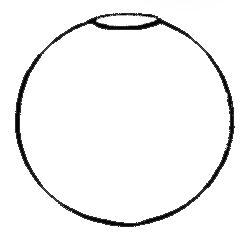
Resonance of a sphere of air

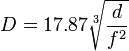
The diameter of a sphere with a sound hole is given by

where: (in meters)

D = diameter of sphere d = diameter of sound hole f = frequency

The diameter of a sphere with a necked sound hole is given by

where: (in meters)

D = diameter of sphere d = diameter of sound hole C = speed of sound L = length of neck f = frequency

3. Third, has to do with exchange of temperature / over time

When there is an increase in area, and flow is reduced, there is a dag in time where temperature can be transfered to maximize efficiency.

Example: A model of a simple heat exchanger theory

A simple heat exchanger might be thought of as two straight pipes with fluid flow, which are thermally connected. Let the pipes be of equal length L, carrying fluids with heat capacity Ci (energy per unit mass per unit change in temperature) and let the mass flow rate of the fluids through the pipes be ji (mass per unit time), where the subscript i applies to pipe 1 or pipe 2.

The temperature profiles for the pipes are T1(x) and T2(x) where x is the distance along the pipe. Assume a steady state, so that the temperature profiles are not functions of time. Assume also that the only transfer of heat from a small volume of fluid in one pipe is to the fluid element in the other pipe at the same position. There will be no transfer of heat along a pipe due to temperature differences in that pipe. By Newton's law of cooling the rate of change in energy of a small volume of fluid is proportional to the difference in temperatures between it and the corresponding element in the other pipe:

where ui(x) is the thermal energy per unit length and γ is the thermal connection constant per unit length between the two pipes. This change in internal energy results in a change in the temperature of the fluid element. The time rate of change for the fluid element being carried along by the flow is:

where Ji = Ciji is the "thermal mass flow rate". The differential equations governing the heat exchanger may now be written as:

Note that, since the system is in a steady state, there are no partial derivatives of temperature with respect to time, and since there is no heat transfer along the pipe, there are no second derivatives in x as is found in the heat equation. These two coupled first-order differential equations may be solved to yield:

where k1 = γ / J1, k2 = γ / J2, k = k1 + k2 and A and B are two as yet undetermined constants of integration. Let T10 and T20 be the temperatures at x=0 and let T1L and T2L be the temperatures at the end of the pipe at x=L. Define the average temperatures in each pipe as:

Using the solutions above, these temperatures are:

Choosing any two of the above temperatures will allow the constants of integration to be eliminated, and that will allow the other four temperatures to be found. The total energy transferred is found by integrating the expressions for the time rate of change of internal energy per unit length:

By the conservation of energy, the sum of the two energies is zero. The quantity is known as the log mean temperature difference and is a measure of the effectiveness of the heat exchanger in transferring heat energy.

Just a simple matter of facts from an old logical thinker.

Best Regards,

Tim

P.S.> I hope this helps you understand the histoical facts of flow, resonance, and Newton's law of cooling.

Register to Reply Score 1 for Off Topic
Anonymous Poster
#6

Re: Expanded Tubes in Boiler Drum

02/05/2011 3:09 AM

because of bank tubes replacing...

Register to Reply
Register to Reply 6 comments

"Almost" Good Answers:

Check out these comments that don't yet have enough votes to be "official" good answers and, if you agree with them, vote them!
Copy to Clipboard

Users who posted comments:

Anonymous Poster (2); PWSlack (1); RicinCinci (1); Tim Hawley Master Mech (1); Tornado (1)

Previous in Forum: Is IC Piston Engine Really Less Than 1% Efficient?   Next in Forum: Tesla Coil Construction

Advertisement