Previous in Forum: Phase to Phase Voltages in Metering   Next in Forum: Lightening(thunder) arrest
Close
Close
Close
11 comments
Rate Comments: Nested
Active Contributor

Join Date: Mar 2010
Posts: 18

PWM signal

06/17/2010 10:43 PM

Dear

Explain Pulse Width Modulated (PWM) signal

Register to Reply
Interested in this topic? By joining CR4 you can "subscribe" to
this discussion and receive notification when new comments are added.

Good Answers:

These comments received enough positive votes to make them "good answers".

"Almost" Good Answers:

Check out these comments that don't yet have enough votes to be "official" good answers and, if you agree with them, vote them!
Guru
United States - Member - New Member

Join Date: Jun 2008
Location: Alabama
Posts: 1604
Good Answers: 63
#1

Re: PWM signal

06/17/2010 11:04 PM
Register to Reply
4
Guru
Hobbies - Musician - Engineering Fields - Chemical Engineering - New Member Engineering Fields - Control Engineering - New Member Engineering Fields - Instrumentation Engineering - New Member

Join Date: Jan 2007
Location: Moses Lake, WA, USA, Thulcandra - The Silent Planet (C.S. Lewis)
Posts: 4216
Good Answers: 194
#2

Re: PWM signal

06/17/2010 11:13 PM

This information was verrrrry difficult to obtain. I would have you send $50 for my services, but I don't want to post my mailing address (or even my email address) on a public forum - (it's an Identity Theft / SPAM welcome call!)

Pulse-width modulation

From Wikipedia, the free encyclopedia Jump to: navigation, search

This article includes a list of references, related reading or external links, but

its sources remain unclear because it lacks inline citations. Please improve this article by introducing more precise citations where appropriate. (April 2009)

An example of PWM: the supply voltage (blue) modulated as a series of pulses results in a sine-like flux density waveform (red) in the magnetic circuit of an electromagnetic actuator. The smoothness of the resultant waveform can be controlled by the width and number of modulated impulses (per given cycle)

Pulse-width modulation (PWM) is a very efficient way of providing intermediate amounts of electrical power between fully on and fully off. A simple power switch with a typical power source provides full power only when switched on. PWM is a comparatively recent technique, made practical by modern electronic power switches, although one of its earlier applications was in the Sinclair X10, a 10 W audio amplifier available in kit form in the 1960s.

In the past, when only partial power was needed (such as for a sewing machine motor), a rheostat (located in the sewing machine's foot pedal) connected in series with the motor adjusted the amount of current flowing through the motor, but also wasted power as heat in the resistor element. It was an inefficient scheme, but tolerable because the total power was low. This was one of several methods of controlling power. There were others—some still in use—such as variable autotransformers, including the trademarked Autrastat for theatrical lighting; and the Variac, for general AC power adjustment. These were quite efficient, but also relatively costly.

For about a century, some variable-speed electric motors have had decent efficiency, but they were somewhat more complex than constant-speed motors, and sometimes required external electrical apparatus, such as a bank of variable power resistors.

However, there is a great need for applying partial power in other devices, such as electric stoves, lamp dimmers, and robotic servos. Basically, a PWM variable-power scheme switches the power quickly between fully on and fully off -- e.g. several times a minute in an electric stove, 120 Hz in a lamp dimmer, and well into the tens or hundreds of kHz in a computer power supply (which has a regulated output). In any event, the switching rate is much faster than what would affect the load, which is to say the device that uses the power. In practice, applying full power for part of the time does not cause any problems; PWM is very practical.

The term duty cycle describes the proportion of on time to the regular interval or period of time; a low duty cycle corresponds to low power, because the power is off for most of the time. Duty cycle is expressed in percent, 100% being fully on.

PWM works well with digital controls, which, because of their on/off nature, can easily set the needed duty cycle.

PWM of a signal or power source involves the modulation of its duty cycle, to either convey information over a communications channel or control the amount of power sent to a load.

Contents [hide]

  • 1 Principle
    • 1.1 Delta
    • 1.2 Delta-sigma
    • 1.3 Space vector modulation
    • 1.4 Time proportioning
    • 1.5 Types
    • 1.6 Spectrum
  • 2 Applications
    • 2.1 Telecommunications
    • 2.2 Power delivery
    • 2.3 Voltage regulation
    • 2.4 Audio effects and amplification
  • 3 See also
  • 4 References
  • 5 External links
    • 5.1 Applications

[edit] Principle

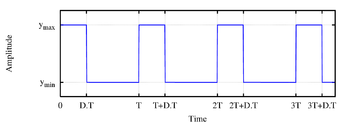
Fig. 1: a pulse wave, showing the definitions of ymin, ymax and D.

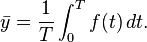
Pulse-width modulation uses a rectangular pulse wave whose pulse width is modulated resulting in the variation of the average value of the waveform. If we consider a pulse waveform f(t) with a low value ymin, a high value ymax and a duty cycle D (see figure 1), the average value of the waveform is given by:

As f(t) is a pulse wave, its value is ymax for and ymin for . The above expression then becomes:

This latter expression can be fairly simplified in many cases where ymin = 0 as . From this, it is obvious that the average value of the signal () is directly dependent on the duty cycle D.

Fig. 2: A simple method to generate the PWM pulse train corresponding to a given signal is the intersective PWM: the signal (here the green sinewave) is compared with a sawtooth waveform (blue). When the latter is less than the former, the PWM signal (magenta) is in high state (1). Otherwise it is in the low state (0).

The simplest way to generate a PWM signal is the intersective method, which requires only a sawtooth or a triangle waveform (easily generated using a simple oscillator) and a comparator. When the value of the reference signal (the green sine wave in figure 2) is more than the modulation waveform (blue), the PWM signal (magenta) is in the high state, otherwise it is in the low state.

[edit] Delta Main article: Delta modulation

In the use of delta modulation for PWM control, the output signal is integrated, and the result is compared with limits, which correspond to a reference signal offset by a constant. Every time the integral of the output signal reaches one of the limits, the PWM signal changes state.

Fig. 3 : Principle of the delta PWM. The output signal (blue) is compared with the limits (green). These limits correspond to the reference signal (red), offset by a given value. Every time the output signal reaches one of the limits, the PWM signal changes state. [edit] Delta-sigma Main article: Delta-sigma modulation

In delta-sigma modulation as a PWM control method, the output signal is subtracted from a reference signal to form an error signal. This error is integrated, and when the integral of the error exceeds the limits, the output changes state.

Fig. 4 : Principle of the sigma-delta PWM. The top green waveform is the reference signal, on which the output signal (PWM, in the middle plot) is subtracted to form the error signal (blue, in top plot). This error is integrated (bottom plot), and when the integral of the error exceeds the limits (red lines), the output changes state. [edit] Space vector modulation Main article: Space vector modulation

Space vector modulation is a PWM control algorithm for multi-phase AC generation, in which the reference signal is sampled regularly; after each sample, non-zero active switching vectors adjacent to the reference vector and one or more of the zero switching vectors are selected for the appropriate fraction of the sampling period in order to synthesize the reference signal.

[edit] Time proportioning

Many digital circuits can generate PWM signals (e.g many microcontrollers have PWM outputs). They normally use a counter that increments periodically (it is connected directly or indirectly to the clock of the circuit) and is reset at the end of every period of the PWM. When the counter value is more than the reference value, the PWM output changes state from high to low (or low to high).[1] This technique is referred to as time proportioning, particularly as time-proportioning control[2] – which proportion of a fixed cycle time is spent in the high state.

The incremented and periodically reset counter is the discrete version of the intersecting method's sawtooth. The analog comparator of the intersecting method becomes a simple integer comparison between the current counter value and the digital (possibly digitized) reference value. The duty cycle can only be varied in discrete steps, as a function of the counter resolution. However, a high-resolution counter can provide quite satisfactory performance.

[edit] Types Fig. 5 : Three types of PWM signals (blue): leading edge modulation (top), trailing edge modulation (middle) and centered pulses (both edges are modulated, bottom). The green lines are the sawtooth waveform (first and second cases) and a triangle waveform (third case) used to generate the PWM waveforms using the intersective method.

Four types of pulse-width modulation (PWM) are possible:[dubious – discuss]

  1. The pulse center may be fixed in the center of the time window and both edges of the pulse moved to compress or expand the width.
  2. The lead edge can be held at the lead edge of the window and the tail edge modulated.
  3. The tail edge can be fixed and the lead edge modulated.
  4. The pulse repetition frequency can be varied by the signal, and the pulse width can be constant. However, this method has a more-restricted range of average output than the other three.

[edit] Spectrum

The resulting spectra (of the three cases) are similar, and each contains a dc component, a base sideband containing the modulating signal and phase modulated carriers at each harmonic of the frequency of the pulse. The amplitudes of the harmonic groups are restricted by a sinx / x envelope (sinc function) and extend to infinity.

[edit] Applications

[edit] Telecommunications

In telecommunications, the widths of the pulses correspond to specific data values encoded at one end and decoded at the other.

Pulses of various lengths (the information itself) will be sent at regular intervals (the carrier frequency of the modulation).

_ __ ___ _____ _ _____ __ _ | | | | | | | || | | || | | | PWM Signal | | | | | | | || | | || | | | __| |____| |___| |__| || |____| || |___| |____

Data 0 1 2 4 0 4 1 0

The inclusion of a clock signal is not necessary, as the leading edge of the data signal can be used as the clock if a small offset is added to the data value in order to avoid a data value with a zero length pulse.

[edit] Power delivery

PWM can be used to reduce the total amount of power delivered to a load without losses normally incurred when a power source is limited by resistive means. This is because the average power delivered is proportional to the modulation duty cycle. With a sufficiently high modulation rate, passive electronic filters can be used to smooth the pulse train and recover an average analog waveform.

High frequency PWM power control systems are easily realisable with semiconductor switches. The discrete on/off states of the modulation are used to control the state of the switch(es) which correspondingly control the voltage across or current through the load. The major advantage of this system is the switches are either off and not conducting any current, or on and have (ideally) no voltage drop across them. The product of the current and the voltage at any given time defines the power dissipated by the switch, thus (ideally) no power is dissipated by the switch. Realistically, semiconductor switches such as MOSFETs or bipolar junction transistors (BJTs) are non-ideal switches, but high efficiency controllers can still be built.

Nevertheless, during the transitions between on and off states, considerable power is dissipated in the switches, but the change of state between fully on and fully off is quite rapid relative to typical on or off times, so the average power dissipation is quite low compared with the power being delivered,

PWM is also often used to control the supply of electrical power to another device such as in speed control of electric motors, fundamental operation of Class D audio switching amplifiers or brightness control of light sources and many other power electronics applications. For example, light dimmers for home use employ a specific type of PWM control. Home use light dimmers typically include electronic circuitry which suppresses current flow during defined portions of each cycle of the AC line voltage. Adjusting the brightness of light emitted by a light source is then merely a matter of setting at what voltage (or phase) in the AC cycle the dimmer begins to provide electrical current to the light source (e.g. by using an electronic switch such as a triac). In this case the PWM duty cycle is defined by the frequency of the AC line voltage (50 Hz or 60 Hz depending on the country).

These rather simple types of dimmers can be effectively used with inert (or relatively slow reacting) light sources such as incandescent lamps, for example, for which the additional modulation in supplied electrical energy which is caused by the dimmer causes only negligible additional fluctuations in the emitted light. Some other types of light sources such as light-emitting diodes (LEDs), however, turn on and off extremely rapidly and would perceivably flicker if supplied with low frequency drive voltages. Perceivable flicker effects from such rapid response light sources can be reduced by increasing the PWM frequency. If the light fluctuations are sufficiently rapid, the human visual system can no longer resolve them and the eye perceives the time average intensity without flicker (see flicker fusion threshold).

In electric cookers, continuously-variable power is applied to the heating elements such as the hob or the grill using a device known as a Simmerstat. This consists of a thermal oscillator running at approximately two cycles per minute and the mechanism varies the duty cycle according to the knob setting. The thermal time constant of the heating elements is several minutes, so that the temperature fluctuations are too small to matter in practice.

[edit] Voltage regulation Main article: Switched-mode power supply

PWM is also used in efficient voltage regulators. By switching voltage to the load with the appropriate duty cycle, the output will approximate a voltage at the desired level. The switching noise is usually filtered with an inductor and a capacitor.

One method measures the output voltage. When it is lower than the desired voltage, it turns on the switch. When the output voltage is above the desired voltage, it turns off the switch.

Variable-speed fan controllers for computers usually use PWM, as it is far more efficient when compared to a potentiometer or rheostat. (Neither of the latter is practical to operate electronically; they would require a small drive motor.)

[edit] Audio effects and amplification

PWM is sometimes used in sound (music) synthesis, in particular subtractive synthesis, as it gives a sound effect similar to chorus or slightly detuned oscillators played together. (In fact, PWM is equivalent to the difference of two sawtooth waves. [1]) The ratio between the high and low level is typically modulated with a low frequency oscillator, or LFO. In addition, varying the duty cycle of a pulse waveform in a subtractive-synthesis instrument creates useful timbral variations. Some synthesizers had a duty-cycle trimmer for their square-wave outputs, and that trimmer could be set by ear; the 50% point was distinctive, because even-numbered harmonics essentially disappeared at 50%.

A new class of audio amplifiers based on the PWM principle is becoming popular. Called "Class-D amplifiers", these amplifiers produce a PWM equivalent of the analog input signal which is fed to the loudspeaker via a suitable filter network to block the carrier and recover the original audio. These amplifiers are characterized by very good efficiency figures (≥ 90%) and compact size/light weight for large power outputs. For a few decades, industrial and military PWM amplifiers have been in common use, often for driving servo motors. They offer very good efficiency, commonly well above 90%. Field-gradient coils in MRI machines are driven by relatively-high-power PWM amplifiers.

Historically, a crude form of PWM has been used to play back PCM digital sound on the PC speaker, which is only capable of outputting two sound levels. By carefully timing the duration of the pulses, and by relying on the speaker's physical filtering properties (limited frequency response, self-inductance, etc.) it was possible to obtain an approximate playback of mono PCM samples, although at a very low quality, and with greatly varying results between implementations.

In more recent times, the Direct Stream Digital sound encoding method was introduced, which uses a generalized form of pulse-width modulation called pulse density modulation, at a high enough sampling rate (typically in the order of MHz) to cover the whole acoustic frequencies range with sufficient fidelity. This method is used in the SACD format, and reproduction of the encoded audio signal is essentially similar to the method used in class-D amplifiers.

[edit] See also

  • Delta-sigma modulation
  • Pulse-amplitude modulation
  • Pulse-code modulation
  • Pulse-density modulation
  • Pulse-position modulation
  • Radio control
  • Sliding mode control - A related topic that produces smooth behavior by way of discontinuous switching in systems.
  • Space vector modulation
  • Switching amplifier

[edit] References

  1. ^ www.netrino.com – Introduction to Pulse Width Modulation (PWM)
  2. ^ Fundamentals of HVAC Control Systems, by Robert McDowall, p. 21

[edit] External links

Wikimedia Commons has media related to:

Pulse width modulation

[edit] Applications

Retrieved from "http://en.wikipedia.org/wiki/Pulse-width_modulation" Categories: Electronics terms Hidden categories: Articles lacking in-text citations from April 2009 | All articles lacking in-text citations | All accuracy disputes | Articles with disputed statements from February 2010 Personal tools

Namespaces

  • Article
  • Discussion

Variants

Views

  • Read
  • Edit
  • View history

Actions

Search Search Navigation

  • Main page
  • Contents
  • Featured content
  • Current events
  • Random article

Interaction

Toolbox

  • What links here
  • Related changes
  • Upload file
  • Special pages
  • Permanent link
  • Cite this page

Print/export

  • Create a book
  • Download as PDF
  • Printable version

Languages

  • This page was last modified on 15 June 2010 at 21:09.
__________________
"Reason is not automatic. Those who deny it cannot be conquered by it. Do not count on them. Leave them alone." - Ayn Rand
Register to Reply Good Answer (Score 4)
Guru
Engineering Fields - Electrical Engineering - Been there, done that. Engineering Fields - Control Engineering - New Member

Join Date: Dec 2008
Location: Long Island NY
Posts: 15600
Good Answers: 981
#3
In reply to #2

Re: PWM signal

06/18/2010 12:05 AM

Excellent

I love your heading in particular. I'd find some way to pay you the $50 if it stopped this kind of a lazy question. But I know that it won't.

I still say that Samuel Morse was the first to codify a form of PWM.

__________________
"Don't disturb my circles." translation of Archimedes last words
Register to Reply
Guru
Hobbies - Musician - Engineering Fields - Chemical Engineering - New Member Engineering Fields - Control Engineering - New Member Engineering Fields - Instrumentation Engineering - New Member

Join Date: Jan 2007
Location: Moses Lake, WA, USA, Thulcandra - The Silent Planet (C.S. Lewis)
Posts: 4216
Good Answers: 194
#4
In reply to #3

Re: PWM signal

06/18/2010 12:42 AM

I still say that Samuel Morse was the first to codify a form of PWM.

Now that you bring it up, I wholeheartedly agree!

__________________
"Reason is not automatic. Those who deny it cannot be conquered by it. Do not count on them. Leave them alone." - Ayn Rand
Register to Reply
Guru

Join Date: Sep 2007
Location: Defreestville, NY
Posts: 1072
Good Answers: 87
#5
In reply to #3

Re: PWM signal

06/18/2010 12:57 AM

. -..- .- -.-. - .-.. -.-- !

__________________
Charlie don't surf.
Register to Reply
Participant

Join Date: Feb 2011
Posts: 2
#8
In reply to #2

Re: PWM signal

02/09/2011 5:43 AM

Looking at this thread it seems the right place to add a question. I am developing a machine in which we have some magnetic vibrator transport mechanisms. These are usually controlled either by frequency converters or a dimmer function.

The units function if connected directly to 220-240VAC, but we need to adjust the effect down. I have free 24VDC outputs, and imagine that we could send a PWM signal to a 24V to 240V relay - is that possible, and how would you write the PWM signal code?

Kind Regard

Jens

Register to Reply
Guru
Engineering Fields - Electrical Engineering - Been there, done that. Engineering Fields - Control Engineering - New Member

Join Date: Dec 2008
Location: Long Island NY
Posts: 15600
Good Answers: 981
#9
In reply to #8

Re: PWM signal

02/09/2011 9:31 AM

To use an actual mechanical relay will not be practical. If your relay has an expected mechanical lifetime of a million cycles and your relay is turned ON/OFF ten times a second in a PWM method then one should expect a mechanical failure in just over one 27 hours of operations. You could use a solid state relay but this will actually be nothing more than reinventing the wheel. SCR (solid state) dimmers that you mentioned that control this vibrator are actually using a PWM approach of the line voltage.

__________________
"Don't disturb my circles." translation of Archimedes last words
Register to Reply Score 1 for Good Answer
Participant

Join Date: Feb 2011
Posts: 2
#10
In reply to #9

Re: PWM signal

02/10/2011 9:32 AM

Thank you.

This is very operational information, and there need to be a good reason to reinvent the wheel! I found an IO card that will do it all. That is probably the way to go.

Register to Reply
Guru
United Kingdom - Member - Indeterminate Engineering Fields - Control Engineering - New Member

Join Date: Jan 2007
Location: In the bothy, 7 chains down the line from Dodman's Lane level crossing, in the nation formerly known as Great Britain. Kettle's on.
Posts: 32175
Good Answers: 839
#6

Re: PWM signal

06/18/2010 5:03 AM

..--.. (?)

__________________
"Did you get my e-mail?" - "The biggest problem in communication is the illusion that it has taken place" - George Bernard Shaw, 1856
Register to Reply
Guru
United States - Member - New Member

Join Date: Jun 2008
Location: Alabama
Posts: 1604
Good Answers: 63
#7

Explain Pulse Width Modulated (PWM) signal

06/18/2010 9:31 PM

Mikerho

I would like to see the OP's facial expression when he tries to read you nice response. Anyone who would ask a question "Explain Pulse Width Modulated (PWM) signal" and expect to receive a simple answer must be stunned.

Register to Reply
Guru
United Kingdom - Member - Indeterminate Engineering Fields - Control Engineering - New Member

Join Date: Jan 2007
Location: In the bothy, 7 chains down the line from Dodman's Lane level crossing, in the nation formerly known as Great Britain. Kettle's on.
Posts: 32175
Good Answers: 839
#11

Re: PWM signal

06/25/2024 11:09 AM

Invitation declined. Wikipedia does a much better job.

__________________
"Did you get my e-mail?" - "The biggest problem in communication is the illusion that it has taken place" - George Bernard Shaw, 1856
Register to Reply
Register to Reply 11 comments

Good Answers:

These comments received enough positive votes to make them "good answers".

"Almost" Good Answers:

Check out these comments that don't yet have enough votes to be "official" good answers and, if you agree with them, vote them!
Copy to Clipboard

Users who posted comments:

BroncofanDK (2); Mikerho (2); PWSlack (2); redfred (2); stevem (1); wareagle (2)

Previous in Forum: Phase to Phase Voltages in Metering   Next in Forum: Lightening(thunder) arrest

Advertisement