Previous in Forum: Electric Motor efficiency   Next in Forum: How to take energy from 480F degree clean flue gas
Close
Close
Close
Page 1 of 2: « First 1 2 Next > Last »
Rate Comments: Nested
Guru

Join Date: Oct 2006
Location: 44.56024"N 15.307971E
Posts: 8277
Good Answers: 270

Which came first..black hole or galaxy?

03/16/2007 9:10 PM

Seems that almost every galaxy with a black hole has a close relationship between the mass of the hole and the mass of the galaxy, and also the rotation rate of the galaxy. And the black hole may have formed first..

Check out this link

http://www.sciencedaily.com/releases/2000/01/000113103114.htm

__________________
"A man never stands so tall as when he stoops to help a child." "Never argue with a stupid person.They will drag you down to their level and beat you with experience" "To create an apple pie from scratch, first you must create a universe"
Register to Reply
Pathfinder Tags: black hole rotation
Interested in this topic? By joining CR4 you can "subscribe" to
this discussion and receive notification when new comments are added.
Associate

Join Date: Feb 2007
Location: Brampton Canada
Posts: 50
#1

Re: Which came first..black hole or galaxy?

03/17/2007 11:08 PM

That is a very good Cosmological question. There are a lot of Cosmologists who are wondering o this very question. But so far nobody has anything even close to a 'proof' observation.

Register to Reply
Guru
Popular Science - Cosmology - Let's keep knowledge expanding Engineering Fields - Retired Engineers / Mentors - Hobbies - HAM Radio - New Member

Join Date: Dec 2006
Location: North America, Earth
Posts: 4528
Good Answers: 106
#2

Re: Which came first..black hole or galaxy?

03/17/2007 11:25 PM

We know that gravity attracts, so in time matter comes together and objects get bigger. Matter is seen spiraling in to the center of quasars, not out. This whole idea is not logical.

__________________
“I would rather have questions that can't be answered than answers that can't be questioned.” - Richard Feynman
Register to Reply
Associate

Join Date: Feb 2007
Location: Brampton Canada
Posts: 50
#3
In reply to #2

Re: Which came first..black hole or galaxy?

03/17/2007 11:34 PM

Do you dispute your own question

Register to Reply
Guru
Popular Science - Cosmology - Let's keep knowledge expanding Engineering Fields - Retired Engineers / Mentors - Hobbies - HAM Radio - New Member

Join Date: Dec 2006
Location: North America, Earth
Posts: 4528
Good Answers: 106
#4
In reply to #3

Re: Which came first..black hole or galaxy?

03/17/2007 11:50 PM

I'm saying that galaxies come first, and the matter in them becomes a supermassive black hole later, so the idea of a black hole first is not logical.

__________________
“I would rather have questions that can't be answered than answers that can't be questioned.” - Richard Feynman
Register to Reply
Associate

Join Date: Jan 2007
Posts: 34
#5

Re: Which came first..black hole or galaxy?

03/18/2007 12:07 AM

I feel Black hole and Galaxy may be of same age or Black hole is prior to Galaxy. Galaxy shouldn't be older than Black hole. Black hole is a nodal point of Galaxy. Existance of Galaxy is due to black hole, hence it cannot be later than Galaxy

Register to Reply
Associate

Join Date: Feb 2007
Location: Brampton Canada
Posts: 50
#12
In reply to #5

Re: Which came first..black hole or galaxy?

03/18/2007 10:59 AM

Blackhole is the best guess. For a galaxy, you need gravity to hold it all together. You would wonder than, how would stars form to make a black hole, easy, the Universe in the time of the big bang would release so much energy that it would create some black holes to give us a start.

Register to Reply
Guru

Join Date: Sep 2006
Posts: 4513
Good Answers: 88
#6

Re: Which came first..black hole or galaxy?

03/18/2007 3:15 AM

I'd say if the black hole came first, it came first in these types of what are now well-formed galaxies, but there are many - and very early - irregular galaxies which do not exhibit properties suggestive of a central, supermassive black hole. So, then, how did star formation occur in these galaxies, if not triggered by a BH? Yet, star formation occurred.

Secondly, I don't believe that on the evidence of a mere twenty or so galaxies having this feature, that anything conclusive can be drawn about who came first - the galaxy or the BH. For my part, the jury's still out on this one.

I tend to think that BH's are not strictly required for galaxy formation, and that galaxies can form from a number of processes, including the one mentioned in the article. One thing that supports this viewpoint is that there are many, many, many more irregular galaxies than there are quasars of the same age. And images of these early galaxies show prolific star formation and no evidence whatsoever of a BH of any kind, let alone a central supermassive one. The article doesn't even mention these.

-e

Register to Reply
Guru
Engineering Fields - Aerospace Engineering - Retired South Africa - Member - The Rainbow-nation Engineering Fields - Engineering Physics - Relativity & Cosmology Popular Science - Cosmology - The Big Picture!

Join Date: May 2006
Location: Pretoria, South Africa
Posts: 3804
Good Answers: 69
#7
In reply to #6

Re: Which came first..black hole or galaxy?

03/18/2007 4:18 AM

Hi -e, I agree with you that we'll have to wait and see.

My bet would however be on galaxies before BHs. Gravitational collapse of large scale gas and dust clouds would be non-homogeneous, with many stars forming more or less simultaneously. Since it takes a lot more mass to produce a black hole than a star, the central black holes of galaxies, if they have any, should come later, I think.

Regards, Jorrie

__________________
"Perplexity is the beginning of knowledge." -- Kahlil Gibran
Register to Reply
Guru

Join Date: Sep 2006
Posts: 4513
Good Answers: 88
#8
In reply to #7

Re: Which came first..black hole or galaxy?

03/18/2007 4:28 AM

Yes, it is hard to imagine that much mass coming together quietly, and then a galaxy forming around it. It's pretty farfetched, IMHO.

-e

Register to Reply
Guru

Join Date: Sep 2006
Posts: 4513
Good Answers: 88
#9
In reply to #7

Re: Which came first..black hole or galaxy?

03/18/2007 5:00 AM

One mechanism for star formation is the presence of shock waves, more commonly produced in the interstellar medium by supernovae. I'd say that if quasars did aid in the formation of galaxies, it was by means of the extreme radiation pressures produced by such objects, a pressure which would act much the same way by compressing surrounding gas and dust sufficiently to ignite large-scale stellar formation. But the stuff has to be there in the first place, and if it is there, it certainly must lead to stellar formation of some kind due to mutual gravitation. There's no way this material is going to sit around idle, waiting for day Big Bertha would finally come around to give it a kick start. And once the quasar kicks in, it's going to drive any "loose" surrounding matter outward, depriving itself of this kind of inflow. That's probably why quasars die out after awhile, but not after they've accelerated the rate of star formation that was happening anyway by other means.

Conservatively, I'd say the galaxy, or at least the makings of a galaxy - and that means stars as well as gas and dust and other clutter - came first.

-e

Register to Reply
Power-User

Join Date: Sep 2006
Posts: 128
Good Answers: 1
#20
In reply to #7

Re: Which came first..black hole or galaxy?

03/18/2007 3:36 PM

Jorrie, I believe that the current theory is that extremely large "clouds" of gas, perhaps many times as large as galaxies, slowly began to collapse, contracting from gravitational forces, and the central core of this collapse became so massive that eventually a super massive black hole was formed. As the black hole continued to ingest matter, the accretion disc began to radiate so much radiation (pressure) that this forced the remainder of the condensing cloud of gas away from the feeding, now super massive, black hole. Localized non-homogeneous centers in the remaining gas cloud (perhaps hundreds of thousands of light years in radius), now contracted to form stars. Massive early stars perhaps went supernova in a rather short time, in astronomical time, and the explosive wave fronts collapsed more localized nearby gas agglomerations, causing more stars to form, and so on, throughout the gas cloud. Even today, in "old" galaxies, concentrations of gas continue to form "stellar nurseries". It used to be that cosmologists and astronomers believed that the mass of a central super massive black hole in galactic centers contained the mass of about one-half of one per cent of the total galactic mass. Now, apparently, some small galaxies have been found to have supermassive black holes that are more massive than the "half-percent rule". And I agree, we have to wait for continued new observations, theories and discussions. I am really enjoying these discussions on black holes!

Register to Reply
Guru
Popular Science - Weaponology - Scapolie, new member.

Join Date: Jan 2007
Posts: 1058
Good Answers: 8
#21
In reply to #7

Re: Which came first..black hole or galaxy?

03/18/2007 3:46 PM

Hi Jorrie, I have been wondering lately if it all started before the big-bang. What if all the material in the universe began to congregate into one ultra massive black hole, then this huge black hole became unstable like the uranium in a fission bomb. This would account for the big bang, and if this happened then we would have an ocillating universe. So far nobody has answered my question," What happend before the big bang, What was before"? I do not subscribe to the theory that it has only happened once.

Register to Reply
Guru

Join Date: Sep 2006
Posts: 4513
Good Answers: 88
#29
In reply to #7

Re: Which came first..black hole or galaxy?

03/19/2007 3:17 AM

One feature of early stellar and black hole formation should be noted, however. The Big Bang produced hydrogen, a far lesser amount of helium, and trace amounts of lithium. Heavier elements were not to be found, at least according to current models.

Consequently, Population III stars (the oldest, and of which there is now no known trace) would have tended to be very massive, 120 Msolar and less, and "suicidal" - ending their short lives as pair-production supernovae. However, what might have otherwise been larger stars with CNO cores (such as we have today) simply collapsed into black holes without even a whimper. Had heavier elements been present the mass might have stabilized temporarily into a supermassive star (like present-day Eta Carinae) before ending life as a supernova.

The early Universe would likely have been populated with massive blue Pop III supergiants and more-massive "Pop III" black holes. I suspect these holes could conceivably be candidates for galactic cores at a later date, and I'm almost sure they didn't form in isolation with no stars already nearby. This mess must have already been part of a system when the holes formed, consisting of clots of gas (but no dust or only traces of it from earlier Pop III supernovae), protostars, Pop III stars, and other black holes. Over time I'm sure bits and pieces merged, with the aggregate growing larger and larger along with the black hole which was to eventually dominate the future galaxy's core. They co-evolved, IMO, but as black holes can grow without bound - and stars can't - it would follow that the most massive object around which the rest of a galaxy dances would eventually be a supermassive black hole at its center.

Just speculation on my part, but as many quasars have spectra exhibiting the presence of metals, I'd say that both Pop III stars and 200+ Msolar BHs formed at the same time. Only later did the BHs grow to dominate their host galaxies' cores as brilliant quasars, IMHO.

-e

Register to Reply
Anonymous Poster
#10

Re: Which came first..black hole or galaxy?

03/18/2007 7:24 AM

Which came first, the eye of the hurricane, or, the hurricane? Forget gravity.

Register to Reply
Associate

Join Date: Feb 2007
Location: Brampton Canada
Posts: 50
#11

Re: Which came first..black hole or galaxy?

03/18/2007 8:30 AM

Yes. According to theory from Einstein black holes make up everything they are capable of scrambling data/information according to the theory.

Black holes could be so abundant that our brains could contain black holes therefore we forget information...

According to the this we can conclude that black holes came first..

Register to Reply
Anonymous Poster
#14
In reply to #11

Re: Which came first..black hole or galaxy?

03/18/2007 12:06 PM

are you speaking from experience?

Register to Reply
Active Contributor

Join Date: Mar 2007
Location: Varies week by week, but all interesting places and people.
Posts: 19
#13

Re: Which came first..black hole or galaxy?

03/18/2007 11:09 AM

All assumptions seem to be based on mutually agreed concept of time, energy and matter, yet only 2% is admittedly known. Probability of any current answer being correct is low but thought experiment certainly stimulates nerve growth factor production which in turn stimulates dendrite growth resulting in more neural processing capacity and ability to process higher input levels more efficiently. Net result is CR4 forums initiate process which raises intelligence level and better solutions to more complex problems are a result. Nice.

__________________
As you think ..... so it is.
Register to Reply
Guru

Join Date: Sep 2006
Posts: 4513
Good Answers: 88
#17
In reply to #13

Re: Which came first..black hole or galaxy?

03/18/2007 12:32 PM

D3 writes: "All assumptions seem to be based on mutually agreed concept of time, energy and matter, yet only 2% is admittedly known."

-----

This is a common misconception. In reality, 100% of it is known only 2% of the time.

-e

Register to Reply
Guru

Join Date: Oct 2006
Location: 44.56024"N 15.307971E
Posts: 8277
Good Answers: 270
#15

Re: Which came first..black hole or galaxy?

03/18/2007 12:14 PM

In galaxies with known black holes at their centers, there is a very close correlation between the mass of the black hole and the mass of the galaxy.The black hole has 1/2 of 1% of the galaxy's mass.The outer reaches of the galaxy are too far from the center to be affected by the gravity of black hole, yet they behave as if they are affected by it, which points to a very close relationship between the two at a very early stage of their development.It is known that supermassive black holes go thru a "feeding" stage, followed by a quiet period, when it has injested all matter within reach, and then for some reason, they start feeding again.A quiet black hole is not observable, so all galaxies may have black holes at their center.

HTRN

__________________
"A man never stands so tall as when he stoops to help a child." "Never argue with a stupid person.They will drag you down to their level and beat you with experience" "To create an apple pie from scratch, first you must create a universe"
Register to Reply
Guru
Canada - Member - Toronto, Ontario (South Parkdale On The Lakeshore) Engineering Fields - Marine Engineering - Great Lakes School Of Marine Technology (Owen Sound and Port Colbourne) Technical Fields - Architecture - Private Practice 1976-1990 Technical Fields - Education - Toronto Teachers' College 1971 Technical Fields - Marketing/Advertising - Founding Member Hobbies - Hunting - Founding Member Hobbies - Target Shooting - Founding Member

Join Date: Mar 2006
Location: Toronto Ontario Canada
Posts: 1265
Good Answers: 14
#16

Re: Which came first..black hole or galaxy?

03/18/2007 12:25 PM

Did black holes preceed the formation of their galaxies?

Not if, according to the linked article at the beginning of this blog, the black hole was formed from the 'death' of a Quasar while it was present in the early stages of the origination of its galaxy. We are already suspicious that after the death of a star, its composition begins to collapse into a black hole formation (matter with zero space between its atomic components), so why would not a Quasar (a "super star") devolving into a black hole experience the same fate? That the black holes we know of are consuming their galaxies is indicative of the strong possibility that the galaxies were there at the same time as the Quasar, behaving much like the sun in a planetary system acts as the major component at its core.

The alternative would require the enormous gravitational field of a collapsed Quasar to attract itself a galaxy. Not completely unlikely, but because the matter for galaxy formation exists in the first place really an unnecessary and prolonged scenario, since the Quasar would have in the same circumstances have already attracted some substantial amounts of accompanying matter during its 'outie' lifespan.

Many of us who believe the universe is capable of regeneration are of the opinion that all matter eventually becomes black hole matter, that all black holes eventually coalesce into one massive black hole, and that the instability of that mass somehow results in a big bang, for the entire process to repeat itself. This is counter-intuitive, since black hole matter would seem to be the ultimate matter in stassis; but atomic physicists might be able to determine why or how such a reversal would be triggered.

Even galaxies without Quasar components are fated to undergo the same black-hole influenced entropic process as each star of any magnitude within the galaxy will eventually collapse; and in all probablility coalesce with other of its galaxy members that have become black holes, especially because of the enormous gravitational influence a black hole exerts opn its surrounding space.

The trick of some living race of beings surviving such a catastrophe would require it to develop a self-sustaining world that has been deliberately moved out of the influence of the gravitational field of the imminent big bang black hole in time to avoid becoming a part of it; and then moved back in to the influence of some nurturing galaxy's friendly star system once the bang's expansion had recommenced. An unlikely process because in addition to having what amounts to a space-ship planet, it would have to have been undertaken over a period of billions of years of racial star consciousness.

Mark

Register to Reply
Guru

Join Date: Sep 2006
Posts: 4513
Good Answers: 88
#28
In reply to #16

Re: Which came first..black hole or galaxy?

03/19/2007 2:01 AM

Mark, quasars are black holes with a hyperluminous "wrapper," so to speak, and depend for their copious energy production on massive black holes. They cannot be stars, as p-p fusion can account for only 0.7% of mass conversion and, consequently, doesn't explain the tremendous luminosity of a quasar. The only mechanism in Nature that can account for this luminosity is the conversion of roughly 10% of the infalling mass directly into energy. The only known machine that can do this is a black hole. They're very efficient!

Basically, a quasar is a massive black hole on one hellacious feeding frenzy, with matter inflows typically on the order of 10 to 1000 (or more) stellar masses per year. This means the entire mass of 1 to 100 stars per year is converted directly into energy, and this explains why quasars shine with a brilliance equal to ten trillion suns - all within in a space about the size of Mars' orbit. So, quasars don't degenerate into black holes. They are black holes, but with hyperluminous accretion disks.

As an aside, the spectra of many quasars exhibit evidence of metals. This implies the existence of the debris of Population III (the oldest) stars which, in turn, suggests the stars came first.

-e

Register to Reply
Guru

Join Date: Feb 2007
Location: Israel
Posts: 2968
Good Answers: 24
#30
In reply to #28

Re: Which came first..black hole or galaxy?

03/19/2007 5:25 AM

Please try to correct my confusion:

...quasar is a massive ...

I was told quasars are embryos of what would later become galaxies, and dated as the oldest elements out there

...exhibit evidence of metals. This implies the existence of the debris of Population III...

Mass spectra of light metals per-se, may imply the presence of anything lighter than iron (Lithium, calcium etc). Given the right conditions, these will be created following the Carbon-Cycle, in fusion-type transmutation.

That of heavy metals, are known to be created in the shockwave of either nova (for second and third generation stars, prior to the formation of, say, a carbon-oxygen white dwarf) and especially in the shockwave of supernova (for first generation stars - prior to the formation of either neutron star, or localised black hole). Element which are known to jump the energy barrier of iron. Was I astray?

I tend to guess BH formed last (locally - not compared chronologically to other regions), only I do so intuitively, not based on any "knowledge" as such, not pointing at anyone, of course. No evidemce, shure, Just Trying to extrapolate here. Hope I got my facts right.

Register to Reply
Guru

Join Date: Sep 2006
Posts: 4513
Good Answers: 88
#33
In reply to #30

Re: Which came first..black hole or galaxy?

03/19/2007 8:46 AM

The term "metals" in astrophysical parlance are used to describe elements - all elements - heavier than helium. Such elements are produced by nucleosynthesis and were not present in the very early universe. The presence of these elements in quasars is evidence that the quasar is eating stars or, at least, stellar debris. This tends to suggest that the "chicken" came first, so to speak.

-e

Register to Reply
Guru

Join Date: Sep 2006
Posts: 4513
Good Answers: 88
#37
In reply to #30

Re: Which came first..black hole or galaxy?

03/19/2007 9:40 AM

Yuvalmate writes: "I was told quasars are embryos of what would later become galaxies, and dated as the oldest elements out there."

-----

Quasars are seen to be the cores of active galaxies; they and the galaxies co-exist. Once the quasar has consumed everything nearby and blown everything else away with radiation pressure, it tends to settle down as an "ordinary" supermassive black hole that only nibbles once in awhile. It is likely that our galaxy and Andromeda, for example, once had quasars at their cores.

A number of the 100,000 or so quasars discovered thus far are seen to have radio lobes or jets visible that bracket the object like giant exclamation points. These are typically produced, again, by black holes.

-e

Register to Reply
Guru
Popular Science - Weaponology - Scapolie, new member.

Join Date: Jan 2007
Posts: 1058
Good Answers: 8
#31
In reply to #16

Re: Which came first..black hole or galaxy?

03/19/2007 6:05 AM

Hi MarkTheHandyman, Basically then, you agree with me?

Register to Reply
Power-User

Join Date: Nov 2006
Location: Canada
Posts: 336
Good Answers: 5
#18

Re: Which came first..black hole or galaxy?

03/18/2007 1:15 PM

Nature shows that any structure needs a seed which is multiplied up to a sustainable and functional scale. It seems that BHs are a very good candidate for a galaxy's seed and I believe that.

Register to Reply
Guru

Join Date: Sep 2006
Posts: 4513
Good Answers: 88
#19
In reply to #18

Re: Which came first..black hole or galaxy?

03/18/2007 1:48 PM

Mutual gravitation alone is sufficient for material to accrete and form planets, stars, clusters, galaxies - and black holes. Why must there be a seed, and why must that seed necessarily be a black hole? Generalizing a behavior from one part of Nature doesn't always generalize across the board. Crystals may form around a seed - itself a crystal - but must this same principle apply elsewhere simply because it happens to crystals, for example? Seems to me that stars of a dozen or so solar masses and less are far more likely to form en masse than a single black hole having millions or billions solar masses. Black holes, once formed, may accelerate the formation of galaxies and continue to grow thereby, but the constituents of galaxies are more likely to form first, IMHO.

-e

Register to Reply
Power-User

Join Date: Nov 2006
Location: Canada
Posts: 336
Good Answers: 5
#22
In reply to #19

Re: Which came first..black hole or galaxy?
03/18/2007 3:52 PM

Europium:

It was just a thought - I'm not imposing here any of my ideas or beliefs.

As you mentioned crystals - it's interesting that any given substance is crystallizing in zero-gravity in a different geometry than on Earth but always around a seed! So covalent, Hydrogen and other atomic bonds are influenced by Gravity but Gravity is not the main factor in building the crystal seed.

Another argument was suggested by the article - most of the BHs in a galaxy are close to its center. This is not excluding the later forming of other off-center BHs in the same galaxy. And there are another two issues here: firstly, we do not have yet a final answer on what Gravity is and secondly, who said that BH's are formed due to Gravity only? They are only displaying a huge mass and disturb all surroundings.

Fractals are another example on how Nature is repeating and organizing itself.

So no hard feelings. I might be right or I might be wrong.

Regards

Register to Reply
Guru

Join Date: Sep 2006
Posts: 4513
Good Answers: 88
#24
In reply to #22

Re: Which came first..black hole or galaxy?
03/18/2007 7:54 PM

Sorry I seemed to be so adamant, Hottech. I re-read my post and it does seem a bit strident doesn't it? I'm the one who should apologize; so, dude, I'm sorry.

Yikes!

-e

Register to Reply
Power-User

Join Date: Nov 2006
Location: Canada
Posts: 336
Good Answers: 5
#25
In reply to #24

Re: Which came first..black hole or galaxy?
03/18/2007 9:11 PM

That's OK - no need to apologize, Europium. I'm still interested in your opinion on my crazy ideas in order to find an answer to the original question (what was first...).

Regards

Register to Reply
Guru

Join Date: Feb 2007
Location: Israel
Posts: 2968
Good Answers: 24
#23

Re: Which came first..black hole or galaxy?
03/18/2007 5:41 PM

How about considering our local stellar formation as a model in much larger scale, applying it to gallaxial formation (No, not further on, to the application of cluster formation) as-is, then deducing further, on the assumption that gravity is a universal act:

A cloud of matter (you wanna callit dispersed particles or sub-particles, fine) collapses on it's own gravity pull;

The lighter elements form the biggest mass-center in, well... the center of-it-all;

The medium elements form the intermediate ring at the equatorial axis (just about);

The heaviest elements initially thrown to the furthest edges, now migrate towards the mass center of the whole system, and reside themselves nicely around it;

The whole system keeps towards the lowest energy troff, that of kinetic equilibrium;

Only by around then, the center-mass is big enough to overcome it's critical point and ignite, in order to rid itself of surplus mass.

This description alone, of our humble solar system, would lead me to assume that the said "event-horizon" formed last, over the accumulation of a succession of super-massive neutron-stars. how?

Giant stars have very short and violent lives. They produce heavy elements when exploded, then re-collapse to form their own new generation, and do so in rapid succession.

This process creates a large amount of heavy elements in an already tight, crowded, neighbourhood. Several super-massive neutron stars in the center collide, and voila!

Feel free to kill me over this. In the rare event that this served to some imaginative inspiration, well, cest la vie

Register to Reply
Guru

Join Date: Sep 2006
Posts: 4513
Good Answers: 88
#36
In reply to #23

Re: Which came first..black hole or galaxy?
03/19/2007 9:13 AM

yuvalmate suggests: "Feel free to kill me over this."

-----

We're letting you live - this time - but you will have to do some sort of Community Service. (It was tough getting your sentence commuted, btw, as the magistrate was in a pretty foul mood this morning. You owe me one. )

Supernova 1987A left a big mess in the LMC. Here's a broom.

-e

Register to Reply
Power-User

Join Date: Mar 2006
Location: Valdosta, GA
Posts: 361
Good Answers: 8
#26

Re: Which came first..black hole or galaxy?

03/18/2007 11:16 PM

As Einstein said, "The only two things that are infinite are man's stupidity and the universe, and I have my doubts about the latter." As one stupid human to others, I believe that he was right about the latter being infinite. Therefore, The black holes and galaxies always have and always will exhist. Prove me wrong! Not that it really matters in the scheme of things from a lowly human perspective.

__________________
Always use protection.
Register to Reply
Associate

Join Date: Feb 2007
Posts: 54
#27

Re: Which came first..black hole or galaxy?

03/19/2007 12:11 AM

Like ripples in the water or more like the ripples in our atmosphere, the early stars formed in the ripples of the big bang. Some think of them as threads or strings. The first stars had lots of material to grow from and were massive, but also had short lives. When they went super nova they created their own shock waves. Those shock waves started out as concentric circles, but as the waves went through space and matter they were changed to a more pinwheel. Gravity of these first dead stars acted to redirect those waves warping them to form pinwheel shaped threads around the first black holes. These threads are still forming stars in our and other galaxy. The threads act the same way as our ripples in the atmosphere becoming focal points for star growth. Take the galactic map add red or blue shift vectors to the galaxies and connect the dots. You'll be shocked at what you'll see.

Which came first the black hole or the galaxy? Should be, which came first the threads or the galaxies? My vote is with the threads. We may be seeing the work of micro wormholes and not even knowing it.

Rory

Register to Reply
Anonymous Poster
#35
In reply to #27

Re: Which came first..black hole or galaxy?

03/19/2007 8:58 AM

How can anyone state with such certainty such a hypothesis? There may have been big bangs, not big bang. How can we know what went before or how far reaching eternity is? Such assumptions postulated as fact only support Einsteins doubts. If you claim to know the answers, you are most certainly in error.

Register to Reply
Guru

Join Date: Feb 2007
Location: Israel
Posts: 2968
Good Answers: 24
#38
In reply to #35

Re: Which came first..black hole or galaxy?

03/19/2007 12:26 PM

Dear guest,

No one here I'm sure, is more or less certain than you about all this.

What is done here I hope, is an attempt to construct a better self understanding of something which is very hard to satisfy with indirect evidence, let alone with any direct evidence.

The "game" here, is played to the effect of "Let's re assess what we think we know, against any new evidence pouring in, and try to better our own understanding, all in an attempt to have a coherent view, ideally void of contradiction and confusion".

I believe we all strive to have a better, clearer, world-view, because this would introduce or maintain some order and meaning to this mortal coil.

No one here is declaring himself a Messiah preaching his ultimate truth. We humbly try to better understand reality, by the exchange of agreed facts, and personal understandings.

Hope none of this offends you, but that's our kind of fun. Better understanding for the heck of it. Is it that terrible?

Register to Reply
Anonymous Poster
#40
In reply to #38

Re: Which came first..black hole or galaxy?

03/20/2007 7:32 AM

Exactly! The bible presents a creationist view that is meant to explain to provide order. Is that so terrible?

Register to Reply
Guru

Join Date: Feb 2007
Location: Israel
Posts: 2968
Good Answers: 24
#41
In reply to #40

Re: Which came first..black hole or galaxy?

03/20/2007 11:12 AM

Dear Guest,

...Is that so terrible?...

Not at all. A creationist view is just as legitimate as any other explanation to reality, provided that a given specific explanation (creationist or otherwise) corresponds to the behaviour of nature in a coherent way.

Using these terms, please allow me to humbly suggest that the laws of physics as discovered and confirmed by science and continuous observation, are "the Hand-print of God" if you will, as nature is his creation. If God is indeed The Creator, then the apparent way, which nature is displaying, is his creation too. Wouldn't you agree?

Taking the scripture's definitions per-se, could also be interpreted as a human folly because we know it is a moral guide, made of meaningful symbolism. In real-life we know, that symbols are not to be interpreted literally, because their meaning may get lost this way, in the haze of the attempt to adhere the symbol to concrete reality and it's entangled contexts.

Each saying to it's proper context, I dare say, and there's no contradiction between God, His Creation, and out deep, deep, understanding. Understanding His Creation for real, is indeed doing His Work faithfully.

Yours, Yuval

Register to Reply
Guru

Join Date: Feb 2007
Location: Israel
Posts: 2968
Good Answers: 24
#42
In reply to #41

Erratum: Which came first..black hole or galaxy?

03/20/2007 11:32 AM

...His Creation, and out deep...

Should be: ...His Creation, and our deep..

Register to Reply
Guru

Join Date: Sep 2006
Posts: 4513
Good Answers: 88
#43
In reply to #42

Re: Erratum: Which came first..black hole or galaxy?

03/20/2007 12:48 PM

Yuval writes: "Should be: ...His Creation, and our deep.."

-----

Now now, yuv-san, let's not split hairs. Split atoms! For my part, I tend to drop connector-type words like a, an, and, the, etc. (well, not etc., per se, but you get the idea). Even a spell-checker won't catch "out," and if I were picky, I'd nab you on the ellipsis: "...". Besides if y'all're Southies, ours might be yous, and if from E. St. Louis, ours might be we's.

Register to Reply
Guru

Join Date: Feb 2007
Location: Israel
Posts: 2968
Good Answers: 24
#44
In reply to #43

Re: Erratum: Which came first..black hole or galaxy?

03/20/2007 2:13 PM

O.K, overshot here. I was very timid trying to answer this. Gimmy some slack man, this is like walking on eggs.

Register to Reply
Guru

Join Date: Sep 2006
Posts: 4513
Good Answers: 88
#45
In reply to #44

Re: Erratum: Which came first..black hole or galaxy?

03/20/2007 3:27 PM

The smiley is a dead giveaway. You can relax.

-e

Register to Reply
Guru

Join Date: Feb 2007
Location: Israel
Posts: 2968
Good Answers: 24
#47
In reply to #45

Re: Erratum: Which came first..black hole or galaxy?

03/20/2007 3:51 PM

Now I'll never even be sure that Gimmy is Gimmie and not Jimmy. I feel like drowning. Here's one for you baby

Register to Reply
Power-User

Join Date: Jan 2007
Location: Walkersville, Md, USA
Posts: 139
#32

Re: Which came first..black hole or galaxy?

03/19/2007 6:25 AM

I'm waiting to hear what String Theory has to say about all of this.

__________________
Out Of The Inner Circle
Register to Reply
Guru

Join Date: Sep 2006
Posts: 4513
Good Answers: 88
#34
In reply to #32

Re: Which came first..black hole or galaxy?

03/19/2007 8:51 AM

They're waiting to tell us, but I'm afrayed they're all tied up at the moment pondering this knotty question. Am I being naughty or what?

Register to Reply
Guru
Popular Science - Cosmology - Let's keep knowledge expanding Engineering Fields - Retired Engineers / Mentors - Hobbies - HAM Radio - New Member

Join Date: Dec 2006
Location: North America, Earth
Posts: 4528
Good Answers: 106
#39

Re: Which came first..black hole or galaxy?

03/19/2007 7:42 PM

Here's a link you might find interesting:

http://hubblesite.org/newscenter/archive/releases/2000/22

The title is Black Holes Shed Light on Galaxy Formation. It start out saying "Astronomers are concluding that monstrous black holes weren't simply born big but instead grew on a measured diet of gas and stars controlled by their host galaxies in the early formative years of the universe."

Later on it says "The bottom line is that the final mass of a black hole is not primordial; it is determined during the galaxy formation process."

__________________
“I would rather have questions that can't be answered than answers that can't be questioned.” - Richard Feynman
Register to Reply
Associate

Join Date: Feb 2007
Posts: 54
#53
In reply to #39

Re: Which came first..black hole or galaxy?

03/20/2007 11:58 PM

I believe the current theory (hypothesis) is that two parallel universes collided causing the big bang. One of the first things I was taught was if you envision it you can draw it. If you draw it, you can build it. If you build it, you can test it. What is being debated is how the early universe formed. Our upcoming space telescopes may be able to look far enough back in time to end this debate, but until then the stranger the better. Now simple tests.

The first take a spray bottle set it on mist, fill it with a colored liquid and spray it on a piece of paper. You'll see a more or less an even pattern but yet there are still some droplets that are bigger than others. This mist pattern is the galaxy forming first Hypothesis and a central black hole taking a long time to occur.

Now take a paint brush and dip it in paint and hit the handle against your hand at a wall or take colored dye dump the dye in the basin of your toilet cover the toilet with paper and flush. You'll see a splatter pattern. This splatter pattern. The spots are larger and more of the paint in the middle of the spot. This pattern suggests gravitational clumping. Neutrons combing into black holes. Black holes combing into supermassive Black holes. The Galaxy first, but a medium speed of development of a centralized black hole.

Now if some of you have been lucky enough have seen high-speed photographs. You'll see material clumping inside the pressure wave produced in a shockwave or pressure wave. This active clumping inside the pressure wave would produce large neutron stars which after they went nova would be the beginnings of the centralized black hole. So the Shock wave supports the black hole first then the galaxy theory hypothesis.

I as I stated earlier I believe in the shock wave hypothesis.

Not hair brained, but model-able and testable. Did black holes develop slowly in the middle of the galaxies, moderately in the middle of the galaxies or Quickly making the galaxies? Is this better? I don't know about you, but I'm having fun.

Register to Reply
Guru

Join Date: Sep 2006
Posts: 4513
Good Answers: 88
#54
In reply to #53

Re: Which came first..black hole or galaxy?

03/21/2007 12:26 AM

RoryH writes: "If you draw it, you can build it."

-----

I just drew myself a winning lottery ticket. I am now $33 million richer.

-e

Register to Reply
Associate

Join Date: Feb 2007
Posts: 54
#83
In reply to #54

Re: Which came first..black hole or galaxy?

03/21/2007 11:56 PM

I'm glad you're richer. Some-one needs to be! Having fun too! I see.

Rory

Register to Reply
Power-User
United States - Member - USA Engineering Fields - Control Engineering - Never enough money

Join Date: Feb 2007
Location: Oregon
Posts: 292
Good Answers: 4
#46

Re: Which came first..black hole or galaxy?

03/20/2007 3:36 PM

If we go on the "Assumption" that the universe formed via the "Big bang" theory then it would stand to reason that the black hole existed first but as an unstable mass. Unless one wants to open the discussion on which BB version we are on, is it number 1 or number 99 to the power of 10000000000?

For me the short answer is,,,,,, Black hole came first since this version of the BB is all we know about.

Register to Reply
Guru

Join Date: Sep 2006
Posts: 4513
Good Answers: 88
#48
In reply to #46

Re: Which came first..black hole or galaxy?

03/20/2007 5:43 PM

Richard L writes: "Black hole came first since this version of the BB is all we know about."

-----

Quite honestly, I've never heard of that "version." Really! Would you please elaborate? Are you saying the Universe started out as a black hole that went "bang" or do you mean something else by "Black hole came first?"

-e

Register to Reply
Power-User
United States - Member - USA Engineering Fields - Control Engineering - Never enough money

Join Date: Feb 2007
Location: Oregon
Posts: 292
Good Answers: 4
#49
In reply to #48

Re: Which came first..black hole or galaxy?

03/20/2007 6:53 PM

Lets restate the original topic "Which came first.. black hole or galaxy?". Keeping in mind that it is generaly accepted that Black holes collect the matter of the universe in their gravity wells and if you continue that concept out for a period of time it is then likely that at some point all matter in the universe will end up in a black hole. The next logical step is for the black holes to join or you might even say the larger ones will consume the smaller ones until there is one remaining black hole.

If we assume that the "Big Bang" theory is correct then at some point as the last bit of matter is merging into the biggest blackhole to ever exist then the whole mass must become unstable and go BANG!!!! again (maybe it a collision of two massive BH's that start the whole thing but still the same effect) . Now it is possible that small portions of the original black hole remained in tact which the matter that makes up a galaxy start collecting around. So the black hole came first then galaxy.

Register to Reply
Guru

Join Date: Sep 2006
Posts: 4513
Good Answers: 88
#51
In reply to #49

Re: Which came first..black hole or galaxy?

03/20/2007 10:33 PM

In the interest of exploring your theory, let's pose it a hypothetical question: Let's say the Solar System is serenely coasting along in its orbit around the Milky Way's barycenter near which a massive (~2 million MSol ) black hole, Sagittarius A* (pronounced 'A-star'), currently resides.

Now, let's assume you suddenly found that you had godlike powers and decided to use them by dropping every other star in the galaxy - all 200+ billion of them - into this black hole. Neglecting the fact that the black hole would momentarily be the brightest inferno in the Universe and accounting for the fact that 10% of all that mass would be converted into energy while the rest of it swelled the black hole's mass to something like a trillion solar masses (as many stars are much more massive than the Sun) what do you think would happen to the Solar System's orbit due to the black hole's new mass? Would anything happen to it? Would it change shape? Get larger? Smaller? Would the Solar System get sucked in as well? From a gravitational standpoint, what would the Solar System experience?

Second question: what does it mean for a black hole to become "unstable?" Nothing can escape a black hole's clutches. Nothing. So, for it to go "BANG," something inside that black hole would have to be travelling far in excess of the speed of light. Then we have the problem with the meaning of "inside." Within the event horizon, timelike and spacelike dimensions get a little strange. Black holes don't go "BANG." If they could, they wouldn't be black.

-e

Register to Reply
Power-User
United States - Member - USA Engineering Fields - Control Engineering - Never enough money

Join Date: Feb 2007
Location: Oregon
Posts: 292
Good Answers: 4
#59
In reply to #51

Re: Which came first..black hole or galaxy?

03/21/2007 12:51 PM

You say Black holes can not go BANG! I would say prove it! Look at how a atomic bomb works i.e. The nucular material requires compression to support a chain reaction (to go bang). Now if a black hole compresses the collected material to a point that there is no space between atoms then it sounds like the makings of one hell of a bomb. Also prove how two black holes of equal size will react when they collide, will there be nothing or one hell of a light show?

If black holes are forever and absolute as you describe then the "Big Bang" theory could not happen since it basicaly says that all matter was originaly in one place before it went Bang......Hmmmm sounds like the grand daddy of black holes to me.

I would agree with you that black holes start out black but I do not agree with your absolute statement that they can not go bang.

Register to Reply
Guru

Join Date: Sep 2006
Posts: 4513
Good Answers: 88
#60
In reply to #59

Re: Which came first..black hole or galaxy?

03/21/2007 1:05 PM

You are thinking of a "primordial" black hole as existing in something larger, perhaps? And thinking of spacetime within the event horizon of a black hole as having more or less the same properties as ordinary space, in which things really can go "BANG?"

What makes a black hole black? Do you really know? Answering this question to your own satisfaction will answer most of your other questions as well. Rather than asking me to prove anything to you (an endeavor toward which I am completely apathetic), how's about you engage in a little more digging for yourself and a little less unfounded speculation?

Until then...

-e

Register to Reply
Anonymous Poster
#61
In reply to #60

Re: Which came first..black hole or galaxy?

03/21/2007 1:45 PM

why do u even bother talking to this troll? he came in here slapping people in the face and just wants to start a fight. ignore him

Register to Reply
Power-User
United States - Member - USA Engineering Fields - Control Engineering - Never enough money

Join Date: Feb 2007
Location: Oregon
Posts: 292
Good Answers: 4
#62
In reply to #61

Re: Which came first..black hole or galaxy?

03/21/2007 2:46 PM

Guest,

Please re-read the thread, no one has been slapped and no one was called any names until your post. No one has started a fight nor picked one.

europium ,

You may assume correctly that I do not have a degree in Astro-physics or related fields but I feel that I know enough about this universe to question statements of absolute based on theories that have yet to be proven in their entirety. In the end though if you do not like what I have to say then I recommend that you not ask questions requiring or that may elicit a response. If my posting in a thread is out of line then by all means have the forums administrator take action. Until then and this is meant in a kind and sincere manner, have a good day.

R

Register to Reply
Guru

Join Date: Sep 2006
Posts: 4513
Good Answers: 88
#64
In reply to #62

Re: Which came first..black hole or galaxy?

03/21/2007 2:56 PM

Richard,

I have every right to discuss the Standard Model and its theories on the basis of them being the best we have so far, as you have the right to propose yours. If you are to demand I prove these theories to your satisfaction, then, like it or not, you are conveying to me the privilege of demanding you do likewise. So, please allow me to turn the tables and ask you: prove your theories. They're yours, after all.

What's good for the goose is good for the gander.

-e

Register to Reply
Power-User
United States - Member - USA Engineering Fields - Control Engineering - Never enough money

Join Date: Feb 2007
Location: Oregon
Posts: 292
Good Answers: 4
#65
In reply to #64

Re: Which came first..black hole or galaxy?

03/21/2007 3:27 PM

-e

You are correct, my response to you could have been worded a bit better. The Guests post that I replied to had iritated me a bit and it came through in my response to you. Sorry for that.

Just for future FYI.... As you have noticed I tend to write with a very blunt and in your face manner . I would never make it as a politician. I welcome discussion and as with this thread if asked or told to prove my theory will math I would have to say "I can't" and I would say it.

-e, we were side tracked, well I was side tracked by the guest and again I say sorry for not using a less confrontational manner of writing.

Register to Reply
Guru

Join Date: Sep 2006
Posts: 4513
Good Answers: 88
#68
In reply to #65

Re: Which came first..black hole or galaxy?

03/21/2007 4:08 PM

It happens. I wrote a reply to someone a few days ago and was surprised at the member's subsequent response; he was apologizing for upsetting me. In reality I was actually quite cheerful when I wrote my reply, but when I went back to read it, it sounded very strident and confrontational. I have no explanation for this other than the fact that I hadn't eaten enough protein at the time I wrote my reply. I have severe hypoglycemia. When my brain is low on fuel it can play some nasty tricks on me. Sometimes out of what seems to be the Clear Blue my blood sugar drops through the floor and I'll pass out right then and there. It's frightening to others who aren't aware of the problem. In case you're not aware, ambulance rides cost about 300 bucks a mile.

So, to make a short story long: no problem.

-e

Register to Reply
Guru

Join Date: Sep 2006
Posts: 4513
Good Answers: 88
#69
In reply to #65

Re: Which came first..black hole or galaxy?

03/21/2007 4:17 PM

In reply to an earlier question, when two black holes merge, their event horizons merge well before the singularities at their cores come into contact. This means that both singularities will share a common event horizon for a "time." (in quotes because timelike and spacelike dimensions get a little weird and don't behave the same as we're accustomed to in ordinary spacetime.) If there are "fireworks" within the composite horizon, we'll never see them as any visible effects will never make it out. If no "ordinary" matter is present outside the horizon, I suspect there won't be any fireworks at all, but (again, according to the S.M.) there's likely to be a whole bunch of gravitational radiation preceding the event as the two holes spiral in toward each other. It is this gravitational radiation that allows two co-orbiting black holes to approach each other, as the radiation dissipates their orbital momentum into space. If there are any fireworks at all, these will more likely to be caused by some quantum-mechanical effects of which I'm not aware (barring other, unrelated infalling matter). I rather suspect that, apart from gravitational radiation, it would stack up pretty much as a non-event from a pyrotechnic standpoint. In all of the foregoing, please insert "according to the Standard Model" between the lines. None of this is Absolute Fact. Only God himself has access to Things As They Really Are. The best we humans can do is to construct educated guesses and test them as best we can.

-e

Register to Reply
Guru

Join Date: Feb 2007
Location: Israel
Posts: 2968
Good Answers: 24
#70
In reply to #69

Re: Which came first..black hole or galaxy?

03/21/2007 4:27 PM

...non-event from a pyrotechnic standpoint...

In the sense that only the (differentially tearing) matter radiates as destroyed ?

Pure gravity must be really dark then ....

Register to Reply
Guru

Join Date: Feb 2007
Location: Israel
Posts: 2968
Good Answers: 24
#71
In reply to #70

Re: Which came first..black hole or galaxy?

03/21/2007 4:30 PM

I actually needed here, an emoticon describing flapping eyelashes, god help me and my poor pretences...

Register to Reply
Guru

Join Date: Sep 2006
Posts: 4513
Good Answers: 88
#72
In reply to #70

Re: Which came first..black hole or galaxy?

03/21/2007 4:32 PM

Hi Yuval. In my post the singularities are both enshrouded by their respective event horizons and never see the horizon of the other. Ordinary infalling matter is radially stretched and tangentially compressed at the same time, not to mention the shearing going on in the accretion disk at adjacent radii. This is what puts on the light show. But a singularity never gets to this point because, as the two holes merge, their event horizons touch and unite well before the singularity of each crosses what would have been the horizon of the other.

Yes, black holes are really quite dark, but google "Hawking radiation."

-e

Register to Reply
Guru

Join Date: Feb 2007
Location: Israel
Posts: 2968
Good Answers: 24
#73
In reply to #72

Re: Which came first..black hole or galaxy?

03/21/2007 4:36 PM

...their event horizons touch...

Is there any estimate to the speed of such process, in terms of earth time?

Register to Reply
Guru

Join Date: Sep 2006
Posts: 4513
Good Answers: 88
#75
In reply to #73

Re: Which came first..black hole or galaxy?

03/21/2007 4:56 PM

I would guess - and it is a guess - that once the horizons come into contact, and depending on the size of the holes, the whole process might take several to tens of seconds.

In the case of a massive star whose aging, iron core has reached the threshold for gravitational collapse, the core shrinks down to a neutron core (a few km across) or proceeds to collapse into a black hole. Even if the core does not collapse as a black hole, its sudden shrinkage leaves an annular gap between the core's surface and the shell of surrounding starstuff. The latter falls inward and rams the core, then bounces, further compressing the core to the point where it may go ahead and form a black hole. The whole process can take several seconds.

-e

Register to Reply
Guru

Join Date: Feb 2007
Location: Israel
Posts: 2968
Good Answers: 24
#77
In reply to #75

Re: Which came first..black hole or galaxy?

03/21/2007 5:03 PM

What's the initial mass range (in sun masses) to determine between the formation of a neutron star or a minimal black hole?

Is there more than such mass range?

Register to Reply
Guru

Join Date: Feb 2007
Location: Israel
Posts: 2968
Good Answers: 24
#74
In reply to #72

Re: Which came first..black hole or galaxy?

03/21/2007 4:56 PM

Popular science publication hardly ever bother describing, the speed of cataclysmic stellar events, unless it's in the range of millions of earth years.

Doesn't quantum mechanics have the math to describe it?

Register to Reply
Guru

Join Date: Sep 2006
Posts: 4513
Good Answers: 88
#76
In reply to #74

Re: Which came first..black hole or galaxy?

03/21/2007 5:01 PM

That's a tough question to answer. QM deals with the very small - in all ways - but General Relativity and its friends deal with the very fast, the very massive, and the very large. So-called gauge theories and the ever-elusive Grand Unified Theory of Everything would hopefully unite the two (else it wouldn't be grand and unified!), but we're not there yet.

-e

Register to Reply
Guru

Join Date: Feb 2007
Location: Israel
Posts: 2968
Good Answers: 24
#63
In reply to #61

Re: Which came first..black hole or galaxy?

03/21/2007 2:49 PM

No, No, No europium, I admire your patience and tolerance, it teaches us all some.

Register to Reply
Guru

Join Date: Feb 2007
Location: Israel
Posts: 2968
Good Answers: 24
#66
In reply to #59

Re: Which came first..black hole or galaxy?

03/21/2007 3:34 PM

...one hell of a bomb...

The bomb you might be referring to, ought to be on the other side of the table. The concept you describe, is of matter compressed to react as an explosion, as a spring. This is a half baked cookie begging to be tasted. It doesn't work this way.

This is not unlike when in elementary school we were taught (or tempted to believe) that atomic bomb has it's energy from the immense power holding atoms together. Later at high school we met some more serious version of physics, describing fission and fusion, and were surprised to realise that the said energy originates in the mass difference between the input and output of the nuclear reaction, surprisingly, exactly as predicted by uncle E.

A black hole is only name calling. It's not black, and it's not really a hole. It's the sum of mass, of falling destroyed matter into it's perimeter. This matter is attracted by the hole's gravitational pull, and as destroyed falling over the perimeter's border (called the "Event Horizon"), it contributes only it's mass (or gravity properties if you will), and dissipate the rest of it's quantum properties outwards, as high energy radiation.

This is not very hard to imagine, what's more they were confirmed and being studied, and what's more, they help us construct a better world view, by re-affirming other unexplained phenomena around. No harm done. God's universe is beautiful. Why fight it in your mind?

Register to Reply
Guru

Join Date: Sep 2006
Posts: 4513
Good Answers: 88
#67
In reply to #66

Re: Which came first..black hole or galaxy?

03/21/2007 3:59 PM

Yuval writes: "Why fight it in your mind?"

-----

Well said.

-e

Register to Reply
Anonymous Poster
#50

Re: Which came first..black hole or galaxy?

03/20/2007 7:10 PM

Which came first..The thought or the idea. Its all academic

Register to Reply
Guru

Join Date: Sep 2006
Posts: 4513
Good Answers: 88
#52
In reply to #50

Re: Which came first..black hole or galaxy?

03/20/2007 10:41 PM

Of course it's academic. Yours is a philosophical question!
-e

Register to Reply
Power-User

Join Date: Mar 2006
Location: Valdosta, GA
Posts: 361
Good Answers: 8
#55

Re: Which came first..black hole or galaxy?

03/21/2007 10:14 AM

Alright, enough of this big bang, black hole stuff. God sneezed and there it all was. So, there you have it... The Big Sneeze theory!

__________________
Always use protection.
Register to Reply
Power-User

Join Date: Mar 2006
Location: Valdosta, GA
Posts: 361
Good Answers: 8
#56
In reply to #55

Re: Which came first..black hole or galaxy?

03/21/2007 10:29 AM

Hmmmm... that would be BS for short, right?

__________________
Always use protection.
Register to Reply
Guru

Join Date: Oct 2006
Location: 44.56024"N 15.307971E
Posts: 8277
Good Answers: 270
#57
In reply to #56

Re: Which came first..black hole or galaxy?

03/21/2007 10:37 AM

Sounds about as good as the P-Brane theory, don't ya think?

__________________
"A man never stands so tall as when he stoops to help a child." "Never argue with a stupid person.They will drag you down to their level and beat you with experience" "To create an apple pie from scratch, first you must create a universe"
Register to Reply
Guru

Join Date: Sep 2006
Posts: 4513
Good Answers: 88
#58
In reply to #57

Re: Which came first..black hole or galaxy?

03/21/2007 10:57 AM

High five!

Register to Reply
Guru
Popular Science - Cosmology - Let's keep knowledge expanding Engineering Fields - Retired Engineers / Mentors - Hobbies - HAM Radio - New Member

Join Date: Dec 2006
Location: North America, Earth
Posts: 4528
Good Answers: 106
#78

Re: Which came first..black hole or galaxy?

03/21/2007 10:14 PM

I believe there is a confusion about black holes and singularities (correct me if I am wrong). Black holes have size, but singularities have zero size and infinite density. This comes about when the pressure is so great that it crushes the protons and neutrons, putting the quarks in contact, and then crushing them, and so on. At one time the big bang theory started the universe with a ball of material the size of a basketball. The inflationary version reduced that size to zero.

The universe starting out as a singularity is quite a different thing than the universe starting out as a black hole. The discussion was whether black holes developed after the big bang before galaxies were formed. It's OK though, I don't mind the discussion changing a bit, as long as we're having fun!

__________________
“I would rather have questions that can't be answered than answers that can't be questioned.” - Richard Feynman
Register to Reply
Guru

Join Date: Feb 2007
Location: Israel
Posts: 2968
Good Answers: 24
#79
In reply to #78

Re: Which came first..black hole or galaxy?

03/21/2007 10:54 PM

...as long as we're having fun...

Besides that, your's is a direct hit to the point. Jorrie?...

Register to Reply
Guru

Join Date: Sep 2006
Posts: 4513
Good Answers: 88
#80
In reply to #78

Re: Which came first..black hole or galaxy?

03/21/2007 10:58 PM

From the title I'd say you're right, but you know how these threads weave this way and that.

-----

StdsGuy writes: "The universe starting out as a singularity is quite a different thing than the universe starting out as a black hole."

-----

Vast difference, actually, and vastly different mechanisms at work in each case. In the primordial singularity, Space - All That Is - is itself bound with the singularity (ie, the singularity isn't in the Universe, it is the Universe), gravity has not yet made its debut, and matter is, well, in the future.

-e

Register to Reply
Guru

Join Date: Feb 2007
Location: Israel
Posts: 2968
Good Answers: 24
#81
In reply to #80

Re: Which came first..black hole or galaxy?

03/21/2007 11:17 PM

...it is the Universe...

Time squeezed to zero?

Register to Reply
Guru

Join Date: Sep 2006
Posts: 4513
Good Answers: 88
#84
In reply to #81

Re: Which came first..black hole or galaxy?

03/22/2007 12:36 AM

Yes, and nothing at all is known about the Universe at t = 0. But time itself gets kind of funky at intervals shorter than about 10-43 seconds, the so-called Planck time (tP), at which gravity separated from the "superforce" - the progenitor of the four fundamental forces seen today which were presumably unified (according to the Standard Model) at the unimaginably high energies present during the nascent Universe.

The First Microsecond

In the era around one Planck time, 10-43 seconds, it is projected by present modeling of the fundamental forces that the gravity force begins to differentiate from the other three forces. This is the first of the spontaneous symmetry breaks which lead to the four observed types of interactions, ie, the four fundamental forces, in the present universe.

Looking backward, the general idea is that back beyond one Planck time we can make no meaningful observations within the framework of classical gravitation. One way to approach the formulation of the Planck time is presented by Hsu: One of the characteristics of a black hole is that there is an event horizon beyond which we can obtain no information - scales smaller than that are hidden from the outside world. Why? This Wiki excerpt describes it best:
-----
"The following thought experiment illuminates this fact. The task is to measure an object's position by bouncing electromagnetic radiation, namely photons, off it. The shorter the wavelength of the photons, and hence the higher their energy, the more accurate the measurement. If the photons are sufficiently energetic to make possible a measurement more precise than a Planck length, their collision with the object would, in principle, create a minuscule black hole. This black hole would "swallow" the photon and thereby make it impossible to obtain a measurement. A simple calculation using dimensional analysis suggests that this problem arises if we attempt to measure an object's position with a precision greater than one Planck length.

This thought experiment draws on both general relativity and the Heisenberg uncertainty principle of quantum mechanics. Combined, these two theories imply that it is impossible to measure position to a precision greater than the Planck length, or duration to a precision greater than the time a photon moving at c would take to travel a Planck length. Hence in any theory of quantum gravity combining general relativity and quantum mechanics, traditional notions of space and time will break down at distances shorter than the Planck length or times shorter than the Planck time."
-----

Equation Time (Sorry!)

For a given enclosed mass, this tiny-scale limit is on the order of

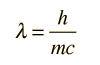
where G is the gravitational constant and c is the speed of light. But from Heisenberg's uncertainty principle and the DeBroglie wavelength, we can infer that the smallest scale at which we could locate the event horizon would be the Compton wavelength.

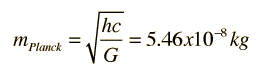
Equating L and λ, we obtain a characteristic mass called the Planck mass:

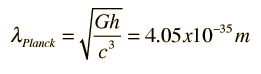
Substituting this mass back into one of the length expressions gives the Planck length

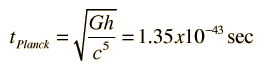
and the light travel time across this length is called the Planck time:

Keep in mind that this is a characteristic time, so its order of magnitude (10-43) is what should be noted. Sometimes it is defined with the above wavelength divided by 2π, so don't sweat the details.

Later, But Not Much Later...

At a time around 10-36 seconds, present models project a separation of the strong force; again, one of the four fundamental forces. Before this time the forces other than gravity would be unified in what is called the grand unification or the less pompous "superforce." The spontaneous symmetry breaking which occurs in this era would distinguish as a separate interaction the force which would hold nuclei together in later eras.

Note: These brief periods (and boy do I mean brief) are called eras for good reason: they constitute a major portion of the entire age of the Universe at that time. It's all relative, hehe (are you listening, Jorrie? )

In the 1970s Sheldon Glashow and Howard Georgi proposed the grand unification of the strong, weak, and electromagnetic forces at energies above 1014 GeV. If the ordinary concept of thermal energy applied at such times, it would require a temperature of 1027 K for the average particle energy to be 1014 GeV. That's one sh!tload of energy, btw.

Though the strong force is distinct from gravity and the electroweak force in this era, the energy level is still too high for the strong force to hold protons and neutrons together, so that the universe is still a seething, boiling sea of quarks.

Then The Universe Gets Phat - Phast!

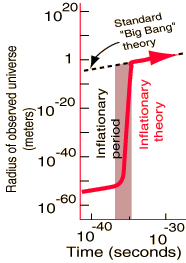
Triggered by the symmetry breaking that separates off the strong force, models suggest an extraordinary inflationary phase in the era 10-36 seconds to 10-32 seconds. More expansion is presumed to have occurred in this instant than in the entire period (~13.6 billion years?) since.

The inflationary epoch may have expanded the universe by 1020 or 1030 times its original volume in this incredibly brief time. The inflationary hypothesis offers a way to deal with the horizon problem and the flatness problem of cosmological models.

Lemonick and Nash in a popular article for Time describe inflation as an "amendment to the original Big Bang" as follows: "when the universe was less than a billionth of a billionth of a billionth of a second old, it briefly went through a period of superchanged expansion, ballooning from the size of a proton to the size of a grapegruit (and thus expanding at many, many times the speed of light). Then the expansion slowed to a much more stately pace. Improbable as the theory sounds, it has held up in every observation astronomers have managed to make."

Note that the Universe - the very fabric of space - can itself expand faster than the speed of light. This does not violate any laws. Light, gravitational waves, and signals in general travel at the speed of light within the fabric of spacetime, but the rate at which spacetime itself can expand is under no such constraints.

Let There Be Light - Finally!

As the inflationary period ends, the universe consists mostly of energy in the form of photons and other particles which exist but cannot bind into larger stable particles because of the enormous energy density. They would exist as a collection of quarks and antiquarks along with their exchange particles, a state which has been described as a "sizzling sea of quarks". This time period is estimated at 10-32 seconds to 10-5 seconds. During this period the electromagnetic and weak forces undergo the final symmetry break, ending the electroweak unification at about 10-12 seconds.

And Now For Something Completely Different: Real Stuff! (Quark Confinement)

When the expansion of the "primordial fireball" had cooled it to 1013 Kelvin, a time modeled to be about 10-6 seconds (one microsecond), the collision energies had dropped to about 1 GeV and quarks could finally cling to each other to form individual protons and neutrons (and presumably other 'heavy' particles called baryons). At this time, all the kinds of particles which are a part of the present universe were in existence, even though the temperature was still much too high for the formation of atomic nuclei. At this point we can join the Standard Big Bang model as outlined by Steven Weinberg in The First Three Minutes. (Steven works in my building. I should buy his Dreams of a Final Theory (which I've been meaning to read someday) and get him to autograph it).

Los Endos

And so ends this epic tale of the First Microsecond.

Eat my dust, Steven Hawking! Your book's still too long!

-e

Register to Reply
Guru

Join Date: Feb 2007
Location: Israel
Posts: 2968
Good Answers: 24
#86
In reply to #84

Re: Which came first..black hole or galaxy?

03/22/2007 8:30 AM

...photons are sufficiently energetic...create a minuscule black hole...

Due to their acquired mass? I'ts hard to visualise. Could you make the effort to be a little more descriptive?

...this problem arises if we attempt to measure an object's position with a precision greater than one Planck length...

Point driven right home. Akinda Heisenberg-with-a-twist?

Register to Reply
Guru

Join Date: Sep 2006
Posts: 4513
Good Answers: 88
#88
In reply to #86

Re: Which came first..black hole or galaxy?

03/22/2007 2:24 PM

Not acquired, but equivalent, mass (E = mc2 rears its ugly head once again), concentrated at the target in the space of one Planck length undergoes gravitational collapse.

Register to Reply
Guru

Join Date: Feb 2007
Location: Israel
Posts: 2968
Good Answers: 24
#87
In reply to #84

Re: Which came first..black hole or galaxy?

03/22/2007 9:09 AM

...Note that the Universe - the very fabric of space - can itself expand faster than the speed of light. This does not violate any laws. Light, gravitational waves, and signals in general travel at the speed of light within the fabric of spacetime, but the rate at which spacetime itself can expand is under no such constraints...

Hmmm... This could eliminate a whole bunch of bitter threads and angry posts. Couldn't you have come up with it earlier ?

Register to Reply
Guru
Popular Science - Cosmology - Let's keep knowledge expanding Engineering Fields - Retired Engineers / Mentors - Hobbies - HAM Radio - New Member

Join Date: Dec 2006
Location: North America, Earth
Posts: 4528
Good Answers: 106
#89
In reply to #84

Re: Which came first..black hole or galaxy?

03/22/2007 8:32 PM

Hi europium,

Really fantastic! You've been reading!

...photons are sufficiently energetic...create a minuscule black hole...

Is this what is happening to klsraina's brain?

S

__________________
“I would rather have questions that can't be answered than answers that can't be questioned.” - Richard Feynman
Register to Reply
Guru

Join Date: Sep 2006
Posts: 4513
Good Answers: 88
#90
In reply to #89

Re: Which came first..black hole or galaxy?

03/22/2007 9:39 PM

Hey SG,

I can't speak for klsraina's brain, but it sure has been happening to mine! Just this morning I went to do my breakfast dishes, and instead of putting a little dish soap in the water, I poured in my favorite hazelnut coffee creamer. Last week I poured hot water into the sugar bowl when attempting to make tea. One nice thing about having A.D.D. is that when you finally get Alzheimer's, you can't tell the difference. You folks Out There who don't have this disorder don't know the half of what you're missing.

-e

Register to Reply
Guru

Join Date: Feb 2007
Location: Israel
Posts: 2968
Good Answers: 24
#95
In reply to #90

Re: Which came first..black hole or galaxy?

03/23/2007 1:41 AM

This is not ADD, this is brainstorming, man! Having Altzheimer is not being able to tell the difference between the two, and not caring either. Oh! the bliss of peacefull ignorance. let me meditate on this here sweet... what was it... ehhh... mmm

Register to Reply
Guru

Join Date: Sep 2006
Posts: 4513
Good Answers: 88
#93
In reply to #89

Re: Which came first..black hole or galaxy?

03/22/2007 10:20 PM

Standards Guy writes: "You've been reading!"

Yes. And my post already needs revision. There's this one tiny little teensy weensy problem that all the other essays on the nascent universe just seem to blithely ignore, as if whistling in the dark, hoping that if they look the other way it won't leap out and suddenly and bite them in the ass (at least in the essays I've read, including those written by some real Brand-Name folks who ought to know better).

Details at 11...

-e

Register to Reply
Associate

Join Date: Feb 2007
Posts: 54
#124
In reply to #84

Re: Which came first..black hole or galaxy?

03/27/2007 12:45 AM

Great job of explaining the standard model. Some cliff notes here. First G (Gravitational force constant) is 1 billionth as strong as the weak electro force. That is why we go splat when we jump from a ten story building instead of going to the center of the earth or through the earth. If I were you I get Dr. Weinberg's book too. This standard model is more then less excepted fact, there is only one modification to it in the parallel universe theory. Which was created to explain galactic clumping. It says we have multiple singularities occurring.

The reason is that galactic formation is placed by Hubble observations at at most plus 1 billion and maybe as little as plus 1 million years after the big bang event. This can not be explained with the mist model. Remember the three simple models by which the universe expanded. The mist theory is being looked at more and more as the reason for roag star formation. Stars forming outside of galaxies. Hubble observations place their age at about the same age as our sun.

The splatter model can explain some galaxies. Those that are spherical or egg shaped and young. Older galaxies that are this shape have been proven by computer models to be pulled a part by galactic collisions. The only model that explains quick black hole formation and thus quick galactic formation as in mean, median and mode (skew max effect "mode"), the galactic drift patterns of the universe and the increase in the rate of the expansion of the universe is the shockwave model. Just like sounds waves move faster in water then through air. Dark matter can't help the splatter effect significantly enough. For the splatter effect to be the significant effect of the post big bang universe. We are as ants on a tree when we talk about the universe. We only live at best a hundred years. but the universe is billions. The only way we have is to time travel using our telescopes. Then we only see is just a snapshot of the past.

Because the shockwave model helps explain the three things we know did and are happening in the universe. I like it, but it also predicts a sort of galactic weather. We have weather on earth. We have solar weather. Well we may have galactic and universal weather too. The remnants of super nova events may leave micro wormholes in the galaxies. And the post big bang universe may have post micro big bang wormholes which may be the steering mechanism in galactic movement. Thus there maybe threads tying the galaxies together and the Universe together. A sort of galactic jet stream controlling movement of matter and energy out from the galactic center in front of the remnant pressure way and back in towards the center of the Galaxy on the backsides with star and solar system formation occurring inside the remnant pressure wave. Think of it like a storm front on earth in front of the cold front you have squall lines. You know birds use these squall lines to migrate. If this model holds true we may be able to one day travel light years in days catching a galactic micro worm hole. Thus the theory is testable. The next generation of space telescope may be able to find one.

Register to Reply
Guru

Join Date: Sep 2006
Posts: 4513
Good Answers: 88
#127
In reply to #124

Re: Which came first..black hole or galaxy?

03/27/2007 1:39 AM

Hi Rory,

Just a note on elliptical (egg-shaped) galaxies.

Elliptical galaxies usually form as the end result of many galactic mergers and tend to be very old. M87, an enormous elliptical with an ultramassive, very energetic black hole core, is very old and full of old, red stars. M87 also contains little gas and dust, making it unusually transparent for a galaxy of its size. It has consumed most of the stuff from which new stars are formed. Besides being unusually transparent, it shows little evidence of star formation, most often seen as clumps of hot, massive blue stars.

This image, below, shows M87 superimposed over its negative which clearly shows the fainter outlying stars and the monster's true extent. If all of M87 were visible to the naked eye, it would be larger than a full moon as seen from Earth in spite of the fact that M87 is over 60 million light years away. The galaxy is at least one million light years in diameter and contains more than a trillion stars.

The next image gives you a general idea of M87's color, due mostly to its large population of very old stars. The faint star-like objects surrounding it are not stars, but globular clusters. Our Milky Way has maybe 150 globular clusters - themselves very, very old and containing upwards of 10,000 to 100,000 stars each. M87 is surrounded by anywhere from 4000 to 15,000 globular clusters:

And finally, this image of M87's core shows the famous 100,000 light-year long stream of electrons ejected from M87's black-hole at nearly the speed of light. Not visible in the pic is this stream's twin ejected in the opposite direction. The twin is more easily "seen" at radio wavelengths:

Giant ellipticals can be found at the heart of most galactic clusters and superclusters. Quite to the contrary, it is the ellipticals who are not the prey, but the predators.

-e

Register to Reply
Guru

Join Date: Feb 2007
Location: Israel
Posts: 2968
Good Answers: 24
#130
In reply to #127

Re: Which came first..black hole or galaxy?

03/27/2007 8:37 AM

...result of many galactic mergers and tend to be very old...

Eventually globular (given enough merges) ?

If so, maybe an indirect proof for tidal mutual-cancelling of localised kinetics, thus an evidence of the second TD law (ignored in so many "perpetuals") in large-scale action?

Register to Reply
Associate

Join Date: Feb 2007
Posts: 54
#133
In reply to #127

Re: Which came first..black hole or galaxy?

03/29/2007 12:38 AM

Thanks for a supporting example. M87 actually supports the Shockwave theory as do 95% of the galactic movements. Mind thought here. Gravity predicts bigger things warp space more so little things move into big things. Mind thought here imagine big sale boat with lots of sails on windward side put little sail boat down wind. I bet that the big sail boat crashes into little sail boat. What occurs @ 2 or 3 degrees above absolute. Isn't it the back ground hiss of the big bang? Remember things are remembered. Mind thought here carny act strongman bends an steel rod into a pretzel. He does that feat quickly and without stopping. Reason is once matter is set in motion is wants to stay in motion. He is using some of the oldest physical principles out there. We are talking calc 1 and calc 2 stuff. As I said take a map of the universe put red or blue shift vectors on the galaxies and connect the dots. You'll be amazed. By the way you said image of jet is a radio telescope image, not a X-ray image? Hmm... What is the energy level of the jet? I bet it is between 6 and 108 degrees above absolute? If it is Lord what is his name now? That English guy I think you used his name. Hawking's? Didn't he predict that black holes evaporate? That m87 must be going at 10100 rev per minute? Could we be seeing an evaporation event? After-all the bigger the black hole the greater it's evaporation rate. Quark event cool. Hawking's may thank you for this. Precisely my point there aren't many spherical or Egg shaped young galaxies so the splatter effect isn't significant. Only old galaxies that have had collisions are this shape. Young galaxies are what shape? Have fun!

Register to Reply
Guru

Join Date: Sep 2006
Posts: 4513
Good Answers: 88
#103
In reply to #81

Re: Which came first..black hole or galaxy?

03/24/2007 6:38 AM

One problem with current inflationary theories that I've not seen addressed satisfactorily is the period of time between the first spontaneous symmetry break - where gravity makes it debut at t = tPlanck (~ 10-43 seconds) - and the beginning of the inflationary epoch at around 10-36 seconds. Prior to Inflation the Universe is smaller than a proton, has a QM-limited density of roughly 1094 grams of equivalent mass per cubic centimeter (what I'm calling "mass-energy" henceforth, as I quickly tire of repeatedly writing the word "equivalent"), the other three fundamental interactions are still unified, the Universe is small and still expanding slowly enough where all parts of it can "communicate" with all other parts at the speed of light (meaning that what happens in one part is soon felt everywhere), and yet, for some inexplicable reason, the Universe is not simply swallowed up in its own black hole. Certainly all the makings of a hole are there - remember, gravity is present but inflation has not yet begun! Between the appearance of gravity and the beginning of inflation there are roughly 107 Planck times. That's a lot of time for the Universe not to collapse under these conditions!

Some offer that the Universe was so hot and energetic at this point that it would naturally expand against any tendency to form a black hole. But the enormous energies present are themselves the problem! And this cannot be true as the "escape velocity" is already well beyond the speed of light. These are ideal - more than ideal - conditions that would otherwise lead to the formation of a black hole. Stuff might want to expand, yes, but it would have to expand at a rate much faster than the speed of light. No, something else is preventing collapse.

I asked one of our cosmologists here (Dr. Komatsu) what was preventing the Universe from undergoing total gravitational collapse during this epoch. "We really don't know," he said. "Some researchers, in fact, never even ask the question!" (I guess he thought it was a good question.) One possibility is that black holes formed, but then instantly vanished, forming "other universes" and taking a bit of our Universe's mass-energy with them. Or, it is possible that there was no delay between the appearance of gravity and the beginning of inflation. This would be the easiest solution, but there's no testing of it one way or another.

Current theory, apparently, traces back to some point at or near the beginning of Inflation, but doesn't have much to say about the Universe prior to that time other than to estimate approximately when gravity appeared. Nor do current theories lead to a unique solution. There is a lot of latitude, Dr. Komatsu said, in exactly when the inflationary period began and almost nothing characterizing the physical nature of the Universe - such as the distribution of mass-energy - prior to that time. Even the WMAP images do not imply with any certainty the homogeneity of the Universe prior to Inflation, as the relaxation of the scalar field (responsible for Inflation) "flattened" the Universe to one part in 1060 long before the fireball became transparent to photons. It is quite possible that the distribution of mass-energy in the nascent Universe was quite granular and "chunky" prior to Inflation, and that some of the denser pieces winked out of existence, having been swallowed up by primordial holes that, at that scale of spacetime, would have been smaller than one Planck length. For my part I don't see why "denser" pieces should be singled out for this honor when the average density of all mass-energy present at that time was many, many, many times denser than that which would quickly lead to wholesale black hole formation.

Comments and discussion appreciated.

-e

Register to Reply
Guru

Join Date: Feb 2007
Location: Israel
Posts: 2968
Good Answers: 24
#104
In reply to #103

Re: Which came first..black hole or galaxy?

03/24/2007 10:27 AM

...limited density of roughly 1094 grams of equivalent mass per cubic centimeter...

Isn't this too low? Maybe later as the universe expands, bosons "acquired" more mass? Am I off here?

Register to Reply
Guru

Join Date: Sep 2006
Posts: 4513
Good Answers: 88
#125
In reply to #104

Re: Which came first..black hole or galaxy?

03/27/2007 1:09 AM

This isn't the total mass of the Universe, but a figure of how the mass was squished together. Conceivably (though I very highly doubt it) the Universe may have had only a moderate amount of equivalent mass at this stage. Much of the current mass showed up after the Inflationary epoch when the potential energy of the relaxing scalar field manifested as the primordial fireball.

The density figure itself can be ascribed to quantum limits on density: 1094 grams per cubic centimeter is the maximum limit Quantum Mechanics places on density.

-e

Register to Reply
Guru
Popular Science - Cosmology - Let's keep knowledge expanding Engineering Fields - Retired Engineers / Mentors - Hobbies - HAM Radio - New Member

Join Date: Dec 2006
Location: North America, Earth
Posts: 4528
Good Answers: 106
#105
In reply to #103

Re: Which came first..black hole or galaxy?

03/24/2007 1:49 PM

Hi e,

"...it would have to expand at a rate much faster than the speed of light. No, something else is preventing collapse."

I offer an explanation for people who believe in God. He made a law that determines when other laws take effect. (This is like DNA having all the instuctions to create a human being). I don't think anyone knows when gravity began (it is the least understood of any phenomenon I know of). It took effect at the time prescibed by the overall law, as well as everything else like mass for instance.

S

__________________
“I would rather have questions that can't be answered than answers that can't be questioned.” - Richard Feynman
Register to Reply
Guru

Join Date: Sep 2006
Posts: 4513
Good Answers: 88
#106
In reply to #105

Re: Which came first..black hole or galaxy?

03/24/2007 2:13 PM

Hi SG,

I agree. But it's rather fun, I think, to see how much we can learn of this creation, as God also created a "curiosity" gene and turned it on! Nothing impresses me more about God's nature than in discovering, one layer at a time, the sheer infinite genius with which the Universe was created. Nor is the Story over, not by a long shot. Looking into this Universe of His is almost like Christmas morning every morning.

-e

Register to Reply
Guru

Join Date: Oct 2006
Location: 44.56024"N 15.307971E
Posts: 8277
Good Answers: 270
#111
In reply to #103

Re: Which came first..black hole or galaxy?

03/25/2007 2:15 PM

Perhaps the black hole did not form because space-time was expanding faster than C, and the expansion of the energy/matter was limited by the speed of C.This would mean that the "rug" was literally pulled out from under the energy in all directions before it could collapse into a black hole.As it tried to collapse, spacetime was expanding at a faster rate, until the concentration was sufficiently diluted by spacetime to it's current semi-stable state.

What say ye?

HTRN

__________________
"A man never stands so tall as when he stoops to help a child." "Never argue with a stupid person.They will drag you down to their level and beat you with experience" "To create an apple pie from scratch, first you must create a universe"
Register to Reply
Register to Reply Page 1 of 2: « First 1 2 Next > Last »
Copy to Clipboard

Users who posted comments:

Anonymous Poster (6); Cardio-2 (1); D3 (1); Hap (1); HiTekRedNek (5); Hottech (3); Jorrie (8); Keywalker (3); klsraina (4); MarkTheHandyman (1); nandan (1); Richard L (5); RoryHoulihan (6); Scapolie (2); StandardsGuy (11); user-deleted-13 (44); Yuval (32)

Previous in Forum: Electric Motor efficiency   Next in Forum: How to take energy from 480F degree clean flue gas

Advertisement