Previous in Forum: Multiple Factor   Next in Forum: Lighting Calculations in Tunnel
Close
Close
Close
50 comments
Rate Comments: Nested
Commentator
India - Member - New Member Engineering Fields - Electromechanical Engineering - New Member

Join Date: Jan 2011
Location: India
Posts: 69

About Stator Poles

06/13/2011 12:12 AM

Hi good day to all....

Generally we mention in Induction motor that 3phase, 4 pole machine...

in this, 4 pole produced by a 1 phase or its produced by 3 phase together...

With regards,

Amith raj

Register to Reply
Interested in this topic? By joining CR4 you can "subscribe" to
this discussion and receive notification when new comments are added.

Good Answers:

These comments received enough positive votes to make them "good answers".

"Almost" Good Answers:

Check out these comments that don't yet have enough votes to be "official" good answers and, if you agree with them, vote them!
Guru
United Kingdom - Member - New Member

Join Date: Aug 2010
Location: Resting under the Major Oak
Posts: 4347
Good Answers: 181
#1

Re: About stator Poles

06/13/2011 12:28 AM
__________________
The reports of my death are greatly exaggerated.
Register to Reply Score 1 for Good Answer
Guru

Join Date: Oct 2010
Posts: 1294
Good Answers: 35
#9
In reply to #1

Re: About stator Poles

06/13/2011 11:22 AM

No offense intended, but I found this sketch just a little unhelpful. At first glance at the rotor, and noticing two different rotors with different numbers of poles, you might think the important thing is the number of poles on the rotor.

But, both of these rotors would rotate at (practically) the same speed (maybe a slight difference due a difference in slip--the four pole rotor may have more magnetic flux and thus slip less (and have more torque).

The critical thing (which sets the speed of the motor) is the number of poles in the stator, per phase. (E.g., a three phase motor with 2 poles per phase in the will run at 3600 rpm, as will a single phase motor with 2 poles per phase.)

Register to Reply Off Topic (Score 5)
Guru
Engineering Fields - Electrical Engineering - Been there, done that. Engineering Fields - Control Engineering - New Member

Join Date: Dec 2008
Location: Long Island NY
Posts: 15600
Good Answers: 981
#10
In reply to #1

Re: About stator Poles

06/13/2011 11:23 AM

Then there are other pictures of four poles.

__________________
"Don't disturb my circles." translation of Archimedes last words
Register to Reply Off Topic (Score 4)
Guru
India - Member - New Member

Join Date: Sep 2009
Location: Temporarily at Ashburn, VA
Posts: 2744
Good Answers: 164
#12
In reply to #10

Re: About stator Poles

06/13/2011 11:50 AM

i am sure you heard about Stanislawski, who was quite happily married to American wife, until he saw that she bought some 'Polish remover' !!! And went running to the police saying his wife is gonna murder him.

__________________
Nothing worthwhile can ever be taught, it can only be learnt.
Register to Reply Off Topic (Score 5)
Guru
United States - Member - Hobbies - Fishing - New Member Hobbies - Target Shooting - New Member Hobbies - RC Aircraft - New Member Engineering Fields - Aerospace Engineering - New Member

Join Date: May 2009
Location: Saint Helens, Oregon
Posts: 2216
Good Answers: 70
#2

Re: About stator Poles
06/13/2011 12:29 AM

What...??? What are you saying?? Or, what are you asking?? Sorry, but this makes no sense, or am I missing something?

__________________
Confucius once said, “ Ability will never catch up with the demand for it".
Register to Reply Score 1 for Off Topic
Participant

Join Date: Apr 2011
Posts: 3
#3

Re: About stator Poles

06/13/2011 3:46 AM

if we are talking about a 4 pole machine we are refering to the number of poles produced per phase

Register to Reply
Guru
India - Member - New Member

Join Date: Sep 2009
Location: Temporarily at Ashburn, VA
Posts: 2744
Good Answers: 164
#4

Re: About stator Poles

06/13/2011 3:47 AM

Better you learn yourself than anyone giving you a readymade answer i think? This link is from IIT Madras (Chennai now)......

http://nptel.iitm.ac.in/courses/IIT-MADRAS/Electrical_Machines_I/pdfs/2_4.pdf

__________________
Nothing worthwhile can ever be taught, it can only be learnt.
Register to Reply
Anonymous Poster #1
#5
In reply to #4

Re: About stator Poles

06/13/2011 6:23 AM

This pdf is on commutated motor.

Register to Reply
Guru
India - Member - New Member

Join Date: Sep 2009
Location: Temporarily at Ashburn, VA
Posts: 2744
Good Answers: 164
#6
In reply to #5

Re: About stator Poles

06/13/2011 7:51 AM

i know. i was just showing what gems are available on google

Whether the OP wants or not, i have enriched my own knowledge....

B7100.pdf

http://www.industrial-electronics.com/elecy4_14.html

00887a.pdf

__________________
Nothing worthwhile can ever be taught, it can only be learnt.
Register to Reply
Guru

Join Date: Oct 2006
Location: Surrey BC Canada
Posts: 1571
Good Answers: 42
#14
In reply to #6

Re: About stator Poles

06/13/2011 11:51 PM

I used to work for the same company, Reliance Electric, as Melfi.

Anyone know where he is now?

Register to Reply Off Topic (Score 5)
Guru
India - Member - New Member

Join Date: Sep 2009
Location: Temporarily at Ashburn, VA
Posts: 2744
Good Answers: 164
#18
In reply to #14

Re: About stator Poles

06/14/2011 8:07 AM

i don't know if this is the person.... you may want to call him and see ?

http://www.spokeo.com/search?q=Michael%20Melfi,%20Euclid,%20OH&g=name_pipl_scd_state01#:4361176271

A very prolific inventor ! Lots of patents. You must have enjoyed the work along with him....

__________________
Nothing worthwhile can ever be taught, it can only be learnt.
Register to Reply Off Topic (Score 5)
4
Associate

Join Date: Apr 2010
Posts: 29
Good Answers: 6
#7

Re: About stator Poles

06/13/2011 8:40 AM

Amith:

A three phase "four pole" motor means that there are four poles per phase. The total number of poles are 3 phases times 4 poles = 12 poles total.

The most correct way to state it is "four poles per phase", although most engineers will simply say it is a "four pole motor".

The synchronous speed for a motor is the supply frequency expressed in RPM. For example, a two pole per phase motor in a 50 Hz system has a synchronous speed of 50 Hz times 60 sec = 3000 RPM. A four pole machine has a synchronous speed of 50 Hz times 1/2 times 60 sec = 1500 RPM.

Naturally, the speed of an induction motor is somewhat less than the synchronous speed because slip is required for inducing rotor currents in order for the motor to produce torque.

Register to Reply Good Answer (Score 4)
Guru
Engineering Fields - Electrical Engineering - Been there, done that. Engineering Fields - Control Engineering - New Member

Join Date: Dec 2008
Location: Long Island NY
Posts: 15600
Good Answers: 981
#8
In reply to #7

Re: About stator Poles

06/13/2011 11:22 AM

You spoiled it.

I was so looking forward to seeing somebody try to explain what the fourth pole would be wired to in a three phase power source.

__________________
"Don't disturb my circles." translation of Archimedes last words
Register to Reply Off Topic (Score 5)
Anonymous Poster #1
#11
In reply to #8

Re: About stator Poles

06/13/2011 11:36 AM

Everybody knows it's a spare. S.M.

Register to Reply
Power-User
Belgium - Member - New Member

Join Date: May 2007
Location: Flanders (Belgium)
Posts: 343
Good Answers: 21
#15
In reply to #7

Re: About stator Poles

06/14/2011 4:41 AM

"A three phase "four pole" motor means that there are four poles per phase. The total number of poles are 3 phases times 4 poles = 12 poles total."

This is not correct.

-

The number of poles determs to the synchroneous motor speed for AC induction motors.

On can have a single phase four pole motor and a three phase four pole motor, (even a 12 phase four pole motor if you would have a 12 phase AC supply and a motor with enough stator slots).

Both motors the 4 pole single phase and the 4 pole three phase will have the same synchroneous speed. Only the layout of the windings are different.

Register to Reply
Guru
India - Member - New Member

Join Date: Sep 2009
Location: Temporarily at Ashburn, VA
Posts: 2744
Good Answers: 164
#16
In reply to #15

Re: About stator Poles

06/14/2011 6:58 AM

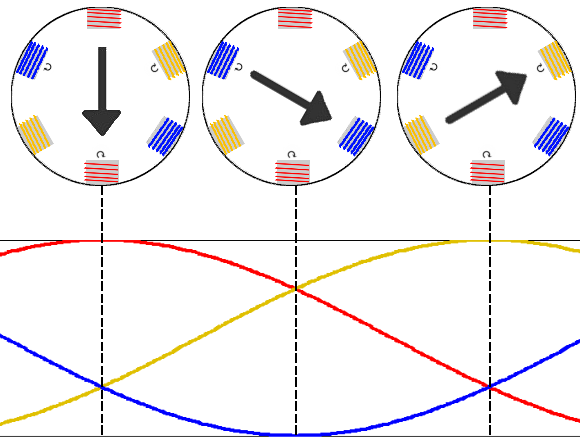
Er....this image from Wiki seems to show 12 poles? Or am i misreading the winding scheme ?

__________________
Nothing worthwhile can ever be taught, it can only be learnt.
Register to Reply
Power-User

Join Date: Apr 2011
Location: Bengaluru, India
Posts: 128
Good Answers: 3
#17
In reply to #16

Re: About stator Poles

06/14/2011 7:31 AM

NO

It is only showing 3 phases in different colors. And an winding arrangement with 4 poles.

The magnetic field generated is by all the 3 phase currents together.

Please also check the link http://en.wikipedia.org/wiki/Rotating_magnetic_field

The figure in the above link shows only two poles on the rotor. the north pole of the rotor will follow towards the south pole on the stator. Since the supply is a sine wave, the stator pole changes continuosly from north to south and south to north. Consequently the rotor is in continous rotation following this "moving" or "Rotating" magnetic field.

Imagine a second stator winding which is displaced at equidistant in space from the first winding but has the same AC source and hence produces identical magnetic field displaced at equal distance from the first one. There will be another set of induced magnetic field in the rotor. So we get 4 poles or two pole pairs.

To summarize, we do not have 12 poles as stated in some of the discussions. But only 4 poles.

__________________
Dr.Raghunatha Ramaswamy - We discover nothing new other than knowledge
Register to Reply
Guru
India - Member - New Member

Join Date: Sep 2009
Location: Temporarily at Ashburn, VA
Posts: 2744
Good Answers: 164
#19
In reply to #17

Re: About stator Poles

06/14/2011 8:23 AM

Dr Raghu,

At the outset, let me tell you that after learning about lap and wave winding in 1964, i promptly forgot all about it. So please bear with my ignorance, i am relearning.

The Wiki link in your post#13 took me to the page where i got that image. Part of the text next to that image is reproduced here :

"....... using the simplified analogy of salient poles, have one salient pole per pole number; a four-pole motor would have four salient poles. Three-phase motors have three salient poles per pole number, so a four-pole motor would have twelve salient poles. This allows the motor to produce a rotating field, allowing the motor to start with no extra equipment and run more efficiently than a similar single-phase motor."

This is what confused me.

Would appreciate more enlightenment... will benefit all here, thanks.

__________________
Nothing worthwhile can ever be taught, it can only be learnt.
Register to Reply
Power-User

Join Date: Apr 2011
Location: Bengaluru, India
Posts: 128
Good Answers: 3
#21
In reply to #19

Re: About stator Poles

06/14/2011 9:05 AM

The practice is to consider only the rotor poles. Stator poles are shown to explain the induction motor principle. The name plate ratings on the Induction motor is based on rotor poles only.

__________________
Dr.Raghunatha Ramaswamy - We discover nothing new other than knowledge
Register to Reply
Guru

Join Date: Oct 2010
Posts: 1294
Good Answers: 35
#25
In reply to #21

Re: About stator Poles

06/14/2011 10:41 AM

Re: The practice is to consider only the rotor poles. Stator poles are shown to explain the induction motor principle. The name plate ratings on the Induction motor is based on rotor poles only.

Interesting.

Please look at the 2 sketches of motors in post #1 of this thread. (I don't know if anyone makes AC motors with permanent magnet motors, so this may be somewhat hypothetical.) What is the speed of those two motors, assuming both are driven from a (3 phase) power source at the same frequency.

I hope you'll agree that they would rotate at the same speed.

So, number of poles on the rotor is not all that important, it is the number of poles in the stator. (Aside:Note also that this question is about the number of poles in the stator.)

Now, what is the definition of a pole? There are at least two--one is the simpler for me to define off the top of my head--think of it as one end of a magnet (and, of course, all magnets have two ends--two pole pieces).

We might also call these ends of the magnets pole pieces (I'm not sure whether that is helpful or not, but let me try it). So how many pole pieces are in a (simple) 3 phase 4 pole motor? There are usually 12, right (I can imagine a motor built with more, for various reasons--any maybe less, but I'll hold that thought until later).

So, with 12 pole pieces, it is logical, and not incorrect, to think of those as 12 poles. And, through time, each pair of pole pieces (diametrically opposite each other) is at one time the north pole of an electromagnet, and at some other time, the south pole of an electromagnet. (And, for future reference, the intensity of those poles (or the magnetic field from those poles) varies with time in sync (but out of phase) with the applied electrical power supplied to the coils of those magnets.)

Now, I think most people here know that the principle of operation of a motor is creating a rotating field, and then having something magnetic (permanent or electro magnetic) sit in that field and be free to rotate (on the appropriate axis).

The thing in that field rotates at (or near--considering slip and such) the speed of the rotating magnetic field.

Is it meaningful to talk about poles in that rotating magnetic field? Yes, I think it is, and it demonstrates the other definition of magnetic pole that I wanted to describe. But it is not easy for me to describe. Clearly, the field rotates. There is a point where the north magnetic field is most intense at any given moment, and a point where the south magnetic field is most intense at any given moment (and, at the same moment, they are diametrically opposite each other, 180 degrees apart).

There is only ever one, can I call it North / South axis of the magnetic field that is most intense, no matter how many (stator) poles are used to create the magnetic field.

The important thing for the speed of the motor is how fast that field rotates.

You could build a single phase motor with 4 poles / pole pieces, and, with a 60 Hz. electrical source, you would have a magnetic field that rotates at 1800 RPM.

You could build a three phase motor to create a magnetic field rotating at the same speed (with the same frequency), but the normal design of that motor would include 12 pole pieces, which it would be fair to call magnetic poles, as, as the field rotates, (the center of) each in turn briefly becomes the most intense (north or south) magnetic pole.

(Not to confuse anybody (including myself, I hope), the most intense (north or south) magnetic pole does not always correspond to the center (or even anywhere) on one of the magnetic pole pieces--that most intense magnetic field can be in the space between two adjacent pole pieces because of the vector addition of the sinusoidally varying magnetic fields (from the sinusoidally varying electric power supplied to the coils).)

So, I think TexasEd in his post states it very well:

The most correct way to state it is "four poles per phase", although most engineers will simply say it is a "four pole motor".

Similarly, kvsridhar in his post quotes Wikipedia which is also helpful, introducing the concept of salient poles:

"....... using the simplified analogy of salient poles, have one salient pole per pole number; a four-pole motor would have four salient poles. Three-phase motors have three salient poles per pole number, so a four-pole motor would have twelve salient poles. This allows the motor to produce a rotating field, allowing the motor to start with no extra equipment and run more efficiently than a similar single-phase motor."

I guess, as a wannabee computer guy, I might call the rotating magnetic field a virtual (rotating) magnetic field.

With 4 magnetic pole (pieces) and a single phase supply at 60 hz., it rotates at (nearly) 1800 rpm. I can create a rotating magnetic field at the same speed with the same supply frequency using three phases, but I will need (normally) 12 pole (pieces) to do that.

Maybe more important, the rotating magnetic field only ever has one axis of most intensity, so you might call that: one two pole (rotating) magnetic field. That rotating field never has two axis of most intensity. Thus, it is not helpful to talk about the poles of the rotating magnetic field, only the speed of rotation.

(Hmm, I wonder if you could create a rotating magnetic field with two axis of highest intensity? I guess not, because the magnetic fields would still add vectorially )sp?) to create an axis of highest magnetic field somewhere between the two (of both were rotating at the same speed). If two magnetic fields were rotating at different speeds, the magnetic fields would still add vectorially, but the combined field would rotate at some other speed, between the speeds of the two magnetic fields. Hmm, I wonder if any of those old rotating control devices (can't think of the names--amplidyne, rotodyne, ... operate on that principle?)

I learned something else from this discussion (and the Wikipedia article on rotating magnetic fields)-- that motor seems to be operating with 3 pole pieces. And, it apparently works. "Splain me that"? (Well, you don't have to, I can see how it works, just very interesting--I never thought about it. Of course, the motor would develop more rotating torque with 6 "explicit" pole pieces.

Register to Reply
Guru
India - Member - New Member

Join Date: Sep 2009
Location: Temporarily at Ashburn, VA
Posts: 2744
Good Answers: 164
#26
In reply to #25

Re: About stator Poles

06/14/2011 10:53 AM
__________________
Nothing worthwhile can ever be taught, it can only be learnt.
Register to Reply
Guru

Join Date: Oct 2010
Posts: 1294
Good Answers: 35
#29
In reply to #26

Re: About stator Poles

06/14/2011 11:31 AM

Nice--thanks!

Too bad they don't show a diagram with, for example, a 3 phase motor with 4 poles per phase and the (single) axis of highest intensity of the resultant rotating magnetic field.

Register to Reply
Guru
India - Member - New Member

Join Date: Sep 2009
Location: Temporarily at Ashburn, VA
Posts: 2744
Good Answers: 164
#33
In reply to #25

Re: About stator Poles

06/14/2011 11:56 AM

I guess, as a wannabee computer guy, I might call the rotating magnetic field a virtual (rotating) magnetic field

i tend to agree with you....the 'rotation' of the magnetic field is an illusion, created by the sequential waxing and waning of the three phase windings in the stator. Much like the chain-lights that we use to decorate our homes during festivals, giving an illusion of movement, created by waxing and waning.

__________________
Nothing worthwhile can ever be taught, it can only be learnt.
Register to Reply
Guru
Engineering Fields - Electrical Engineering - Been there, done that. Engineering Fields - Control Engineering - New Member

Join Date: Dec 2008
Location: Long Island NY
Posts: 15600
Good Answers: 981
#36
In reply to #33

Re: About stator Poles

06/14/2011 1:35 PM

[Coming out of lurker mode for IMHO an important semantic correction.]

In an induction motor there is one and only one magnetic field. This field direction does actually move, there is nothing virtual about this motion. The multiple poles and phases of the stator concentrate their magnetic field energy in the gap between the stator core material and the rotor core material. So this field shape is a complicated three dimensional shape that can have multiple North and South polarities depending on the number of poles present. Most of the magnetic energy reside in the thin toroid that makes up the gap between stator and rotor. Now to calculate this complicated single field we break this up into individual vector problems and do a vector summation to get to the final single field condition in this gap. Now the core laminations in the rotor do provide the critical return path for the field geometry but very little magnetic energy resides in these laminations. (Well the eddy current losses happen here but that's another story.) A way to think of this is to think of just an ideal circuit of battery, wires and load resistance. The battery is providing the energy but all of the energy being released is happening at the resistor.

[Returning to lurk mode.]

__________________
"Don't disturb my circles." translation of Archimedes last words
Register to Reply
Guru
India - Member - New Member

Join Date: Sep 2009
Location: Temporarily at Ashburn, VA
Posts: 2744
Good Answers: 164
#41
In reply to #36

Re: About stator Poles

06/15/2011 6:03 AM

i agree there is nothing virtual about the motion. Of the rotor. After all, a coil-gun does launch projectiles at high speed. A linear induction motor too...

Anyway, i am talking about a subject which i haven't used in 45 years.

A nice website here, you should sequentially activate one phase at a time and then all phases together....

__________________
Nothing worthwhile can ever be taught, it can only be learnt.
Register to Reply Score 1 for Good Answer
Power-User

Join Date: Apr 2011
Location: Bengaluru, India
Posts: 128
Good Answers: 3
#42
In reply to #41

Re: About stator Poles

06/15/2011 6:28 AM

Initially I took this as only one "effective field per stator winding".

Some other inputs and discussions earlier, considered varying fields and associated number of poles.

I was tempted not to particpate further in this discussion, as every one could be right depending on how they are interpreting.

I guess this link should clarify enough. Every one is free to assume poles depending on their own interpretations.

__________________
Dr.Raghunatha Ramaswamy - We discover nothing new other than knowledge
Register to Reply Score 1 for Good Answer
Guru

Join Date: Oct 2010
Posts: 1294
Good Answers: 35
#43
In reply to #42

Re: About stator Poles

06/15/2011 9:36 AM

Very nice page / animations. I hope you've clicked on the animations to watch them .

Just looking at them might seem to support my old way of thinking (only one main magnetic axis / two poles) in the rotating magnetic field, but I do think I'm wrong.

I've written to the owner / author of the web site to ask the question of him. If I get a response, I'll either post or relay (i.e., paraphrase) it here.

Register to Reply
Guru
India - Member - New Member

Join Date: Sep 2009
Location: Temporarily at Ashburn, VA
Posts: 2744
Good Answers: 164
#44
In reply to #43

Re: About stator Poles

06/15/2011 11:35 AM

What a nice thought ! Never occurred to me. Are you in the USA? Then you may want to call Michael Melfi at that contact i found (post #18) ... a prolific inventor from Reliance/Baldor...

i look forward to more on that awesome website's creator !!! Thank you.

__________________
Nothing worthwhile can ever be taught, it can only be learnt.
Register to Reply Off Topic (Score 5)
Guru

Join Date: Oct 2010
Posts: 1294
Good Answers: 35
#45
In reply to #44

Re: About stator Poles

06/15/2011 12:11 PM

Re: Then you may want to call Michael Melfi at that contact i found (post #18) ... a prolific inventor from Reliance/Baldor...

Actually, I'm unlikely to do that--I'd be more likely to email him if I had an email address, but I didn't notice one there. Of course, by email, you could contact him as well as I could.

If I don't hear something from the guy I wrote to in, say, a week, then I might try Michael, but I'd suggest you should feel free to try it.

Register to Reply Off Topic (Score 5)
Guru
India - Member - New Member

Join Date: Sep 2009
Location: Temporarily at Ashburn, VA
Posts: 2744
Good Answers: 164
#46
In reply to #45

Re: About stator Poles

06/15/2011 10:36 PM

You are quite right ... it would be presumptous ... only GW can perhaps do that. Wonder why he has not revisited this thread.

That search site doesn't list email id. So, not much chance of getting it. Hmm, maybe one can try thru Baldor's website...let me see.

__________________
Nothing worthwhile can ever be taught, it can only be learnt.
Register to Reply Off Topic (Score 5)
Guru

Join Date: Oct 2010
Posts: 1294
Good Answers: 35
#49
In reply to #46

Re: About stator Poles

06/16/2011 9:36 AM

Well, I didn't mean to imply it was presumptuous--I think it is quite an alright thing to do--just ask if he is the guy you are thinking of, and if so, would he give mind answering a question. He might say no to one or both, but I wouldn't consider it presumptuous, rude, or anything else to ask him.

I feel I have a specific question of (presumably Dr.) Knight (about the animations he created). Asking somebody else about Dr. Knight's animations is not the most direct route--if I get no reply, I might try indirect routes. Asking the question(s) of somebody else, will, at the very least (for me) take more words and explanation. Asking Dr. Knight, I think I managed to ask in fewer words--I pointed out the disagreement to him, suggested that his animation might support my (old) point of view, and is that really his intent.

If you've got the time or inclination to ask the question of this other guy, please do--I don't think it is presumptuous, rude, or anything similar.

Register to Reply Off Topic (Score 5)
Guru
India - Member - New Member

Join Date: Sep 2009
Location: Temporarily at Ashburn, VA
Posts: 2744
Good Answers: 164
#50
In reply to #49

Re: About stator Poles

06/16/2011 9:55 AM

Thank you.

i sure hope Dr Knight will answer. Judging by the quality of that website, i am certain we all will benefit greatly.

i didn't mean to ask Mr/Dr Melfi about this weblink, just the general question about the poles, same as Amith has asked (poor chap must be wondering what Pandora's box has he opened here ). Well, an email id would have been good.

Let's wait for Dr Knight.

__________________
Nothing worthwhile can ever be taught, it can only be learnt.
Register to Reply Off Topic (Score 5)
Power-User

Join Date: Apr 2011
Location: Bengaluru, India
Posts: 128
Good Answers: 3
#13

Re: About Stator Poles

06/13/2011 11:39 PM

If you see figure 4 in the link http://en.wikipedia.org/wiki/Induction_motor , you will find that it depends on stator winding arrangement on the number of poles generated.

The 4 poles are generated by all the 3 phases R,Y,B [The colors shown in the reference do not use Y]

__________________
Dr.Raghunatha Ramaswamy - We discover nothing new other than knowledge
Register to Reply Score 1 for Good Answer
Anonymous Poster #2
#20
In reply to #13

Re: About Stator Poles

06/14/2011 8:37 AM

This is the correct explanation.

AC multiphase motors are a bit unlike DC motors that have salient(predefined) poles. here depending on the phase status, the different portion of the windings may become N, S or even neutral (magnetically)

Consider a particular winding section connected across R and Y, Y and B and the third B and R.

When the R is at maximum positive, the B and Y will be half amplitude negative one rising and another falling.

So BY current is zero,

RB is some current and YR is same current and if corerctly wired in opposite direction making one N pole and other S pole.

As we move away from here the current changes and hence the pole strengths change and this is the property that converts the rotation in phase to the rotating motion in space.

This is the simple single pole pair 3 phase machine. Of course the same logic applies to more than three phase too.

Adde another same sequence and you land up in 4 pole (2 pole pair) machine and so on.

Here you have 6 segments of wiring but poles are only 4 two N and two S.

marking off topic since it has nothing really new to add

Register to Reply Off Topic (Score 5)
Associate

Join Date: Apr 2010
Posts: 29
Good Answers: 6
#22
In reply to #13

Re: About Stator Poles

06/14/2011 9:26 AM

The number of poles works like this, depending on whether you are looking at the stator or the rotor. For a squirrel cage induction motor:

For a single phase motor at 50 Hz and 3000 RPM synchrounous speed, there are 2 stator poles and 2 induced rotor magnetic poles. From the stator, we have 2 poles per phase and for the rotor there are 2 poles. Again, remember that an induction motor cannot run at synchronous speed. Synchronous speed is a reference. (For an induction motor, the rotor magnetic poles rotate at synchrounous speed even thought the rotor is physically moving at less than synchrounous speed. Naturally, the stator magnetic poles are stationary, which is why it is a "stator".)

For a three phase motor at 50 Hz and 3000 RPM synchrounous speed, there are 6 stator poles and 2 induced rotor poles. From the stator, we have 2 poles per phase or a total of 3 x 2 = 6 poles. I hope that this is obvious because a 3 phase motor stator is essentially 3 single phase motor windings intertwined on the stator.

For a three phase motor at 50 Hz and 1500 PRM synchronous speed, there are 12 stator poles and 4 induced rotor poles. From the stator, we have 4 poles per phase or a total of 3 x 4 = 12 poles.

Similarly, for 1000 RPM there are 18 stator poles and 6 rotor poles.

I hope this is clear to everyone. Please post if you need additional help.

Register to Reply
Power-User

Join Date: Apr 2011
Location: Bengaluru, India
Posts: 128
Good Answers: 3
#23
In reply to #22

Re: About Stator Poles

06/14/2011 10:27 AM

"For a three phase motor at 50 Hz and 3000 RPM synchrounous speed, there are 6 stator poles and 2 induced rotor poles"

The critical difference is that, a 3 phase motor even though it has 3 phases, these 3 phases are not independent of each other as in 3 single phase supplies. Rather the 3 phases have a specific phase relationship and consequently cannot have 6 poles.

It works like this

Effective Flux = vector sum of individual Fluxes and is constant in time and space [ideally, rotating and yet constant at all points within the motor airgap].

However, individual phase flux is varying as per AC sine wave.

Repeat, the rotating field is constant in magnitude and denotes a single constant, effective magnetic field per stator winding.

While, individual phase fluxes are sinusoidally varying and is not constant.

Check the diagram in the link, which shows 3 individually varying flux, but a single constant effective magnetic field responsible for rotor rotation.

http://en.wikipedia.org/wiki/File:Rotatingfield.png

To summarize the 3 phase supply results in only one magentic field of constant strength per stator winding. Thus the number of poles are only 2 per stator winding considering effective magnetic field strength.[Can a single effective magnetic field have more than 1 pair of poles?]

__________________
Dr.Raghunatha Ramaswamy - We discover nothing new other than knowledge
Register to Reply Score 1 for Good Answer
Associate

Join Date: Apr 2010
Posts: 29
Good Answers: 6
#27
In reply to #23

Re: About Stator Poles

06/14/2011 11:04 AM

There are two poles associated with each stator phase. There is a winding on the stator for each pole, i.e. for a four pole machine there are 12 stator windings and 12 stator poles. For example, if only stator phase A is excited, there are four magnetic poles at the physical locations of the four windings for phase A. The same is true for phase B and phase C. Consequently, there are four poles per phase.

Now, when all three phases are excited together, we have the law of superposition at work. The three phases working together create a rotating magnetic field that has four rotating poles created by the superposition of the excitation to the 12 stator poles, with each phase excited 120 degrees out of phase from its adjacent phases.

For a four pole motor, there are 12 stator poles physically associated with the 12 stator windings, four rotating magnetic poles synthesized by the three phase excitation of the 12 stator poles and four induced poles on the rotor.

Register to Reply
Guru

Join Date: Oct 2010
Posts: 1294
Good Answers: 35
#28
In reply to #27

Re: About Stator Poles

06/14/2011 11:27 AM

Re: The three phases working together create a rotating magnetic field that has four rotating poles created by the superposition of the excitation to the 12 stator poles, with each phase excited 120 degrees out of phase from its adjacent phases.

I disagree--the rotating magnetic field has only one axis of highest magnetic intensity (is that a good way to describe it) corresponding to two virtual magnetic poles (one north, one south).

Register to Reply
Associate

Join Date: Apr 2010
Posts: 29
Good Answers: 6
#34
In reply to #28

Re: About Stator Poles

06/14/2011 1:09 PM

rhkramer:

A three phase stator with 6 poles (2 poles per phase and 2 induced rotor poles) will induce one north and one south pole on the rotor.

However, a stator with 12 poles (4 poles per phase and 4 induced rotor poles) will induce two north and two south poles on the rotor.

A stator with 18 poles (6 poles per phase and 6 induced rotor poles) will have three north and three south poles induced on the rotor.

Careful thought will reveal that it has to be this way in order to obtain rotary motion at a fraction of synchronous speed, which is defined by the input electrical frequency.

Naturally, a two pole motor could run at half speed if the electrical frequency is reduced from 50 to 25 Hz, which is the principle of variable frequency drives. However, if the stator has four poles per phase and the frequency is 50 Hz and you want have speed, there will be 4 poles induced on the rotor.

Register to Reply
Guru

Join Date: Oct 2010
Posts: 1294
Good Answers: 35
#37
In reply to #34

Re: About Stator Poles

06/14/2011 1:46 PM

Ok, sorry, I'm almost 100% sure I had it wrong and you are correct. (I'll sleep on it tonight, and I hope, become 100% sure.) (My apologies to you (TexasEd), raghunath7, and anybody else whose time I took up with this.)

I'm also about 99% sure that, in the sketch of the two motors in post #1, both will turn at the same speed (given the same input frequency). (Maybe that contributed to my confusion.) I've since found that sketch online, and in the text, they are described as synchronous motors and the writing seems to confirm they both operate at the same speed:

The 3-phase 4-pole (per phase) synchronous motor (Figure below) will rotate at 1800 rpm with 60 Hz power or 1500 rpm with 50 Hz power. If the coils are energized one at a time in the sequence φ-1, φ-2, φ-3, the rotor should point to the corresponding poles in turn. Since the sine waves actually overlap, the resultant field will rotate, not in steps, but smoothly. For example, when the φ-1 and φ-2 sinewaves coincide, the field will be at a peak pointing between these poles. The bar magnet rotor shown is only appropriate for small motors. The rotor with multiple magnet poles (below right) is used in any efficient motor driving a substantial load. These will be slip ring fed electromagnets in large industrial motors. Large industrial synchronous motors are self started by embedded squirrel cage conductors in the armature, acting like an induction motor. The electromagnetic armature is only energized after the rotor is brought up to near synchronous speed.

Sorry for the confusion (possibly compounded by my obstinateness ;-). I don't plan to post again tomorrow unless I become unconvinced (or have some specific further doubt).

(Oh, for future reference (maybe only my own), the document that started to convince me I was wrong (aside from comments here) was the first sketch and associated text from this: THE ROTATING MAGNETIC FIELD (Motors And Drives)

Register to Reply
Power-User

Join Date: Apr 2011
Location: Bengaluru, India
Posts: 128
Good Answers: 3
#30
In reply to #27

Re: About Stator Poles

06/14/2011 11:31 AM

Can we agree to the following Summary:

1. Each Stator AC phase has 2 poles, resulting in 6 stator poles per 3 phase stator winding. The magnetic field of these individual phases is not constant and varies as sine wave, with 120 deg separation from other phases.

2. The effective constant magnetic field is "one" per 3 phase stator winding "using super position of individual 3 phases"

3 The effective and constant magnetic field has two corresponding effective poles per 3 phase stator winding, which is specified in the rating name plate and determines the speed of the motor.

__________________
Dr.Raghunatha Ramaswamy - We discover nothing new other than knowledge
Register to Reply
Guru

Join Date: Oct 2010
Posts: 1294
Good Answers: 35
#32
In reply to #30

Re: About Stator Poles

06/14/2011 11:46 AM

You're not asking me (based on the "In Reply to" line), but I have to say I disagree. My best attempt at explaining why and to what I disagree is in my post #25.

The two points I'd ask you to consider:

  • Again, look at the two motors diagrammed in post #1. What speeds do they operate at given a power source with the same frequency.
  • The rotating magnetic field (as I tried to describe in post #25) has only one axis of highest intensity corresponding to two poles. The speed at which it rotates is affected by the number of poles, but not the axis of highest intensity.
Register to Reply
Associate

Join Date: Apr 2010
Posts: 29
Good Answers: 6
#35
In reply to #30

Re: About Stator Poles

06/14/2011 1:26 PM

Raghunath7:

Yes, we agree. I knew we did, just looking at the same thing from different perspectives.

A note: The effective air gap rotating magnetic field is not a constant magnetic field because it is changing direction, but it is constant in magnitude.

I know that you meant "constant magnitude rotating magnetic field", but I want to make that point so that others are not confused.

Another note: In the general case of motors (e.g. stepping motors, reluctance motors, synchrounous motors and linear motors) the number of stator poles, how they are excited and how it all relates is a bit more obvious.

In the general case of motors, the phases are not always excited by sine waves and all phases are not always excited.

Register to Reply
Power-User
Belgium - Member - New Member

Join Date: May 2007
Location: Flanders (Belgium)
Posts: 343
Good Answers: 21
#47
In reply to #30

Re: About Stator Poles

06/16/2011 5:43 AM

I still have a problem with your vision on magnetic poles and poles per phase.

first thing

there is a formule : synchr speed = 60 x f / 2p

  • synchr speed : synchroneous speed
  • f : supply frequency
  • 2p : number of pole pairs
  • [RPM] = [Hz] x [sec]
  • synchronous speed equals 60 times frequency devided by the number of pole pairs.

this means for a 1500 RPM motor working at 50 Hz

  1. there are 60 x 50 / 1500 = 2 pole pairs
  2. 2 pole pairs give me 4 poles
  3. a 1500 RPM motor is thus a 4 pole motor.

second thing.

When I have a motor with only 6 slots, and I put one coil per 2 slots, then I can mount 3 coils in the stator. Such a motor will run at 3000 RPM at 50 Hz, and is normally called a 2 pole motor.

According to your definitions, there are 3 magnetic poles in this motor…..

Register to Reply
Power-User

Join Date: Apr 2011
Location: Bengaluru, India
Posts: 128
Good Answers: 3
#48
In reply to #47

Re: About Stator Poles

06/16/2011 6:27 AM

I am in total agreement with you.

If you read entire discussions, I have always maintained that there is one pole pair per one 3 phase stator winding. This is true in terms of the effective magnetic field rotating at synchronous speed.

The other poles originated in the discussions, representing individual alternating magneitc fields due to individual phases. We cannot say that these individual alternating fields do not exist. Rather, they actually exist. Hence the concept of poles per individual phases, that at one time assumes the north and another time assumes the south pole due to sinusoidal variation. These concepts were posted by others in the forum.

It takes time, But, when you are free, please take time to analyze the progress of the discussions.

Basically we need to distinguish between alternating fields and uniform fields. The industry goes by uniform field and the discussion forum considered alternating fields also in counting poles.

__________________
Dr.Raghunatha Ramaswamy - We discover nothing new other than knowledge
Register to Reply
Guru

Join Date: Oct 2010
Posts: 1294
Good Answers: 35
#31
In reply to #27

Re: About Stator Poles

06/14/2011 11:39 AM

Re: There are two poles associated with each stator phase.

Oops, I missed that--I disagree with that (and so do you, I think).

Register to Reply
Associate

Join Date: Apr 2010
Posts: 29
Good Answers: 6
#39
In reply to #31

Re: About Stator Poles

06/14/2011 2:20 PM

rhkramer:

Your are exactly correct. That was a mistake. Clearly there are two poles associated with each stator phase only for the case of a "two pole" motor.

A half speed four pole motor obviously has four poles per stator phase and four induced poles on the rotor.

Thank you very much for the correction.

Register to Reply
Guru

Join Date: Oct 2010
Posts: 1294
Good Answers: 35
#40
In reply to #39

Re: About Stator Poles

06/14/2011 2:32 PM

You're welcome! (Of course, I found out later I was mistaken about things to--I've posted on that.)

Register to Reply Off Topic (Score 5)
Guru
India - Member - New Member

Join Date: Sep 2009
Location: Temporarily at Ashburn, VA
Posts: 2744
Good Answers: 164
#24

Re: About Stator Poles

06/14/2011 10:31 AM

Wowie.

This thread and one other (http://cr4.globalspec.com/thread/69395#newcomments )on dielectric constant have come up with diametrically opposite views by learned people.

i now understand how Harry Belafonte felt...Man Piaba

No offence to anyone meant

__________________
Nothing worthwhile can ever be taught, it can only be learnt.
Register to Reply
Active Contributor

Join Date: Jun 2011
Posts: 12
#38

Re: About Stator Poles

06/14/2011 2:09 PM

CR4 ADMIN: Deleted Post

Spam: This post was deleted because it contained advertising outside the Commercial Space forum. Please review Section 14 of the CR4 Site FAQ about advertising.

Register to Reply Off Topic (Score 5)
Register to Reply 50 comments

Good Answers:

These comments received enough positive votes to make them "good answers".

"Almost" Good Answers:

Check out these comments that don't yet have enough votes to be "official" good answers and, if you agree with them, vote them!
Copy to Clipboard

Users who posted comments:

Anonymous Poster (3); dj95401 (1); GW (1); kvsridhar (13); raghunath7 (7); redfred (3); rhkramer (11); rudy.leurs (2); TexasEd (6); TonyS (1); Welsh Andile (1); Zlatkodo (1)

Previous in Forum: Multiple Factor   Next in Forum: Lighting Calculations in Tunnel

Advertisement