You have asked many questions in regard to inverter designs. You have rightly been told you will not be able to build a good inverter for less money than you can purchase one. The designs you have presented here are simple, and not very good. They will give you a modified square wave output. You have been rightly told that many electrical loads will not be very happy with a modified square wave output. Inverter designs have been around for many years, and there are many good ones on the market, and a lot of junk, too. You would spend a lot of money to build a good one, much more than you would spend to just buy one. Asking the same question in different ways will not get the answer you want, it will just frustrate those trying to help you, and they will not want to continue offering help.
Now, if you are wanting to learn about inverters, building one can be a very good learning experience, but it will not be cheaper than buying one, unless you have all the parts necessary to build one already on hand. If you chose to build, be sure to observe proper safety, there are dangerous voltages involved!
Effective, not very, but perhaps good enough for a few simple applications. The transistor called out, a BD699 npn Darlington, rated at 80V and 8A, has long since been discontinued. It can be replaced by almost any power Darlington, like the popular TIP142, rated at 100V and 10A, $1.28 at Mouser. According to the datasheet, the recommended base drive is 10mA for switching 5A and 40mA for switching 10A.
With a 12V supply, each side of the transformer primary will see a 24Vpp square wave. So for 240Vpp out (120V rms) you'd want a 24:24:240 step-up ratio, and for 440Vpp out (220V rms) you'd want a 24:24:440 ratio. Turned the other way around, you'd want a roughly 24V center-tapped AC power transformer.
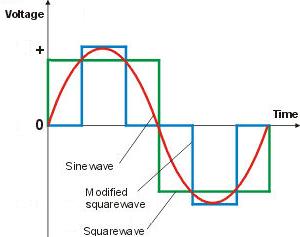
But a square wave is not a very good inverter waveform, even for the cheapest of the cheap. That's because a 50% duty-cycle square wave (green waveform) fails to have a √2 = 1.414 peak-to-rms ratio like a sine wave has. Circuits that work from the peak of the sine wave, like full-wave rectifiers, etc., need 165 to 170 volts peak, rather than 120 volts. And yet we need to also adhere to the 120-volt RMS rule (and double that for 220V systems). To achieve this cheaply, a "modified sine" 25 to 33% duty-cycle rectangular wave is often used (blue waveform). During part of the waveform, the output is zero.
As you can see, with a this type of waveform, you'll want a higher step-up ratio for your transformer. You can easily create the required driving waveform using 4000-series cmos logic chips, e.g., with an oscillator driving a 4017 counter with convenient decoded outputs. To set the number of states per cycle, you can loop one of the counter's decoded outputs back to its reset pin.
As tdesmit and others have said, unless if you want to learn by experimenting, you're better off with a purchased inverter. I would add, even if your purpose is for learning, you can learn a lot by tearing apart and reverse engineering a commercial design. Recommended.
As they are available over-the-counter for £30-45GBP including manufacturer's Warranty, why on earth make one <rhetorical question>?
__________________
"Did you get my e-mail?" - "The biggest problem in communication is the illusion that it has taken place" - George Bernard Shaw, 1856