Previous in Forum: China's Share in India's Engineering Business Will Affect World Trade   Next in Forum: A Brave Step To Curb China's Influence
Close
Close
Close
11 comments
Rate Comments: Nested
Guru
Engineering Fields - Nuclear Engineering - New Member

Join Date: Sep 2009
Location: Louisville, OH
Posts: 1925
Good Answers: 36

Theory of Error

11/15/2011 10:04 PM

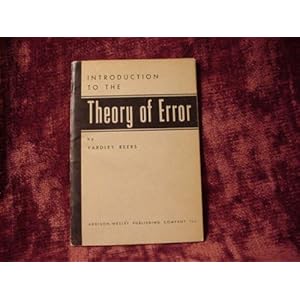
When I was in college, graduated 1961, we had a pamphlet named (by memory) Theory of Error written by (memory again) Yardley Beers. It gave information for when you had numbers of the form x +/- z and y +/- z added, multiplied, or divided together; what was the error of the result. (Not said very well!) I don't need that particular pamphlet (Can't find mine,) but does anyone know where I can find similar information?

Thanks.

__________________
Lehman57
Register to Reply
Interested in this topic? By joining CR4 you can "subscribe" to
this discussion and receive notification when new comments are added.

Good Answers:

These comments received enough positive votes to make them "good answers".

"Almost" Good Answers:

Check out these comments that don't yet have enough votes to be "official" good answers and, if you agree with them, vote them!
2
Guru
Technical Fields - Technical Writing - New Member Engineering Fields - Piping Design Engineering - New Member

Join Date: May 2009
Location: Richland, WA, USA
Posts: 21017
Good Answers: 795
#1

Re: Theory of Error

11/15/2011 10:52 PM

Looks like it is still available here. (Curious range of prices.)

__________________
In vino veritas; in cervisia carmen; in aqua E. coli.
Register to Reply Good Answer (Score 2)
2
Guru

Join Date: Mar 2007
Location: City of Light
Posts: 3943
Good Answers: 183
#2

Re: Theory of Error

11/16/2011 3:33 AM

It is called algebra of stochastic values. A value is defined by its mean (most probable value) and its standard deviation (in case of a normal Gauss distribution).

For sums or differences the mean of the result is the sum or difference of means and the standard deviation is the square root of the standard deviations squares sum:

x= (Xm;stdX) y=(Ym;stdY) → (x±y)= (Xm±Ym; (stdX^2+stdY^2)^0.5)

A constant is a value without a std only a mean since it is not chnaging its value.

For multiplications and divisions it is more complex.

x*y= (Xm*Ym;≈((Xm*stdY)^2+(Ym*stdX)^2)0.5)

x/y= (Xm/Ym;≈(((Xm*stdY)^2+(Ym*stdX)^2)^0.5/Ym^2)

The sign ≈ is present because the "exact" equation is more complex but for usual computations the other terms are of very low importance.

Register to Reply Good Answer (Score 2)
2
Guru

Join Date: Mar 2007
Location: by the beach in Florida
Posts: 33392
Good Answers: 1817
#3

Re: Theory of Error

11/16/2011 3:39 AM

$5 on amazon.... paperback....now if you want a signed first edition, well that's another story...

http://www.amazon.com/Introduction-Theory-Error-yardley-beers/dp/B0000CKA89/ref=tmm_pap_title_0

__________________
All living things seek to control their own destiny....this is the purpose of life
Register to Reply Good Answer (Score 2)
Guru
Engineering Fields - Nuclear Engineering - New Member

Join Date: Sep 2009
Location: Louisville, OH
Posts: 1925
Good Answers: 36
#5
In reply to #3

Re: Theory of Error

11/16/2011 10:17 PM

You guys are amazing (which I knew before!). A 54 year old memory of a book I got as a freshman in college, and I even get a photo of it! I'm going to check out Amazon, but the equations will be great until I can do that.

__________________
Lehman57
Register to Reply
Power-User

Join Date: Apr 2011
Posts: 100
Good Answers: 5
#7
In reply to #3

Re: Theory of Error

11/17/2011 8:52 AM

I tried your link.....not $5 any more! Even used copies are $19.95 plus shipping.

Register to Reply
Guru
Engineering Fields - Electrical Engineering - Been there, done that. Engineering Fields - Control Engineering - New Member

Join Date: Dec 2008
Location: Long Island NY
Posts: 15600
Good Answers: 981
#4

Re: Theory of Error

11/16/2011 5:22 PM

My reference on measurement theory was by D.C. Baird. I'm pleased to see that this little book is still in print. It has saved my career more than once when correcting irate experimenters that don't understand the subtle differences of measurement errors and their effect on analysis.

__________________
"Don't disturb my circles." translation of Archimedes last words
Register to Reply Score 1 for Good Answer
Guru

Join Date: Jun 2011
Location: Phnom Penh
Posts: 4019
Good Answers: 102
#6

Re: Theory of Error

11/17/2011 5:05 AM

I didn't learn from that book. It was spelled out to me and my cohorts in a book titled "The handling of experimental data" (or some such).

If data is added or subtracted then the component errors are added.

If multiplied or divided than the component percentage (proportional) errors are added.

With due consideration to the units of course.

__________________
Difficulty is not an obstacle it is merely an attribute.
Register to Reply Score 1 for Good Answer
Guru

Join Date: Mar 2007
Location: City of Light
Posts: 3943
Good Answers: 183
#9
In reply to #6

Re: Theory of Error

11/17/2011 9:22 AM

This is only valid when the probabilistic aspect of errors is NOT considered. This way one obtains extreme values which have low probability to appear but the procedure is simpler.

In fact one can use the definition of a function variation to obtain the equations:

d(F) = Σ (∂F/∂vi) dvi. F= function of variables vi where i is an index from 1 to n and ∂F/∂vi is the parial derivate according to variable vi.

Register to Reply
Guru

Join Date: Aug 2005
Location: Hemel Hempstead, UK
Posts: 5826
Good Answers: 322
#8

Re: Theory of Error

11/17/2011 9:18 AM

As an alternative to the "academic" approach:

Stick all the numbers and formulas in a spread sheet;
Create several copies of the work area;
Make each independent variable in the copies different from the original by the uncertainty;
Use your intuition/experiment to find out which combinations of positive and negative deviations lead to the biggest deviations in the final results.

__________________
If you spend all your time looking for people and things to complain about: trust me, you will find plenty to complain about.
Register to Reply Score 1 for Good Answer
Participant

Join Date: Jan 2011
Posts: 3
#10

Re: Theory of Error

11/17/2011 9:37 AM

Go to the NPL website www.npl.co.uk and search for 'uncertainties' and there are several links that will guide you through the process and how to set up an uncertainty budget.

The reference document (All the information that you need) is the Guide to Uncertainty in Measurement (GUM) that you can download free from BIPM http://www.bipm.org/en/publications/guides/gum.html . This will cover how to propagate uncertainties (your issue) and how to get to the confidence interval (say 95%) for your combined result. The document is fairly clear and shows you all the steps that you will need to go through.

The simplest way to approach uncertainty propagation in a function is to use a Taylor's expansion f(x+delta_x) is approximately f(x)+delta_x*d(f(x))/dx. From this u(f(x))=u(x)*|d(f(x))/dx|. All the terms combine in quadrature (u1^2+u2^2...) if your uncertainties are uncorrelated. If they are correlated it is a more advanced problem.

Register to Reply Score 1 for Good Answer
Power-User

Join Date: Aug 2010
Posts: 209
Good Answers: 8
#11

Re: Theory of Error

11/18/2011 3:45 PM

Let's not forget the engineer's best friend: actual field data. Many formulas are expressed in ideal form, like the ideal gas law, which can be related to pv=nRT, which is close but not wholly correct. If you heat a gas like air with combustion, you get different heat values based on starting temperature, pressure, composition et al. These are theoretical "errors". If you include these "errors" with measurement errors - all of them, including variable operator errors of the measuring equipment, you can wind up with better error data from just doing it. And if you do it right, its more fun. Isn't that why you became an engineer?

Register to Reply Off Topic (Score 6)
Register to Reply 11 comments

Good Answers:

These comments received enough positive votes to make them "good answers".

"Almost" Good Answers:

Check out these comments that don't yet have enough votes to be "official" good answers and, if you agree with them, vote them!
Copy to Clipboard

Users who posted comments:

Comms_metrologist_NPL (1); Lehman57 (1); nick name (2); pdef (1); Randall (1); redfred (1); SolarEagle (1); Tornado (1); Wal (1); woodpower (1)

Previous in Forum: China's Share in India's Engineering Business Will Affect World Trade   Next in Forum: A Brave Step To Curb China's Influence

Advertisement