Previous in Forum: RCD in TN-C Earthing System   Next in Forum: Restart of Motor After Stopping It
Close
Close
Close
23 comments
Rate Comments: Nested
Active Contributor

Join Date: Jun 2009
Location: Sri Lanka
Posts: 16

How to Test a Capacitor Without a Multimeter

07/13/2013 6:56 AM

I Just want to test a 250 Micro Farad Capacitor (440VAC) and need to use to 230VAC fan. when I connected the capacitor to the fan it is not starting. However, it was started when rotated manually. Therefore I need to check the capacitor whether it is healthy or defective.

Register to Reply
Interested in this topic? By joining CR4 you can "subscribe" to
this discussion and receive notification when new comments are added.

Good Answers:

These comments received enough positive votes to make them "good answers".

"Almost" Good Answers:

Check out these comments that don't yet have enough votes to be "official" good answers and, if you agree with them, vote them!
Guru
United States - Member - New Member

Join Date: Mar 2010
Location: In the pool because it is too hot.
Posts: 3054
Good Answers: 141
#1

Re: How to test a capacitor without a multimeter

07/13/2013 8:10 AM

If it is a simple capacitor without (built in) resistor, you can connect it to your 230 VAC. Just a short contact touch. The capacitor will take the real-time load and store it for a while. You can unload this to a conductor (touch e.g. metal with the connectors or wires and you will see and hear a spark when good)

On the 13, you can also touch the wires when disconnected. If your heart is weak, let your wife do it. Personally I feel more for unloading to metal.

When the spark is not there, or there is a discharge resistor or the capacitor is bad. They tend to dry out sometimes.

__________________
Plenty of room here
Register to Reply
Power-User

Join Date: Oct 2007
Location: S. California, USA
Posts: 279
Good Answers: 12
#14
In reply to #1

Re: How to test a capacitor without a multimeter

07/15/2013 12:17 PM

A capacitor connected to 230VAC 60 Hz may or may not be charged when disconnected from the power source. It is charged and discharged 120 times a second (60 with + polarity and 60 with the - polarity) and the voltage left on the capacitor depends on where in the AC cycle that it is disconnected.

Also, shorting a capacitor can damage it if there is not a resistor to limit the peak current. AC capacitors have both peak and RMS current ratings which should never be exceeded.

Register to Reply
Guru
United States - Member - New Member

Join Date: Mar 2010
Location: In the pool because it is too hot.
Posts: 3054
Good Answers: 141
#15
In reply to #14

Re: How to test a capacitor without a multimeter

07/15/2013 11:04 PM

The OP asked how to "without a multimeter". I think I gave an answer. It doesn't tell us the value of the capacitor - it just gives an idea that it takes "a" charge. You need to be very experienced and have done this test multiple times to "feel" the value or determine it by the sound the spark makes.

About the polarity change: not one is fast enough to not put a charge on the capacitor. and the probability to have 0 volts is statistically about nihil.

I beg you to disagree respectfully with your answer:

The capacitor has not its worst situation by loading or unloading the way I suggested. Practically in circuit it may have to deal with a real time reverse voltage/ and/or current when in service ( ON- OFF sequence can be worse)

Shortening the capacitor has also no destructive character because - try it - it sparks, meaning the energy flows. The person also reacts (and retracts) suddenly and sometimes doesn't even unload the capacitor completely.

Other than a battery, a 250 microfarad capacitor is not a high current source.

And when there is a resistor involved, this is parallel over the terminals, not in series. In this case the resistor, a relatively high value has discharged the capacitor already partially if not completely.

And people without a multimeter, probably and mostly have no specific capacitance meter. Thank you for the reply. D

__________________
Plenty of room here
Register to Reply
Guru

Join Date: Jul 2006
Location: CA (Central Arkansas, USA)
Posts: 599
Good Answers: 10
#16
In reply to #15

Re: How to test a capacitor without a multimeter

07/16/2013 9:04 AM

Your reply compared to Snave's is the difference between book learning and field experience. In the field you do what you have to. I've charged up and sparked many caps. At the supply house, guy's horsing around do it to as a joke to the person getting the cap. You certainly can, and often do get little spark, but if you repeat a few times, you will get a big one, too. -- JHF

__________________
If it's too good to be true, it probably isn't
Register to Reply
Guru

Join Date: Jun 2007
Posts: 1035
Good Answers: 40
#18
In reply to #16

Re: How to test a capacitor without a multimeter

07/16/2013 1:36 PM

I have to give an "Amen" to your post here. When I worked HERE (old post), we used a makeshift 'Load Bank' to limit the amount of current that could flow, through whatever we were testing. (Any point in 'reviving' an OLD Thread...?)

A single bulb would suffice for a "quik-chek" of capacitors ; a few 200W bulbs being screwed-in would get most "walk-in" motors (up to 2hp) spinning-up to speed.

The capacitors on (most) motors (most-all-applications) are specified with a given tolerance, yet the motor will perform satisfactorily with an even w-i-d-e-r tolerance. Thus (since a capacitor that is "going-bad" will tend to fail, altogether, fairly quikly), a rudimentary check such as you have 'sustained' will generally tell-the-tale as to whether the cap might be "THE" trouble.

Primary lessons learned at "this-old-job" revolved around the 'KISS' principle...

Del's (woodworking) talents would come-in very handy constructing some fine, electric motor "Dyna-Brakes" for testing start-up torque......(much like giant wooden 'nut-crackers')!

Register to Reply
Power-User

Join Date: Oct 2007
Location: S. California, USA
Posts: 279
Good Answers: 12
#19
In reply to #16

Re: How to test a capacitor without a multimeter

07/16/2013 5:21 PM

Gentlemen, I must kindly disagree that shorting a charged capacitor is a good test method.

I had my head in a control cabinet and not a book when a 1000v, 20ufd, 20A rms Cornell Dubilier capacitor blew and sprayed me with hot PCB oil.

I my head in a 400 kW motor drive cabinet when a 3" dia, 12" long electrolytic capacitor in a bank of 24 blew its top and bent the bus bar connecting the caps in parallel.

I had the habit when working on house wiring to apply a short to turn off a circuit breaker. It was a great time saver until one day when I found a CB that did not trip.

The above experiences, along with a few others, got my attention and encouraged me to open a book (look a the spec sheets) and discover that components do have maximum ratings and exceeding them has consequences.

Register to Reply
Guru

Join Date: Jun 2007
Posts: 1035
Good Answers: 40
#20
In reply to #19

Re: How to test a capacitor without a multimeter

07/16/2013 6:12 PM

Please , DO feel free to disagree (having EARNED the right to, by having forgotten your

MASKA , in that control cabinet...)

But whilest disagreeing, please recall that I don't believe ANYBODY HERE would suggest (and WE most certainly aren't) that one should sally forth into the field to test "the massive capacitors required for the Shadowsword's Volcano Cannon to fire", using a shorting-screwdriver...(!)

Nor would I or anyone else suggest taking a 3-ft crowbar up on a ladder to check out this condensor bank...!

The Title of this thread is:
How to Test a Capacitor Without a Multimeter, and the OP (if he ever comes back)
"Just want to test a 250 Micro Farad Capacitor (440VAC)" for a ... ("ahem") "fan"... of what sort we will probably never know....

If E-V-E-R-Y thread in the forum had to be appended with *ALL* the usual disclaimers (such as the obvious: "Don't forget to wear suitable gloves and eye protection, lest the worst-case scenario should result from your otherwise improper actions"), then, we'd ALL tire of browsing-around and chiming-in when we feel that we have something to offer.

Your sharing of your experiences is received with 'thanks'... (I, for one, WILL remember hard-hat/face-shield etc next time I am sticking *my* neck into a 400 kW motor drive cabinet ... ). And (if I can ever stop laughing), I'll remember to NEVER try to trip a breaker by "crossing two butterknives in a receptacle"...

"Peace" ~ !

Register to Reply
Guru
Hobbies - Fishing - New Member

Join Date: Jun 2008
Location: Raleigh, NC USA
Posts: 13529
Good Answers: 468
#2

Re: How to test a capacitor without a multimeter

07/13/2013 9:09 AM

If I'm having a similar problem, and everything else looks good, I buy a new capacitor.

Most of them are garbage these days. Don't expect a long life; in fact, you may want to buy two of them so you have a backup.

I like the idea of having my wife check them; I hate getting shocked.

__________________
Those who would give up essential Liberty, to purchase a little temporary Safety, deserve neither Liberty nor Safety. Ben Franklin
Register to Reply
Associate

Join Date: Apr 2009
Location: Australia
Posts: 54
Good Answers: 5
#6
In reply to #2

Re: How to test a capacitor without a multimeter

07/13/2013 10:47 PM

Sure, for us it is chicken feed to buy a new capacitor, or to spend a little bit of time to find one of the 6 multimeters that we have lost around the workshop somewhere. Or just buy yet another one.

In Sri Lanka, it's gunna be a bit different. The OP has no multimeter and the idea of buying one apparently has not entered his/her head.

__________________
Frankston
Register to Reply Score 1 for Good Answer
Guru
United Kingdom - Member - Indeterminate Engineering Fields - Control Engineering - New Member

Join Date: Jan 2007
Location: In the bothy, 7 chains down the line from Dodman's Lane level crossing, in the nation formerly known as Great Britain. Kettle's on.
Posts: 32175
Good Answers: 839
#10
In reply to #6

Re: How to test a capacitor without a multimeter

07/15/2013 3:47 AM

It would seem that the concept of checking the start contact that energises said capacitor during run-up has not surfaced either...

__________________
"Did you get my e-mail?" - "The biggest problem in communication is the illusion that it has taken place" - George Bernard Shaw, 1856
Register to Reply
Guru

Join Date: Mar 2007
Location: by the beach in Florida
Posts: 33392
Good Answers: 1817
#3

Re: How to Test a Capacitor Without a Multimeter

07/13/2013 11:55 AM

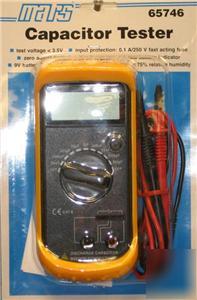
You need a capacitor tester....without the proper test equipment you will be unable to determine the capacitance....and yes I've seen plenty of weak new ones...that being said start caps usually have a visible sign of failure, either leaking or top blown off or loose top.....

__________________
All living things seek to control their own destiny....this is the purpose of life
Register to Reply
Guru

Join Date: Oct 2008
Posts: 42355
Good Answers: 1693
#4

Re: How to Test a Capacitor Without a Multimeter

07/13/2013 12:31 PM

Digi-Key

Register to Reply
Guru

Join Date: Feb 2011
Posts: 7025
Good Answers: 207
#5

Re: How to Test a Capacitor Without a Multimeter

07/13/2013 5:43 PM
Register to Reply Score 1 for Off Topic
Guru

Join Date: Jun 2007
Posts: 1035
Good Answers: 40
#17
In reply to #5

Re: How to Test a Capacitor Without a Multimeter

07/16/2013 10:30 AM

In 're-visiting' (to read the last couple of posts), not only am I perplexed that alnashadh has not bothered to return and help to unravel the ENIGMA which his OP displayed...

...but (with no apologies today) I had to rate the youtube.vid as "OT". Why?

The thread Title = How to Test a Capacitor Without a Multimeter.

First words on the video: "We're just gonna go through a little process to show how you can determine if a capacitor is serviceable or not, using a multimeter..."

[ Along the same rationale, for-what-it's-worth (to repeat), I qualify my own previous post as being not "OT" because it emphasizes the conundrum that the OP displays...!

'Regulars' here (CR4) would serve the community VERY WELL , to begin answering "Simple Questions" (WHENEVER appropriate*) with a series of questions probing for more depth-and-detail.

*(?) Unsure as to whether it might be appropriate to respond with a few 'probing questions'...? Look-over a few examples, as provided by 1st-responses here, and here, and here ("Thanks, lyn", for providing those...) and ask yourself whenever reading an "OP": does this leave ANY ambiguity in 'translation'? Reviewing the stats, I'm willing to stick my neck out and state that if the Poster's ID is 'Anonymous', then questions abound! ]

Register to Reply
3
Commentator

Join Date: Jul 2010
Location: North West Province, South Africa
Posts: 67
Good Answers: 18
#7

Re: How to Test a Capacitor Without a Multimeter

07/14/2013 5:17 AM

Hi Alnashadh,

On the presumption that the wiring is ok and it is just the capacitor that is suspect I would suggest you carry out the following:

a) Spin the fan in one direction and then switch on the the power. Switch off the power.

b) After the fan has stopped, spin the fan in the opposite direction and then switch on the power.

If the fan continues running in both directions then the capacitor is faulty!

Hope this helps you,

Regards, Keith

__________________
A little knowledge that acts is worth infinitely more than much knowledge which is idle! Khalil Gibran
Register to Reply Good Answer (Score 3)
Power-User
Belgium - Member - New Member

Join Date: May 2007
Location: Flanders (Belgium)
Posts: 343
Good Answers: 21
#9
In reply to #7

Re: How to Test a Capacitor Without a Multimeter

07/15/2013 3:26 AM

What will happen if the auxilary (or starting) winding is broken and the capacitor is still good ?

Register to Reply
Guru

Join Date: Jul 2006
Location: CA (Central Arkansas, USA)
Posts: 599
Good Answers: 10
#12
In reply to #7

Re: How to Test a Capacitor Without a Multimeter

07/15/2013 9:42 AM

That still does not tell if the start switch or relay is working. -- JHF

__________________
If it's too good to be true, it probably isn't
Register to Reply
Power-User
Belgium - Member - New Member

Join Date: May 2007
Location: Flanders (Belgium)
Posts: 343
Good Answers: 21
#8

Re: How to Test a Capacitor Without a Multimeter

07/14/2013 2:59 PM

To control your capacitor you can do it this way. It works only with a capacitor for continuous duty NOT FOR START CAPACITOR

  • You need a 230 or 115 Volt 50 or 60 Hz power supply
  • You need a AC current meter, multi-meter that can measure AC current, or a current clamp.
  • You need a capacitor which is suspicious, but you can still read the capacitor value ex 250µF 440V

Explanation :

  • Ohms law for AC signals _ _ _ _ _ _ _ _ U = Z x I _ _ _ _ _ _ _ _ _ _ _ _ [V = Ω x A ] _ _ _ _ _(1)
  • Impedance of an ideal capacitor _ _ _ _ Xc = 1/(2 x π x f x C) _ _ _ _ _ [Ω= Hz-1 x F-1] _ _ _ (2)

Combination of (1) and (2) gives : _ _ _ _ _ _ I = U x 2 x π x f x C

.

.

If you are in Europe and have 50Hz 230V supply

  • I = 230 x 2 x 3.1415 x 50 x C
  • I = 72254 x C

A capacitor with capacity X farad equals to 0.000 0001 times the capacity X expressed in micro farad

  • I = 0.072254 x C
  • I = +/- 0.07 x C

This means if I connect a capacitor to the mains supply and measure the current, I can calculate the capacitor value, by multiplying the current value with 0.07

.

.

If you are in the USA and have 60Hz 115V supply

  • I = 115 x 2 x 3.1415 x 60 x 0.000 0001 x C
  • I = 0.04335 x C
  • I = +/- 0.04 x C

This means if I connect a capacitor to the mains supply and measure the current, I can calculate the capacitor value, by multiplying the current value with 0.04

.

.

Examples :

  • On a 230V 50Hz supply a 10 µF capacitor will take a current +/- 0.07 x 10 = 0.7 Amp
  • On a 115V 60Hz supply a 80 µF capacitor will take a current +/- 0.04 x 80 = 3.2 Amp
  • On a 230V 50Hz supply a 250 µF capacitor will take a current +/- 0.07 x 250 = 17.5 Amp

Warning :

  • Keep in mind that a bad capacitor might explode, when connected to a power supply.
  • Keep in mind that a START capacitor just may used a fraction of a second and will explode if it stays connected to the supply.
Register to Reply Score 1 for Good Answer
Guru

Join Date: Feb 2012
Posts: 595
#11

Re: How to Test a Capacitor Without a Multimeter

07/15/2013 5:56 AM

no matter the voltage rating i usually test above 1µF capacitors with multimetes ohm-meter - the procedure - ("unload" Hi-Voltage cap through ~230VAC incandescent light bulb) , load it /=+>→[+]╫[-]←<-=/ at 20k to 0.2k range .. (depending on meter (start from 200Ωrange)) .. the meter will show some resistance fading from ±Max to [1. _ _ Ω] (infinity) during about the second range reverse polarity /=+>→[-]╫[+]←<-=/ and it should fade to infinity again repeat with reversals -- if at any time it fails to reach the infinity -- there's likely something "not so" (as it should)

the electrolytic's have a nasty property of being able to store capacities at 1 polarity while (when becoming bad) they start curent-leak at reverse

__________________
ci139
Register to Reply
Guru

Join Date: Jun 2007
Posts: 1035
Good Answers: 40
#13

Re: How to Test a Capacitor Without a Multimeter

07/15/2013 10:22 AM

Aarrrgghhh! ... this thread TOO has taken-off like an LSD trip through a smokey maze! (just as too many others!)

The OP says: "I Just want to test a 250 Micro Farad Capacitor (440VAC) and need to use to 230VAC fan...."

He insinuates a "fan-duty" motor, but, as far as we know, his "fan duty" might be a belt-driven squirrel-cage blower*!

*(i.e., the old language barrier thing; like the difference between an American 'billionaire' and his counterpart in the UK...! It ain't JUST the difference between the 'units' ... but, there's a difference of 3 zeros!!!)

The cap that he wants to 'test' is 250 μfd (440vac).

That ain't your typical "fan-duty" cap for a "capacitor-run" / "fan-duty" motor.

Forgive me, but 'pw' I believe BEGAN to acknowledge the possibility of "omissions" in the OP's request for assistance. [Another "likewise" gave some instructions that "assumed" a different "track". Meaning, testing whether the "Run" windings on a motor are "good" by being able to start a motor {manually} in EITHER Direction works fine for split-phase cap-start motors....

...but, a ("typical-fan-duty") "Capacitor-Run" motor has the ("low-μfd-rated") capacitor in series with the start winding, "always-and-forever-energized" from turn-on to shut-down. Thus, the "manual-spin-start" (in either direction) says 'something different' from the results of testing a split-phase motor having a start cap in series with the start windings (and a switch or relay to kick them out).]

Let's IMPLORE the OP to INSURE we are on the RIGHT TRACK HERE, before going any further, PLEASE...!

Either a decent photo-or-two , or NAMEPLATE Data, or something additional, besides the ENIGMA with which this thread has begun...

Register to Reply
Commentator
India - Member - New Member Engineering Fields - Electrical Engineering - New Member

Join Date: Feb 2012
Location: Krishnagiri, Tamilnadu, India
Posts: 61
#21

Re: How to Test a Capacitor Without a Multimeter

07/18/2013 1:46 PM

Just connect those two ends of the capacitor to a single phase supply and switch it ON for a few seconds. Then take that two terminal and short it, you will get a spark. And so you can somewhat assume that your capacitor is in good condition.

__________________
All is well !!! All is well !!
Register to Reply
Guru
Hobbies - CNC - New Member

Join Date: Jul 2013
Location: Lost Wages Nevada
Posts: 1578
Good Answers: 55
#22

Re: How to Test a Capacitor Without a Multimeter

07/24/2013 6:59 PM

I'm sure you just did the most definitive test there is without a multimeter. if the fan started when spun by hand then the CAP is bad. Replace it!

__________________
Though it does seem he frequently has a Swiss Army knife or Leatherman and a roll of duct tape with him.
Register to Reply Score 1 for Off Topic
Power-User

Join Date: Feb 2009
Posts: 176
Good Answers: 6
#23

Re: How to Test a Capacitor Without a Multimeter

08/18/2013 4:57 AM

The only way I know to test a capacitor in this situation with out the appropriate meter is to find the same motor known to work with it's capacitor of the same size & replace it's capacitor with the capacitor that I wish to test. If it works it is healthy if it does not then it is defective. Do it the other way around if you want to test the rest of the motor, put the capacitor known to work from other motor into your motor to test.

Register to Reply
Register to Reply 23 comments

Good Answers:

These comments received enough positive votes to make them "good answers".

"Almost" Good Answers:

Check out these comments that don't yet have enough votes to be "official" good answers and, if you agree with them, vote them!
Copy to Clipboard

Users who posted comments:

bharath boss (1); brettj1au (1); ci139 (1); Circuit Breaker (2); dvmdsc (2); Frankston (1); Fredski (1); Keith Grewar (1); kramarat (1); lyn (1); ndt-tom (4); Original_Macgyver (1); PWSlack (1); rudy.leurs (2); Snave (2); SolarEagle (1)

Previous in Forum: RCD in TN-C Earthing System   Next in Forum: Restart of Motor After Stopping It

Advertisement