Previous in Forum: SCR Bay Repair   Next in Forum: 33 KV/ 110 V Solar Power Station Question
Close
Close
Close
24 comments
Rate Comments: Nested
Power-User

Join Date: Jan 2011
Location: Scotland
Posts: 361

Really Confused About Mosfet Current Limits

12/11/2013 2:15 AM

I am sure I asked this before but it somehow disappeared.

I have bought a 3 phase bike controller which I plan to modify by replacing all the mosfets with IRFB4110. This mosfet can take 100V at 120A with a pulsed drain current of 670A. Why on earth then, is a controller that uses 12 of them, that's 4 to a phase limited to only 40 amps? Why is it not a 1440 amp controller?

Said controller can be found here: http://em3ev.com/store/index.php?route=product/product&product_id=82

The controller I bought most likely has 2 mosfets to a phase.

Register to Reply
Pathfinder Tags: irfb4110 electric bike
Interested in this topic? By joining CR4 you can "subscribe" to
this discussion and receive notification when new comments are added.

Good Answers:

These comments received enough positive votes to make them "good answers".
Guru
Engineering Fields - Electrical Engineering - Analog and Digital Circuit Design Engineering Fields - Electromechanical Engineering - Transformers, Motors & Drives, EM Launchers Engineering Fields - Engineering Physics - Applied Electrical, Optical, and Mechanical

Join Date: Jan 2008
Location: NY
Posts: 1207
Good Answers: 119
#1

Re: Really confused about mosfet current limits.

12/11/2013 7:11 AM

EVERYTHING in the battery/controller/motor path needs to be UPSIZED to handle higher current. The little plastic transistor package and tiny wires pictured will not handle continuous current above what the "controller" manufacturer specifies.

Read the FET data sheet carefully and you will see additional time and temperature limits that make the "ideal" 120A continuous drain current per FET possible only with infinite heat sink conditions.

I suspect 6 FETs may used in a 3ph drive bridge and the other 6 FETs may be a 3ph regen bridge for braking. Even if FETs are paired in a single bridge for current/power-dissipation sharing, no sane Engineer would design a circuit using critical components AT their rated limits.

Take a look at stock 1000 Amp motor controllers; their SIZE, COST, and massive copper LUGS for connecting #0000 gauge welding cable! You can try to modify your stock controller, and you may get "some" improved performance. However, I'd bet you'll be sacrificing some other performance factors (duty cycle, reliability, etc.). If the 40 AMP controller you purchased is not big enough for your application, I suggest you buy one that meets your specifications.

Register to Reply
Power-User

Join Date: Jan 2011
Location: Scotland
Posts: 361
#6
In reply to #1

Re: Really confused about mosfet current limits.

12/11/2013 2:44 PM

Replacing the mosfets in cheap Chinese controllers is quite common from what I have seen. When I perform the modification, the PCB traces will be thickened using thick stripped copper wire.

Register to Reply
10
Power-User

Join Date: May 2010
Location: Cambridge, MA
Posts: 390
Good Answers: 82
#2

Re: Really confused about mosfet current limits.

12/11/2013 8:41 AM

Yep, the IRFB4110 is an impressive part, and not very expensive either, $3.22 qty 25 at Digi-Key. Why is the EM3ev model 12F4110 motor controller rated at only 40A? Because they don't want it to burn out! The manufacturer's datasheet highlighted maximum-current ratings are only theoretical values, meant to compare different MOSFETs under a conceptual paper-only ideal theoretical condition. It's not possible to actually use the MOSFETs at those currents. Let's explore why.

Calculating maximum MOSFET operating currents.

The IRFB4110 FET's datasheet shows an impressive on-resistance RDS(on) = 4.5 milli-ohms, maximum, with the junction temperature at TJ= 25°C. The manufacturer's datasheet maximum current value is calculated as follows: First we'll let the junction heat up to TJ= 175°C, while keeping the case at TC= 25°C.

If we calculate P = ΔT / RΘ using the temperature difference ΔT = TJ - TC= 150°C and the junction-to-case thermal resistance RΘJC = 0.4 °C/W, we get Pmax = 150°C / 0.4°C/W = 375 watts. Note the datasheet says 370W. Next we look at the MOSFET's on-resistance, but at the 175°C junction temperature. With the junction temperature at TJ= 25°C, the FET's on-resistance RDS(on) is 4.5 milli-ohms max. But the datasheet graph Figure 4 tells us to multiply by 2.5 for 175°C, so now we have RDS(on) = 11.25 milliohms.

We know that power dissipation P = I2 R, and I = sqrt (P/R). So we can calculate the MOSFET's theoretical maximum current I = sqrt (375/0.01125) = 182 amps. The datasheet says 180A. You can see that these are calculated rather than measured values.

But please note that these are impossible values, because it's not possible in the real world to keep the case at 25°C. Even if we could keep the heatsink at 25°C, which we can't, the case will be hotter because of its imperfect thermal connection to the heatsink; the datasheet suggests using RΘCS = 0.5 °C/W. This gives us a new P = ΔT / RΘ = 150°C / (0.4 + 0.5°C/W) = 167 watts.

Now just wait a minute, we're not done yet. If we want our MOSFET to survive for long, we won't run its junction right at the absolute-maximum limit of 175°C, we'll pick a more sensible temperature like TJ= 125°C. We'll also assume the heatsink gets pretty hot, at least right at the point where it's contacting the MOSFET, let's allow it to get to TS= 75°C (to keep it that low we'll need a fan). Now our maximum operating power-dissipation value, P = ΔT / RΘ = 50°C / (0.4 + 0.5°C/W) = 55 watts. Hah, compare that to the datasheet's 370W value!

We can recalculate a maximum switch current, I = sqrt (P/R) = sqrt (55/0.01125) = 69 amps. But oops, this assumes a total resistance of 11.25 milliohms, which may be true for a Kelvin measurement right at the MOSFET's terminals, but in the real world we have copper wiring and PCB resistances heating up, and that has to be cooled through the MOSFET's leads, case and heatsink connections as well. So maybe we'd better derate our 69 amps a little bit, say by 25% to 50 amps. That'll allow us to have 2.5 milliohms of wiring resistance.

OK, now we can consider evaluating the EM3ev 12F4110 controller. This beast uses pulse-width modulation to control a motor, so in addition to simple ohmic conduction losses, it has switching losses to consider. These can be serious at 40 amps. What's more, in an outdoor product environment they probably do not want to use a fan on their heatsink. Hmm, now we begin to wonder if their 40 amp rating is quite a bit on the optimistic side? Hey, maybe that's why they use two MOSFETs per switch? And we note that the 40A rating is for their safety current-limit value, and presumably not for any standard continuous operating condition.

__________________
Thanks, Win
Register to Reply Good Answer (Score 10)
Guru

Join Date: Mar 2007
Location: by the beach in Florida
Posts: 33392
Good Answers: 1817
#3
In reply to #2

Re: Really confused about mosfet current limits.

12/11/2013 10:59 AM

Great explanation.....thank you

__________________
All living things seek to control their own destiny....this is the purpose of life
Register to Reply
Power-User

Join Date: Jan 2011
Location: Scotland
Posts: 361
#4
In reply to #2

Re: Really confused about mosfet current limits.

12/11/2013 11:17 AM

That was nothing short of awesome for an explanation. Great. I suppose to get 100 amps out of an irfb4110 it would probably need liquid nitrogen to cool it. I have bought 16 of them. I will make sure I use at least 4 for the high power desulfator I plan to make. I will then replace the 9 mosfets in my 800w controller and will have to thicken the PCB traces and current shunt.

Register to Reply
Guru
Hobbies - Musician - New Member Greece - Member - New Member

Join Date: Mar 2007
Location: Greece / Athens
Posts: 722
Good Answers: 28
#7
In reply to #2

Re: Really confused about mosfet current limits.

12/12/2013 4:23 AM

Nice explanation, Mr. Hill. It shows how much the real value for P and I can differ from the theoretical-ideal value (as given in the datasheet).

__________________
George
Register to Reply
Guru

Join Date: Feb 2011
Posts: 7025
Good Answers: 207
#11
In reply to #2

Re: Really confused about mosfet current limits.

12/13/2013 2:21 PM

can ya be a bit more precise?

Register to Reply
Guru

Join Date: Jun 2013
Location: Central Canada
Posts: 677
Good Answers: 28
#5

Re: Really Confused About Mosfet Current Limits

12/11/2013 12:16 PM

My best GUESS would be super redundancy. The over rating of the devices gives a very good fault tolerance; and if a failure-open should occur in one device there are several in parallel to continue operations. Multiple paths allow each device to be somewhat protected by the others, so the entire path should be super robust. I would not be confident with a unit in a power control application that operated anywhere near rated current of the devices.

__________________
Smart as a post and twice as fast.
Register to Reply
Guru

Join Date: Sep 2007
Location: East Texas
Posts: 1439
Good Answers: 31
#8

Re: Really Confused About Mosfet Current Limits

12/13/2013 1:22 AM

Hydrogen Head:

I have been in communication with several Chinese Engineers over the past several years regarding regenerative capable transportation processes.

My most recent interest has been a Regenerative Capable Human/Electric Full Hybrid Bicycle; which I see a the most elegant challenge in regenerative capable transportation systems.

There has been a little discussion here on CR4.

When I look at super capacitance I see an enabling technology.

Regeneration at high efficiency requires a storage device of very high power in acceptance.

An example: a 150 kg system (fat guy like me and my bike) braking to a stop on a grade would have to accept power at a rate that would approximate .5m(D v^2) + mg(D h)/t where t is the braking time.

For the 150 kg system, storing the braking energy from 30 m/s in 5 second would require about .5*150*30*30/5 or 13.5 KW. That's a ton of power.

I would probably not feel comfortable with a system that had more than 24 volts of electrical potential. This puts the peak repeatable ampere rating at 13500/24 = 562.5 ampere !!!!!

Its obvious to me that existing technology for my high efficiency regenerative panic braking isn't there yet; but you know what? If I could regenerate just half of the energy I spend braking for the stop lights and stop signs in an urban environment I would be happy as a hot pig in a cool wallar.

The direction I have seen here on CR4 is regenerative braking isn't worth the mass and expense . But I've ridden in an urban environment, and to follow the rules you have to dump significant energy in braking getting to the store and back at best speed.

If those motors can regenerate then you could possibly use Maxwell Super Caps as your storage device.

When I look at a "Buck Circuit" I see a resonant circuit where the power throughput, and therefore power acceptance, should be controllable by frequency modulation; this translating to - impedance control. This would seem to be an inherently efficient control method because I believe only the resistive component of impedance contributes to thermal losses.

One of the folks I have been in communication with says a 1KW Buck Circuit is possible. If I could regenerate at half that I would be a happy rider - anticipating my stops and timing the lights the best I could.

__________________
"The greater danger for most of us lies not in setting our aim too high and falling short; but in setting our aim too low, and achieving our mark." -- Michelangelo
Register to Reply
Guru

Join Date: Sep 2007
Location: East Texas
Posts: 1439
Good Answers: 31
#9
In reply to #8

Re: Really Confused About Mosfet Current Limits

12/13/2013 1:52 AM

Duhhh --- I guess nearly 70 mph is a bit fast for a bicycle; but you get the picture.

Lets try 15 m/s.

Braking from 15 m/s to a stop in 5 seconds for a 150 kg system -- about 3.375 KW --- about 140 amps with a 24 volt system.

Gee -- fat guy on a bicycle regenerating significant brake energy in a panic stop looks possible?

__________________
"The greater danger for most of us lies not in setting our aim too high and falling short; but in setting our aim too low, and achieving our mark." -- Michelangelo
Register to Reply
Power-User

Join Date: May 2010
Location: Cambridge, MA
Posts: 390
Good Answers: 82
#10
In reply to #8

Re: Really Confused About Mosfet Current Limits

12/13/2013 7:28 AM

You have opened a fascinating area to explore. Let me comment about the technologies involved with the EM3ev 12F4110 and similar controllers. Safe steady current ratings for MOSFET switches are much lower than the impressive datasheet peak values, as I showed, but the short-term current capabilities are much higher. That's because this is calculated using short-term thermal-mass parameters rather than the long-term thermal resistances. Two IRFB4110 MOSFETs could easily handle 280A currents (in a 50V system) for a few seconds. EM3ev doesn't offer peak-current information on their web page, but unless they've added fast active current sensing and limiting, it should be dramatically higher than their 40A continuous spec, at least for a few seconds.

My intuition is that a capable battery is a better choice than a super capacitor to accept momentarily-high peak currents. That's because instead of charging to an excessive voltage, a battery can accept the high charge without the voltage climbing unreasonably. EM3ev offer some serious batteries, such as their 50V 18.5Ahr Samsung triangle pack ($725). Again they don't offer short-term peak ratings, but I'm sure measurements will show that these cells can handle very high currents for a brief time without overheating. Their specs are for continuous charge (12A max) and full 90% -10% charge-discharge cycles, etc., BMS limited, etc.

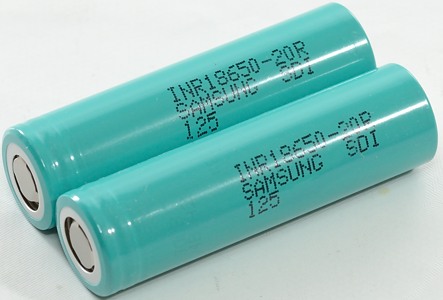
EM3ev also offers these packs made with the Samsung Li-ion "High Power cell, the INR18650-20R. This is an NCA type cell, 10C rated with Capacity of approximately 1.95Ah" and 7 W-hr, just add $180. :-) That's a 20A charge rating. The cells have a low internal resistance of 15 milliohms, which means a 30A peak current adds/subtracts only 0.45 volts, as these curves and these curves show. A 14-cell 50V stack would deviate by 6V at 30A for the stack.

I think they use nine stacks in parallel, which implies a 270A peak-current capability, at 30A/stack. That would be with an appropriate battery-management system (their standard BMS is rated at 40A or 80A, but I see they offer one rated at 120A continuous, 320A peak, for $150).

There is an issue that's been overlooked in these simple discussions, and that's the difference between AC peak voltages and currents compared to the 30% lower RMS values. A carefully-engineered system might well use super capacitors to help reduce the very high AC peak currents handled by the MOSFET inverters down to lower DC peak currents for the Li-ion battery electronics.

One other issue we've overlooked is safety. A battery with over 120 high-capacity Li-ion cells can be a dangerous beast, capable of generating a very high-temperature fire. A safe truly battery-management system would have a separate regulator and disconnect for each cell in the battery pack (as opposed to one regulator per stack as is common). Several make IC manufacturers make ICs meant to handle this task, such as the LTC6801. This is a topic we highlight in our new book, but that's another story.

__________________
Thanks, Win
Register to Reply
Guru

Join Date: Sep 2007
Location: East Texas
Posts: 1439
Good Answers: 31
#12
In reply to #10

Re: Really Confused About Mosfet Current Limits

12/13/2013 2:48 PM

Thanks Win;

Its wonderful to have access to someone with your knowledge base and is greatly appreciated by me and I am sure many others.

How do the batteries stand up to the super caps in terms of charge/discharge life cycle? In a very high performance regenerative capable transportation power process the storage unit could expect a cycle depth of about 25 percent at each stop and go cycle. During heavy grading this is anticipated to be closer to 90 percent of cycle depth.

In such cycling; how does a battery compare to a capacitor in terms of life span?

__________________
"The greater danger for most of us lies not in setting our aim too high and falling short; but in setting our aim too low, and achieving our mark." -- Michelangelo
Register to Reply
Power-User

Join Date: May 2010
Location: Cambridge, MA
Posts: 390
Good Answers: 82
#13
In reply to #12

Re: Really Confused About Mosfet Current Limits

12/13/2013 3:35 PM

Good question. Charge-discharge cycles are typically measured with large changes in the battery's stored energy, e.g., a spec may take the battery from 90% of full charge down to 10% and back, etc. That might yield a modest spec of only 1000 cycles. But we expect a much longer life for smaller cycle depths. My Prius battery can probably handle 5000 to 10000 cycles.

I'd imagine it'd be wise to use a large enough battery so stop and go cycles make smaller changes, like 5 or 10%. It's interesting to think about an occasional big charge down a long grade, that would be like one of the daily trip charging events. To capture most of the energy one would have to insure being nearly empty at the top of the grade!

__________________
Thanks, Win
Register to Reply
Guru

Join Date: Sep 2007
Location: East Texas
Posts: 1439
Good Answers: 31
#14
In reply to #13

Re: Really Confused About Mosfet Current Limits

12/13/2013 7:36 PM

Win;

"To capture most of the energy one would have to insure being nearly empty at the top of the grade!" - or while traveling at best speed.

Yes indeed. That's why the control algorithm in a power averaged process would compare the sum of Kinetic, Stored energy, and an arbitrary gravitational potential to a program constant - ensuring adequate storage is available as well as reserving stored energy for grading and acceleration while at the same time optimizing power output throughout the entire transportation cycle.

__________________
"The greater danger for most of us lies not in setting our aim too high and falling short; but in setting our aim too low, and achieving our mark." -- Michelangelo
Register to Reply
Power-User

Join Date: Jan 2011
Location: Scotland
Posts: 361
#15

Re: Really Confused About Mosfet Current Limits

12/14/2013 8:37 AM

I have successfully replaced all the mosfets in the controller. There was actually 12 of them. I thickened the current shunt and the bike accelerates much faster. The connectors and wires to the motor now get quite warm. The controller only gets a little warm. I will add some interesting pictures later.

As for regenerative, I am working on a system which uses a boost converter that boosts the voltage from the freewheeling motor up to 42v for my 10s lipo battery. I have to use a 3 phase bridge rectifier on the motor to get DC. I did a trial run with just the boost converter alone and it made the bike very difficult to pedal because of all the power going back into the battery. I need to find a spdt switch that can handle 40 amps so I can switch between the regen module and controller. The regen will not be variable, it will be full on or off.

Register to Reply
Guru

Join Date: Sep 2007
Location: East Texas
Posts: 1439
Good Answers: 31
#16
In reply to #15

Re: Really Confused About Mosfet Current Limits

12/14/2013 11:40 AM

Very cool stuff. I wish I were nearby so I could see your work.

How rapidly can your battery accept power?

Its too bad about the regen not being variable. Perhaps someday you will be able to modify it?

Why could multiple high power transistors operating in parallel not be used as a 40 amp switch?

Have you considered using a "Buck Circuit" as a controller?

Would it be possible to use the AC output of the motor during regen to pump a "Buck Circuit" - (or convert to a fixed input frequency) and vary the circuit throughput by using variable capacitance in the Buck Circuit? ( Or fixing the Buck resonant frequency and altering input frequency)? Where variable capacitance is used to "tune" the Buck (or input) to match resonance at max braking? The circuit acceptance (1/impedance) could be varied by varying the control capacitance translating to variable control of braking?

The same controller could possible be used for both power and regen by switching the supply leads and output leads?

You are into some exciting stuff my friend - wish I could participate!!!

__________________
"The greater danger for most of us lies not in setting our aim too high and falling short; but in setting our aim too low, and achieving our mark." -- Michelangelo
Register to Reply
Power-User

Join Date: Jan 2011
Location: Scotland
Posts: 361
#17
In reply to #16

Re: Really Confused About Mosfet Current Limits

12/14/2013 2:17 PM

The batteries I am using are Turnigy lithium polymer batteries. They can accept a charge at 2c maximum so in my case the battery is a 23.6Ah 37v battery. It could accept a maximum current of 47.2 amps for charging. As for buck circuits, I am not that far into things yet.

Register to Reply
Guru

Join Date: Sep 2007
Location: East Texas
Posts: 1439
Good Answers: 31
#18
In reply to #17

Re: Really Confused About Mosfet Current Limits

12/14/2013 11:31 PM

Hydrogenhead:

"As for buck circuits, I am not that far into things yet." -

You are definitely a doer; I hope you keep us informed as to your progress in exploring motor/regeneration methodologies.

I have nearly completed a little pencil thingy I will call "O.P. Art - Sheet III" - dealing with Hybrid Bicycles - Probably not technically astute; but hopefully gets the picture across.

When I get it done I am going to try to resurrect this -

http://cr4.globalspec.com/thread/80026 - "Building a Regenerative Capable Bicycle."

I think its a fun topic and the folks here have a HUGE knowledge base - some share what they know; but there is also no shortage of Zombie Geeks ready to eat your brain if you wander too far outside vetted principles. In both cases it keeps me on the learning curve.

"O.P. Art Sheet III" will be on the order of what is shown below; but showing a bicycle using a generator at the crank and a motor/generator in the rear hub. I am almost done - kind of 5th gradeish but it explains things much more quickly than I can in a written post alone. This is something using the same format - "O.P. Art - Sheet II." - but a different technology application.

http://cr4.globalspec.com/thread/51026#comment880377 - post #10

It is explained in the lead in post.

If feasible; hopefully some doer from North America will run off with them.

Anyway - what you are doing is cool stuff !!!

I really think that a single optimized motor/generator design could provide generation, simultaneously with motoring or regeneration.

I imagine a control and storage device in a plug in back pack for security as well as coolness. You walk out to your bike, plug in you back pack - which also charges your communication and music - and blow out of the parking lot as you start inputting average transportation cycle power into the system.

Yes my friend - IMHO - that would be elegantly applied transportation technology!!!!

__________________
"The greater danger for most of us lies not in setting our aim too high and falling short; but in setting our aim too low, and achieving our mark." -- Michelangelo
Register to Reply
Power-User

Join Date: Jan 2011
Location: Scotland
Posts: 361
#19
In reply to #18

Re: Really Confused About Mosfet Current Limits

12/15/2013 6:22 AM

I like the idea of a plug in power and control backpack. The problem is, 10 Turnigy 5000 5s lipos are quite heavy. It is not ideal to be carrying much weight on your back while cycling. It would be brilliant if I could make panniers out of aluminium and put a lock on them. My panniers I have now are just zip up bags which will eventually burst with the weight of batteries bouncing round inside.

Register to Reply
Guru

Join Date: Sep 2007
Location: East Texas
Posts: 1439
Good Answers: 31
#20
In reply to #19

Re: Really Confused About Mosfet Current Limits

12/17/2013 1:07 AM

Hydrogenhead:

Looking at your numbers;

23.6 Amp Hr at 37 volts is = 873 watt Hr = 3143520 Joules !!!

That is WAY more energy storage than is needed for a human powered hybrid bicycle!!

A super high performance hybrid system would only need to store about 2 to 4 times its Kinetic Energy at Max Sustained Speed plus some arbitrary value for grading. This would give the system plenty of peaking power capability for high speed bursts, passing, and grading.

For a 100KG system designed to be operated at a maximum sustained speed of 7 m/s on level terrain the energy storage requirements would be somewhere between 4900 J - 9800 J + an arbitrary value for grading.

If we give it an additional value for a 100 meter grade then our storage device would need 9800 +mgh = 107800 Js = 107800 watt seconds = 29 Watt Hr = .8 Amp Hour at 37 volts.

For a super high performance human powered hybrid bicycle using efficient energy management your storage device is about 29 TIMES larger than needed.

Take a look at this and see if this makes any sense to you - http://cr4.globalspec.com/thread/37460

Its just a matter of scale - from a Switching Locomotive to a Human Powered Hybrid Bicycle; the same efficiencies apply.

Braking from 2 X maximum sustained speed the storage device would have to accept power at 2*KE/t where t is the stopping time. The ideal would be the capability to regenerate at the limits of cohesion between wheel and road.

Drop the 100 meter zero input grading capability and the required energy storage would drop to 9800 joules. Drop the burst speed to 2 times cruising speed and the energy storage drops to 4900 Joules. Optimize for efficiency and kinetic regeneration alone and that drops to 2450 Joules.

Unless I have screwed up my arithmetic again you can store that much energy using 180 grams of storage mass when using Maxwell Super Caps.

I believe the caps could easily handle the power and I believe power density in acceptance is the most limiting variable to high efficiency regeneration.

What can you tell me about your motor/re-generator?

__________________
"The greater danger for most of us lies not in setting our aim too high and falling short; but in setting our aim too low, and achieving our mark." -- Michelangelo
Register to Reply
Power-User

Join Date: Jan 2011
Location: Scotland
Posts: 361
#21
In reply to #20

Re: Really Confused About Mosfet Current Limits

12/17/2013 2:39 AM

"

23.6 Amp Hr at 37 volts is = 873 watt Hr = 3143520 Joules !!!

That is WAY more energy storage than is needed for a human powered hybrid bicycle!!"

For me it's not enough. I am wanting a 30Ah 10s setup because when the summer comes and I have my 800w solar panels all set up on my shed to charge the bike with, I hope to go on very long cycle runs maybe even go tearing around the old bing near my local model flying club where I fly my electric aircraft and tell the other flyers how crap their petrol and glow models are.

My motor is a direct drive hub motor. It was rated 36v 800w and barely got warm at full power. Since I did the mosfet modification, the bike accelerates rapidly and the wiring gets warm quickly. My regenerator is this: http://www.ebay.co.uk/itm/10A-DC-DC-600W-10-60V-to-12-80V-Boost-Converter-Step-up-Module-Power-Supply-/310705571577?pt=UK_BOI_Electrical_Test_Measurement_Equipment_ET&hash=item48577ec6f9ff

To produce 42v, the motor needs to be going at over 24mph. I chose a boost converter because it will be kind of like a joule thief which will boost up the lower voltage of the spinning motor to 42v and put that directly into the battery. I will need to work out a way of switching between regen and power to the controller.

Register to Reply
Guru

Join Date: Sep 2007
Location: East Texas
Posts: 1439
Good Answers: 31
#22
In reply to #21

Re: Really Confused About Mosfet Current Limits

12/17/2013 2:48 AM

It sounds like your bike is more of a Electric Vehicle than a Human Powered Hybrid.

With a thoughtful design for your controllers you should be able to regen at fairly high current all the way down to just about stop.

Probably not something you will be doing with off the shelf technology.

__________________
"The greater danger for most of us lies not in setting our aim too high and falling short; but in setting our aim too low, and achieving our mark." -- Michelangelo
Register to Reply
Power-User

Join Date: May 2010
Location: Cambridge, MA
Posts: 390
Good Answers: 82
#23
In reply to #21

Re: Really Confused About Mosfet Current Limits

12/17/2013 6:18 AM

May I ask how much you have invested in your bike so far.

__________________
Thanks, Win
Register to Reply
Power-User

Join Date: Jan 2011
Location: Scotland
Posts: 361
#24
In reply to #23

Re: Really Confused About Mosfet Current Limits

12/17/2013 10:36 AM

About £450 not including the bike.

Register to Reply
Register to Reply 24 comments

Good Answers:

These comments received enough positive votes to make them "good answers".
Copy to Clipboard

Users who posted comments:

Fredski (1); G.K. (1); Gavilan (8); hydrogenhead (7); LongintheTooth (1); mjb1962853 (1); SolarEagle (1); Winfield Hill (4)

Previous in Forum: SCR Bay Repair   Next in Forum: 33 KV/ 110 V Solar Power Station Question

Advertisement