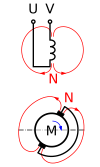
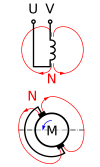
I acquired my very first repulsion inductance motor today - a 110 V, 1/2 hp, 45 pound behemoth. It's old - probably 70 years or so, and covered with grease and dirt, but it runs like a champ. My problem is that it runs in the wrong direction, and I'm puzzled how to reverse it. I know that it's a matter of brush location, and the good folks at Delco Remy were nice enough to put a little pointer on the brush assembly and an indent on the end bell so that I can get the setting exactly right . . . for CW rotation.
I understand the theory that I could loosen the clamping bolt on the brush assembly and rotate it until the motor runs CCW like I want, but I am stuck between the horns of a dilemma: (1) There is no other mark on the end bell, so I could only wildly guess where to move the brushes; (2) figuring it out "by the seat of my pants" means reaching in there and grabbing hold on the assembly and turning it slowly whilst I listen to the sound.
If I just start a hit-and-miss effort, moving the brushes, then clamping them, I have to remember that I am an old fellow now (the guy who sold me the motor referred to me as "elderly" - bah!) without months and months of life to waste on this.
If I grab the assembly with my hand, I have this unnatural fear of getting zapped by 50 or 60 volts, and jerking my hand back, impaling my palm on a sharp piece of the mount that has 70 years of tetanus and other toxins built up on it. I understand that an induced voltage in the armature is theoretically harmless, but I worry this thing is old and dirty enough to have enough leakage to get a nice ground reference.
What am I missing (other than the $125 to buy a new induction motor down at the Harbor Freight store)?


 5
5
 How Do I Reverse a Repulsion Inductance Motor?

 Re: How do I reverse a Repulsion Inductance motor?


Good Answers:
"Almost" Good Answers: