What will be the Inrush Current of 80 kVA,415/115V transformer & how to select MCCB as a incomer of transformer & load is heater which is connected to secondary of transformer.
Based on my experience, the inrush current of a transformer is a sudden pulse (ampere) flowing though it. For instance, when energizing a transformer, inrush current will appears.
You can choose MCCB following the capacity of the transformer or the rating of the load, the heater for example.
I've not ignored the wiring,it would be as per load current but i'm worried about MCCB because incase of high inrush current MCCB will trip,so to avoid this nuisance tripping i would like to know inrush current of transformer.
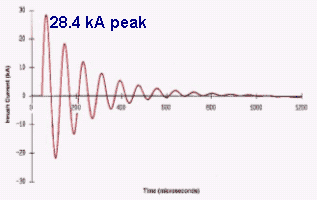
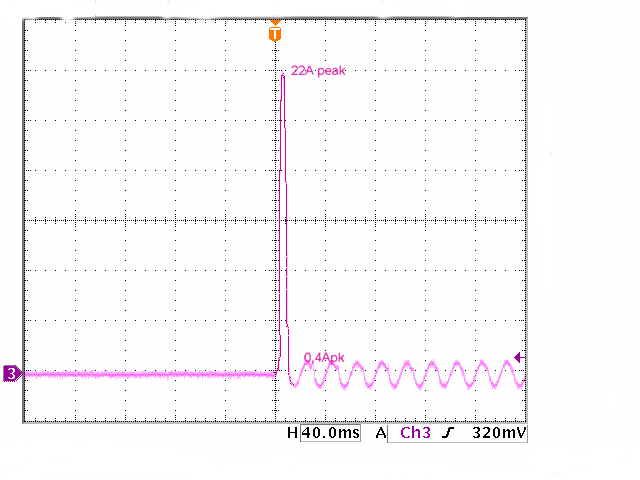
"When a transformer is first energized, a transient current up to 10 to 15 times larger than the rated transformer current can flow for several cycles. Toroidal transformers, using less copper for the same power handling, can have up to 60 times inrush to running current. Worst case inrush happens when the primary winding is connected at an instant around the zero-crossing of the primary voltage, (which for a pure inductance would be the current maximum in the AC cycle) and if the polarity of the voltage half cycle has the same polarity as the remnance in the iron core has. (The magnetic remanence was left high from a preceding half cycle). Unless the windings and core are sized to normally never exceed 50% of saturation, (and in an efficient transformer they never are, such a construction would be overly heavy and inefficient) then during such a start up the core will be saturated. This can also be expressed as the remnant magnetism in normal operation is nearly as high as the saturation magnetism at the "knee" of the hysteresis loop. Once the core saturates however, the winding inductance appears greatly reduced, and only the resistance of the primary side windings and the impedance of the power line are limiting the current. As saturation occurs for part half cycles only, harmonic rich waveforms can be generated, and can cause problems to other equipment.
For large transformers with low winding resistance and high inductance, these inrush currents can last for several seconds until the transient has died away (decay time proportional to ~XL/R)and the regular AC equilibrium is established. To avoid magnetic inrush, only for transformers with an air gap in the core, the inductive load needs to be synchronously connected near a supply voltage peak, in contrast with the zero voltage switching which is desirable to minimize sharp edged current transients with resistive loads such as high power heaters. But for toroidal transformers only a premagnetising procedure before switching on allows to start those transformers without any inrush current peak."
So as you can see it depends on many factors, the design of the transformer, the switching characteristics of the load, the type of breaker you're using etc....
It's impossible to give you a inrush current. As you provide no information on the load. Your MCCB is to protect the wiring not the transformer or the load.
If the heater is going to have that much inrush current that you worry about it. You may want to look at a solid state device for switching that will control the inrush. These devices will also by doing so increase heater life. In not providing more information on the application of heater load. You may have an issue with switch if done with a mechanical contactor.
__________________
Life is not a journey to the grave with the intention of arriving in a pretty, pristine body but rather to come sliding in sideways, all used up and exclaiming, "Wow, what a ride!"
In the U.S. NEC (National Electrical Code), for your voltage class and size of transformer, the maximum overcurrent protection is 125% of full-load current. If this does not match a standard fuse or circuit breaker size, you can use the next higher standard size.
Your local code mileage may differ.
__________________
In vino veritas; in cervisia carmen; in aqua E. coli.
Good Answers: