Previous in Forum: Which Oscilloscope?   Next in Forum: Current Transducer Low Range Accuracy?
Close
Close
Close
33 comments
Rating: Comments: Nested
Associate

Join Date: Oct 2011
Posts: 29
Good Answers: 2

Using PID Controller with Inclinometer as Input and DC Motor as Final Element

11/15/2014 5:23 AM

Hi....I need your opinion on employing a combination of PID controller + Inclinometer + DC motor to control a small platform.

To describe my application, I have a small platform that need to be kept perfectly horizontal. The platform will tilt in only ONE axis and will not tilt in the other two axes.

I intend to use an inclinometer to measure the tilt / variation in angle along that particular axis. The output from the inclinometer (4-20mA, corresponding to +/- 10 Deg.) will go as PV, to a PID controller whose SV is 0 Deg (absolutely horizontal).

I intend to use the Valve Position Control mode of Eurotherm's Model 2404, with potentiometric feedback to drive a motor which will rotate in either CW / CCW (open close outputs) based on the error.

The logic outputs(CW / CCW) from the controller (open / close) shall drive a H bridge for bidirectional rotation of the motor. The motor will have a gear box and other stuff.

Is this scheme technically viable ?

Register to Reply
Interested in this topic? By joining CR4 you can "subscribe" to
this discussion and receive notification when new comments are added.

"Almost" Good Answers:

Check out these comments that don't yet have enough votes to be "official" good answers and, if you agree with them, vote them!
Guru
Popular Science - Weaponology - New Member United Kingdom - Member - New Member

Join Date: May 2007
Location: Harlow England
Posts: 16512
Good Answers: 670
#1

Re: using PID Controller with Inclinometer as input and DC motor as final element.

11/15/2014 5:31 AM

Sounds ok to me.

Rig up a prototype and see if it works.
I'd think it's more about getting the gearing right than anything else.

Mind you could probably lash up something that would basically work with a pendulum and a few sets of contacts.Or a pendulum with a potentiometer for a pivot!
Depends on the precision you need!

Del

__________________
health warning: These posts may contain traces of nut.
Register to Reply Score 1 for Good Answer
Associate

Join Date: Oct 2011
Posts: 29
Good Answers: 2
#10
In reply to #1

Re: using PID Controller with Inclinometer as input and DC motor as final element.

11/15/2014 9:34 PM

Thanks for your time. I will rig it up and let you guys vide my next post, it could be some time though...thanks again.

Register to Reply
Guru
United Kingdom - Member - Not a New Member Hobbies - Musician - New Member Hobbies - Fishing - New Member

Join Date: May 2006
Location: Reading, Berkshire, UK. Going under cover.
Posts: 9684
Good Answers: 468
#2

Re: using PID Controller with Inclinometer as input and DC motor as final element.

11/15/2014 7:29 AM

As Del says, it should work OK. Can't see any reason why not. Setting up should be easy enough for gentle changes - shuch as a rolling ship. More tricky if you also want it to cope with e.g. a rally car.

__________________
"Love justice, you who rule the world" - Dante Alighieri
Register to Reply
Guru
Technical Fields - Technical Writing - New Member Engineering Fields - Piping Design Engineering - New Member

Join Date: May 2009
Location: Richland, WA, USA
Posts: 21017
Good Answers: 795
#3

Re: using PID Controller with Inclinometer as input and DC motor as final element.

11/15/2014 7:34 AM

Bear in mind that the only thing that gets your system to operate is that the angle deviates from zero. You need to study how fast any upsetting forces can move the platform, and apply larger forces to restore it to zero inclination. There will be time lags, so you can never maintain exact horizontality.

__________________
In vino veritas; in cervisia carmen; in aqua E. coli.
Register to Reply Score 1 for Good Answer
Guru

Join Date: Oct 2008
Posts: 42355
Good Answers: 1693
#4

Re: using PID Controller with Inclinometer as input and DC motor as final element.

11/15/2014 8:16 AM

Depending on magnitude and frequency of deviation from horizontal, you may find that you have constructed a vibrating platform.

Your motor will be constantly changing directions, due to inertia of the platform.

Look at:

Active vibration control - Wikipedia, the free encyclopedia

Sound and Vibration Control Strategies - DEICON

Register to Reply
Guru
United Kingdom - Member - Not a New Member Hobbies - Musician - New Member Hobbies - Fishing - New Member

Join Date: May 2006
Location: Reading, Berkshire, UK. Going under cover.
Posts: 9684
Good Answers: 468
#7
In reply to #4

Re: using PID Controller with Inclinometer as input and DC motor as final element.

11/15/2014 7:51 PM

This shouldn't be a problem, provided the motor, geartrain and linkages are sized correctly (and there's minimal backlash), and the PID is correctly tuned.

__________________
"Love justice, you who rule the world" - Dante Alighieri
Register to Reply
Guru

Join Date: Oct 2008
Posts: 42355
Good Answers: 1693
#8
In reply to #7

Re: using PID Controller with Inclinometer as input and DC motor as final element.

11/15/2014 7:57 PM

Just sayin'.

You could do it with a single transducer instead of a motor and gears.

Register to Reply
Guru

Join Date: Feb 2011
Posts: 1119
Good Answers: 11
#5

Re: using PID Controller with Inclinometer as input and DC motor as final element.

11/15/2014 8:43 AM

Yes, try it.

__________________
" To infinity and beyond" - Buzz Lightyear
Register to Reply
Power-User

Join Date: Oct 2014
Posts: 143
Good Answers: 4
#6

Re: using PID Controller with Inclinometer as input and DC motor as final element.

11/15/2014 12:47 PM

Simplified version of a classical platform stabilization application.

It's important to choose correctly the inclinometer and digital servoregulator (don't remember the exact technical term in English). I was involved in a project using direct drives (i.e. a torque motor for each axis), a gearless design which allows high dynamics though sensor devices were not just a simple inclinometer.

Register to Reply
Guru

Join Date: Apr 2010
Location: About 4000 miles from the center of the earth (+/-100 mi)
Posts: 9910
Good Answers: 1141
#9

Re: Using PID Controller with Inclinometer as Input and DC Motor as Final Element

11/15/2014 8:04 PM

It should work. Or you could float your platform in a small container half filled with liquid.

Keep in mind that your inclinometer measures the direction of g force, which is only "down" if you are not accelerating. To maintain a horizontal platform under acceleration (straight line or change of direction) you need a gyro stabilized platform such are used in aircraft artificial horizon instruments.

Register to Reply Score 1 for Good Answer
Guru

Join Date: Jun 2010
Posts: 1296
Good Answers: 104
#12
In reply to #9

Re: Using PID Controller with Inclinometer as Input and DC Motor as Final Element

11/15/2014 11:55 PM

Or, for the rest of us, half empty .

Register to Reply Off Topic (Score 5)
Associate

Join Date: Oct 2011
Posts: 29
Good Answers: 2
#11

Re: Using PID Controller with Inclinometer as Input and DC Motor as Final Element

11/15/2014 10:38 PM

Thanks to each of you guys, for your time and inputs.

I would like to know more on the role of acceleration on the platform and the use/need of Gyro stabilization. How does a vertical drop effect the output of the inclinometer, if I have correctly understood Rixter's advice? I am presently reading about Gyro to understand its functionality, but an explanation from knowledgeable guys like you, will expedite it.

@Rixter, can you please elaborate your answer?

Thanks yet again.

Register to Reply
Guru

Join Date: Apr 2010
Location: About 4000 miles from the center of the earth (+/-100 mi)
Posts: 9910
Good Answers: 1141
#32
In reply to #11

Re: Using PID Controller with Inclinometer as Input and DC Motor as Final Element

11/19/2014 7:56 PM

If you're an airline passenger with a full cup of coffee on the tray table and the pilot banks into a turn, the coffee remains parallel with the tray table, not with the horizon. The force of gravity and the acceleration add together giving you a force that is not downward but part way between downward and the outside of the turn. The coffee behaves as if down is toward the bottom of the airplane.

A pilot literally "flying by the seat of his pant" cannot tell the difference between level flight and a banked turn if he is in clouds and cannot see the horizon. A graveyard spiral, unfortunately, feels the same as flying straight and level.

A spinning gyroscope does not respond to the direction of g force. What it does is maintain its orientation in space. If it is set spinning with its axis vertical, it will maintain that orientation if it is freely suspended. The technical reason is conservation of angular momentum. A simpler way to look at it is that the mass of the fast moving outer rim of the spinning disk would have to change direction if you change the direction the axis is pointed.

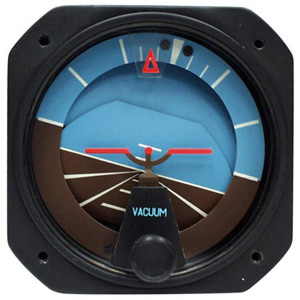
In an artificial horizon, the gyroscope is connected to the internal part of the instrument that looks like a horizon to the pilot and gives him a visual indication of the attitude of the aircraft, both in pitch up and down and in bank. The horizon remains level.

Register to Reply
Guru

Join Date: Apr 2010
Location: About 4000 miles from the center of the earth (+/-100 mi)
Posts: 9910
Good Answers: 1141
#33
In reply to #11

Re: Using PID Controller with Inclinometer as Input and DC Motor as Final Element

11/21/2014 6:49 PM

How does a vertical drop effect the output of the inclinometer...In free fall, there is no g force, so your inclinometer would not function. 3 axis accelerometers, which basically do the same function, are used to detect free fall to retract the read/write head on disk drives.http://www.amazon.com/Western-Digital-Scorpio-Sensor-WD3200BJKT/dp/B001FBJJQ4This idea has also been proposed to help the elderly...http://www.analog.com/library/analogdialogue/archives/43-07/fall_detector.html

Register to Reply
Guru
Hobbies - Musician - Engineering Fields - Chemical Engineering - New Member Engineering Fields - Control Engineering - New Member Engineering Fields - Instrumentation Engineering - New Member

Join Date: Jan 2007
Location: Moses Lake, WA, USA, Thulcandra - The Silent Planet (C.S. Lewis)
Posts: 4216
Good Answers: 194
#13

Re: Using PID Controller with Inclinometer as Input and DC Motor as Final Element

11/16/2014 2:02 AM

Hi madhavdivya,

I have a small platform that need to be kept perfectly horizontal

I am having trouble with the editor here, so please bear with me.

Your proposed setup sounds doable as others here have expressed. However, you should consider the following:

  1. How small (or large!) is the platform?
  2. What will be the load on the platform?
  3. What type and severity of upsets from horizontal will there be?
  4. The platform will never be kept "perfectly horizontal" all the time, so what are you willing to live with?

The answer to these (and I'm sure I have missed some) will determine what equipment/instrumentation will be required. The more rapid and wide the deviations from horizontality, the more precise and faster measuring/controlling the equipment will need to be, and this will have a direct bearing on cost.

__________________
"Reason is not automatic. Those who deny it cannot be conquered by it. Do not count on them. Leave them alone." - Ayn Rand
Register to Reply
Power-User

Join Date: Oct 2014
Posts: 143
Good Answers: 4
#14

Re: Using PID Controller with Inclinometer as Input and DC Motor as Final Element

11/16/2014 8:45 AM

DC servo is not really up-to-date, use direct-drive AC servo technology (or unaffordabe servo-hydraulics if masses are very high), fiber gyros, 3-axis accelerometesr, etc. or complete strap-on AHRS units. :)

But instrumentation for premium performance is very expensive.

Register to Reply
Guru
Popular Science - Weaponology - New Member United Kingdom - Member - New Member

Join Date: May 2007
Location: Harlow England
Posts: 16512
Good Answers: 670
#15
In reply to #14

Re: Using PID Controller with Inclinometer as Input and DC Motor as Final Element

11/16/2014 11:32 AM

Not really up to date???
A pendulum isn't up to date, but it still works.

Up to date is over rated.
up to date= over complicated and unreliable

Del

__________________
health warning: These posts may contain traces of nut.
Register to Reply
Power-User

Join Date: Oct 2014
Posts: 143
Good Answers: 4
#24
In reply to #15

Re: Using PID Controller with Inclinometer as Input and DC Motor as Final Element

11/17/2014 6:00 AM

Have you designed a system including a servodrive within the last couple of years?

Excepted for some extremely small motors (typically less than a few dozen watts) where DC can still be found instead of brushles, AC servo motors are considered as state-of-the-art, at least in modern countries. It has nothing to do with uselessly complicated and unreliable.

And BTW DC servomotors + old analogic servo amplifier are not necessarily more reliable than AC servos with digital servo amplifier (I talk about experience, I've designed, commisioned and mainted both types of servo drive systems). Of course it also depends on the chosen products, some are more reliable than others.

Register to Reply
Guru
Popular Science - Weaponology - New Member United Kingdom - Member - New Member

Join Date: May 2007
Location: Harlow England
Posts: 16512
Good Answers: 670
#27
In reply to #24

Re: Using PID Controller with Inclinometer as Input and DC Motor as Final Element

11/17/2014 8:07 AM

No...

__________________
health warning: These posts may contain traces of nut.
Register to Reply
Guru
United States - Member - Born, raised halfway 'round .....

Join Date: May 2010
Location: Metro.Manila, Philippines.
Posts: 1268
Good Answers: 27
#16

Re: Using PID Controller with Inclinometer as Input and DC Motor as Final Element

11/16/2014 4:49 PM

To describe my application, I have a small platform that need to be kept perfectly horizontal. The platform will tilt in only ONE axis and will not tilt in the other two axes.

Based on the above description of you project, IMHO you are actually describing / simulating how the HVAC people were controlling /maintaining building or big hall /room the temperature in the past! In your case, the small platform is akin or can be to what HVAC people called as ventilation "Dampers" which is in turn is controlled by a "proportional valve motor"!

The damper's positioning is either fully close, (as your horizontal position), maximum fully open, or anywhere in-between, driven or positioned by the proportional valve which is in turn controlled or dependent on the temperature setting of the controlling thermostat in an HVAC applications.. The axis point is fixed being in the pivot point, attached to the shaft of the proportional valve motor which is permanently mounted!

The temperature /thermostat settings in your situation and application can be programmed /replaced by a PID. Operating /behaving similar to the 24V AC operations of the HVAC ventilation control system.

__________________
vsar
Register to Reply
Guru
United Kingdom - Member - Not a New Member Hobbies - Musician - New Member Hobbies - Fishing - New Member

Join Date: May 2006
Location: Reading, Berkshire, UK. Going under cover.
Posts: 9684
Good Answers: 468
#17
In reply to #16

Re: Using PID Controller with Inclinometer as Input and DC Motor as Final Element

11/16/2014 5:50 PM

"The damper's positioning is either fully close, (as your horizontal position), maximum fully open, or anywhere in-between" - No! Fully closed would be e.g. +10°, with fully open at -10°. Horizontal would be the "somewhere in-between".

If horizontal were fully closed, the platform could only tilt to one side.

__________________
"Love justice, you who rule the world" - Dante Alighieri
Register to Reply
Guru
United States - Member - Born, raised halfway 'round .....

Join Date: May 2010
Location: Metro.Manila, Philippines.
Posts: 1268
Good Answers: 27
#19
In reply to #17

Re: Using PID Controller with Inclinometer as Input and DC Motor as Final Element

11/16/2014 7:04 PM

the example I cited and explained is a how "dampers" are set in automated HVAC applications...

However, depending on how the proportional valve motor will be mounted or positioned, the angle of the plate and its range of motion for positional purposes can be set anywhere. This will also serve as the axis of the plate.

i.e. the midpoint of the proportional valve's full range can be set as the center for the the up /down motion of the plate's floating end. This same midpoint can be mechanically set as the motor is mounted, and therefore where the horizontal plate positioning will coincide... as well as where a protractor can be positioned for inclination readings..

__________________
vsar
Register to Reply
Guru

Join Date: Oct 2008
Posts: 42355
Good Answers: 1693
#18
In reply to #16

Re: Using PID Controller with Inclinometer as Input and DC Motor as Final Element

11/16/2014 6:22 PM

If we are really talking about HVAC damper control, this entire thread is a major waste of time.

Register to Reply
Guru
United States - Member - Born, raised halfway 'round .....

Join Date: May 2010
Location: Metro.Manila, Philippines.
Posts: 1268
Good Answers: 27
#20
In reply to #18

Re: Using PID Controller with Inclinometer as Input and DC Motor as Final Element

11/16/2014 7:11 PM

It is really surprising what a bit of imagination or visualization can do!

__________________
vsar
Register to Reply
Guru

Join Date: Oct 2008
Posts: 42355
Good Answers: 1693
#21
In reply to #20

Re: Using PID Controller with Inclinometer as Input and DC Motor as Final Element

11/16/2014 7:52 PM

"I have a small platform that need to be kept perfectly horizontal"

I imagine that the OP wants to keep in a small platform in a single, stable, unmoving position.

I can't imagine a moving damper given the OP's statement.

<unsubscribe because I no help here>

Register to Reply
Associate

Join Date: Oct 2011
Posts: 29
Good Answers: 2
#22

Re: Using PID Controller with Inclinometer as Input and DC Motor as Final Element

11/16/2014 10:56 PM

@lyn & VSAR: Not it is not for a HVAC application.

@MikerHo: the platform is 3' x 4' and is 15 kg in weight. The platform is subjected to gentle to mild forces and may be the term used by JOHNDG - "roll of a ship" would be an appropriate explanation. I am willing to live with a max deviation of 0.5 Deg. Eurotherm 2404 scan / update rate is 8 Hz.

update:

1. Got the inclinometer from Kuebler.

2. Got the DC motor with inbuilt gear box.

3. Testing the H bridge with TIP 122 and TIP 127, will upgrade to MOSFETs subsequently.

4. PWM circuit under finalisation.

5. PID controller from Eurotherm is likely to be delayed.

and thanks one again.....

Register to Reply
Guru
Technical Fields - Technical Writing - New Member Engineering Fields - Piping Design Engineering - New Member

Join Date: May 2009
Location: Richland, WA, USA
Posts: 21017
Good Answers: 795
#23
In reply to #22

Re: Using PID Controller with Inclinometer as Input and DC Motor as Final Element

11/17/2014 1:18 AM

Is "8 Hz" a misprint? That is very slow, and will not respond adequately if disturbances are any faster than that.

__________________
In vino veritas; in cervisia carmen; in aqua E. coli.
Register to Reply
Power-User

Join Date: Oct 2014
Posts: 143
Good Answers: 4
#25
In reply to #23

Re: Using PID Controller with Inclinometer as Input and DC Motor as Final Element

11/17/2014 6:07 AM

The OP is referring to this: :)

http://www.eurotherm.com/products/controllers/single-loop/2400/2404/

which is a... temperature controller (Eurotherm is known for those, they're widely used in the industry, I had some of them for heating zone controls of large extruders). :)

This type of regulator is optimized for slow processes, not dynamic motion.

Register to Reply
Guru

Join Date: Jun 2011
Location: Mossel Bay, SA
Posts: 777
Good Answers: 21
#26
In reply to #25

Re: Using PID Controller with Inclinometer as Input and DC Motor as Final Element

11/17/2014 7:01 AM

Not a bad observation (slow process), but note that the OP has specified a PID controller, where the derivative action will speed up the change in output, relative to the change in the controlled variable. ie what appears to be a relatively slow process, may require a relatively fast corrective action, so that the controller doesn't begin to 'hunt', as some of the posters have already mentioned, causing a rocking action on the platform. I assume here that the OP knows what a "PID controller" actually describes.

Register to Reply
Associate

Join Date: Oct 2011
Posts: 29
Good Answers: 2
#28

Re: Using PID Controller with Inclinometer as Input and DC Motor as Final Element

11/17/2014 11:52 AM

I have chosen, the 2404 Auto tuning PID Controller for the following reasons:

a. I have used this instrument before - the comfort zone......

b. I have about 15 DI + 15 DO as interlocks which the controller can handle with I/O expander.

c. The local display and key board allows me to complete the programming without the need of software (iTools) at site.

d. The controller is with pre-built Valve Postion Control strategy, and accepts the feedback vide a potentiometer.

e. The controller also gives me a program (profile - ramp / soak) which I need it for maintenance.

yes, I will be depending on the inbuilt auto-tune / adaptive tuning of the controller while commissioning the system.

As per your comment, if 8 Hz (125 ms) is slow, would 20 Hz (50 mS) be any better?. I can maybe changeover to Fuji electric model of Controller.

http://www.fujielectric.com/products/instruments/library/catalog/box/doc/ECNO1152c.pdf

thanks,

Register to Reply
Guru

Join Date: Jun 2011
Location: Mossel Bay, SA
Posts: 777
Good Answers: 21
#29
In reply to #28

Re: Using PID Controller with Inclinometer as Input and DC Motor as Final Element

11/18/2014 3:47 AM

I have never used the 2404, and I have only praise for Fuji control instrumentation.

You sound as though you have this project quite clear in your mind. I suggest you don't let yourself be side-tracked in this forum....just get on with it. Let us know if it works or fails, and then ask for advice if necessary.

Register to Reply
Associate

Join Date: Oct 2011
Posts: 29
Good Answers: 2
#30

Re: Using PID Controller with Inclinometer as Input and DC Motor as Final Element

11/18/2014 6:04 AM

Thanks Hilton, I will share the results once the Eurotherm Controller is in my hand (next week hopefully)....

Register to Reply
Guru

Join Date: Nov 2007
Location: Eastern Arizona mountains on Route 666 about a mile from God's country
Posts: 1676
Good Answers: 122
#31

Re: Using PID Controller with Inclinometer as Input and DC Motor as Final Element

11/18/2014 10:40 AM

This control is already being used on portable aerial platform equipment with the difference being that the inclinometer feedback is connected to the hydraulic control valve solenoids instead of a DC motor.

There are technical downloads available from various equipment websites that include IOM's and drawings for reference.

__________________
They said; "Brain size?" I heard; "Train size?" so I said: "I'll take a small one, thank you."
Register to Reply
Register to Reply 33 comments

"Almost" Good Answers:

Check out these comments that don't yet have enough votes to be "official" good answers and, if you agree with them, vote them!
Copy to Clipboard

Users who posted comments:

bigg (1); Hilton (2); JohnDG (3); lyn (4); madhavdivya (5); Mikerho (1); Noudge79 (1); Plimos (4); Rixter (3); SHOCKHISCAN (1); Tornado (2); user-deleted-1105 (3); vsar (3)

Previous in Forum: Which Oscilloscope?   Next in Forum: Current Transducer Low Range Accuracy?

Advertisement