Previous in Forum: Why Do We Need "Paradigms"   Next in Forum: 10 Bucks a Barrel?
Close
Close
Close
36 comments
Rate Comments: Nested
Guru
Technical Fields - Project Managers & Project Engineers - New Member

Join Date: Aug 2006
Location: Midwestern United States
Posts: 843
Good Answers: 76

Math Question

02/17/2015 1:18 PM

In regards to Floor Scales, I'm in the process of selecting one and want to account for lift-truck fork lowering speed (i.e. the operator setting the load on the scale).

And apparently I'm asking the mighty internet search engine incorrectly because I keep getting answers with acceleration in them.

My givens are:

- Hopper Tare Weight: 916 lbs.

- Hopper Capacity: 4,000 lbs.

- Total Mass: 4,916 (say 5,000) lbs.

- Fork-Truck Fork Lowering Velocity (max.): 500 mm/s

My first thought was the stand-by F=MA, but I have a 'V' not an 'A' and the only net force I have continuously acting on the object is in the opposite direction against gravity.

In the scheme of things, I'm probably just going to select a 10k capacity scale and call it done. But I'd still like to do a reality check and ID the correct formula to identify the force on the scale applied by a mass whose decent is at a controlled velocity... and, well, apparently my brain if frozen and drawing a blank.

Thanks,

JavaHead

__________________
Reuters - Investigators found that the recent thread derailment in CR4 was caused by over-weight creatures of lore and request that membership DON'T FEED THE TROLLS.
Register to Reply
Interested in this topic? By joining CR4 you can "subscribe" to
this discussion and receive notification when new comments are added.

Good Answers:

These comments received enough positive votes to make them "good answers".

"Almost" Good Answers:

Check out these comments that don't yet have enough votes to be "official" good answers and, if you agree with them, vote them!
3
Guru
Popular Science - Evolution - New Member Popular Science - Weaponology - New Member

Join Date: May 2006
Location: The 'Space Coast', USA
Posts: 11119
Good Answers: 918
#1

Re: Math Question

02/17/2015 2:24 PM

Okay. So you are trying to size a scale so that the force on the scale of a load of 5,000 lbs at velocity V is less than the maximum of the scale?

If so, the the formula you want is a derivative of Ke = 1/2 [ m • v^2]

Then you need to consider the problem as a change in momentum. That is, your load has a velocity, so it has momentum until it hits the scale. That means you need to consider the problem as Impulse, or J = F •  ∆t

Now, is the scale a spring scale or is it a force gauge that doesn't move? If it doesn't move, then the force applied to the scale is a true impulse. You could probably should treat the problem this way, but you still are left with trying to calculate the time or duration, in seconds, that the load impulse has on the scale.

The time from .5 m/s to 0 m/s is not really zero, but some finite number that is going to be hard to measure.

Register to Reply Good Answer (Score 3)
Guru
Technical Fields - Project Managers & Project Engineers - New Member

Join Date: Aug 2006
Location: Midwestern United States
Posts: 843
Good Answers: 76
#5
In reply to #1

Re: Math Question

02/17/2015 2:58 PM

Thanks Anonymous...

Scale would be a force-gauge, so Impulse. As for the Time component, I'll mess around with a couple values to see where it puts me.

__________________
Reuters - Investigators found that the recent thread derailment in CR4 was caused by over-weight creatures of lore and request that membership DON'T FEED THE TROLLS.
Register to Reply
Guru
Technical Fields - Technical Writing - New Member Engineering Fields - Piping Design Engineering - New Member

Join Date: May 2009
Location: Richland, WA, USA
Posts: 21017
Good Answers: 795
#14
In reply to #1

Re: Math Question

02/18/2015 6:42 AM

Strain gauges do move; that is how they work. Admittedly not by much, so overload stops need to be finely adjusted to keep the strain gauges in the elastic range.

__________________
In vino veritas; in cervisia carmen; in aqua E. coli.
Register to Reply
Guru
Popular Science - Evolution - New Member Popular Science - Weaponology - New Member

Join Date: May 2006
Location: The 'Space Coast', USA
Posts: 11119
Good Answers: 918
#16
In reply to #14

Re: Math Question

02/18/2015 9:35 AM

True, but the movement is tiny compared to a spring scale.

Register to Reply
Guru
Engineering Fields - Nuclear Engineering - New Member

Join Date: Sep 2009
Location: Louisville, OH
Posts: 1925
Good Answers: 36
#20
In reply to #1

Re: Math Question

02/18/2015 12:44 PM

I concur with AH, especially his last sentence. The instantaneous force can be quite high. My practical instance was breaking non-breakable fiberglass heel support cups in high jumping. You may have to use the WAG method.

__________________
Lehman57
Register to Reply
Power-User
United States - Member - Western Wisconsin

Join Date: Mar 2007
Location: Wisconsin USA
Posts: 305
Good Answers: 25
#2

Re: Math Question

02/17/2015 2:28 PM

I believe momentum is the term you are looking for.

The elasticity of the forklift and scale will have a huge effect on the force "felt" by the scale.

For example: a forklift with pneumatic tires will transfer the weight to the scale over a much longer time than one with solid tires.

Edit: I see AH answered while I composed this.

__________________
Troy
Register to Reply
Guru
Popular Science - Evolution - New Member Popular Science - Weaponology - New Member

Join Date: May 2006
Location: The 'Space Coast', USA
Posts: 11119
Good Answers: 918
#3
In reply to #2

Re: Math Question

02/17/2015 2:34 PM

That's the thorny part of the problem. The scale, the load, and the delivery vehicle all have an elastic component.

Register to Reply
Guru
Technical Fields - Project Managers & Project Engineers - New Member

Join Date: Aug 2006
Location: Midwestern United States
Posts: 843
Good Answers: 76
#6
In reply to #2

Re: Math Question

02/17/2015 3:29 PM

Thanks Troy36... the lifts that will be loading the scale have solid tires, so a little tighter load/time curve but yeah... still a lot of elastic components to the problem.

And, yeah - certainly you can take this to a really detailed level and try to get exact numbers, by calculating and accounting for every variable... that's why my initial scenario was only looking at the load and its movement, taking the tow-motor out of the equation.

Once you add the tow-motor then you have two additional scenarios: first scenario assumes the lift-truck operator stops the downward movement of his forks at conclusion of initial impact, the second scenario is that he doesn't and essentially lifts the front of the tow-motor.

__________________
Reuters - Investigators found that the recent thread derailment in CR4 was caused by over-weight creatures of lore and request that membership DON'T FEED THE TROLLS.
Register to Reply
3
Guru

Join Date: Mar 2007
Location: by the beach in Florida
Posts: 33392
Good Answers: 1817
#4

Re: Math Question

02/17/2015 2:53 PM

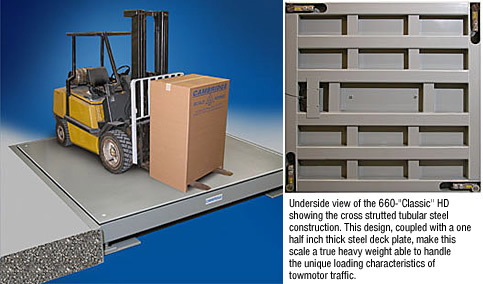
Why not just measure the load and lift-truck all at once, and eliminate the problem altogether...

http://www.greenvillescale.com/Cambridge.php

__________________
All living things seek to control their own destiny....this is the purpose of life
Register to Reply Good Answer (Score 3)
Guru
Technical Fields - Project Managers & Project Engineers - New Member

Join Date: Aug 2006
Location: Midwestern United States
Posts: 843
Good Answers: 76
#7
In reply to #4

Re: Math Question

02/17/2015 3:38 PM

I like those. When I was in Automotive, we had a lot of those. And a couple of our newer plants had CAC Card or RFID Readers where the driver would insert their card and the tow-motor's card which contained weight data that would be subtracted from the total.

But, not in automotive anymore, and this particular scale isn't going to be inside... rather outside at a West Texas location; so no pits or anything that caliche can get into and impact operation.

__________________
Reuters - Investigators found that the recent thread derailment in CR4 was caused by over-weight creatures of lore and request that membership DON'T FEED THE TROLLS.
Register to Reply
Guru

Join Date: Apr 2010
Location: About 4000 miles from the center of the earth (+/-100 mi)
Posts: 9910
Good Answers: 1141
#8

Re: Math Question

02/17/2015 3:58 PM

Momentum = mass x velocity. It also equals force x time. So the maximum force (in addition to weight) depends on how fast you stop your object. (If you drop a fragile object on a pillow, it slows down a lot slower than if you drop it on a concrete floor, and hence the force is much less.)

Another way to approach it is ... Kinetic Energy = 1/2 mass x velocity squared. Energy also equals force x distance. So if you have some sort of padding to absorb the impact, the force stopping the object will be applied over the distance that the object compresses the padding. (Remember this force is in addition to the weight.)

Register to Reply
5
Guru

Join Date: Oct 2008
Posts: 42355
Good Answers: 1693
#9

Re: Math Question

02/17/2015 4:22 PM

You're overthinking this.

Just buy a quality floor scale with adequate overload and shock protection.

A 10,000# scale should have a 100% overload protection. That math is simple enough even for me.

Register to Reply Good Answer (Score 5)
Guru
Hobbies - Fishing - Old Salt Hobbies - CNC - New Member United States - US - Statue of Liberty - New Member

Join Date: Mar 2007
Location: Rosedale, Maryland USA
Posts: 5197
Good Answers: 266
#10

Re: Math Question

02/17/2015 4:49 PM

"rather outside at a West Texas location; so no pits or anything that caliche can get into and impact operation"

These scales can be at grade and a ramp to the top of scale.

First you have to ask yourself the frequency of use and whether stopping to set it on the scale slows production over a drive over.

Don't worry about caliche getting in them. No matter which scale you get sooner or later there will be a caliche problem. Something Murphy said. From experience one at grade is always easier to work on then one in a pit. West Texas be more worry about a blowing sand filling a the pit.

__________________
Life is not a journey to the grave with the intention of arriving in a pretty, pristine body but rather to come sliding in sideways, all used up and exclaiming, "Wow, what a ride!"
Register to Reply
Guru
Technical Fields - Technical Writing - New Member Engineering Fields - Piping Design Engineering - New Member

Join Date: May 2009
Location: Richland, WA, USA
Posts: 21017
Good Answers: 795
#11

Re: Math Question

02/17/2015 11:45 PM

Get better forklift operators who are not so clumsy as to lower a load at full velocity.

Instruct management to allow operators enough time to be careful.

__________________
In vino veritas; in cervisia carmen; in aqua E. coli.
Register to Reply
4
Guru

Join Date: Dec 2010
Location: North West England
Posts: 1170
Good Answers: 153
#12

Re: Math Question

02/18/2015 5:46 AM

Taken direct from Avery advertising blurb

"Rugged overload stops - protect against dropped loads and accidental overloading"

I have not checked but I am prepared to bet that most other floor scale firms will incorporate similar features. As suppliers do not know the size or height from which loads will be dropped, overload stops is the only reliable way of tackling the problem. Note no maths required.

Register to Reply Good Answer (Score 4)
Guru

Join Date: Aug 2005
Location: Hemel Hempstead, UK
Posts: 5826
Good Answers: 322
#13

Re: Math Question

02/18/2015 6:22 AM

The answer to the question you asked is implied by Newton's first law of motion:-

"Every object in a state of uniform motion tends to remain in that state of motion unless an external force is applied to it."

In other words if the load is being lowered at a constant velocity then the effect on the weight is zero.

__________________
If you spend all your time looking for people and things to complain about: trust me, you will find plenty to complain about.
Register to Reply
Guru
Popular Science - Evolution - New Member Popular Science - Weaponology - New Member

Join Date: May 2006
Location: The 'Space Coast', USA
Posts: 11119
Good Answers: 918
#15
In reply to #13

Re: Math Question

02/18/2015 9:34 AM

That is not quite true (if I understand your answer correctly). A body lowered to the ground at a constant .5 m/s will still impart a force equal to its mass on the forklift all the way to the floor.

There must be an acceleration component to the body for it to either become "lighter" or "heavier".

In the case of the load of 2000 kg on a forklift that is descending at .5 m/s, the forklift sees the same load as long as the velocity is constant. When the load hits the ground there is an acceleration component where the velocity transitions from .5 m/s to 0 m/s over some unknown delta of time.

The shorter that delta of time (i.e., t = 0.01 s), the higher that component of acceleration and thus the maximum will be really high. Whereas if the time from .5 m/s to 0 m/s is 100 seconds the maximum load will be barely more than the static load (2000 kg).

If you were to graph the load force for both scenarios you would find that the integral (area under the curve) is exactly the same for both.

F=ma, so we just need to solve for acceleration in both cases.

a = (Vf - Vi) / t

Solving for the two cases yields:

High impulse: a= (0m/s - .5m/s) / .01s = -50m/s^2

Low impulse: a= (0m/s - .5m/s) / 100s = -0.005m/s^2

Now we can calculate the actual maximum force of the load over the time that it decelerates:

F = m • a

High impulse: F= 2000 kg • -50m/s^2 = -100,000 Newtons

Low impulse: F= 2000 kg • -0.005m/s^2 = -10 Newtons

Again, if you take the integral of both cases you will see that the total work done in each case is exactly the same.

The problem for the original poster's question is knowing the ∆t between the .5 m/s to 0 m/s. That is undefined in the problem.

Register to Reply Score 1 for Good Answer
Guru
Technical Fields - Project Managers & Project Engineers - New Member

Join Date: Aug 2006
Location: Midwestern United States
Posts: 843
Good Answers: 76
#18
In reply to #15

Re: Math Question

02/18/2015 10:29 AM

Question though. How would you handle a theoretical case of Zero Time... Meaning two objects, one of which is traveling at a constant velocity, that have perfectly flat faces in parallel, make contact with each other. The resulting force is not enough to make the stationary object move, nor either object to incur any compression.

That would make ∆t = 0, correct?

Or, am I delving into a whole new realm of math, and in general practicality there is no such thing as a Zero Time Event?

__________________
Reuters - Investigators found that the recent thread derailment in CR4 was caused by over-weight creatures of lore and request that membership DON'T FEED THE TROLLS.
Register to Reply
Guru
Popular Science - Evolution - New Member Popular Science - Weaponology - New Member

Join Date: May 2006
Location: The 'Space Coast', USA
Posts: 11119
Good Answers: 918
#19
In reply to #18

Re: Math Question

02/18/2015 11:11 AM

It would have to be theoretical as the acceleration would be infinite!

In the real world there is always a finite amount of deflection in the material(s), therefor ∆t will also be a number greater than zero.

Even if you dropped a cement block onto a concrete floor, both the block and the floor will deform a small amount.

For the scale there is going to be some form of compression because you can't measure force without it. Even strain sensors are measuring the compression or expansion of steel. You may not see the deformation, but it really happens.

For your real word question I would recommend that you contact the scale company and ask them what their drop load ratings are. They can tell you what you want to know.

The rest of this is just academic banter for the fun of it. ;-)

Register to Reply
Guru

Join Date: Aug 2005
Location: Hemel Hempstead, UK
Posts: 5826
Good Answers: 322
#26
In reply to #15

Re: Math Question

02/18/2015 3:05 PM

Fair enough and good answer: I was answering the part of the question which stated:-

"the correct formula to identify the force on the scale applied by a mass whose decent is at a controlled velocity",

and, he had already stated that he was interested in fixed velocity not acceleration or deceleration.

I can see now that I did not really understand the problem at all.

__________________
If you spend all your time looking for people and things to complain about: trust me, you will find plenty to complain about.
Register to Reply
Guru
Engineering Fields - Electrical Engineering - New Member Fans of Old Computers - Commodore 64 - New Member Popular Science - Evolution - New Member United States - Member - New Member

Join Date: Oct 2013
Location: Illinois, 7 county region (The 'blue dot' that drags the rest of the 'red state' around during presidential elections.)
Posts: 3683
Good Answers: 89
#21
In reply to #13

Re: Math Question

02/18/2015 12:52 PM

"Every object in a state of uniform motion tends to remain in that state of motion unless an external force is applied to it."

The 'external force' will be the 'normal(1)' of the scale when the load touches/impacts it.

Newton's laws of motion work beautifully for objects in space, or billiard balls, but in 'job site applications' there are always obstacles and external forces that interfere with the application of the laws as pure math. Friction of the load against the forks work to 'keep the load attached' to the fork truck when the truck decelerates or stops, when newton's second law (if looked at alone) would say that ALL loads must continue forward then the truck stops.

Notes:

1) The 'Normal' is the force that generally acts 'equal and opposite' to gravity. When you stand on the ground, gravity is atempting to accelerate you to the Earth's core, with a force of <your 'body weight'> pounds (to use the Imperial system, since 'pounds' is a measure of force, while kilograms is a measure of mass. I'm not going to dig out the equations to determine how many Newtons of force you get for 1Kg under 9.8m/s2 accelaration). Since you are not plummeting through the ground, that means that the floor is exerting a force of <your 'body weight'> pounds in opposition to gravity. It's not limited to that, it's the 'static opposition' to ANY applied force. If you try to push a building down the street, the wall will exert a 'normal' in exact opposition to your attempts to push it. If you try to push a car in neutral, it responds with an almost-matching normal, since some of the energy goes to overcoming the vehicle's inertia, since the exerted force exceeds the resisted normal, you have a net acceleration, small though it might be. (As anyone who has helped a friend get their car out of the road after it has run out of gas can attest to, cars are HEAVY and HARD TO MOVE.)

__________________
( The opinions espressed in this post may not reflect the true opinions of the poster, and may not reflect commonly accepted versions of reality. ) (If you are wondering: yes, I DO hope to live to be as old as my jokes.)
Register to Reply
Guru
Popular Science - Evolution - New Member Popular Science - Weaponology - New Member

Join Date: May 2006
Location: The 'Space Coast', USA
Posts: 11119
Good Answers: 918
#22
In reply to #21

Re: Math Question

02/18/2015 1:06 PM

"I'm not going to dig out the equations to determine how many Newtons of force you get for 1Kg under 9.8m/s2 accelaration)"

I was thinking that was pretty straight forward as F=m•a will have a label of Newtons if the mass is in kilograms and acceleration in meters/seconds^2.

So, F=1kg • 9.8m/s^2 = 9.8 N

Someone correct me if I am wrong.

Register to Reply
Guru
Engineering Fields - Electrical Engineering - New Member Fans of Old Computers - Commodore 64 - New Member Popular Science - Evolution - New Member United States - Member - New Member

Join Date: Oct 2013
Location: Illinois, 7 county region (The 'blue dot' that drags the rest of the 'red state' around during presidential elections.)
Posts: 3683
Good Answers: 89
#23
In reply to #22

Re: Math Question

02/18/2015 1:23 PM

Okay, so it's simpler than I thought.

I just remembered the 'conversion error' when one group at NADA was using foot-pounds, and another was using Newton-metres,' and we turned TWO Mars orbiting probes into crash-test dummies. I remember well the 'gazing into horror' response after the first probe did its unexpected 'impact test,' and Mission control realized that they could not change the programming on the second probe, and could only watch it 'cheerfully' follow its 'big brother' into oblivion. So I thought the math was a bit more complex than that if they couldn't send the probe an updated program in time, they still had something like WEEKS before the next 'subsurface orbit' experiment, so it wasn't like time was the pressing issue there.

Besides, using <your 'body weight'> pounds made it easily relatible, as almost everyone using this forum has a body, and they know what the pressure feels like on their feet when they're standing.

__________________
( The opinions espressed in this post may not reflect the true opinions of the poster, and may not reflect commonly accepted versions of reality. ) (If you are wondering: yes, I DO hope to live to be as old as my jokes.)
Register to Reply
Guru
Technical Fields - Project Managers & Project Engineers - New Member

Join Date: Aug 2006
Location: Midwestern United States
Posts: 843
Good Answers: 76
#24
In reply to #21

Re: Math Question

02/18/2015 1:30 PM

"...to use the Imperial system, since 'pounds' is a measure of force, while kilograms is a measure of mass..."

Pounds is both mass and force, depending on context of use: lbm vs. lbf... which is why I like SI; although I still naturally think in Imperial. Maybe one day I'll wake up and my natural thoughts will be in SI and I wont have to constantly convert... how splendid that day will be. :-)

__________________
Reuters - Investigators found that the recent thread derailment in CR4 was caused by over-weight creatures of lore and request that membership DON'T FEED THE TROLLS.
Register to Reply
Guru
Engineering Fields - Electrical Engineering - New Member Fans of Old Computers - Commodore 64 - New Member Popular Science - Evolution - New Member United States - Member - New Member

Join Date: Oct 2013
Location: Illinois, 7 county region (The 'blue dot' that drags the rest of the 'red state' around during presidential elections.)
Posts: 3683
Good Answers: 89
#25
In reply to #24

Re: Math Question

02/18/2015 2:43 PM

One of the things drilled into me while taking my Physics courses in college was that, without annotations, pounds measured force, kilograms measured mass.when doing the experiments, we even had to openly correct our lab partner if they measured a steel ball and said 'the ball weighs 75 grams.'

A: "The ball weighs 75 grams."

B: "You mean to say the ball has a MASS of 75 grams."

A: "You're right, 'the ball has a mass of 75 grams.'"

It seemed a little Orwellian, a bit oppressively regimented, but the teacher believed that language shaped thought and wanted to make sure we were learning to use the 'right' works. Also, it was just one class, just one teacher. I had crazy teachers before, and I had them later. I had one teacher who was trying to use the Formal Writing class he was teaching as a way to indoctrinate us into Marxist-Maoist idealism- until he quit mid-semester without notice to take a BETTER PAYING JOB. (He quit his indoctrination plans for mere money? Not very Marxist, if you ask me.) Another teacher was adamant about not calling the Fundimental Frequency the 'first harmonic,' "The Fundimental is not the first harmonic, the fundimental is the fundimental." This despite the textbook, which talks about harmonics starting with the text (and I quote, I memorized this part) "The fundimental frequency, also known as the first harmonic, is.." [emphasis added].

For 'everyday, around the house' stuff, I use force and mass names interchangibly, since in the kitchen, a poundm of sweet potatoes is a poundf of sweet potatoes, but when talking about math (as we are in this thread) I try to use unambiguous terms, and unannotated pounds is poundsf, unannotated Kg is Kgm.

__________________
( The opinions espressed in this post may not reflect the true opinions of the poster, and may not reflect commonly accepted versions of reality. ) (If you are wondering: yes, I DO hope to live to be as old as my jokes.)
Register to Reply
Guru
Engineering Fields - Control Engineering - Time to take control United States - Member - New Member Engineering Fields - Systems Engineering - New Member Engineering Fields - Mechanical Engineering - New Member

Join Date: Apr 2009
Location: Tampa, Florida, USA
Posts: 2129
Good Answers: 87
#27
In reply to #21

Re: Math Question

02/18/2015 3:14 PM

but in 'job site applications' there are always obstacles and external forces that interfere with the application of the laws as pure math.

Uhmmm no they don't interfere with the application of the laws. It just means there are more forces to keep track of. Or is it that you mean those other forces make figuring out the results based on the laws more difficult?

If you try to push a building down the street, the wall will exert a 'normal' in exact opposition to your attempts to push it.

Only until the force you apply exceed the wall's structural integrity or the building's connection to the ground. While you may have intended to mean a single person not a bull dozer pushing against the wall, but what you wrote could have meant that or even a single individual pushing against a weakly built structure like a shed.

__________________
J B
Register to Reply
Guru
Engineering Fields - Electrical Engineering - New Member Fans of Old Computers - Commodore 64 - New Member Popular Science - Evolution - New Member United States - Member - New Member

Join Date: Oct 2013
Location: Illinois, 7 county region (The 'blue dot' that drags the rest of the 'red state' around during presidential elections.)
Posts: 3683
Good Answers: 89
#28
In reply to #27

Re: Math Question

02/18/2015 3:55 PM

with the application of the laws as pure math.

Yes, I meant that in 'practical applications,' there are other factors than just the three laws of motion, such as gravity, friction, tensile/compressive strengths, etc. Which is why I opened with comments that the three laws [used without other factors] are good for objects in space (where all you have is momentum and gravity, and for non-orbital calculations, you can even ignore gravity. Yes those two asteroids are going to interact gavitationally before they hit, but the difference in the post collision trajectories from gravity and no-gravity calculations are close enough to ignore the difference) and billiard balls (where all objects are spherical, of equal mass, and move only in two dimensions (barring trick shots), so they behave very close to the 'pure math' version of the laws of motion, two objects collide and trade inertias, etc.)

If you try to push a building down the street, the wall will exert a 'normal' in exact opposition to your attempts to push it.

Since my previous example was a human body being accelerated into the floor and the floor pushing up, and the example following this one involved pushing a car, it seemed a bit redundant to keep pointing out that I was talking about one person acting unaided by machine.

__________________
( The opinions espressed in this post may not reflect the true opinions of the poster, and may not reflect commonly accepted versions of reality. ) (If you are wondering: yes, I DO hope to live to be as old as my jokes.)
Register to Reply
Guru
Engineering Fields - Control Engineering - Time to take control United States - Member - New Member Engineering Fields - Systems Engineering - New Member Engineering Fields - Mechanical Engineering - New Member

Join Date: Apr 2009
Location: Tampa, Florida, USA
Posts: 2129
Good Answers: 87
#29
In reply to #28

Re: Math Question

02/19/2015 7:01 AM

there are other factors than just the three laws of motion, such as gravity, friction, tensile/compressive strengths

Newton's laws do not preclude friction or gravity or tensile/compressive strengths which is why i responded. Friction is a force acting on a body which has contact with some other material (ground, road, table, air, water, etc). It's why a body in motion on Earth will not continue in motion....because there is a force acting on it which opposes that motion.

Remember F=ma? Well the F is not just a force, it's the sum of all forces acting on the body and includes friction and gravity.

__________________
J B
Register to Reply Score 1 for Good Answer
Guru
Engineering Fields - Electrical Engineering - New Member Fans of Old Computers - Commodore 64 - New Member Popular Science - Evolution - New Member United States - Member - New Member

Join Date: Oct 2013
Location: Illinois, 7 county region (The 'blue dot' that drags the rest of the 'red state' around during presidential elections.)
Posts: 3683
Good Answers: 89
#30
In reply to #29

Re: Math Question

02/19/2015 9:42 AM

Yes, I know all that, but when giving examples to explain a theory, I prefer to keep things simple. If a system can be explained without having to factor in gravitational pull on all objects, then I'll leave 'gravity' out of the explanation.

Remember, you build a pyramid by first laying the stones at the bottom, not the top. Explain the basics in a simple, easy to understand way, and when the student asks, "But what about X?" You can say "I was leaving X out to keep the math simple, but since you asked, I'll explain."

__________________
( The opinions espressed in this post may not reflect the true opinions of the poster, and may not reflect commonly accepted versions of reality. ) (If you are wondering: yes, I DO hope to live to be as old as my jokes.)
Register to Reply Score 1 for Good Answer
Guru
Engineering Fields - Control Engineering - Time to take control United States - Member - New Member Engineering Fields - Systems Engineering - New Member Engineering Fields - Mechanical Engineering - New Member

Join Date: Apr 2009
Location: Tampa, Florida, USA
Posts: 2129
Good Answers: 87
#31
In reply to #30

Re: Math Question

02/19/2015 1:49 PM

There is nothing wrong with simplifying things to clarify or make a point.

Your intent may have been better illustrated by saying if we omit friction and gravity, instead of stating something that misleading and basically false. The real world forces may make the math a bit messier but it doesn't interfere with the application of the laws as pure math.

Anyway, I understand and essentionally agree with your point. Just knit picking over some minor details for clarity's sake.

__________________
J B
Register to Reply
Guru
Engineering Fields - Electrical Engineering - New Member Fans of Old Computers - Commodore 64 - New Member Popular Science - Evolution - New Member United States - Member - New Member

Join Date: Oct 2013
Location: Illinois, 7 county region (The 'blue dot' that drags the rest of the 'red state' around during presidential elections.)
Posts: 3683
Good Answers: 89
#32
In reply to #31

Re: Math Question

02/19/2015 2:39 PM

Well, I would sat the Nit (not Knit) has been well picked at this point.

(I could go into detail about nits and nit picking, but to save time (and keep this from feeling like a 'last word' competition) I'll just toss up a link to the Wikipedia page: http://en.wikipedia.org/wiki/Nitpicking )

"Foushta!"

-Van Helsing getting the last word in on the remains of the Count in Dracula: Dead and Loving It.

(Sorry, couldn't resist.)

__________________
( The opinions espressed in this post may not reflect the true opinions of the poster, and may not reflect commonly accepted versions of reality. ) (If you are wondering: yes, I DO hope to live to be as old as my jokes.)
Register to Reply
Guru
Engineering Fields - Control Engineering - Time to take control United States - Member - New Member Engineering Fields - Systems Engineering - New Member Engineering Fields - Mechanical Engineering - New Member

Join Date: Apr 2009
Location: Tampa, Florida, USA
Posts: 2129
Good Answers: 87
#33
In reply to #32

Re: Math Question

02/20/2015 8:16 AM

Nice link.

Yes, Nits, not Knits. I wish I could say it was a typo, but it was really just lack of attention on my part.

__________________
J B
Register to Reply
2
Guru
Technical Fields - Project Managers & Project Engineers - New Member

Join Date: Aug 2006
Location: Midwestern United States
Posts: 843
Good Answers: 76
#17

Re: Math Question

02/18/2015 10:01 AM

I'd like to thank you all for your responses and assistance, but I'd like to point out, less I be labeled an over-thinker regarding such a simple thing as a floor scale; in my OP, I said:

"In the scheme of things, I'm probably just going to select a 10k capacity scale and call it done."

Prior to the first response from AH, the PO was let and an adequate scale with appropriate overload protection was procured, and is scheduled to be delivered tomorrow and operational by week's end.

Having said that, the root of my inquiry was related to the mathematical application of the problem (hence the title of the post) - on which I was drawing a blank and was frustrating me to no end. Being primarily self-taught, there are gaps in my knowledge foundation and when situations occur that highlight them - I fill in the gap.

So again - thanks all for the responses - I know I can always count on the CR4 community to go above and beyond, just want to reiterate - providing a weigh-scale solution was not the issue, in and of itself, (it's now long gone off my desk) but it was the math of the application that I was reaching out for. So, again - thanks for the tutelage... I now know more than I did yesterday, and that's always a good thing to be able to say. ;-)

__________________
Reuters - Investigators found that the recent thread derailment in CR4 was caused by over-weight creatures of lore and request that membership DON'T FEED THE TROLLS.
Register to Reply Good Answer (Score 2)
Guru

Join Date: Mar 2007
Location: Etherville
Posts: 12362
Good Answers: 115
#34

Re: Math Question

02/20/2015 8:49 AM

If you can do so without danger, have you tried the minimal approach ? Too many variables for an exact calculation, but a picture speaks many words.

Do you seek a theoretical answer, or one that just gets the job done? Interesting to discuss, but just double size and cross fingers.

__________________
For sale - Signature space. Apply on self addressed postcard..
Register to Reply
Associate

Join Date: Nov 2014
Posts: 43
Good Answers: 1
#35

Re: Math Question

02/24/2015 8:21 PM

You have to draw the force diagram for normal force, weight force and the kinetic force such as sin and cos F then you will be able to find the best force to reach the balance of the force

Register to Reply
Guru
Popular Science - Evolution - New Member Popular Science - Weaponology - New Member

Join Date: May 2006
Location: The 'Space Coast', USA
Posts: 11119
Good Answers: 918
#36
In reply to #35

Re: Math Question

02/25/2015 7:53 AM

Sin and cos are not a factor as the problem is one dimensional. There is just one degree of freedom in the problem.

Welcome to CR4, by the way!

Register to Reply
Register to Reply 36 comments

Good Answers:

These comments received enough positive votes to make them "good answers".

"Almost" Good Answers:

Check out these comments that don't yet have enough votes to be "official" good answers and, if you agree with them, vote them!
Copy to Clipboard

Users who posted comments:

adreasler (6); Anonymous Hero (7); JavaHead (6); JBTardis (4); jhhassociates (1); Kris (1); Lehman57 (1); lyn (1); ozzb (1); Randall (2); Rixter (1); SolarEagle (1); Tornado (2); Troy36 (1); ZakariaSalim10 (1)

Previous in Forum: Why Do We Need "Paradigms"   Next in Forum: 10 Bucks a Barrel?

Advertisement