|
A Big Block in the Spread of Breast Cancer

October is Breast Cancer awareness month. It's a time to
celebrate the breakthroughs made in the prevention, treatment and cure for a
disease that has touched the lives of so many people. In the United States
alone, 1 in 8 women will develop invasive breast cancer over the course of their
lifetime. In the United Kingdom,12,000 people die each year from the disease.
The devastation that breast cancer causes has led to a wide range of scientists
from all over the world conducting research to fight breast cancer.
What is Breast
Cancer?
According to the American Cancer Society, breast cancer
is a malignant tumor that starts in the cells of the breast. The tumor forms in
the cells that line the ducts or the lobules of the breast tissue. If not detected early, the cancer cells
then invade or metastasize to other parts of the body. The
primary reason for mortality in breast cancer patients is secondary tumors
forming in other areas of the body, including the lymph nodes. But now a new
discovery reduces the chances that the cancer will spread.

A New Discovery
In the September 2011 issue of Breast Cancer
Research, an article titled "Suppression of apoptosis inhibitor c-FLIP
selectively eliminates breast cancer stem cell activity in response to the anti-cancer
agent, TRAIL" was published discussing this new discovery. This article
was written by Luke Piggott, 25, a PhD student at Cardiff University in Wales.
It identifies a breakthrough which could stop patients from dying from breast
cancer.
Piggott's study describes a way to stop the spread of the
disease by switching off breast cancer stem cells' resistance to a particular
drug. Even though cancer stem cells make up a small proportion of the cells in
a tumor, the highly drug-resistant cells play a large role in cancer growth,
spread and relapse. Piggott managed to
make breast cancer cells sensitive to the anti-cancer drug (TNF)-Related
Apoptosis Inducing Ligand (TRAIL), which targets tumor cells for instructive
cell death via the cell-surface receptors TRAIL-R1 (DR4) and TRAIL-R2 (DR5).
The receptors initiate the formation of death-inducing signaling complexes
(DISCs) and lead to the activation of the caspase casade (a series of steps
which lead to the induction, transduction, amplification, and execution of
programed cell death, apoptosis, signals within the cell). TRAIL had not
previously been used to treat breast cancer because it is blocked by a protein
in the breast cancer cells, but Piggott was able to suppress the effect, making
the stem cells sensitive to the drug. The anti-cancer drug works by knocking
out a protein, called c-FLIP, that gave stem cells their drug resistance.
Here is a video with Luke Piggott
explaining his research.
The new approach reduced secondary
cancer tumors by 98%, and repeat treatments killed cancer stem cells if they
reappeared. Piggott's supervisor, Richard Clarkson, said, "We believe we have
found a crucial 'Achilles heel' in breast
cancer stem
cells. We can almost completely shut down their ability to spread the
disease through the body through secondary tumors. Our success with repeat
treatments is also important, offering hope that we can reduce relapse rates of
the disease." Researchers are now planning to expand the study and eventually
try the method on breast cancer in the body.
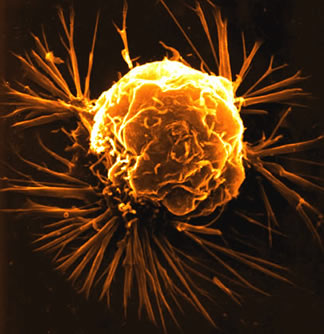
Electron micrograph of a single breast cancer cell. Image Credit: NewsMedical
This is an amazing leap forward in
the fight against breast cancer, and I hope that research like Luke Piggott's
will continue working towards new ways to prevent, treat and cure the disease.
If you would like to learn more
about breast cancer, new research, or show your support, please check out the
links below.
Breast Cancer - American Cancer Society
Susan
G. Komen for the Cure
BreastCancer.org
Resources
What is
breast cancer?
Breast
Cancer
U.S.
Breast Cancer Statistics
PhD
student discovers breast cancer's 'Achilles heel'
Breast
cancer breakthrough by Welsh medical student
Caspase
cascade
| 


 Re: Breakthrough in Breast Cancer Research


