|

Extracellular matrix could be key to regrowth. Image Credit: Nathan Perkel.
There are three ingredients that patients will need to regrow fresh, functional
slabs of their own muscle: a few pig cells, a single surgery, and a rigorous
daily workout. Growing parts of people is becoming less science fiction and
more a reality thanks to the Pentagon-backed science research.
The Need
Thousands of soldiers in the last decade have suffered major
muscle loss during this decade's war and with this new discovery many of them
will overcome the devastating impairment. More than 50 percent of the injuries
in Iraq and Afghanistan have been considered "massive" injuries by researchers,
which is defined as missing at least 25 percent of the muscle mass in a given
area. Massive loss inevitable leads to loss of function, prolonged pain and
suffering, and surgical challenges for the physician. Since reconstruction of
the muscle tissue is often not possible, amputation is not uncommon. A regrowth
technique could greatly benefit not only soldiers but also civilians, who will
be significantly impacted by the reduced need for amputation from trauma such
as car accidents and diseases like cancer.
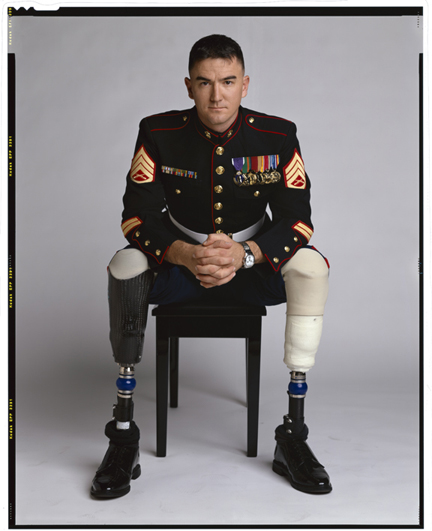
Portrait of Marine Staff Stg. John Jones Image Credit: Timothy Greenfield-Sanders
The research comes out of the University of Pittsburgh McGowan Institute for
Regenerative Medicine and is headed by Dr. Stephen Badylak. The group is one of several leading "far-out"
research projects that are part of the Pentagon's Armed Forces Institute of
Regenerative Medicine (AFIRM). AFIRM is a
$250 million undertaking with the goal of quickly introducing regenerative
medicine into mainstream medicine. Badylak's study has made swift progress in
moving forward with clinical trials. So far four soldiers have already had the
surgery and are serving as examples for teams of surgeons being trained across
the country. With this progress, the new technique will become the "standard of
care of orthopedists and trauma surgeons" in 24 months.
The Science
The human body has evolved to scar
injuries to avoid infection but this limits the amount of self-repair the body
can do. Fortunately there is an inner lining of the intestine that regenerates
itself every six days. This layer is called the submucosa. When Badylak used
this layer in animal experiments
he found that wounded organs grew back because the submucosa had stopped the
scarring process and promoted regrowth. The approach the study uses to grow
muscle tissue starts with the surgeon implanting this lining which has been
identified as an extracellular matrix (ECM). The ECM works as a scaffold that
connects cells to one another and is made of growth factor proteins which
trigger the body's own stem cells to flock to the area and initiate the process
of tissue growth and wound repair. The stem cells come from the body's own
reserve in the bone marrow and other places. "We put a homing device inside and
it recruits (human) stem cells on its own," Badylak said. "It's a shortcut." Adult
stem cells are not as flexible as embryonic stem cells but they have potential
to aid in the regeneration of multiple tissues.

Image
Credit: LOURDES SENIOR MEDIA ARTS
Pig cells were used because they
have a similar genetic makeup and they are already a source of parts for human
surgeries and research. The pig cells were removed from the ECM. The material
can be turned into a powder, made into a sheet like waxed paper or modeled into
a shape, like that of an esophagus. The "decellularized" material around the
cells avoids interactions with the human body's immune system, which normally
attacks cells and biological material from another species.
The surgery is paired with an intensive rehab program
designed to "exercise" the nascent muscle. The approach allows the body to
restore basic muscle tissue including the tendons and nerves that are necessary
for function, which it normally wouldn't do on its own.
Success
The first patient enrolled in the
study was a veteran who lost the majority of the anterior tibial muscle in his
lower leg during an IED attack. The
surgery was completed in 2008 and the solider describes the surgery: "They
cut a little slit into my thigh where they were going to put the material," Hernandez
told Discovery News. "It was like blood in an envelope." As of November 9th 2011, he has
graduated the six month rehabilitation program and is said to being doing
great.

Soldier's
regrowing muscle. Image Credit: McGowan Institute for Regenerative Medicine
The Institute is still recruiting soldiers
and veterans for the study who have suffered a "massive loss" and they do not
expect a shortage of volunteers. "From what we're seeing, it works," Badylak
said of the technique. "And there's a huge need here. So of course, we're being
as aggressive rolling it out as we can."
Resources
Pentagon
Regrowing Soldiers' Muscles From Pig Cells
A Doctor, a
Pig, and a Magical Pixie Dust That Could Regrow Fingers
Pig
Proteins Help Re-Grow Human Skeletal Muscle
| 


 Re: Success In Regrowing Muscles From Pig Cells


