|
No, I don't mean a tool that's not cool- on the contrary, boring tools are pretty awesome to watch in action.
Their main functions are
- Bringing holes to the proper size and finish.
- Straightening original drilled or cored holes and correcting defects in casting.
- Making the holes concentric with the outside diameter
Buying Boring Tools
When buying a boring tool for industrial use there are a few things you should think about.
1. Do you need an automated or manual machine?
This is pretty self-explanatory: Either the machine makes the holes or you better get cranking.
2. What "style" of boring is right for you?
The chart below compares the different automated boring processes.
|
Type |
Function |
Tool Material |
Application |
Tolerance |
|
Precision Boring | Produce a precise internal cylindrical surface by enlarging an existing opening in a workpiece. | Carbide, ceramic and diamond tools | Accurate finishing on internal bearing surfaces for part production, turning facing, grooving, chamfering and contouring. | +/-0.0001 in. |
|
Lathe Boring | Produce conical and cylindrical surfaces | High Speed steel, brazed carbide, carbide or ceramics | Straight holes, tapered holes, holes with several diameters | +/- 0.002 in. for deep holes. +/-0.0005in. for shallow holes |
|
Vertical Boring | produce an accurate internal cylindrical or conical surface by enlarging an existing opening | High speed steel, carbides, ceramics, or diamonds | Small length-to-diameter ratio. The workpiece is often very large and cannot be rotated on a horizontal axis. | +/-0.005 in. for most.
+/-0.002 for precision |
|
Jig Boring | Produces holes with highly precise dimensions and locations | High speed steel, carbides, ceramics, diamonds | High level of dimensional accuracy such as jigs, tools, and fixtures. | +/-0.001 in. for diameter and +/-0.003 in. for depth. For precision applications +/-0.002 in. for diameter, +/-0.005 in. for depth |
|
Horizontal Boring | Produce an accurate cylindrical surface by enlarging an existing opening | | Large work pieces | |
3. What can you handle? Ok maybe not you specifically, but your system has certain limitations you should think about.
Power- calculated based on unit power and material removal rate.
Machine hp = unit power x removal rate (in.3 /min)
(a chart with the unit power can be found in the full selection guide)
|
Cutting Speed: | SFM = D x 0.26 x RPM |
|
Feed per Tooth: | IPT = IPM ÷ Z ÷ RPM |
|
Spindle Speed: | RPM = SFM x 3.82 ÷ D |
|
Table Feed: | IPM = IPT x Z x RPM |
|
Inch (Feed) per Revolution: | IPR (FR) = IPM ÷ RPM |
|
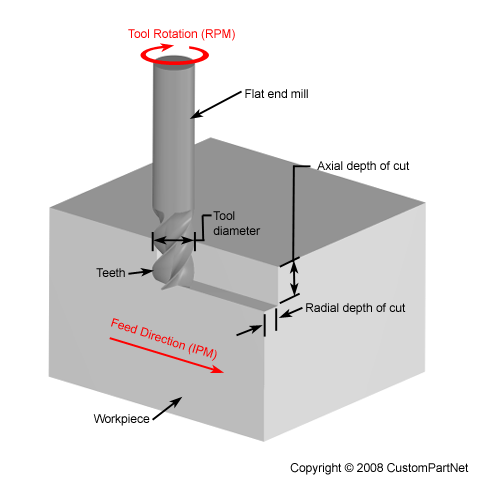
Metal Removal cubic in/min: | MR = IPM x RDC x ADC |

I know, I know…That all seems pretty tedious. Luckily there are some great online calculators available to help you out.
4. How much can you spend?- This is probably based on what the boss says. So let's try to impress. Here are some things to think about.
· Setup time
· Load/unload time
· Idle time
· Cutting time
· Tool changing time
· Tool costs
· Direct labor rate
· Overhead rate
But- I'm no boring tool expert and here at GlobalSpec we are always looking to give our users the best experience and help them make the right choice on our site. With that said, if you have any insights or experiences into the world of boring tools and their selection, we would like to hear about them. The full Boring Tools Specification Guide is available on the website.
See, was that so boring? (I'm sorry- I can't resist a good pun)
| 


 Re: What To Know When Buying A Boring Tool


