|
 Fires are a part of our everyday reality. We see them on the
news and read about them in our local newspapers. In fact, just Monday morning
I heard about an apartment
fire in Boston and the story of a heroic passerby who saved seven
residents. Fires are a part of our everyday reality. We see them on the
news and read about them in our local newspapers. In fact, just Monday morning
I heard about an apartment
fire in Boston and the story of a heroic passerby who saved seven
residents.
(Image Credit: Commandsafety.com)
This reality is not likely to change. Even with the most
fire-proof materials and systems, there will always be devices that fail or people
that cause accidents or do stupid things (aka arson). What are engineers and
building designers to do?
Nowadays, continuously improved fire-safety codes and
standards exist to reduce the creation and spread of fires. Unfortunately, the
simplest of these standards weren't followed until after hundreds of people
lost their lives in a number of catastrophic fires. The worst of these was the Cocoanut
Grove fire (also in Boston), way back in 1942.
The Incident
On November 28, 1942, a famous Boston nightclub called the
Cocoanut Grove caught fire in the midst of its operation. Apparently, a busboy
looking for a light socket had lit a match to see what he was doing, catching
some very flammable decorations on fire. The flames quickly spread across the
sealing and along the floor, moving at speeds up to 20mph.
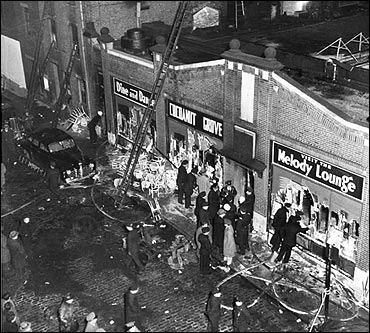
The Cocoanut Grove aftermath… - Image Credit: Boston.com photo
gallery -->
The chaos that followed involved guests and workers racing
and crawling to exits that were either locked or became bottlenecked and
largely impassible. All in all, the fire killed 492 people and injured many
more. It is considered the second-worst building fire in American history next
to the Iroquois Theatre fire in Chicago (1903).

The Cause
While the busboy's match and the extremely flammable
decorations and materials were the initial cause of the fire, a large portion of
the resulting casualties could be attributed to the design of the exit doors.
Most of the doors for commercial buildings today have
push-bar mechanisms and open out. This design prevents bottlenecking or opening
problems in the event of a disaster and the associated panic. Fire-exit doors have
crash bars which (as the name implies) allow people to literally run into them to
open the doors up and get out.

The design of the doors in the Cocoanut Grove swung inward
instead of outward. This made them extremely difficult to open, considering
that hundreds of panicked people were trying to push their way to the exit.
Some estimates say a large percentage of deaths could have been prevented with
proper door design.
Lessons Learned?
Apart from the doors, there were many other safety
violations to blame for the tragedy. The club was rated for a maximum occupancy
of 600 persons, but on this Saturday (of Thanksgiving) it was packed with some
say more than a thousand people, though the exact number is unknown. In
addition, some of the exits were locked, and many others were both improperly
marked and over-decorated.
In the aftermath of the fire, a number of new safety
standards for buildings were developed nationwide in the U.S. These included
requirements for outward swinging door designs, sprinkler systems in
nightclubs, and accessible exits marked by emergency lighting in commercial
buildings. These simple safety design features are often taken for granted
today, but the Cocoanut Grove is just one terrifying reminder of why we need
them.
Sources:
Boston.com
- The Cocoanut Grove Inferno
NFPA
- Large Building Fires and Subsequent Code Changes
Wikipedia
- Cocoanut Grove Fire
Fire Exit Image - Happy Tourist
Crash bar Image - 512 Locksmith
| 


 Re: Cocoanut Grove Fire – November 28, 1942


