|
The famous leaning Tower of Pisa is among Italy's most
well-known tourist attractions. I remember first learning about it in
elementary school, though the term "learning" is likely a stretch. In
elementary school, only the main facts stuck with me:
1) It's a tower.
2) It leans.
3) It's made of pizza.

(Credit: Worth1000 - LRGx20)
Since I haven't been there, I can't confirm #3, but what I
do know now is that the structure got its name and fame because of a simple,
yet important engineering flaw.
 How to Construct a
Leaning Tower: Ignore the Foundation How to Construct a
Leaning Tower: Ignore the Foundation
The construction of the Tower of Pisa began on August 8,
1173 in Pisa, Italy as part of a cathedral complex (known as Piazza dei
Miracoli) that would include four separate structures. The bell tower, intended
to stretch 185 feet high, would be a symbol of the city's wealth. But because
Pisa was a warring city-state at the time, its coffers were frequently run dry
due to the expense of war. When no money was available, progress on the tower was
halted. All in all, it took the city 136 years to complete from start to
finish.
(Credit: Symon Sez -->)
The problem came after the first three floors were completed
by 1185 and funding ran out. In that same year, the tower began to lean. This
lean was not originally noticeable, but became apparent by the time
they had reached the sixth floor over a hundred years later. Today, the tower's lean has extended to over 14
feet from center and is six feet shorter than it was originally.
The fault was due to the poor foundation upon which it was
constructed. Pisa lies on a thin layer of soft alluvial silt above an even
softer level of marine clay. The designer allowed the tower to be constructed
on a stone bed footing with a depth of only ten feet into this soft ground. The
weight from the structure was thus more than enough to gradually compact the
earth, causing the tower to sink and tilt. Some say that the delays in
construction are the only reason that the tower did not catastrophically
collapse, and the extended time allowed the structure to settle and stabilize.
It was also found that the reason the tower leans south
(rather than sinking straight down) is due to fluctuations in the water-table
on the upper layer of silt. Pisa's water-table rose noticeably higher on the
north side of the tower, causing the tower to dip on its south side.
Failed and Temporary Fixes
In 1934, Mussolini had concrete injected into the
foundation, hoping to fix the tower's lean as a symbol of Italian pride. Some
say this actually accelerated the leaning (way to go, Benito), but it certainly
did not fix the problem.
By 1993, the rate of inclination had accelerated to concerning levels. In response, 600t of lead weights were placed on the towers
north side as a temporary fix. These weights
reduced inclination by about one minute of arc and reduced the overturning
moment by about ten percent. The load was increased to 900t after unsuccessful
attempts to replace the weights with more aesthetically pleasing anchors caused the rate of inclination to increase again.

(I think you've got something here... maybe just a few more giant
lead bricks… - Credit: Talisman Coins)
Permanent Fixes
From supporting with cables, to drilling, to completely
dismantling and relocating the structure, none of the permanent solutions for
the unstable structure were particularly convenient. I remember coming up and
drawing my own solution in an art class years ago, though I don't think my 100
foot tall wooden beam design would have impressed any civil engineers. Nowadays
I think just hiring a giant person to hold it steady might be the simplest
option:
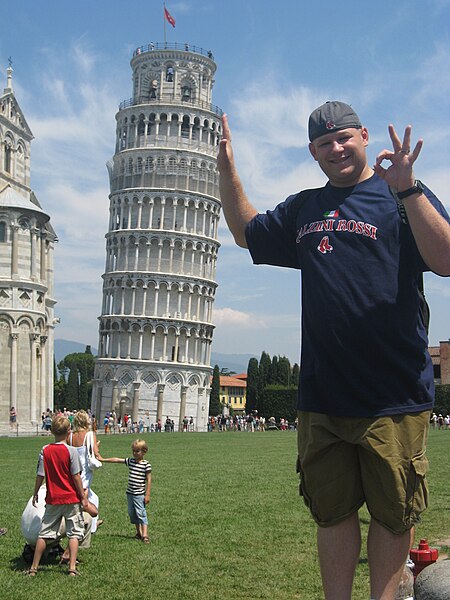
In 1998, soil extraction was proposed and tested as a means
to promote leaning back towards the towers north side. The test was a success,
and extraction went full scale across the north side. By 2001, all the lead
ingots had been removed. In 2003, a new drainage system was introduced on the
north side to stabilize the water table. Settlement rates at the center of the
tower's foundation are now less than 1.0 mm/year, close to the rate of the
settlement of the entire Piazza from the Pisa plain itself.
The Future
The Tower of Pisa is a great example of a very fortunate mistake.
It emphasizes the importance of ensuring a solid foundation and knowing the
ground and soil consistency being worked with.
Scientists and engineers have also gained a lot of specific knowledge
and experience from studying and tackling the unique problems surrounding the
leaning phenomenon and how it relates to soil structure and interactions.
Unfortunately, the complexity of the Tower of Pisa problem
(and the phenomena controlling it) makes it impossible to know exactly what
will happen in the future. If the dominant mechanism for instability is ground
water levels, the tower will likely stay where it is. If the leaning is
dependent on ground stabilization, it is likely the tower could resume leaning
after the effects of the under-excavation are complete. However, serious rates
of inclination (like those in 1993) will not likely return for at least 200
years.
Geo
Engineer - Leaning Tower of Pisa: Behaviour after Stabilization Operations
(pdf)
Symon
Sez - Leaning Tower of Pisa, A Magnificent Engineering Failure
The
Telegraph - Solving the 800-year mystery of Pisa's Leaning Tower
For some more reading on the leaning tower, check out these past entries on CR4:
"Workaholic Goes to Pisa"
Pisa: We All Need Someone To Lean On
| 

 2
2


 Re: Learning from the Leaning Tower


Good Answers: