|
The Texas City Oil Refinery is the second largest in the
state of Texas, and the third biggest in the U.S. Up until early 2005, the
1200-acre facility processed up to 460,000 barrels of crude oil every day, and from
a distance it seemed like the plant was in good order. Unfortunately, it wasn't
until after the worst refinery explosion of the decade that the facility's
major safety procedure and safety culture flaws were revealed.
Incident
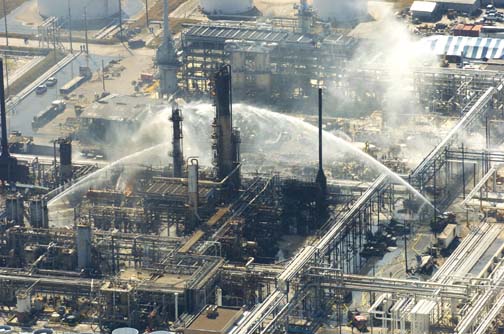 On March 23, 2005, operators had started up the raffinate
splitter tower (gasoline component separator) section of the ISOM unit used to
increase the octane of gasoline, and began filling it with hydrocarbon fluid.
Abnormal pressure built up in the tower due to an abundance of fluid, and
relief valves opened to allow the components to escape to the "blowdown" drum.
Shortly thereafter the filled drum ejected fluid and vapor in a "geyser-like"
stream out the vent stack into the air. While workers alerted to the cloud
rushed to shut-off all hot-running equipment, a contractor attempted to turn on
his diesel pick-up truck. Operators ran to him in an attempt to stop him, but
once the fuel content in the air had diluted to the UEL (Upper Explosion Limit),
the engine provided an ignition source, resulting in a huge vapor cloud
explosion. The fireball injured 100 people and killed 15, including some workers
in a trailer parked near the process unit. They were in a meeting, and were
unaware of the situation. On March 23, 2005, operators had started up the raffinate
splitter tower (gasoline component separator) section of the ISOM unit used to
increase the octane of gasoline, and began filling it with hydrocarbon fluid.
Abnormal pressure built up in the tower due to an abundance of fluid, and
relief valves opened to allow the components to escape to the "blowdown" drum.
Shortly thereafter the filled drum ejected fluid and vapor in a "geyser-like"
stream out the vent stack into the air. While workers alerted to the cloud
rushed to shut-off all hot-running equipment, a contractor attempted to turn on
his diesel pick-up truck. Operators ran to him in an attempt to stop him, but
once the fuel content in the air had diluted to the UEL (Upper Explosion Limit),
the engine provided an ignition source, resulting in a huge vapor cloud
explosion. The fireball injured 100 people and killed 15, including some workers
in a trailer parked near the process unit. They were in a meeting, and were
unaware of the situation.
(Fire extinguishing operations after the explosion. -->)
Cause
The direct cause of the incident was the poor operation and
condition of the raffinate splitter tower, and its flawed blowdown system. In
1997, the atmospheric blowdown was replaced with an identical one due to budget
constraints, despite safety regulations prohibiting that type. Between 1994 and
2004, apparently eight similar cases of flammable emissions from the blowdown vent
occurred, but no corrective action was taken. In addition, operators involved
with the raffinate splitter tower did not follow standard (timely) procedures for
discharging the fuel during the restart, and ignored the open maintenance
orders on the tower's instrumentation. The alarm meant to warn workers of
excess liquid in the unit was disabled.
Many other safety problems could be considered causes of
failure. A number of other alarms and safety sensors were disabled,
malfunctioning, or non-existent. Poorly trained control operators worsened the
situation by opening the discharge valve, allowing hot discharge to flow
through a heat exchanger and pre-warm the inlet fluid. Safety protocols for
equipment and vehicle placement were also not being followed by some of the
staff, including the guest contractors.
For a complete breakdown of the disaster and its causes,
check out this video by CSB (the Chemical Safety Board).
Lessons Learned
 On top of the casualties, BP (the owner of the refinery) had
$1.5 billion in expenses and lawsuits to take away as a hard learned lesson on
process safety. Among the refinery's most fatal flaws was its inadequate safety
culture; disaster investigators concluded the facility nurtured an environment
in which workers were neither well-informed of nor well-encouraged to speak up
about safety issues. On top of this, leadership did not take control to
properly train workers and operators on emergency procedures and situations. Replacing
the actual blowdown system, as well as the numerous malfunctioning safety systems,
alarms, and sensors were also not a high priority under a tight budget. The
lack of alarms was the reason that some people remained unaware of the
emergency that was taking place until after the explosion. On top of the casualties, BP (the owner of the refinery) had
$1.5 billion in expenses and lawsuits to take away as a hard learned lesson on
process safety. Among the refinery's most fatal flaws was its inadequate safety
culture; disaster investigators concluded the facility nurtured an environment
in which workers were neither well-informed of nor well-encouraged to speak up
about safety issues. On top of this, leadership did not take control to
properly train workers and operators on emergency procedures and situations. Replacing
the actual blowdown system, as well as the numerous malfunctioning safety systems,
alarms, and sensors were also not a high priority under a tight budget. The
lack of alarms was the reason that some people remained unaware of the
emergency that was taking place until after the explosion.
This horrible accident is just another example of how
important it is to keep safety a priority in the workplace. Establishing and
following standard work safety practices, doing routine tests and maintenance
of safety systems, and encouraging open communication among workers are all
important aspects of a safe work culture. Furthermore, investment into work
safety should be considered synonymous with investments towards quality work
and quality product. As we have seen in numerous case studies, the bottom line
is a very thin line to walk alone; companies with a misplaced emphasis on it
are setting themselves up for a dangerous fall.
References
Texas
City Refinery Explosion - Wikipedia
What
Went Wrong: Oil Refinery Disaster - Popular Mechanics
| 


 Re: Texas City Refinery Explosion


