|
 Atomic power is one of those funny things in American
culture and psyche. I don't necessarily mean funny as in "ha-ha" funny (though
Homer Simpson has occasionally supplied a chuckle), but more
of an ironic kind of funny. Atomic power is one of those funny things in American
culture and psyche. I don't necessarily mean funny as in "ha-ha" funny (though
Homer Simpson has occasionally supplied a chuckle), but more
of an ironic kind of funny.
It was promised in the early years of its development that
it would provide limitless, cheap power for every American. Eventually cars and
coffee makers (hmm, I may have misunderstood
that) everywhere would run on stable, untethered nuclear fission. Obviously we do not have many instances of
nuclear power running vehicles. Although over 150 vessels have utilized such
fuel and a few nuclear
powered cars received concepts, aviation has been largely left to fossil
fuels.
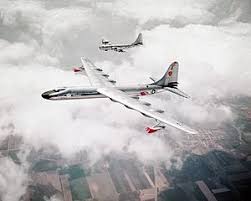 One such aircraft was the Convair X-6. Built but
never flown, the aircraft was deemed too dangerous to fly. Aerospace engineers
couldn't prevent radiation sickness in crews and if that plane were to crash
the results would be catastrophic. Yet American weapon manufacturers were
determined to harness nuclear power for flight, and they got this crazy idea of
a nuclear powered ramjet cruise missile. Just like its bomber cousin it could
stay airborne for weeks and deliver payloads, but the ultimate design was
possibly the most malevolent weapon ever envisioned. One such aircraft was the Convair X-6. Built but
never flown, the aircraft was deemed too dangerous to fly. Aerospace engineers
couldn't prevent radiation sickness in crews and if that plane were to crash
the results would be catastrophic. Yet American weapon manufacturers were
determined to harness nuclear power for flight, and they got this crazy idea of
a nuclear powered ramjet cruise missile. Just like its bomber cousin it could
stay airborne for weeks and deliver payloads, but the ultimate design was
possibly the most malevolent weapon ever envisioned.
Ramjets are jet engine devices that require airflow in order
to activate. The cone of the engine provides an inlet where the air is
compressed, ignited, exhausted, and directed to provide thrust. These engines
are best used at speeds of Mach 2 or 3, but can power up to Mach 6. 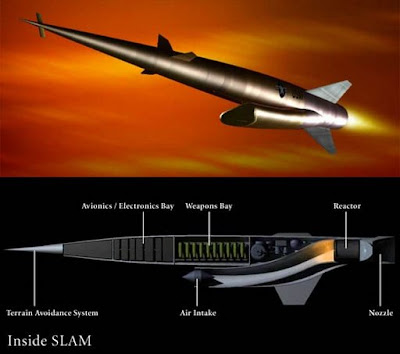 The U.S.
Air Force and Atomic Energy Commission believed a nuclear ramjet would be their
ace-in-the-hole in a nuclear war with the USSR. The U.S.
Air Force and Atomic Energy Commission believed a nuclear ramjet would be their
ace-in-the-hole in a nuclear war with the USSR.
Since the late 1950s, the U.S., U.K. and Soviet Union were
negotiating a ban on nuclear testing in the atmosphere and outer space. Also,
with the U.S.S.R.'s launch of Sputnik, American officials believed their rocket
capabilities to be inferior, and their anti-missile capabilities to be
similarly deficient. An ultra-range missile able to slip below enemy warning
systems was their only conclusion.
Many new technologies were borne from this endeavor--dubbed
Project Pluto. A nuclear reactor small enough to outfit on a ramjet had to be
configured. Furthermore, materials able to withstand months of weather and
irradiation were needed to construct the supersonic, low altitude missile
(SLAM). Engineers and researchers on  the project considered the weapon
"technically sweet" and "pretty close to the limits in all respects." Ultimately,
Colorado-based ceramic company Coors (yes, this Coors) was asked to
produce fuel elements for the reactor. A test was needed to apply this
technology and learn about structural limits so an 8 squaremile parcel of the
Nevada desert was converted into a test facility where a nuclear ramjet was
outfitted to a railroad car. the project considered the weapon
"technically sweet" and "pretty close to the limits in all respects." Ultimately,
Colorado-based ceramic company Coors (yes, this Coors) was asked to
produce fuel elements for the reactor. A test was needed to apply this
technology and learn about structural limits so an 8 squaremile parcel of the
Nevada desert was converted into a test facility where a nuclear ramjet was
outfitted to a railroad car.
What officials learned there was that such a
ramjet flying at treetop level at supersonic speeds would not only deafen
nearby individuals, but would also create a shockwave that would level
structures and flatten people underneath it. Also, since the missile would be
flying over the enemy it wouldn't require any type of radiation shielding and would leave behind an unhealthy dose of
radiated emissions and fragments. Keep in mind that this isn't just a missile,
but also a cluster bomb. While the SLAM's finale was a kamikaze effort, it
would also deliver dozens of atomic warheads across the world's largest country
in just a few hours. With an inexhaustible fuel supply, the SLAM could be
launched months or years in advance of its deployment, circling over the ocean.
 There were notable operational challenges to overcome. First, ramjets require significant
pre-existing airflow in order to combust, so the SLAM would need rocket
boosters to reach an initiation speed. Second, in order to reach some of the
most valuable Soviet cities the SLAM would have to fly over allied countries,
and they may not want their lands or citizens exposed to SLAM. Some American
officials began questioning what would happen should the U.S. lose control over
a SLAM or what the Soviets would conjure up when they got wind of this weapon.
It was proposed as another nuclear deterrence, and there was virtually no
defense against a SLAM. There were notable operational challenges to overcome. First, ramjets require significant
pre-existing airflow in order to combust, so the SLAM would need rocket
boosters to reach an initiation speed. Second, in order to reach some of the
most valuable Soviet cities the SLAM would have to fly over allied countries,
and they may not want their lands or citizens exposed to SLAM. Some American
officials began questioning what would happen should the U.S. lose control over
a SLAM or what the Soviets would conjure up when they got wind of this weapon.
It was proposed as another nuclear deterrence, and there was virtually no
defense against a SLAM.
Finally, as ICBM development
accelerated in the 1960s, officials realized that the SLAM was not only
horribly expensive but also terrifying to the Americans it was protecting.
Project Pluto was cut from the 1965 military budget. Although an estimated $260
million (by today's standards, nearly $2 billion) had been sunk on the project,
some spin-offs have gained an application. Derived technology has been used in
ceramic turbines and space-based reactors.
I'd say Project Pluto and SLAM serve as reminders that atomic
fusion is an  exponentially dangerous energy source. Whether used to power
cities or ships, unforeseeable dangers always exist. As late as 2011
significant power plant accidents
have occurred, and New Zealand's ANZUS
alliance with the U.S. has been severely
damaged by New Zealand's refusal to provide harbor for nuclear powered
American warships. exponentially dangerous energy source. Whether used to power
cities or ships, unforeseeable dangers always exist. As late as 2011
significant power plant accidents
have occurred, and New Zealand's ANZUS
alliance with the U.S. has been severely
damaged by New Zealand's refusal to provide harbor for nuclear powered
American warships.
Perhaps for once the U.S. accepted a more mild MAD policy,
and it may have been the smartest nuclear decision of the Cold War. Heavy
armament rarely serves as a deterrent. In 1861 Dr. Richard Gatling invented a
rapid fire gun meant to inflict such hefty causalities that war would be
futile. The result was both the American Union and Confederacy adopting the
weapon and losing more soldiers than thought possible. I'm sure if SLAMs were
further pursued, the Cold War would have been significantly closer to a 'hot' war.
Resources
(Image credits: Wikimedia; Rocket Dungeon; Merkle)
Wikipedia - Project Pluto; ramjet; Partial Nuclear Test Ban Treaty
Merkle - Project Pluto
| 

 6
6


 Re: The Most Dangerous Weapon Ever?


Good Answers:
"Almost" Good Answers: