|
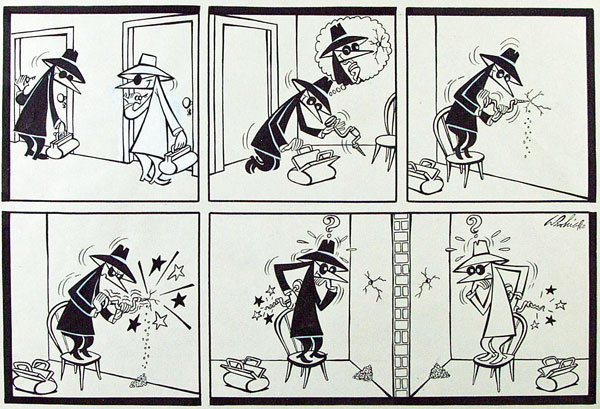 Growing up,
I saw always a fan of Spy vs. Spy (that according to my research is still
appearing in MAD Magazine to this day). For those unfamiliar, it was a Wild E.
Coyote vs. Roadrunner-style comic about two international spies constantly
trying to kill one another. One would spy on the other, try to exploit his
opponent's vulnerability, but ultimately he would meet his untimely doom. This occurred
week after week, all in just a few black-and-white panels. Growing up,
I saw always a fan of Spy vs. Spy (that according to my research is still
appearing in MAD Magazine to this day). For those unfamiliar, it was a Wild E.
Coyote vs. Roadrunner-style comic about two international spies constantly
trying to kill one another. One would spy on the other, try to exploit his
opponent's vulnerability, but ultimately he would meet his untimely doom. This occurred
week after week, all in just a few black-and-white panels.
Yet real
espionage doesn't work that way. If someone finds a vulnerability, they're
going to exploit it viciously and mercilessly (right, Jennifer Lawrence?). It's
these type of people and events that make me reconsider my own electronics
security, as well as a phone from ESD America.
ESD America
is a value-added reseller of Android phones. The company employs a team of
software engineers to make cell phones more secure and it claims to have
patched nearly 500 security vulnerabilities in the Android OS found on the
Samsung Galaxy III. Beforehand, the phone was susceptible to 90 unregulated
data transmissions per hour-not leaks necessarily, just instances where the
phone transmitted data to an unknown recipient.
Attacking
low security cell phones is becoming more and more common. First, there is the
problem of fake
phone cell towers, a.k.a. "interceptors." These towers are perceived by
phones as a typical antenna, but they are radio-equipped computers that use
obscure commands to communicate with a phone's secondary operating system that
is inherent on the device and relays info between the main OS and the cell
tower. While this equipment isn't cheap (starts at $3,000), its attacks are
unperceivable. Simply entering the interceptor's range is enough to render your
private data publically available.
 ESD creates
a monthly interceptor map to illustrate known locations. Interceptors are
commonly found nearly military bases, implying government administration. They
are also used by organized crime syndicates to steal secrets or personal
information. They can eavesdrop, intercept calls and texts and even take
'spiritual' possession of the device. Last month, the FCC announced they had
begun investigating
the use of interceptors. ESD creates
a monthly interceptor map to illustrate known locations. Interceptors are
commonly found nearly military bases, implying government administration. They
are also used by organized crime syndicates to steal secrets or personal
information. They can eavesdrop, intercept calls and texts and even take
'spiritual' possession of the device. Last month, the FCC announced they had
begun investigating
the use of interceptors.
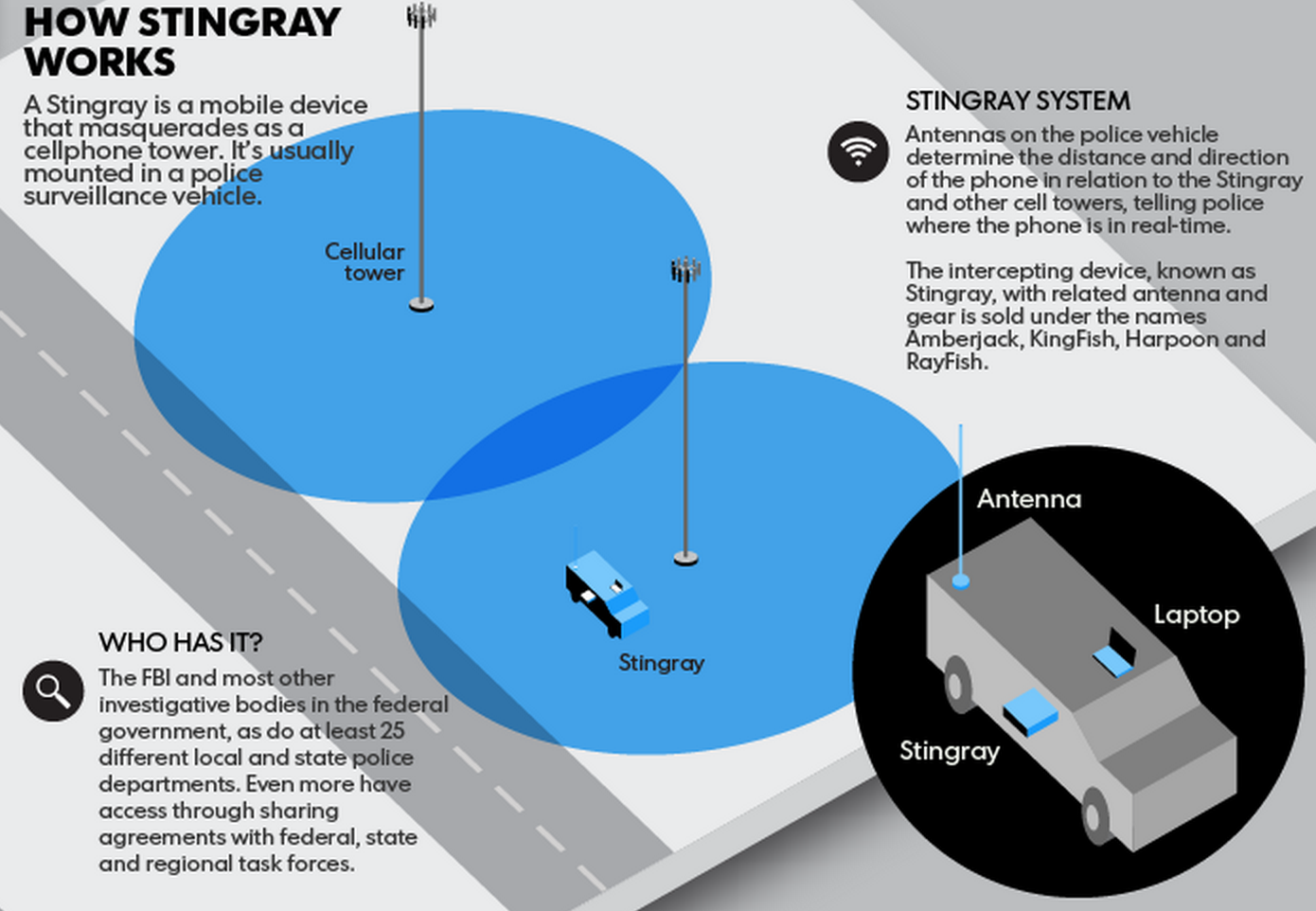 There is
also the StingRay phone
tracker, which in many ways acts like an interceptor. But while
interceptors are primarily used by upper-echelon government agencies and
criminals, StingRays are used by local and regional police departments. Often,
these devices are vehicle or hand mounted, meaning that mobile interception has
been brought purposefully to your doorstep. Some American agencies have
admitted to regularly using StingRays without obtaining a warrant and this
practice, at least initially, has been protected by anti-terror laws. There is
also the StingRay phone
tracker, which in many ways acts like an interceptor. But while
interceptors are primarily used by upper-echelon government agencies and
criminals, StingRays are used by local and regional police departments. Often,
these devices are vehicle or hand mounted, meaning that mobile interception has
been brought purposefully to your doorstep. Some American agencies have
admitted to regularly using StingRays without obtaining a warrant and this
practice, at least initially, has been protected by anti-terror laws.
Basically,
the gist of it is this: once you elect to electronically record and store data,
you need to assume its public property. It is an unfortunate consequence of an
era that has essentially shaped up to be the Wild West of Information
Technology: a no-holds-barred free-for-all on both sides of the law.
While
someone like me probably doesn't need the $3,500 ESD America encrypted
smartphone, it's easy to envision a huge market for true cellular protection.
I'm sure if more cell carriers were able to offer better protected phones at a
higher price, at least half of their customers would consider buying them.
| 


 Re: Who's Spying on Your Cell Phone?


"Almost" Good Answers: